Ukraine's 2027 EU accession goal at risk: Key obstacles and Brussels demands


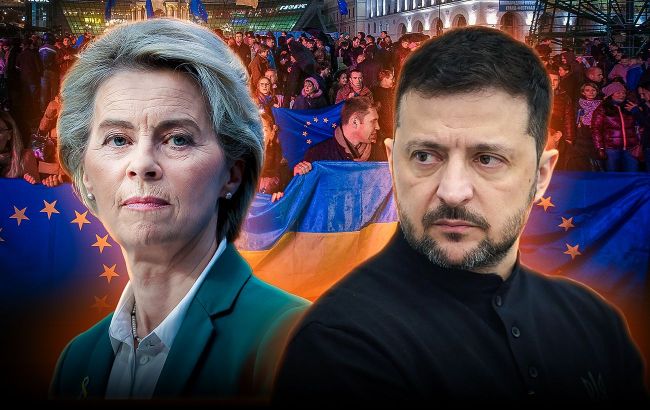 European Commission President Ursula von der Leyen and Ukrainian President Volodymyr Zelenskyy (photo: RBC-Ukraine collage)
Signing an agreement on Ukraine’s accession to the EU as early as 2027 — this is the goal the Ukrainian authorities have set.
Read below how realistic this goal is, how to deal with Orbán, and what other challenges lie ahead.
Key points
- The goal is 2027. This is the key date Kyiv aims for, but meeting the timeline depends on the pace of reforms and the political will of the EU.
- No fast track. Brussels is not ready to accept Ukraine under an accelerated procedure, insisting on all standard stages of accession being completed.
- Economic fears. A number of EU countries are wary of competition from Ukraine’s agricultural sector and other industries.
- Signing the accession agreement is only half the way. Major difficulties may await Ukraine at the ratification stage.
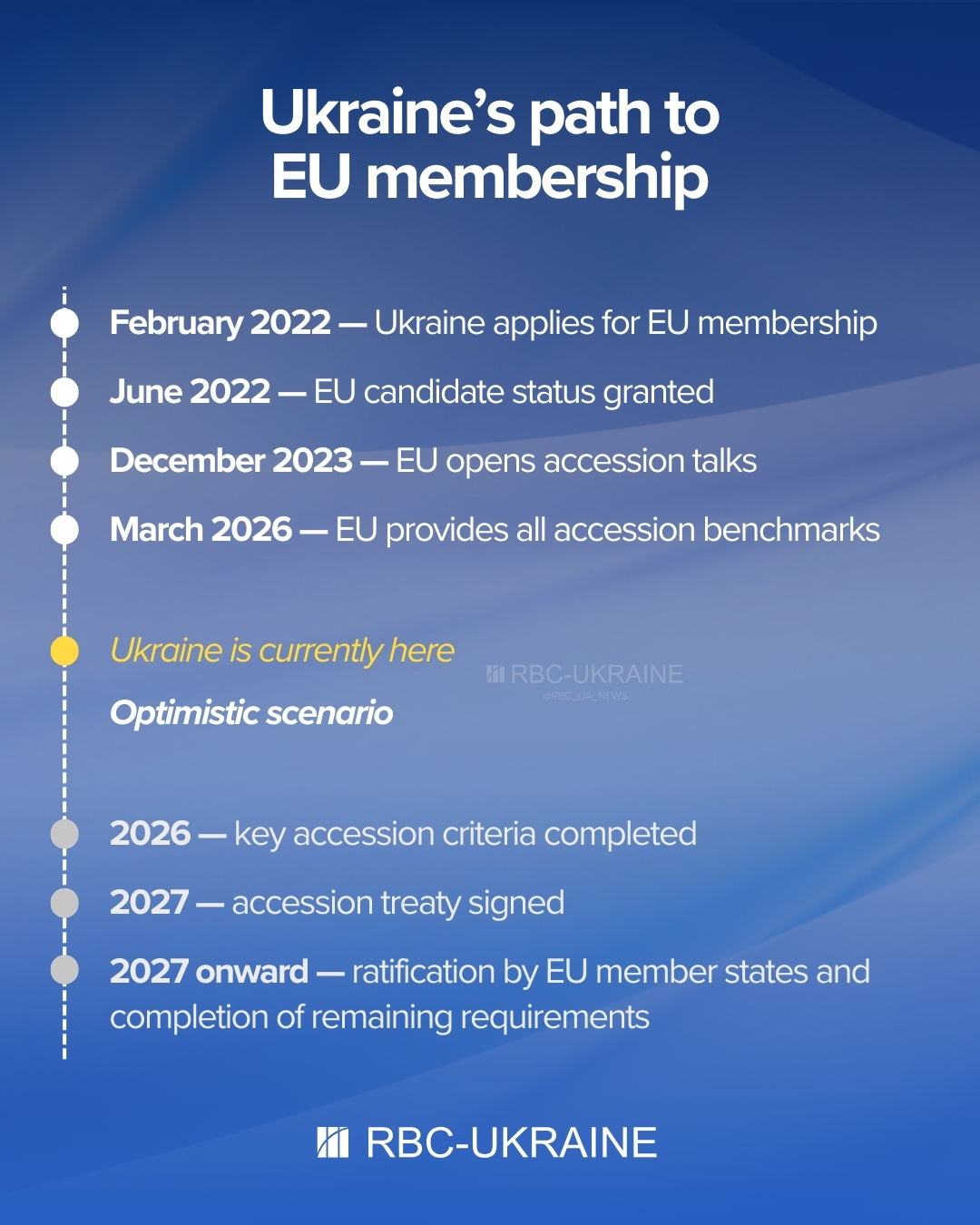 Ukraine has already come a long way toward membership, but the main challenges lie ahead (source: RBC-Ukraine infographic)
“In 2027, we can sign an agreement on EU membership,” Deputy Prime Minister for European Integration Taras Kachka said in a recent interview with RBC-Ukraine.
Of course, this forecast is quite optimistic, as even the authorities acknowledge. A large number of factors must align simultaneously: from the Verkhovna Rada working and consistently passing laws, to the necessary political climate within EU member states.
Not to mention that signing an EU membership agreement is not membership itself. It will be followed by a lengthy and likely problematic process of ratification of this agreement in each of the 27 current EU member states. Only after its completion will Ukraine finally be a full member of the EU.
Ukraine’s European integration accelerated sharply with the start of the full-scale invasion. Literally on the fifth day of the war, on February 28, 2022, when Russian troops were approaching Kyiv, the Ukrainian leadership, headed by Volodymyr Zelenskyy, submitted an official application for EU membership.
At the time, not everyone in the West reacted with understanding: the country’s very survival was hanging by a thread, enemy troops had nearly encircled the capital — what EU are we talking about? At least then, European integration did not look like a key priority.
The president’s team, on the contrary, believed that at that very moment a unique geopolitical window of opportunity had opened.
The calculation quickly paid off — just four months later, in the summer of 2022, Ukraine received candidate status for EU membership, largely as an advance, something other countries usually take much longer to achieve. Although, of course, not only geopolitics played a role — in the eight years since the Revolution of Dignity, Ukraine had already carried out a large number of reforms.
Talk of rapid EU membership returned to the top of the agenda last fall, when Donald Trump’s peace efforts materialized in the well-known 28-point peace plan. Ukraine’s accession to the EU was included there from the outset, even before subsequent revisions.
The peace talks have clearly stalled in recent weeks. But fast-track EU membership has not disappeared from the agenda. It is now seen as one of the key post-war security guarantees for Ukraine. Moreover, it is beneficial both for the White House and Bankova Street.
Ukraine’s accession to the EU is one of the “cards” Trump would gladly play, since it would not require any effort or cost from him personally, perhaps apart from a few phone calls to Budapest and other European capitals.
For Zelenskyy, Ukraine’s EU membership is also a major political asset that he could confidently take into any elections. Especially since any peace agreement, if one is ever reached, will be extremely difficult to sell to society as a grand victory.
EU accession, on the other hand, is the full, maximum practical realization of the Euromaidan slogan “Ukraine is Europe!” This victory would be clear to everyone — unlike, for example, the complex mechanics of European integration.
Where Ukraine stands now on the path to the EU
The decision to open accession negotiations with Ukraine was made in December 2023. This was when the famous episode occurred with Hungarian Prime Minister Viktor Orbán, who was asked to “step out for a coffee” so as not to block the required consensus.
In the summer of 2024, the negotiations were officially launched. And this is where Ukraine’s formal progress stalled. The reason was the same Orbán, who no longer yielded to persuasion to step aside and not interfere.
On the contrary, as parliamentary elections in Hungary approached, confronting Ukraine and its European integration became the central theme of his entire campaign.
Orbán effectively blocked the next stage of negotiations — the opening of negotiation clusters, which are blocks of reforms Ukraine must implement to join the EU.
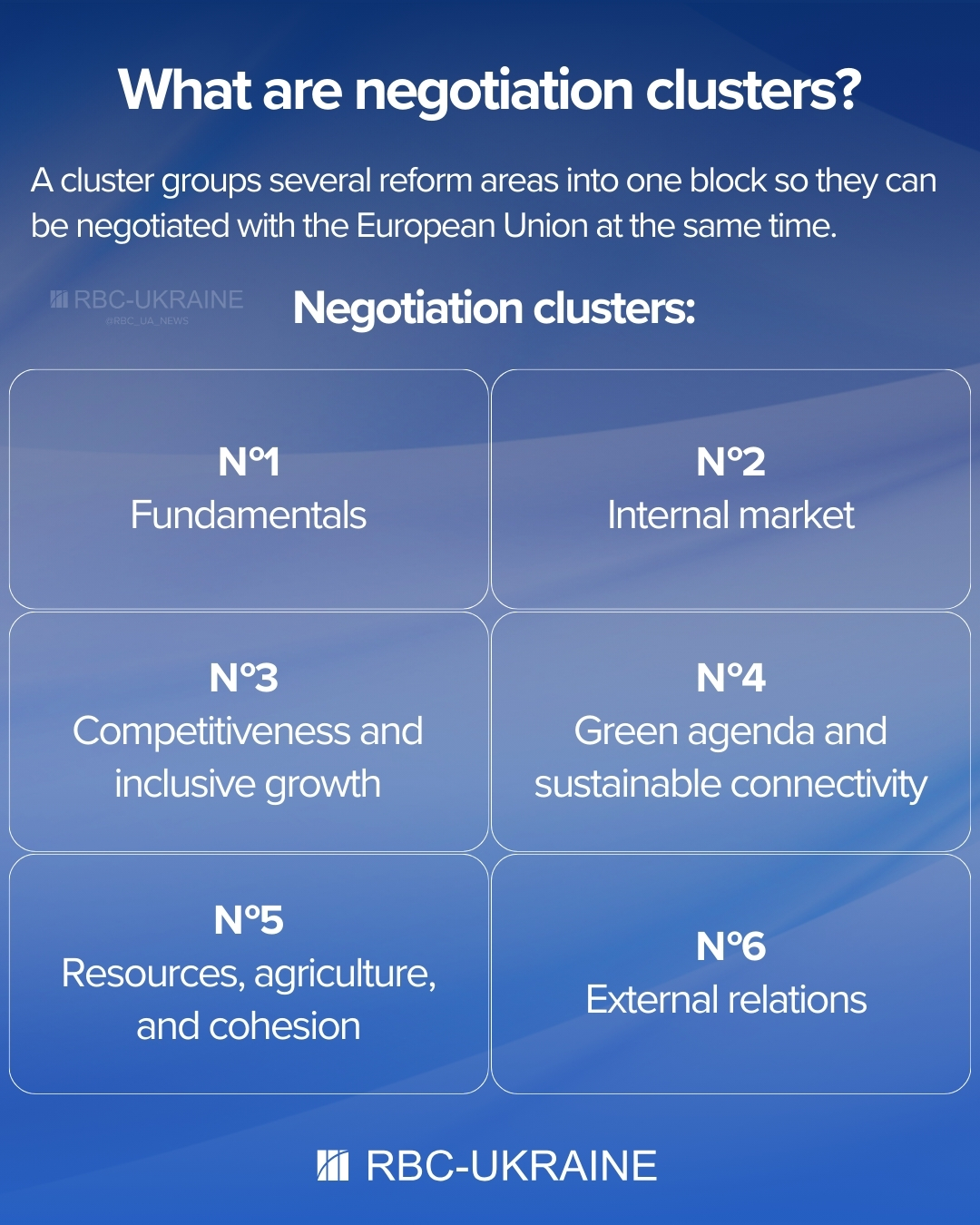 All necessary reforms for EU accession are divided into six clusters (source: RBC-Ukraine infographic)
Ukraine, together with EU leadership and friendly member states, began searching for a way out and came up with several solutions that would allow bypassing Orbán's veto and moving forward. Even if some of these ideas looked questionable from the standpoint of European law and faced resistance from the EU bureaucracy, which does not like anything new.
In this regard, Ukraine’s European integration was harmed by the episode with the attack on NABU and SAP (Ukraine's anti-corruption agencies) last summer. As RBC-Ukraine sources in European diplomatic circles said, after that, enthusiasm in Europe to help Ukraine and look for creative solutions somewhat decreased.
However, last December, a solution was found and approved — the frontloading. It means that Ukraine and the EU will conduct negotiations unofficially, since Orbán has for now blocked the formal path forward.
Ukraine has already received from the EU all the necessary benchmarks for all negotiation clusters — a list of criteria by which the EU will assess Kyiv’s fulfillment of its homework — the reforms required and mandatory for EU membership.
The idea is as follows: Ukraine will implement what is expected of it, disregarding Hungary’s veto. And when the Hungarian obstacle is removed, the stage of opening and closing negotiation clusters could be completed almost in a single day. The main thing is that Ukraine has carried out all the necessary reforms by that time.
What to do about Orbán
There are two ways to lift the Hungarian veto. The first and most obvious is that Orbán loses the election and his opponent, Péter Magyar, becomes the next prime minister of Hungary.
As sources in Hungarian political circles said, one should not expect that under Magyar Budapest will instantly become Kyiv’s best European friend.
But one of Magyar’s priorities will be restoring relations with Brussels — so he will definitely not invent artificial obstacles for Ukraine, as Orbán is doing now.
Moreover, if Magyar reverses the course Hungary is currently taking, it will play into Ukraine’s hands. The conflict between Brussels and Budapest has lasted for years, not even because of the Ukrainian issue, but due to Orbán's ongoing rollback of democracy and the rule of law in his own country.
There have been many instances when the European Union blocked funding for Hungary over this, and Orbán, in response, took some important decisions on Ukraine hostage. There are reasonable hopes that under Magyar, such situations will no longer appear.
If Orbán manages to stay in power, the situation looks much more threatening. Unfortunately, there is no practical or even theoretical way for Ukraine to become an EU member if Hungary keeps its veto in place.
There is hope that if Orbán wins, he will lift his veto. Or at least allow several next formal steps, such as the official opening of negotiating clusters.
“After the elections, the working conditions will change. A parliamentary campaign involves emotions, advertising, campaigning. Any interaction with Ukraine is used for campaigning. The elections will end, and normal work of governments will begin,” Taras Kachka said in an interview with RBC-Ukraine.
Kyiv and Brussels also have a potential trump card up their sleeve — Donald Trump. If lifting the Hungarian veto on Ukraine’s European integration becomes critically important for a peace settlement, Trump will likely find convincing arguments for his European friend.
When will there be a date?
Ukraine’s main line of political pressure on Brussels right now is obtaining a specific accession date.
“It is extremely important for us to get a clear date of accession to the EU. This is an important part of the diplomatic process aimed at ending the war. This is not just a desire — it is a clear understanding of how Putin will act if there is no such date. He will find a way to block Ukraine for decades,” Zelenskyy said in his address to the European Parliament on the fourth anniversary of Russia’s full-scale invasion.
His words are certainly logical. On the one hand, with the end of the war, both the geopolitical situation and the special attitude toward Ukraine will change — that same window of opportunity, if it does not close, will turn into a small window.
And Moscow, even if it does not officially object to Ukraine’s EU membership (by the way, it supposedly does not object even now), will undoubtedly make considerable efforts to derail Ukraine’s European integration. Given how fragile this process is, it is enough to block it at the level of a single EU member state, at any stage, and everything will collapse or at least stop.
Regardless, the European Union has its own logic. It lies in the fact that accession to the EU is a merit-based process.
In practice, this means that a candidate country must first demonstrate its progress in reforms and fulfill all requirements. The European Union will assess and approve this, and only then can a specific date appear. But by no means the other way around — fitting membership to a predetermined date.
Now Zelenskyy is trying to pull off the same move as with obtaining candidate status in 2022 — membership “in advance.” Taking into account all geopolitical realities, the war, the peace process, etc., the EU deviates from its rules and accepts Ukraine into its ranks. And Ukraine undertakes to complete the remaining homework as soon as possible.
This approach has even been called reverse enlargement, and European Commission President Ursula von der Leyen has even tested the ground among EU member states regarding readiness for such an option.
But, as several Western media reported (and as RBC-Ukraine’s diplomatic sources confirm), EU member states turned out not to be ready for such a radical paradigm change.
One of the sources compared joining the EU without meeting the requirements to a car without an engine — it seems like there is a car, but you cannot go anywhere with it.
“The scheme that was possible with obtaining candidate status is fundamentally impossible with membership — nothing will simply work. Especially when it comes to the accession of such a huge country as Ukraine. And the fact that you are at war, a victim of aggression, does not in any way reject the fact that you need to carry out the necessary reforms,” the interlocutor says. First of all, they concern the rule of law.
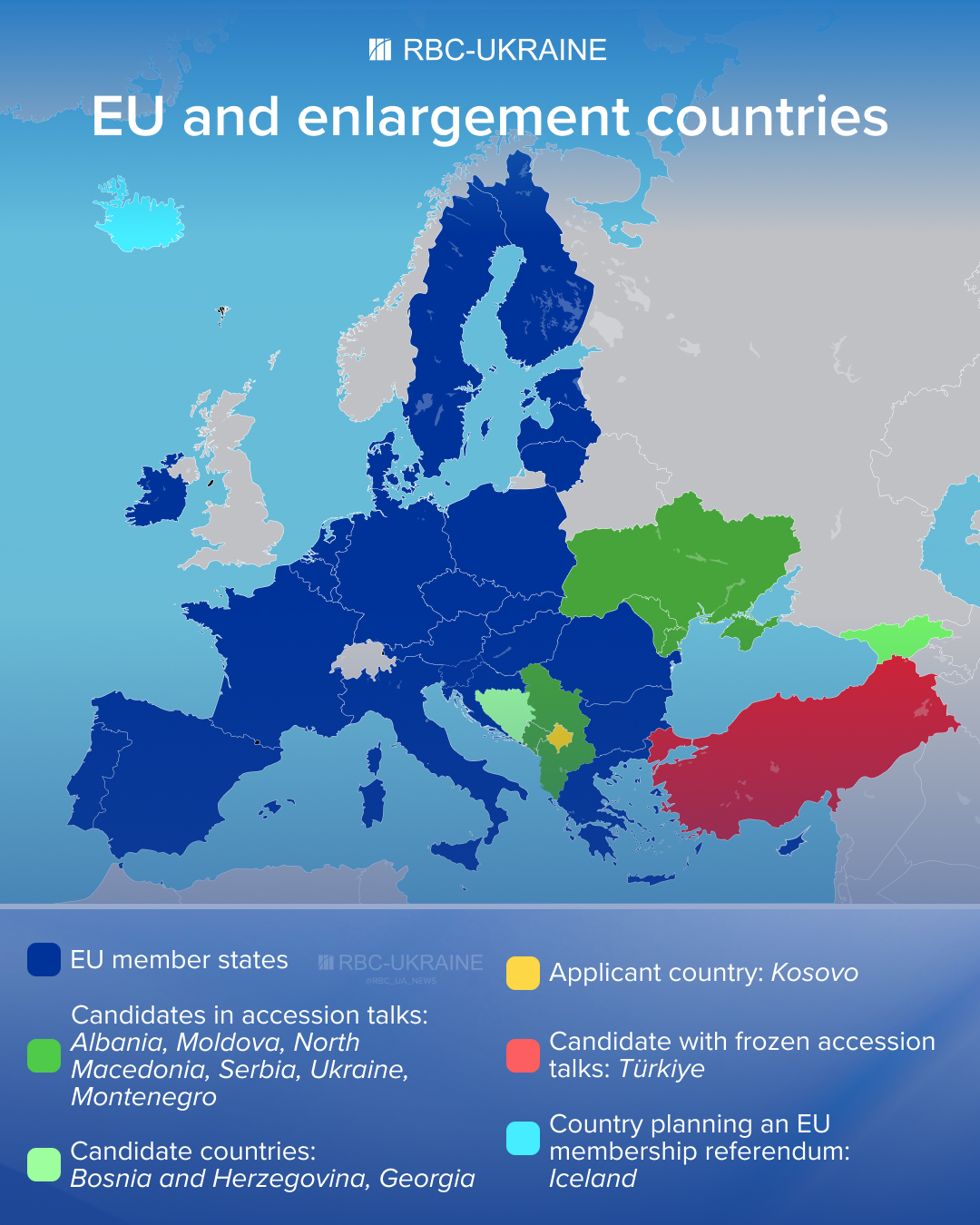 Current map of EU member states and candidate countries (source: RBC-Ukraine infographic)
Ukraine will have to adopt a huge number of regulatory acts, and in conditions of a semi-paralyzed Verkhovna Rada, which recently has almost stopped producing 226 votes “in favor.” As well as resistance from within the system, because accession to the European Union and preparation for it imply a deep transformation of the state mechanism. And this, of course, many do not like.
Taras Kachka emphasizes: Ukraine does not demand abandoning the principle of merit-based integration. “We are not ready to move away from the merit-based process. This is very important. There is a small bias that we are demanding to move away from it,” he said.
The deputy prime minister also believes that in the process of European integration, Ukraine will be able to obtain the desired specific date. Although he admits that it will be very difficult and will primarily be a political decision of Europeans.
But Ukraine may have serious problems with the political climate in Europe.
Hybrid membership
Several RBC-Ukraine sources in European diplomatic circles note that even if Ukraine copes with its reform homework, serious political obstacles on the further path are inevitable.
One of the reasons is that Europeans simply see in Ukraine a serious competitor in several sectors, including agriculture, transport, and the defense industry.
Some EU countries may have their own specific grievances against Ukraine. For example, Poland, considering the difficult pages of shared history. A number of RBC-Ukraine interlocutors named Poland among potentially problematic countries for Ukraine. And the fact that Poland itself, during its accession to the European Union, also had to overcome strong resistance from some old-timers of the EU for economic reasons.
Even if problematic issues can be settled at the stage of signing the accession treaty, it will be far too early to relax. RBC-Ukraine sources warn: real difficulties may begin at the stage of ratification in each of the 27 countries.
In some of them, for example, France, a nationwide referendum will likely be unavoidable. And this is extremely fertile ground for right- and left-wing populists and a wide field for subversive work from Russia. For example, a 2016 referendum in the Netherlands failed on the Association Agreement with Ukraine.
And EU membership is a much more important issue affecting Europeans’ interests than the Association. Populists of all kinds have greatly strengthened their positions across the EU over the past decade.
So, in talks with European diplomats, the topic of some kind of “hybrid” or “partial” integration of Ukraine constantly came up as a realistic option. Especially since some other EU candidate countries, such as Serbia and Albania, openly declare their readiness for such a format, for example, without veto rights in the EU for a certain period or on certain issues.
If such an approach is approved for, for example, Montenegro (which is currently the leader among all candidate countries), it will likely be applied to Ukraine as well.
For now, Kyiv declares readiness only for full-fledged EU membership. “You cannot be half-active or a half-member of the European Union,” Zelenskyy said last fall. But some transitional periods are inevitable anyway — all sources in the Ukrainian government agree.
“If we are talking about the political sphere, obviously, we can talk about certain models where Ukraine at the beginning will have limited voting rights on certain issues,” Deputy Head of the Presidential Office Ihor Zhovkva said in a recent interview with RBC-Ukraine.
However, some European sources believe that even this will be too ambitious a task. And in practice, for now, Ukraine is facing closer cooperation with the EU in certain, albeit important areas, such as joining the EU single market. But not full membership.
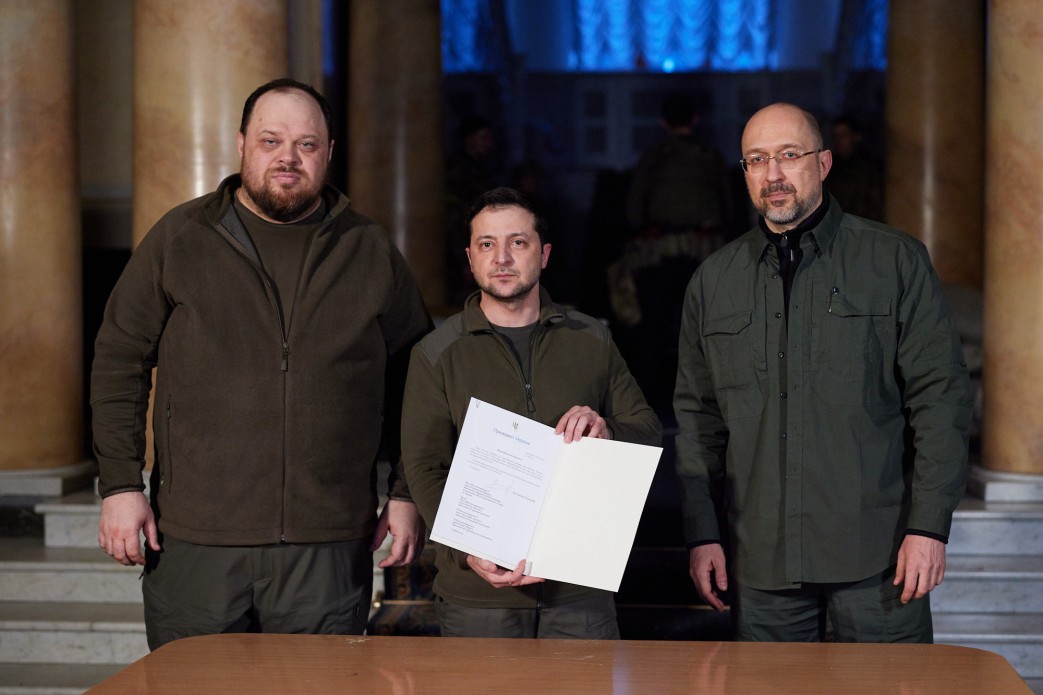 Volodymyr Zelenskyy, Ruslan Stefanchuk, and Denys Shmyhal with Ukraine's bid for EU membership, February 28, 2022 (photo: president.gov.ua)
And then Kyiv will have to look for an answer to whether it will be enough. From a political point of view, also. After all, EU membership is something clear and electorally attractive. But clusters, benchmarks, and even the single market are not.
Over more than four years of the full-scale war, Ukraine has repeatedly demonstrated real miracles, achieving what even its best Western friends considered fundamentally impossible. But EU membership is not about a miracle or even the political will, but about systematic and methodical work. Although some political luck will also be necessary.
Quick Q&A
– Will Ukraine be admitted to the EU under a fast-track procedure?
This idea was proposed in Kyiv and Brussels, but did not find support among EU member states.
– Is it realistic to sign an EU accession treaty in 2027?
Kyiv is targeting this date, but the EU considers it ambitious and depends on the pace of reforms.
– What are the main conditions set by Brussels?
The key requirements concern reforms in the rule of law. But they may not be enough.
– What worries European countries the most?
Some capitals fear economic competition from Ukraine, particularly in agriculture.