Spies, GRU and kompromat: Shadow battle behind Orbán's push to stay in power


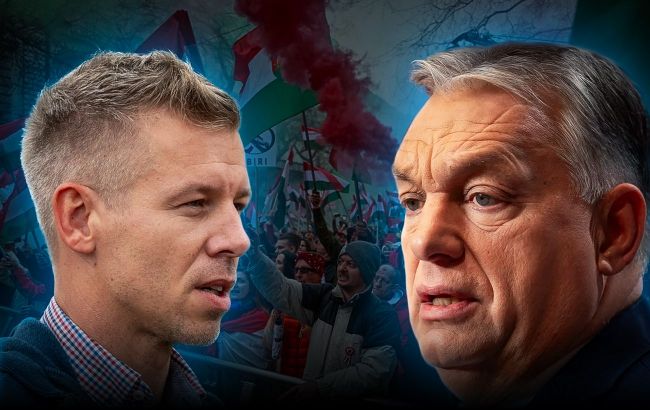 Viktor Orbán and Péter Magyar (collage: RBC-Ukraine)
One month before the elections in Hungary, the opposition has a significant lead over Orbán's party. But the current government is not ready to give up.
Will Orbán be removed this time? What he is doing to stay in power, and how this affects Ukraine – read in the RBC-Ukraine report.
Key points:
- Opposition lead: Péter Magyar's party holds a 10–15% advantage in polls despite the government's total control over media and administrative resources.
- Government advantage: Orbán's party maintains strong positions in many single-member districts, so it still has chances to win.
- Dirty tactics: campaigns with compromising materials and deepfakes are being used against the opposition.
- Orbán's "external enemy": Ukraine has been unwillingly drawn into a political confrontation, which only harms Kyiv.
- Russian influence: A group of specialists under the supervision of Sergey Kiriyenko arrived in Budapest to assist Orbán.
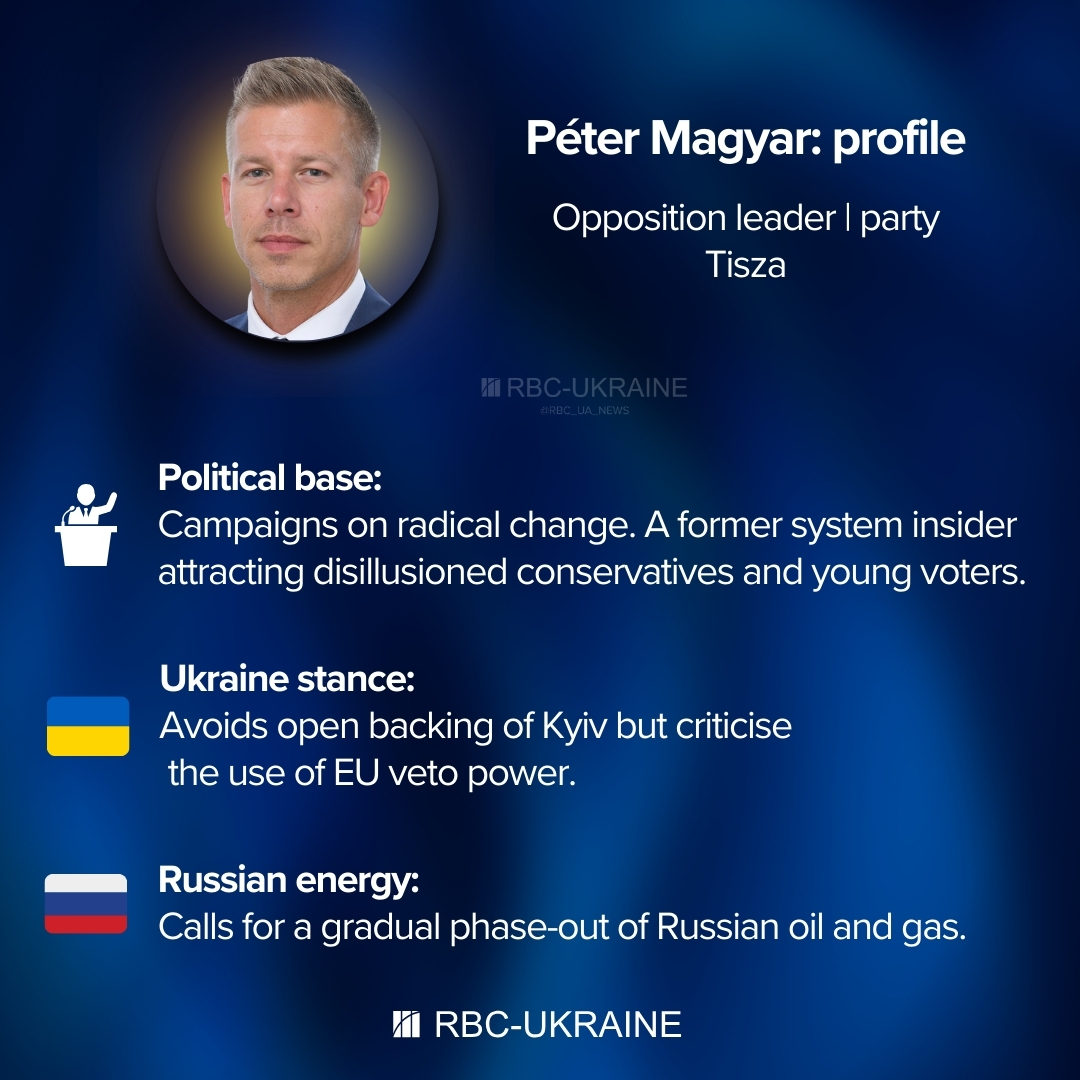 Viktor Orbán and Péter Magyar have different positions on key agenda issues (photo: infographic: RBC-Ukraine)
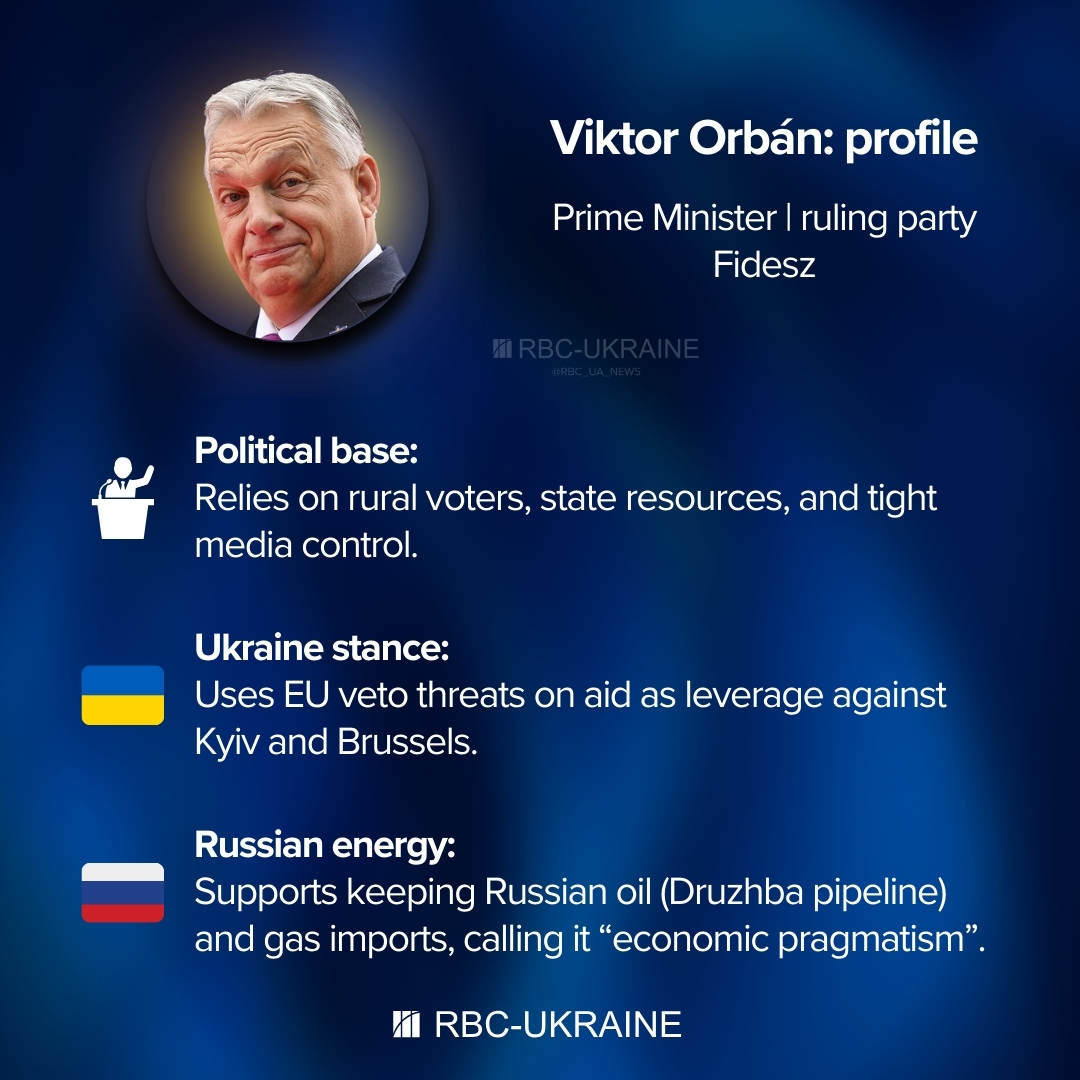 Viktor Orbán and Péter Magyar have different positions on key agenda issues (photo: infographic: RBC-Ukraine)
Highway M-5 from Austria to Ukraine. One of many gas stations. Armored vehicles with Ukrainian license plates. Soon, they will find themselves at the center of an international scandal staged by Hungarian authorities.
A signal – and operation began. Within seconds, seven men in black uniforms were forced face down onto the asphalt. This was how cash collectors transporting funds for Ukrainian banks were detained. They were later released, but money – more than 75 million dollars and euros – remains in Hungary.
Orbán has used such demonstrative actions before. For example, last year, "Ukrainian spies" were detained in the center of Budapest.
But this year, the aggressiveness of the Hungarian leader and his allies is larger in scale. Orbán is blocking the opening of negotiations on Ukraine's accession to the European Union and placing a veto on the allocation of an important 90-billion-euro credit from the European Union to Kyiv, allegedly because Ukraine does not want to restore the Druzhba oil pipeline.
However, Ukraine is only part of government propaganda.
In mid-February, Hungarian journalists began receiving photos of a bedroom with the caption Soon. Shortly after that, the country's main opposition figure, Péter Magyar, said the government was preparing a campaign against him using intimate videos allegedly filmed with a hidden camera.
Video has not been published so far, although Magyar's allies do not rule out that it may still appear. All these cases show that Orbán and his entourage are ready to use the dirtiest tactics to stay in power. For the first time in 16 years, this danger is real – elections will take place on April 12.
Orbán's system
Magyar's party, Tisza, has been leading the ruling Fidesz in polls by 10–15% for a long time. But this does not mean that a change of power in Hungary is inevitable.
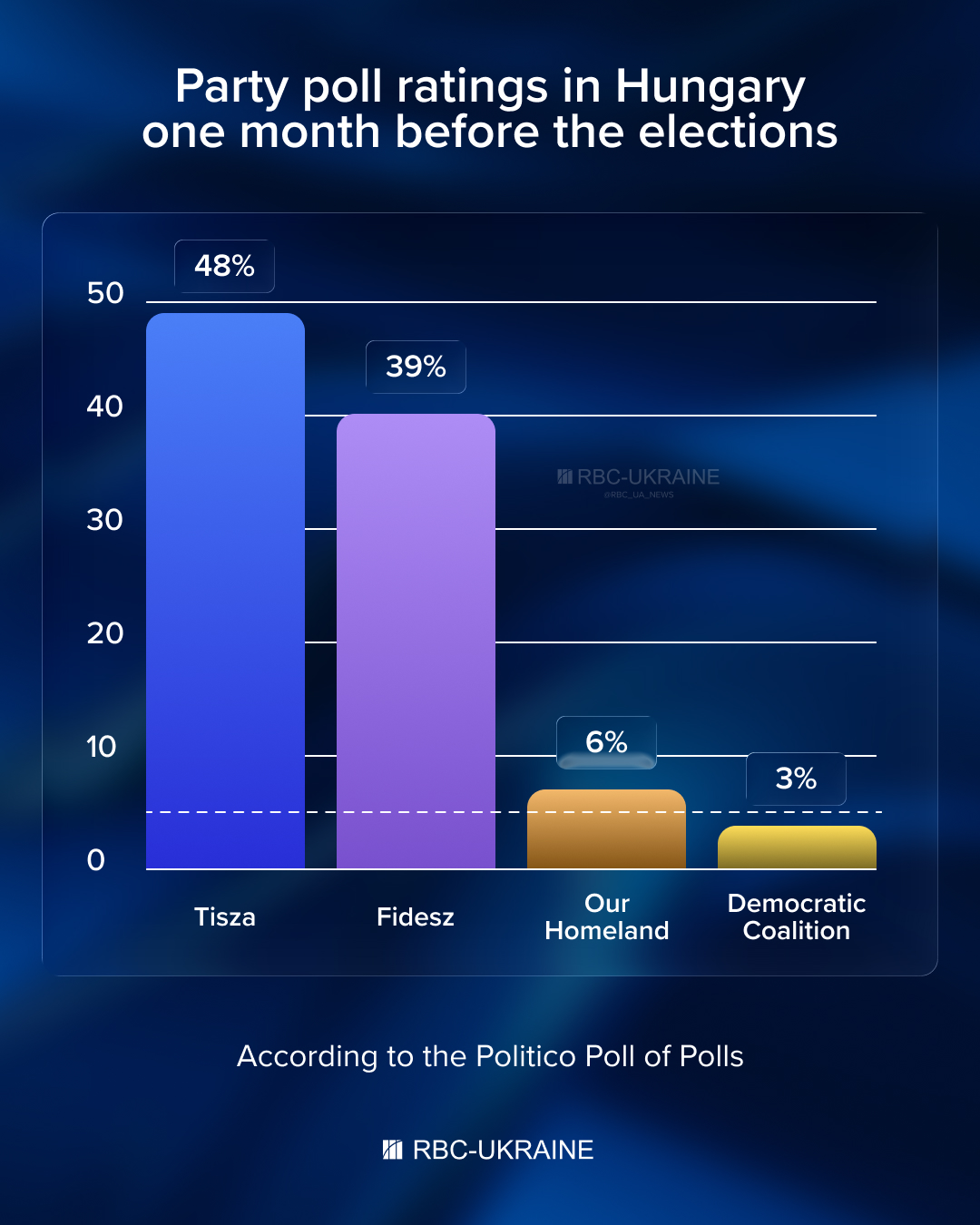 According to polls, three parties will enter the Hungarian parliament (photo: infographic: RBC-Ukraine)
Over the years in power, Orbán has built a complex system that still allows him to hope to retain his positions.
Hungary has a mixed electoral system in which a smaller share of deputies is elected by party lists – 93 seats. The other 106 mandates are distributed in single-member districts. And while Tisza dominates in districts of large cities, towns, and villages favor Fidesz. Orbán organized this scheme deliberately.
For example, in 2024, more than a third of parliamentary electoral districts were redrawn, including in Budapest, Vitaliy Diachuk, analyst at the Institute for Central European Strategy and the Re:Open Ukraine project, told RBC-Ukraine.
"Budapest and other large cities are traditionally weak places for Fidesz, as they give greater support to the opposition. Because of this, Fidesz has greater chances to gain advantage in mandates, since it wins in less populated districts, in small rural communities," Diachuk said.
How strong government positions are in such districts can be seen from specific results. Since 2024, when Magyar appeared in national politics, the ruling party has won eight by-elections in single-member districts.
According to Diachuk, unlike Fidesz, Tisza did not have decades to build local organizational networks, establish ties with local elites, and create a network of loyal media.
"Therefore, now opposition is holding primaries to nominate candidates in districts, but they will have a chance only thanks to party rating and political capital of Péter Magyar himself," Diachuk emphasized.
In addition, Hungary has a mechanism of so-called winner compensation. The party that wins many districts by a large margin receives an additional bonus in proportional mandates. To all this should be added Orbán's advantage in control over traditional media and administrative resources.
So even with Tisza leading in polls, the election campaign in Hungary remains extremely heated, and both key parties are competing intensely for voters who have not yet decided.
Magyar and everyone else
Growth of support for Tisza is primarily connected with the fact that it managed to form a broad coalition of dissatisfied voters. These include disappointed conservatives and former opposition supporters who are looking for a real force capable of defeating Viktor Orbán.
"Party leader Péter Magyar is a former insider of the system, which allows him to criticize the government from the position of a person who knows mechanisms of power from inside," Rasto Kuzel, executive director of Memo 98 in Slovakia, an organization that monitors political processes in Europe, told RBC-Ukraine.
This is clearly visible from the people he has brought into his team. For example, it includes Anita Orbán, who worked on energy diplomacy at the Ministry of Foreign Affairs of Hungary when Viktor Orbán had just returned to power.
Another notable figure is Romulusz Ruszin-Szendi, former Chief of General Staff of the Armed Forces of Hungary, dismissed in 2023 for pro-Ukrainian positions.
Fatigue among part of society from nearly two decades of Orbán's dominance in Hungarian politics also plays an important role for Magyar. He has served as prime minister for about 19 years in total – first from 1998 to 2002 and then continuously since 2010. Against this background, the demand for political change is growing.
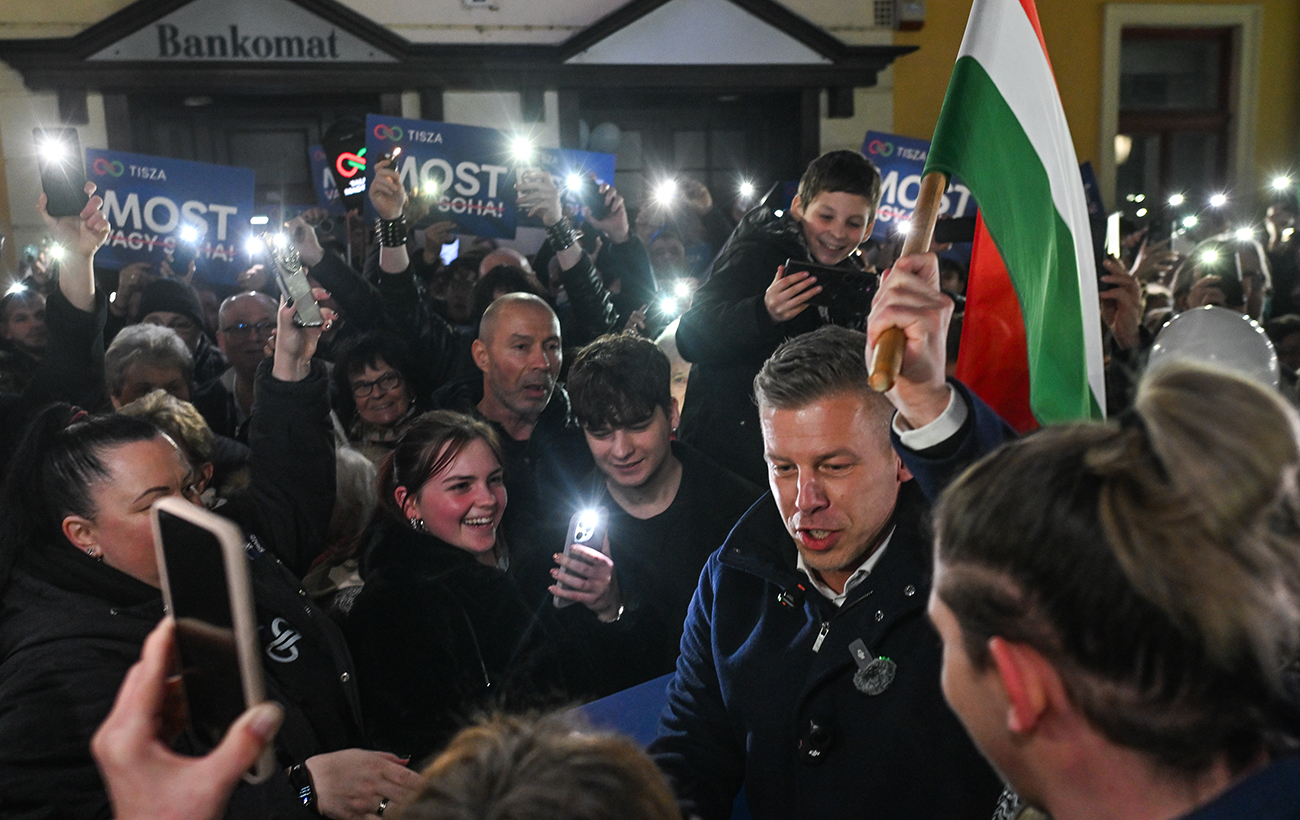 Péter Magyar among his supporters (photo: Getty Images)
"In combination with economic difficulties, rising cost of living and frozen European funds, this has created an environment in which readiness to support political change has become higher than before," Kuzel emphasized.
According to him, surveys also show a noticeable generational divide: younger and more educated voters are much more likely to support Tisza, while Fidesz still maintains strong positions among older voters and residents of small settlements.
This is reflected in messages with which the opposition appeals to Hungarians. Magyar presents the upcoming elections as a referendum on Orbán's rule and Hungary's place in the European Union and the North Atlantic Treaty Organization. In this framework, Tisza presents itself as a safe choice against unpredictability.
Government's stakes
For his part, Orbán is responding to falling ratings and the threat from Magyar by mobilizing his traditional electorate through the escalation of artificial conflicts.
At the same time, Magyar is being portrayed as a foreign agent. For example, in February this year, pro-government resources circulated a deepfake video of an alleged phone conversation between Ursula von der Leyen and Péter Magyar. In it, the head of the European Commission supposedly gives Magyar direct instructions: after victory in elections on April 12, immediately send Hungarian money and weapons to Ukraine.
Another line of attack against Magyar is the claim that he is supported by Ukraine. Orbán himself speaks about this openly, of course, without any evidence.
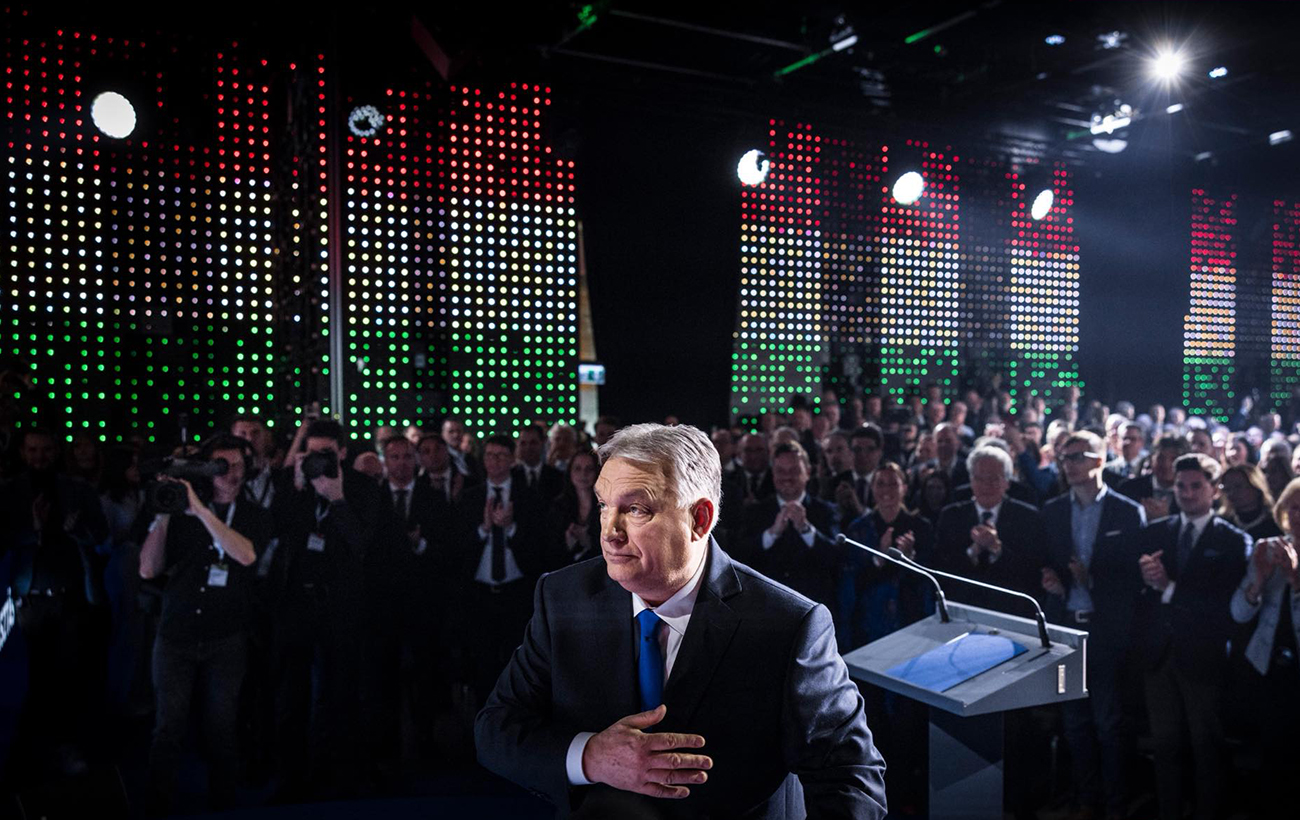 Viktor Orbán (photo: facebook.com/orbanviktor)
In the context of Hungarian elections, Kyiv has essentially been unwillingly drawn into confrontation. Negative consequences of this are already being felt. If earlier Orbán's rhetoric toward Ukraine was not so radical and from time to time he allowed himself to be persuaded into some pro-Ukrainian decisions, last year saw a sharp escalation.
In this regard, recent statements by President of Ukraine Volodymyr Zelenskyy paradoxically help Hungarian leader as well, Rasto Kuzel believes.
On March 5, Zelenskyy said he would give the address of Orbán to fighters of the Armed Forces of Ukraine if he continued blocking a 90-billion-euro credit for Ukraine. These words were immediately picked up by pro-government Hungarian media and representatives of the authorities.
"Orbán uses them as confirmation of his long-standing narrative that Hungary is under external pressure and that his government must protect the country from being dragged into war," Kuzel noted.
However, the effectiveness of this strategy remains questionable this time. "There are signs that some Hungarian voters are tired of such rhetoric. After many years of constant confrontational campaign, its mobilization effect may be weaker than before," an expert emphasized.
Magyar and Ukraine
Against this background, Magyar's position toward Ukraine remains more pragmatic and cautious. At least, he does not try to gain political points through conflict with Kyiv.
Moreover, the desire to unite everyone against the government is one of the reasons why Magyar tries not to comment on Ukraine at all. Orbán has made this topic extremely sensitive, and almost any remark about Kyiv can be used against the opposition.
Almost the only statement by Magyar about Ukraine appeared last week and was rather unpleasant. Responding to Zelenskyy's idea to give Orbán's address to the Armed Forces of Ukraine, Magyar said that no foreign leader may threaten any Hungarian citizen.
"I expect the leadership of the European Union to break all relations with Ukraine until President Zelenskyy clarifies his words and apologizes to all Hungarian citizens for his statements," Magyar said.
All this means that if Magyar comes to power, he will certainly not be an easy partner for Kyiv.
 Péter Magyar and his foreign policy adviser Anita Orban (photo: Getty Images)
At the same time, Magyar's advisers on economic and foreign policy issues openly say there is a need to abandon purchases of oil and gas from Russia and to stop the practice of abusing the veto right in the European Union, which is especially important for Ukraine.
Third forces and their role
In these conditions, smaller parties may also play an important role in the final result.
According to preliminary polls, in addition to Tisza and Fidesz, ultraright party Mi Hazánk may also enter parliament. For Orbán, this is both risk and reserve, Vitaliy Diachuk believes.
"Even a situational alliance between them could give advantage to this right-wing bloc as a whole. But in single-member districts, every vote for Mi Hazánk is a minus for Fidesz. At the same time, a public coalition between Orbán and the ultraright would likely become a burden at the level of the European Union," an expert said.
Balance of power could also be partly changed by another political force – the Liberal Democratic Coalition. However, with a rating of 3 percent, it currently does not enter parliament.
According to Diachuk, without a public call to support Péter Magyar, this party is rather a burden for Tisza. This is even though voters of the Democratic Coalition are natural allies of Tisza in terms of their views.
"By voting for the Democratic Coalition if it does not enter parliament, its voters will take these votes away from Tisza. Therefore, much depends on whether the electorate of the Democratic Coalition on April 12 will vote tactically and pragmatically or emotionally, with their hearts," Diachuk emphasized.
Russian shadow
Final battle for power in Hungary is only beginning. The result of the elections will largely depend on the last weeks of the campaign and the mobilization of voters.
"At the same time, in my opinion, it will be very important to closely follow post-election developments as well. In this campaign, there is an impression that both Russia and the United States, to some extent, have bet on one of the candidates and are trying – in different ways – to influence the election result," Kuzel added.
Support for Orbán from the United States has already appeared directly, during the visit of United States Secretary of State Marco Rubio at the end of February.
Russia is acting more covertly, but according to old patterns of hybrid methods. As VSquare reports, the entire team of political strategists is working on elections in Hungary. Their goal is to ensure that Orbán remains in power.
The process is led by First Deputy Head of Putin's administration Sergey Kiriyenko, who previously oversaw similar operations in Moldova, Georgia, and other countries of post-Soviet space.
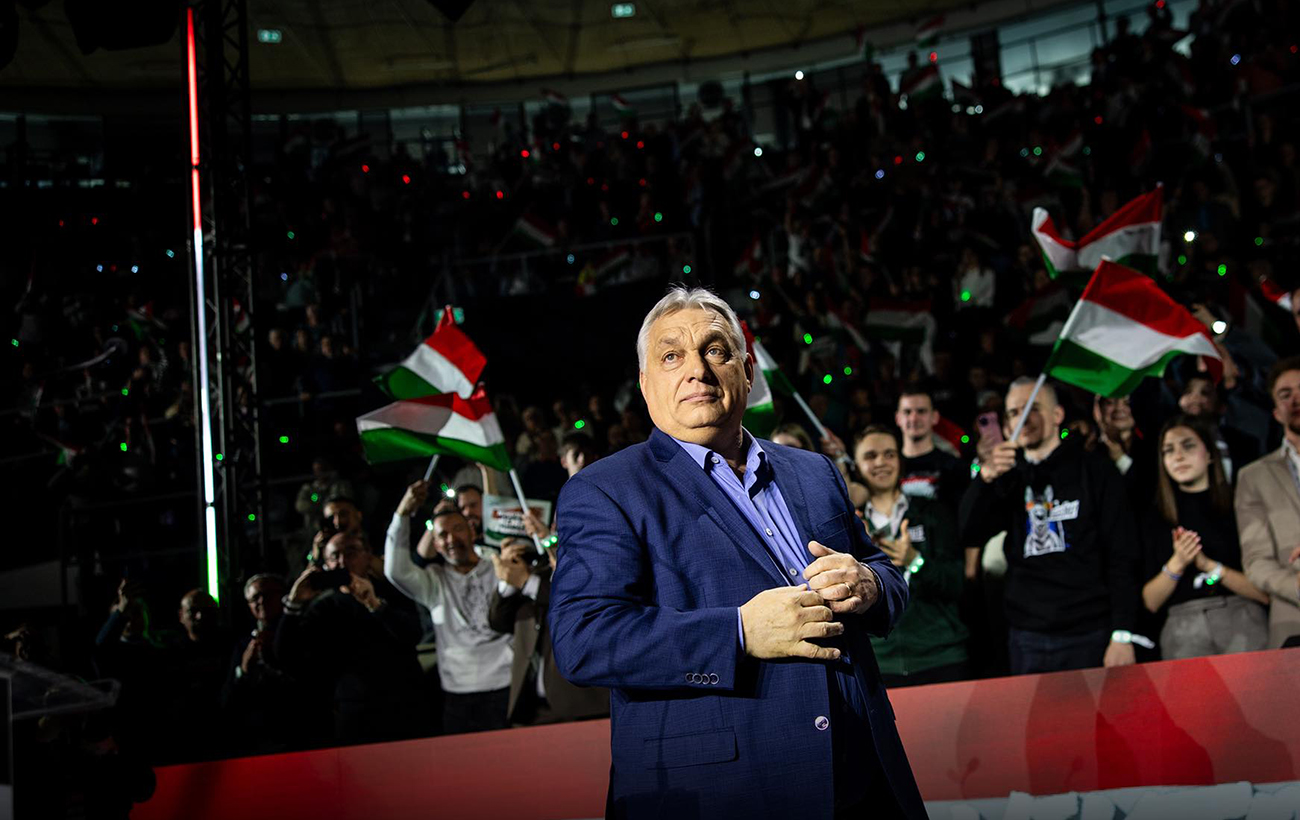 Viktor Orbán at one of his rallies (photo: facebook.com/orbanviktor)
According to European national security sources of VSquare, the plan includes the placement of a team of specialists in social media manipulation at the Russian embassy in Hungary. This group of three people arrived in Budapest several weeks ago.
Péter Magyar accused Orbán of inviting representatives of the Russian Main Intelligence Directorate to Hungary. According to him, they are supposed to influence elections.
According to Magyar, an active disinformation campaign will begin in the coming days and will focus in particular on TikTok. This is something Russia has already done recently – in Moldova, Romania, and during several other elections.
At the same time, Orbán continues to play the Ukrainian card. On March 11, he sent a delegation to Ukraine that is supposed to check whether the Druzhba oil pipeline was really damaged by a Russian strike. The trip was not coordinated with Kyiv, so Hungarian inspectors are simply tourists without proper permissions.
The question is whether the opposition will be able to counter Russian influence, combined with the resources of the authorities. And whether Hungarian voters themselves will mobilize and finally remove Orbán from power.
Quick Q&A:
– When and how will parliamentary elections in Hungary take place in 2026?
– Decisive vote is scheduled for April 12. On this day, Hungarians will elect a new parliament under a mixed system, where 93 deputies will be elected by party lists and 106 in single-member districts.
– Why is Hungary blocking European Union credit for Ukraine worth 90 billion euros?
– Official Budapest links its veto to Kyiv's alleged unwillingness to restore the operation of the Druzhba oil pipeline. In addition, Viktor Orbán uses the blocking of financial aid as a tool of pre-election mobilization, accusing Ukraine of external pressure.
– What are the chances of Péter Magyar and Tisza party to defeat Viktor Orbán?
– At present, opposition party Tisza is ahead of ruling Fidesz by 10–15 percent in nationwide polls. However, because of the specifics of the electoral system and redrawing of districts in favor of small towns, the opposition needs a significant advantage in single-member districts to obtain a majority of mandates.
– How is Russia trying to influence the results of elections in Hungary?
– The Kremlin is using a group of political strategists under the leadership of Sergey Kiriyenko to conduct disinformation campaigns on social media, particularly on TikTok. The main goal of operations is to discredit opposition through deepfakes and spread a narrative about foreign agents.
– What will happen to the oil and gas embargo if the opposition wins?
– Advisers of Péter Magyar say they intend to gradually abandon purchases of Russian energy resources and stop the practice of abusing the veto right in the European Union. At the same time, the leader of Tisza maintains a pragmatic position and tries to avoid sharp statements that could alienate conservative voters.