Ukraine could sign EU accession treaty in 2027: Interview with chief negotiator Taras Kachka


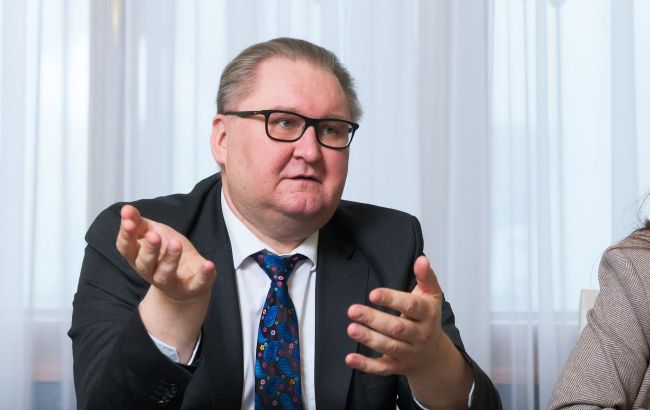 Taras Kachka, Deputy Prime Minister for European and Euro-Atlantic Integration of Ukraine (photo: Vitalii Nosach/RBC-Ukraine)
How realistic is it for Ukraine to become a member of the EU within the next couple of years? Is Europe ready to create any special conditions for us – and is Ukraine asking for such conditions?
Answers to these questions, as well as whether Ukraine is ready for any hybrid formats of accession to the EU, the main demands from Brussels, and the veto from Viktor Orbán – read in the interview with Deputy Prime Minister for European and Euro-Atlantic Integration of Ukraine, Taras Kachka.
Key points:
- Realistic timeline – 2027. Ukraine could sign an accession treaty as early as next year. Authorities aim to meet all key requirements during 2026 in order to reach final signing without unnecessary delays.
- Accession without a 20-year queue. Despite calls from some EU countries to wait, Ukraine insists on a faster path. Instead of long delays, a special monitoring mechanism is proposed: Ukraine becomes an EU member, but Brussels continues to closely monitor the state of the rule of law for some time.
- Money and work in the EU. Immediately after accession, Ukraine may face certain restrictions: for example, on free movement to work in other European countries or rapid access to all financial funds. This is a normal practice that other countries have also gone through after joining.
- 300 laws. For accession, parliament needs to adopt a large amount of legislation. Most important changes concern judicial and law enforcement systems and the fight against corruption.
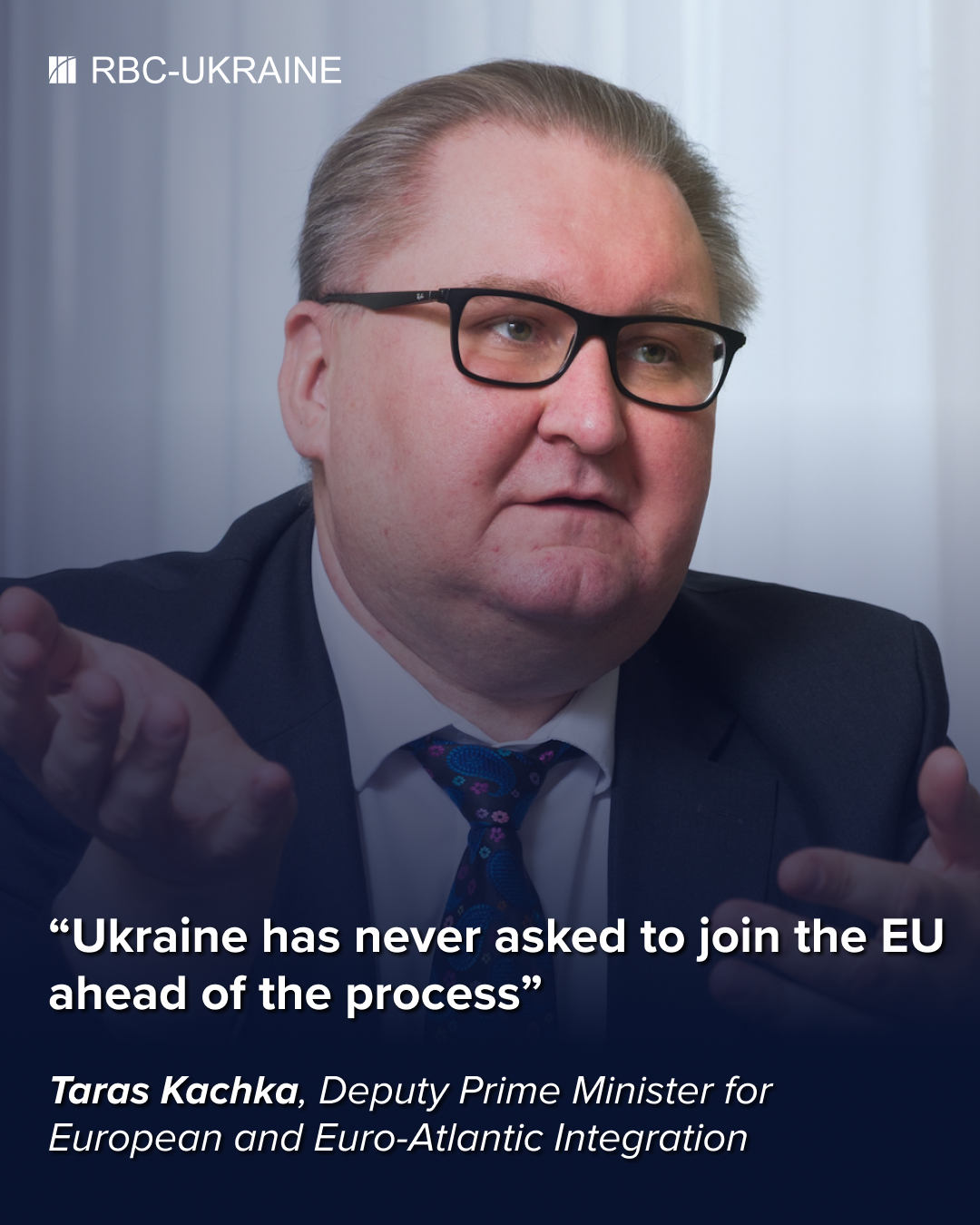 Taras Kachka on the process of Ukraine's accession to the EU (RBC-Ukraine infographic)
During the process of Ukraine's integration into the European Union, broad segments of Ukrainian society are primarily interested in a concrete result – when exactly Ukraine will become a full member of the European Union.
At the same time, in practice, this process has a very technical nature, and explaining the significance of its individual important stages to a wide audience is not so easy, even in terms of terminology.
For example, as early as tomorrow, Deputy Prime Minister for European and Euro-Atlantic Integration Taras Kachka will receive benchmarks for the last three negotiating clusters from Europeans in Brussels.
Simply put, Ukraine will soon receive the full list of criteria that must be fulfilled in order for accession to the European Union to become possible, across all possible areas. Moreover, an exception was made for Ukraine: as a rule, criteria are officially handed to a candidate country only after a unanimous decision of all member states of the European Union.
However, official and formal progress of Ukraine on the path toward the European Union has so far faced a major obstacle in the form of Hungarian Prime Minister Viktor Orbán. Therefore, Kyiv and Brussels have been forced to find creative ways to move forward while Orbán remains in power.
Obviously, creative options may also be needed further on, even if Hungarians soon remove Orbán from the prime minister's office. This is because Ukrainian President Volodymyr Zelenskyy categorically demands that the European Union announce a specific date for Ukraine's accession.
This contradicts the traditional European approach to enlargement – the so-called merit-based process, when a country moves toward the European Union to the extent that it actually implements necessary reforms.
Therefore, fierce debates about the possible accelerated accession of Ukraine have been ongoing for many weeks both in Brussels and in the capitals of member states of the European Union. Interlocutors of RBC-Ukraine in diplomatic circles, including those most friendly toward Ukraine, emphasize that without fulfilling requirements, Ukraine will not enter the European Union, and Russian aggression against Ukraine is not grounds for exceptions.
Notably, in conversation with RBC-Ukraine, Kachka says the same thing: Ukraine does not demand accession "in advance". As the deputy prime minister emphasizes, without fulfilling accession requirements, Ukraine's membership in the European Union would be non-functional.
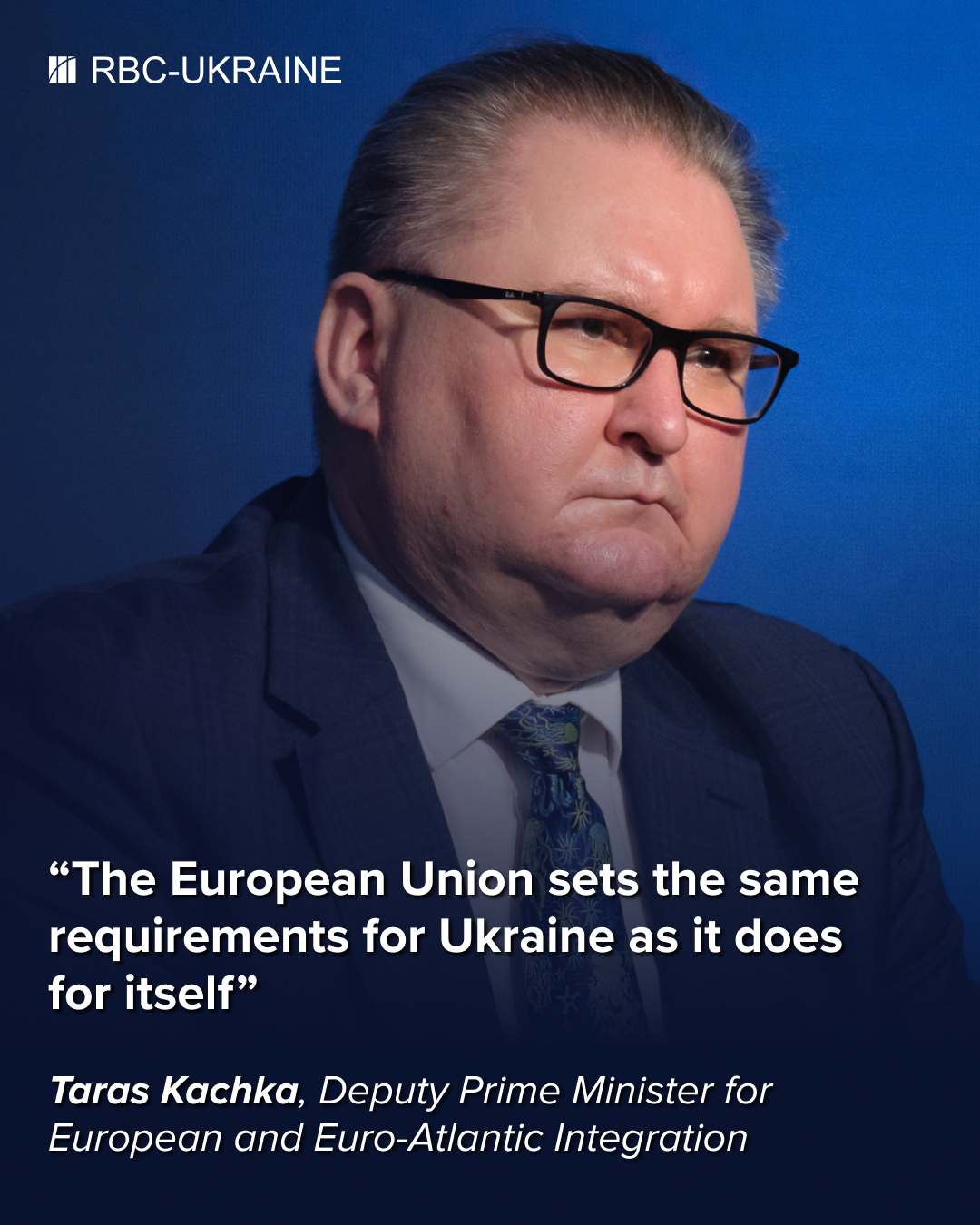 Taras Kachka on why the requirements for Ukraine are not exceptional (RBC-Ukraine infographic)
At the same time, he explains in detail how, in practice, it may be possible to ensure that Ukraine joins the European family in the foreseeable future.
On the timeline for accession to the European Union
Taras Kachka emphasizes that Ukraine is moving according to a unique schedule. Despite skepticism from some countries, the government sees a clear window of opportunity for rapid accession.
"We are shortening the path in such a way that signing the accession treaty itself could become possible already in 2027," he predicts.
According to the deputy prime minister, Ukraine has already de facto opened negotiating clusters. During 2026, work on all benchmarks (criteria) is planned to be completed, which will make it possible to move toward signing the treaty in 2027.
"This is not a question of doing something in advance. It is a question of whether we can do everything faster within a compressed timeframe," the deputy prime minister says.
On conditions and reverse accession
When asked whether Ukraine must fulfill 100 percent of the requirements of the European Union before signing the agreement, Kachka responds that part of them could be completed afterwards, in parallel with the ratification process in member states of the European Union.
"In 2027, we can sign an agreement. The signed agreement will not yet enter into force. This will happen after 27 ratifications by member states of the European Union. The ratification process may take a very long time. Our political dream is for it to go as quickly as possible. Nevertheless, we signed the agreement, and we continue fulfilling what we have not yet completed."
He emphasizes that such an approach is not a departure from the principle of merit-based process (assessment based on achievements). Key element here is the rule of law: if major progress is achieved in this area, the rest of the issues will have "technical significance."
On skepticism in the European Union and the safeguards mechanism
The deputy prime minister said that some countries, including Germany, fear that reforms may not be irreversible.
"We need trust. So you will carry out your reforms, and we need a conditional 20 years for you to settle in, so that we can be sure everything works and so on. This is not because we do not want to accept you, we simply need trust," Kachka describes the position of his interlocutors.
In response, Ukraine refers to the experience of Romania and Bulgaria, where a cooperation and verification mechanism was applied upon accession. This allows a country to become a member of the European Union while leaving Brussels the right to restrict certain rights of the new member state (safeguards) if reforms slow down. For Ukraine, this is the only option, as waiting for decades is not possible. "Maybe I exaggerate about 20 years, maybe 10 years – but for us this is eternity," Kachka said.
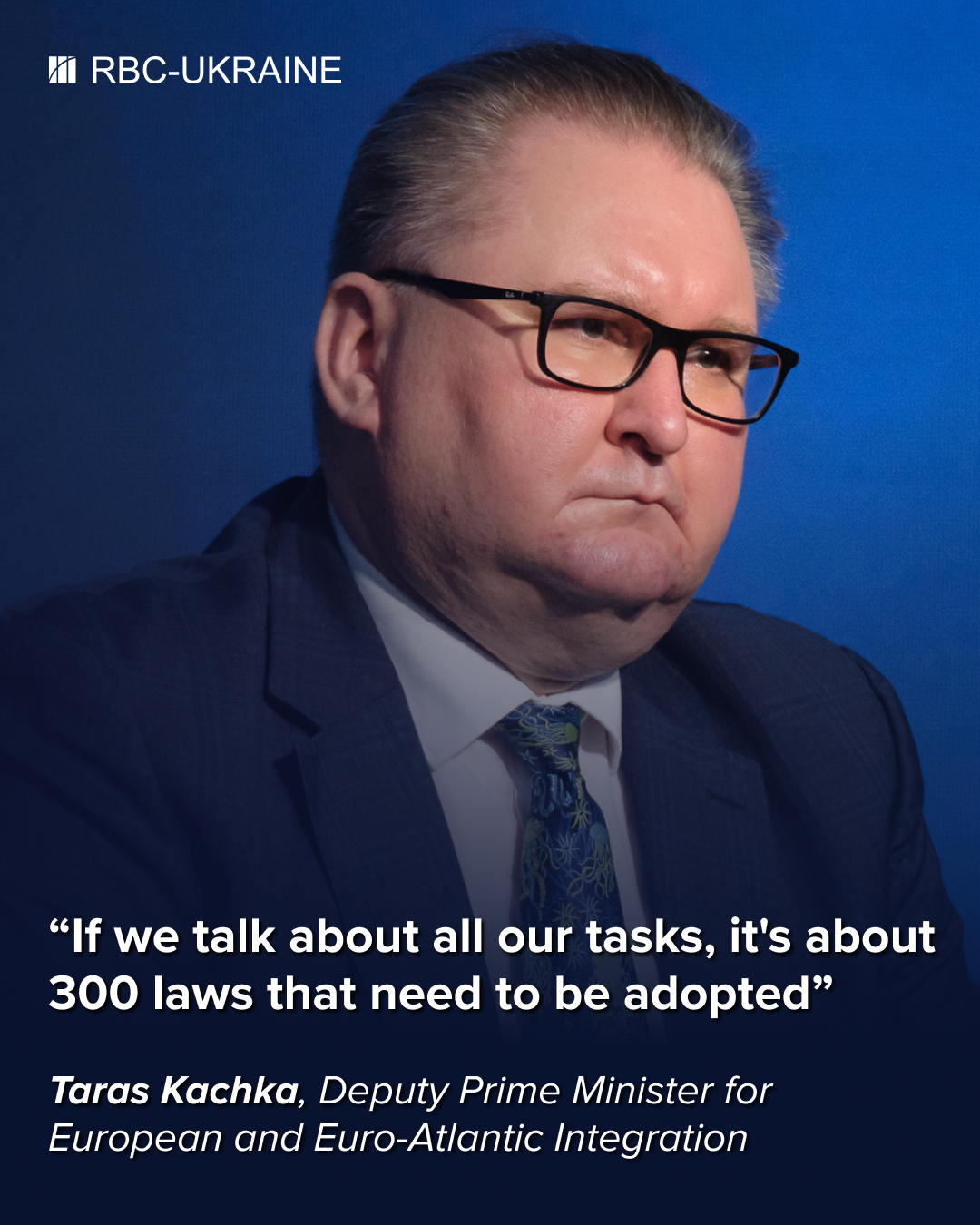 Taras Kachka on the scope of work facing Ukraine's parliament (RBC-Ukraine infographic)
On 300 laws and judicial reform
Legislative workload required to meet European requirements remains significant – it concerns about 300 laws. The main focus is on the Criminal Procedure Code, forensic expertise, and the second-generation anti-corruption strategy.
"When you break everything down sentence by sentence, the overall picture gets lost. But if you come to Verkhovna Rada (Ukraine's parliament - ed.) with a big picture and say: look, here is our rule of law, we need to finish this here, improve this here, and fix this here. Maybe not one project, because then it could become a mess, but several large projects – that is entirely possible," the deputy prime minister said.
On difficult issues: Railway, agriculture, and competition
In addition to the rule of law, there are purely economic challenges in accession negotiations. Kachka highlights several areas where negotiations could be most problematic:
- Railway: Need to create an independent regulator and unbundling of Ukrzaliznytsia (Ukraine's state railway company). "This is an inevitable story. We are deliberately postponing it because of the war… But it has to be done," Kachka said.
- Agriculture: Problem of pesticide use, where the standards of the European Union are becoming increasingly strict.
- Road transport: Another area where Europeans see Ukraine as a serious competitor.
On the United States and Hungary
Kachka notes that despite the antagonism of the Trump administration toward the European Union, the position of the United States regarding Ukraine's membership remains positive. At the same time, he believes Ukraine could join the European Union in a wave together with other countries:
"I am confident that with the rapid completion of all reforms this year, we can be there together with Iceland, together with Montenegro," Kachka said.
Regarding relations with Hungary, the deputy prime minister is rather optimistic. He believes that after the parliamentary elections on April 12, tension will decrease:
"End of elections will change working conditions. Parliamentary campaign is emotions, advertising, and campaigning. Any interaction with Ukraine is used for campaigning. Elections will end – and there will be normal work of governments," Kachka said.
He calls the main problem the unwillingness of Hungary to give up Russian oil, as well as the resolution of bilateral disputes between Budapest and Brussels.