Changing tactics and new targets: How Russia could try to shift course of war


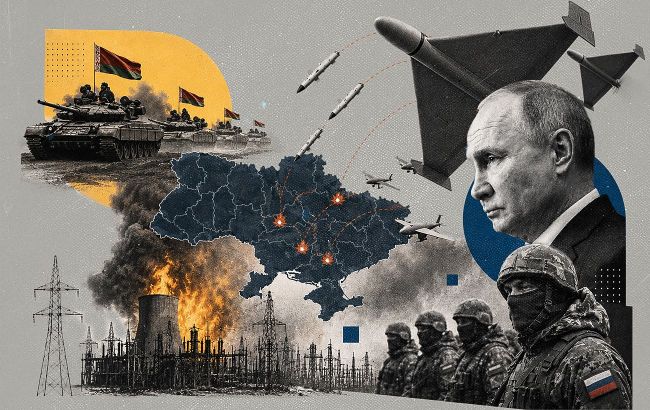 Belarus, mobilization and new strikes: How Russia could try to change course of war against Ukraine (collage: RBC-Ukraine)
No progress is being observed in negotiations between Ukraine and Russia. The three-day parade ceasefire does not yet look like the beginning of real peace.
Whether Putin will dare to again carry out mass mobilization of Russians to change the course of the war, whether there is a threat from Belarus, and which new targets could become objectives of Russian strikes — in the RBC-Ukraine article.
Main points:
- Attempt to change course. If negotiations finally reach a deadlock, the Kremlin may move to a new stage of escalation in the war against Ukraine.
- Change of priorities. Alongside the energy sector, defense industry facilities, gas production infrastructure, and fuel infrastructure are increasingly becoming priority targets for Russia.
- Mobilization in Russia. Kremlin has not yet made a decision on large-scale mobilization, but such a scenario remains one of the possible options and could involve a repeat of autumn 2022.
- Belarus activity. Lukashenko continues to help Russia in the war. However, direct threat from Belarus is currently assessed as low.
The peace process between Ukraine and Russia has stalled. The United States calls this a deadlock, but it managed to help achieve a three-day ceasefire during the parade in Moscow.
"Parade has been propaganda of victory since Soviet times, and use of victory in Second World War as myth can be destroyed by one drone that demonstrates Putin's inability to protect Russia against the background of the same Soviet-era leaders," said head of the Center for Countering Disinformation of the National Security and Defense Council Andriy Kovalenko.
Donald Trump suggested that this ceasefire could continue after May 11 as well. However, several military and political sources interviewed by RBC-Ukraine consider such a possibility extremely unlikely. Moreover, according to them, the current silence can also be called very conditional.
"In fact, this is a pause in strikes with guided aerial bombs, long-range drones, and missiles. Nothing stopped on the front line. They continue assaults as before. We expected them to launch a massive missile strike before May 9 — this did not happen. But they accumulated capabilities, and we know about their plans," one informed source told the publication.
Putin's latest statements also do not indicate that he is currently ready to stop. And although his army can continue fighting for the Donetsk region for more than another year, while the Russian economy increasingly feels the price of the war they unleashed, Moscow shows no readiness for compromise decisions.
The question is — what else can Putin do to change the situation in his favor if there is no peace?
Strikes
The Russian campaign of strikes against energy infrastructure, which they carried out during winter and autumn, was devastating for Ukraine but unsuccessful for Moscow. Hundreds of missiles and drones managed to cause even greater damage to our energy system than in 2022-2023, but did not force our authorities and society to accept any of the Kremlin's demands.
"After winter, they held a review within military leadership: Ukraine increased production and use of weapons, particularly the drones they use — how did this happen? And then they realized: for several months in a row, they concentrated on energy facilities and did not attack our defense production," one informed RBC-Ukraine source said.
Now, Russians have somewhat shifted focus: Moscow identified our defense industry facilities among key targets, while at the same time periodically attacking energy and fuel infrastructure facilities.
"The enemy is interested in our strategic enterprises. Among priority targets of Russian strikes are our defense production facilities, energy facilities, gas production and oil production sectors, gas stations in frontline territories, strikes on which we have recently recorded. But the enemy also often strikes civilian facilities that have no strategic or military significance. The goal is to keep the population under pressure," Yurii Ihnat, head of the communications department of Air Force Command of Armed Forces of Ukraine, told RBC-Ukraine.
Several sources of publication predict that at least until autumn, Russians do not plan to conduct such a concentrated campaign of attacks against our energy infrastructure as they did in autumn and winter. However, they continue reconnaissance of these facilities and monitor how they are being restored and repaired. At the same time, one of the sources sees a threat that during summer the enemy may begin attacks on water supply systems — something President Volodymyr Zelenskyy warned about at the end of March.
The enemy has also begun experimenting with approaches to carrying out strikes. It increased the use of drones of different types and started periodically conducting massive raids throughout the entire day. According to RBC-Ukraine, this was facilitated by an increase in the number of launch sites and production volumes of drones themselves — both long-range strike drones of Shahed type and decoys.
"The enemy is changing the frequency of strikes. The fact that they began carrying out massive strikes during daytime as well, organizing attacks in several waves, is primarily aimed at exhausting our air defense, equipment, and personnel. Such attacks indicate that Russians either accumulated unmanned aerial vehicles or increased production of certain types of these drones launched against our territories," Ihnat said.
Another trend is that Russians began accumulating Iskander-M ballistic missiles after the active use of these missiles during the autumn and winter. According to the publication, Moscow failed to significantly increase production of long-range missiles compared to last year. In June 2025, RBC-Ukraine wrote that, according to the Main Intelligence Directorate, Russians produce about 195 long-range missiles of various types per month, including up to 60 Iskander-M missiles. Currently, these figures remain unchanged.
Belarus factor
Since the beginning of the full-scale war, Lukashenko has been helping Putin in the war. First, by providing Belarusian territory for invasion, then military infrastructure for training Russian recruits, and later by transferring Soviet-era weapons from his stockpiles.
"Belarus also assists Russia by strengthening the signal for enemy aerial assets. These can be stationary systems installed in the territory of Belarus. And now we have seen that this is also happening with the help of balloons," spokesperson for the State Border Guard Service of Ukraine Andrii Demchenko told RBC-Ukraine.
He clarified that a balloon recently entered our territory from Belarus. It carried a repeater at the moment when Russia was attacking Ukrainian regions with drones. These enemy assets enter from Russian territory and then move along the border with Belarus.
From time to time, versions appear in the information space that Belarus could directly enter war or once again allow Moscow to use its territory as a bridgehead for an attack by Putin's troops.
Once again, such a threat was discussed at the end of April after Volodymyr Zelenskyy stated that the activity of armed forces had increased on the territory of Belarus, roads toward Ukrainian territory were being built, and artillery positions were being arranged.
"We believe Russia will once again try to drag Belarus into its war. I instructed through appropriate channels to warn actual leadership of Belarus about Ukraine's readiness to defend its land and independence," the president said.
Later, at the beginning of May, he also reported specific activity detected in certain sections of the border between Ukraine and Belarus. Demchenko says activity on Belarusian territory continues — this concerns further expansion of logistical routes, arrangement of training grounds and bases.
"General threat from the territory of Belarus has not disappeared anywhere. Earlier, Minsk announced the creation of the Southern Operational Command specifically in the direction of the border with Ukraine. This is also an information step by Belarus aimed at shifting responsibility onto our state, claiming that we allegedly pose a threat to Belarus. Although there have never been threats toward Belarus," a spokesperson for the State Border Guard Service explained.
According to him, infrastructure being built by Belarusians in the direction of our border, even dozens of kilometers away, could also be used by Russia. However, at present, Russia does not have units on the territory of Belarus that could carry out another invasion, Demchenko clarified.
"Near our border, in immediate proximity, border groups are not recording movement or accumulation of equipment or personnel. But once again, Minsk is playing along with Moscow, as happened in previous years when Belarus provided its territory and infrastructure for Russian troops — such a threat certainly remains," a spokesperson for the State Border Guard Service added.
The Center for Countering Disinformation also states that, as of now, there is no threat of invasion from Belarus. This information was confirmed by two more informed sources of publication.
"But there is activity on the Belarusian side, particularly in the construction of fortifications. It cannot be ruled out that these are demonstrative actions, but we are monitoring everything closely," Kovalenko clarified.
Defense Forces, for their part, maintain a necessary number of forces and resources near Belarus and constantly monitor the situation on both sides of the border, Demchenko clarified. Expansion of engineering infrastructure directly along the border line continues, fortifications and mine-explosive barriers are being built.
"Russia, all this time, is also likely pressuring Belarus to join the war unleashed by Russia against our country on a larger scale. Belarus appears to be resisting. But it cannot be ruled out that, even not through a full-scale invasion, but through attempts to destabilize the situation or provocations on the border, Belarus could become involved. We must remain vigilant in every direction," Demchenko believes.
Minsk's entering the war could create additional problems for Ukraine, either by stretching the active front line or by adding several tens of thousands of soldiers to the Russian army. But currently, uncertainty is not whether Putin wants or does not want to use this trump card, but how much longer Lukashenko can maneuver under pressure from Moscow.
It can be assumed that during more than four years of war, the Kremlin repeatedly sought to draw Minsk into combat operations. Lukashenko apparently tried each time to avoid this, understanding that it would bring war onto his territory. This, in turn, could become a serious threat to his regime.
Perhaps Putin also understands this and does not want to lose one of his regime's satellites nearby. Moreover, direct involvement of Belarus in war — much smaller and weaker than Russia — would become a clear sign for the Kremlin that it is becoming increasingly difficult for them to wage a campaign against Ukraine on their own.
Mobilization in Russia
Local authorities and governors are mostly responsible for finding recruits for the war in Russia. People are lured with high payments, benefits, and other bonuses, and in some places simply by a lack of alternatives. The Russian army is replenished through Ukrainians in occupied territories, volunteers who come for money, the recruitment of foreigners, prisoners, and suspects in exchange for amnesty, and debtors who are promised repayment of their loans. In addition, Russian authorities also campaign among conscripts to sign contracts. According to RBC-Ukraine, the contract signing rate in prisons is 20-25%, while among conscripts it is 10-12%.
To fulfill the recruitment plan, in some Russian regions, enterprises outside the defense industry were ordered to transfer a certain percentage of employees to the Ministry of Defense. At the same time, students began facing artificially created academic problems while being encouraged instead to sign contracts. They are mostly being recruited into newly created unmanned systems forces. Currently, this campaign in Russia is not successful — students fear they will be sent into assault units.
This year's approved recruitment plan for the war against Ukraine is 409 thousand contract soldiers, around 34 thousand per month. Kremlin and regions are so far managing to fulfill this plan. Such a recruitment level allows them to remain at zero, barely covering current losses, but does not allow the formation of new formations and units.
At the end of April, the president suggested that Russia could be preparing for a large-scale mobilization. This may be signaled by even greater restrictions on access to social networks inside the country and the closure of one of the loopholes for those who received draft notices. Previously, conscripts who were banned from leaving Russia traveled to Belarus and from there to Georgia or other countries. Now, those Russian citizens who were banned from leaving the country after receiving a draft notice can no longer travel abroad through Belarusian territory.
"We have concrete documents from the Russian General Staff confirming that the occupiers themselves acknowledge the inability to fulfill tasks set by their political leadership. The Defense Forces of Ukraine are ensuring the destruction of the offensive potential of the Russian army, while the level of irreversible losses among occupiers is already about 60% of total losses. Despite this, Russian political leadership is planning further offensive operations and preparing to involve more personnel, particularly through expansion of mobilization processes in Russia," Zelenskyy said after a report from the head of the Main Intelligence Directorate at the end of April.
The first and last time the Kremlin carried out a large-scale mobilization was in the autumn of 2022 after the defeat in the Kharkiv region. They managed to achieve their short-term goal — by recruiting about 300 thousand people within several months, they succeeded in preventing the collapse of the front line. However, at the same time, at least half a million people additionally left Russia, while dissatisfaction and tension in society intensified. Whether Putin will take such a step again remains an open question.
"This is one of the scenarios they are considering if they decide to continue the war for another one or two years," the head of the Center for Countering Disinformation, Kovalenko, says.
Another source of publication claims that such a decision has not yet been made in Moscow, but all necessary procedures and processes for this are ready. First of all, the mobilization decree used by Putin in the autumn of 2022 is still in force.
"Russians have plans for broader mobilization if such a necessity arises, and they are ready for this. This new wave of mobilization could involve, for example, a draft of 300 thousand people, as it was in 2022. But this would have a serious negative impact on the economic situation in Russia," one RBC-Ukraine source said.
Decision to expand mobilization will become a difficult choice for Moscow between attempting to accelerate advance on front line on one hand, and threat of rise in protest sentiments inside country together with even greater pressure on economy on the other. Unemployment level in Russia is at a historic low — around 2.5% — which indicates not their success in surviving, but the fact that people physically are not there anymore: they are either on the front line or at defense industry factories.
Large-scale mobilization would become not only a military but also a political signal for the Kremlin: the current model of replenishing the army no longer allows maintaining the pace of war without additional involvement of the population.
In any case, not only force and fear but also the love of the masses serve as a pillar of Putin's regime. And it certainly has not increased over the past four years of large-scale war. Therefore, if Putin faces a dilemma of carrying out further mobilization, he will definitely carefully weigh all the problems and risks he will face as a result.
Quick Q&A
– Is Russia preparing for a new large-scale mobilization?
Such a scenario is likely being considered in the Kremlin, and they are procedurally ready for it. However, for now, Russia is trying to cover losses through contract soldiers — prisoners, conscripts, and hidden mobilization mechanisms in regions.
– Which targets are Russians currently focusing their strikes on?
At present, these are primarily defense industry facilities, energy facilities, gas production, and oil production sectors. Several sources of publication predict that at least until autumn, Russians do not plan to carry out such a concentrated campaign of attacks against our energy infrastructure as they did in autumn and winter. Authorities also see a threat that during the summer, the enemy may begin attacks on water supply systems.
– How real is the threat from Belarus?
Activity related to the development of logistical routes toward our border is being observed there. However, at present, the Ukrainian military does not detect in Belarus a sufficient grouping for another large-scale offensive. Near our border, there is also no movement of equipment or personnel. However, Minsk continues to support Russia with infrastructure and logistics.