If Russia collapses, China may take over half the country: Interview with Garry Kasparov


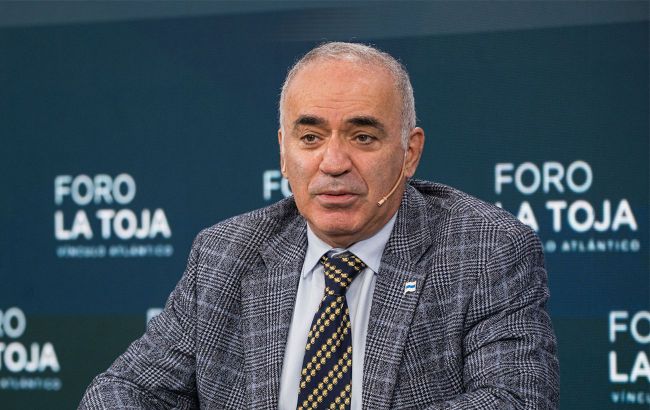 Russian opposition figure Garry Kasparov (photo: Getty Images)
Russian chess grandmaster and opposition activist Garry Kasparov says NATO leaders will lack the courage to fight Putin if he decides to invade the Baltic states and analyzes the fictitious nature of Article 5 of the NATO treaty, Trump's business deals at the expense of Ukrainian land, the collapse of Navalny's concept, and the risk of Russia being absorbed by China in an interview with RBC-Ukraine.
Read also Russian opposition figure estimates percentage of Russians against war
Key takeaways:
- NATO on paper: If Putin invades Latvia or Estonia, European leaders will simply be afraid to give the order to fire back.
- War: As long as Putin is in power, the war will continue, because it is the only way for him to retain power.
- Trump's selfishness: US President does not care about the fate of Ukraine or even his own country — all his decisions are dictated by personal gain.
- Leadership crisis in Europe: Today's European politicians resemble clowns who are afraid to make radical decisions and try to shirk their historical responsibility.
- Threat from China: The Russian empire will inevitably collapse, but this could create a new problem – Beijing is ready to take Russian lands all the way to Lake Baikal.
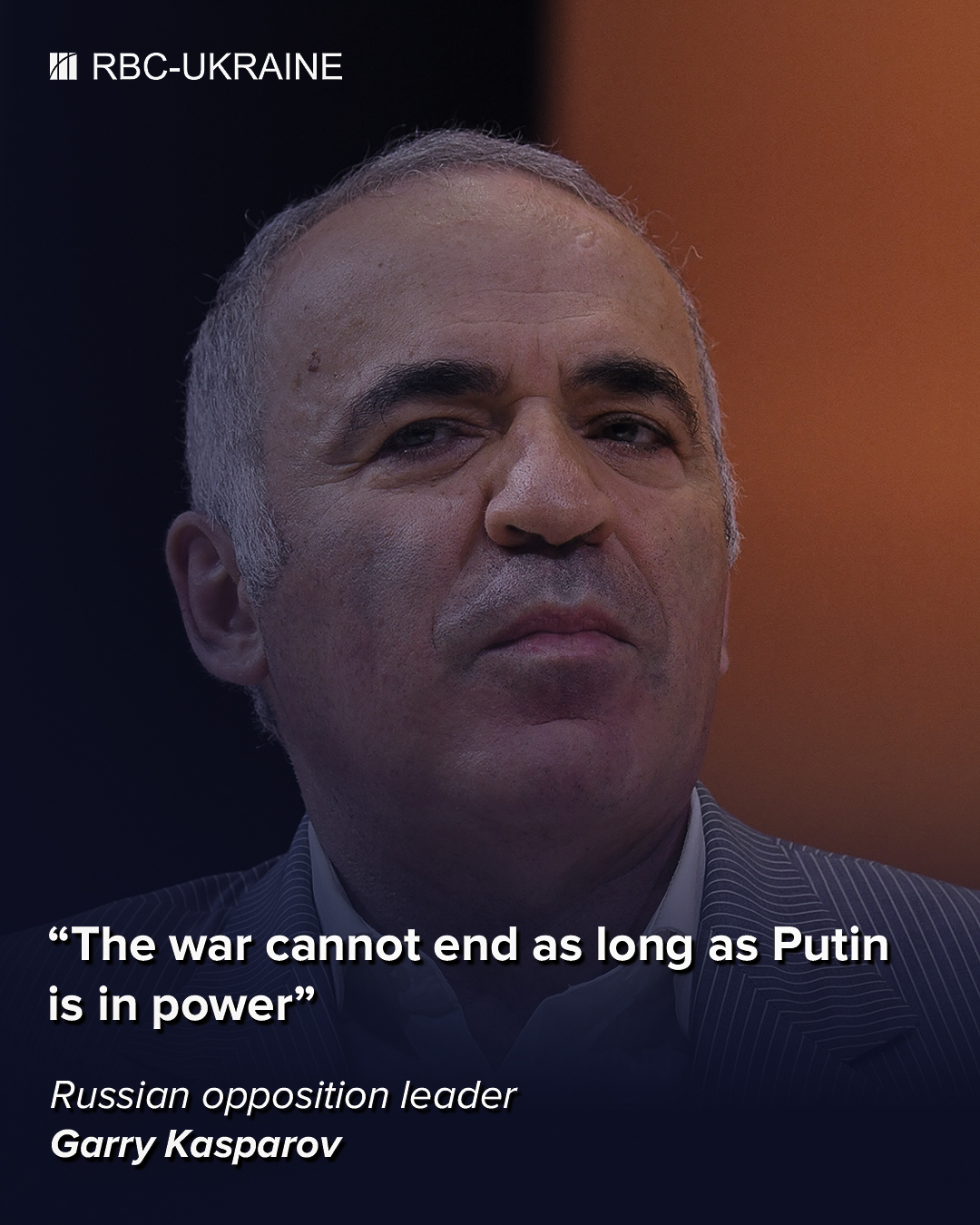 Kasparov on the possibility of ending the war under Putin's rule (source: RBC-Ukraine infographic)
Ukrainians' attitude toward the vast majority of Russian opposition figures is critical, to say the least. And for good reason. Throughout the entire period of Russian aggression against Ukraine, since 2014, many of them, if not supporting the occupation of Crimea and the occupied territories of Donetsk and Luhansk regions, were at least unable to clearly articulate their attitude toward these events.
And with the start of Russia's full-scale invasion of Ukraine, many opposition figures made great efforts to convince the world that Putin and his inner circle were solely and exclusively to blame for the aggression.
The situation is different with former world chess champion and Russian opposition figure Garry Kasparov, founder of the Free Russia Forum. Since 2014, he has consistently taken a pro-Ukrainian stance. This has led to disputes and conflicts with other opposition figures.
"Navalny's views on Russian reality, and especially on Russian foreign policy, differed greatly from mine. Why was Navalny able to continue working in Russia? Because, in general, his supporters accepted Crimea," Kasparov says in an interview with RBC-Ukraine.
But he adds that two years ago, the Kremlin eliminated perhaps the most charismatic leader of the Russian opposition.
When asked whether a normal, adequate Russia is possible, Kasparov admits that he has no answer. He is confident that Russia as an empire is doomed, but warns about China's territorial ambitions in the event of its total collapse. At the same time, unlike many other opposition figures, he recognizes the right of the North Caucasian peoples to self-determination.
However, in the context of the current Russian aggression against Ukraine, Kasparov has an unambiguous vision. He believes that as long as Putin remains in power, the war will not end, although some kind of truce is possible.
"Putin is war. Putin's Russia is a military camp. This does not mean that without Putin, Russia will end the war, but the war cannot end as long as Putin is in power," Kasparov is convinced.
A noteworthy detail: unlike many Russians who oppose Putin and like to give Ukrainians advice on how to negotiate peace or even on internal Ukrainian affairs, Kasparov emphasizes that as a Russian citizen, he has no right to criticize any decisions made by the Ukrainian government or the Ukrainian people.
Peace talks and ending war
— In the context of the current peace talks, the phrase Ukraine's victory is virtually never heard; the talk is always about some kind of compromise. If these compromises are indeed made and the war does not end in defeat for Russia, what could this mean for all of us, for the West, for Europe, for Ukraine, for the US, and even for Russia itself?
— Any compromise is the result of some kind of agreement, when the causes of the conflict are eliminated or at least leveled out.
In this case, all these negotiations are, let's say, cowardly and corrupt on the part of the West.
On the part of the Trump administration, it is openly corrupt. On the part of Europe... the word timid may not be the best, but Europe is not ready for war. It is fundamentally unable to cross the line that relations with Russia are not just a conflict, not just a confrontation.
This is a potential war, and a real war at that, because a hybrid war is already underway.
Europe is trying to live in a world of illusions. These illusions, despite four years of full-scale war, are still part of the European political landscape.
The reason for the war has not yet been clearly defined, or rather, everyone understands... But the key phrase defining the cause of the war as Putin's desire to eliminate Ukrainian statehood and restore Russian-Soviet imperial influence in Eastern Europe (and, in general, revising the results of the Cold War, which is the ideological basis of Putin's war), everything else is just talk for the poor.
A compromise would mean that Putin would simply regroup and move on, because for Putin, the war does not end even in Ukraine.
Putin's war is global, a war against the West, against liberal democracies, and here, Putin represents the illiberal part of the world.
It's like the tip of a spear, of course, with China behind it. But it's a coalition, a coalition that includes many countries. I'm currently finishing reading a book, a biography of Zbigniew Brzeziński. It's a very interesting book.
And it was in 1992, on the wave of the collapse of the USSR, when there was euphoria, that Brzeziński said that we should look to the future. And a potentially possible coalition, as he said, not ideological, but based on interests, on opposition to the West – a coalition of Russia, China, and Iran. That was his vision of the future.
In other words, we have the root causes of the war, and any attempt to find an agreement without eliminating these causes is doomed to failure.
So, yes, Ukraine can make some kind of compromise.
Read also Historical lecture over compromise: Kremlin's new delegation heads to Geneva for Donbas talks
I will note right away that I do not consider it possible for myself, as a citizen of Russia, to criticize any decisions. If the Ukrainian authorities decide that it is necessary to compromise by making territorial concessions, in my opinion, this may not be the best decision; it may be a bad one, but I, of course, can never express my opinion or criticize. This is the decision of the Ukrainian people. I support it, whatever the Ukrainian authorities and the Ukrainian people decide on this issue.
But it's absolutely clear that the war cannot end as long as Putin is in power.
 Kasparov on the US under Trump (source: RBC-Ukraine infographic)
Everything else is just noise. Putin is a war. Putin's Russia is a military camp. This does not mean that, without Putin, Russia will end the war, but the war cannot end as long as Putin is in power.
There are no alternatives to Putin. Putin will continue the war because war has become the main mechanism for maintaining his power.
And again, trying to sidestep this, to find some verbal acrobatics to obscure it, is self-deception, which ultimately leads to even greater casualties.
— We see Donald Trump's approach to this story. He is trying to make a deal, a big deal. And he keeps saying: Why are you fighting? You can stop fighting, and we, the Americans, together with you, the Russians, and with Europe, and with the Ukrainians, with the whole world, will earn a lot of money, isn't that great? Can this approach be productive, lead to something good?
— Of course not, because Trump is not interested in anyone but Trump. Not Ukraine, not Russia, not even America. It's Trump's interests, the interests of the Trump family.
And the fact that negotiations on such a crucial issue are being conducted not by the US State Department but by Trump's son-in-law and his business partner simply indicates that these talks are driven by personal gain.
Let's imagine Witkoff for a second. Basically, he's a mid-level land speculator. And now he has the opportunity to sell real estate the size of New Jersey. There is no political justification for this.
And when Europe also tries to put on a brave face, saying that, yes, of course, we cannot agree with you, but we need to look for some kind of option...
In other words, we see that the simplest words, "Ukraine must win," have still not been uttered.
The Biden administration tried to get around this. Now there seems to be some movement in Europe, and yet, except for perhaps some Eastern Europeans and Balts, we still see attempts to find some kind of middle ground, not even a compromise, but a way to avoid making radical decisions.
To make decisions of this magnitude, we need leaders, not clowns, who are currently at the helm of European countries. Just imagine: Macron and de Gaulle.
That is Europe's problem today. When the NATO Secretary General, the former Prime Minister of the Netherlands, comes to Kyiv and speaks at the Ukrainian Parliament... Isn't he ashamed?
— What do you mean?
— He says we have to wait until winter is over. He can't say anything definite. He reminds me of Medvedev, who says, there's no money, but hang in there.
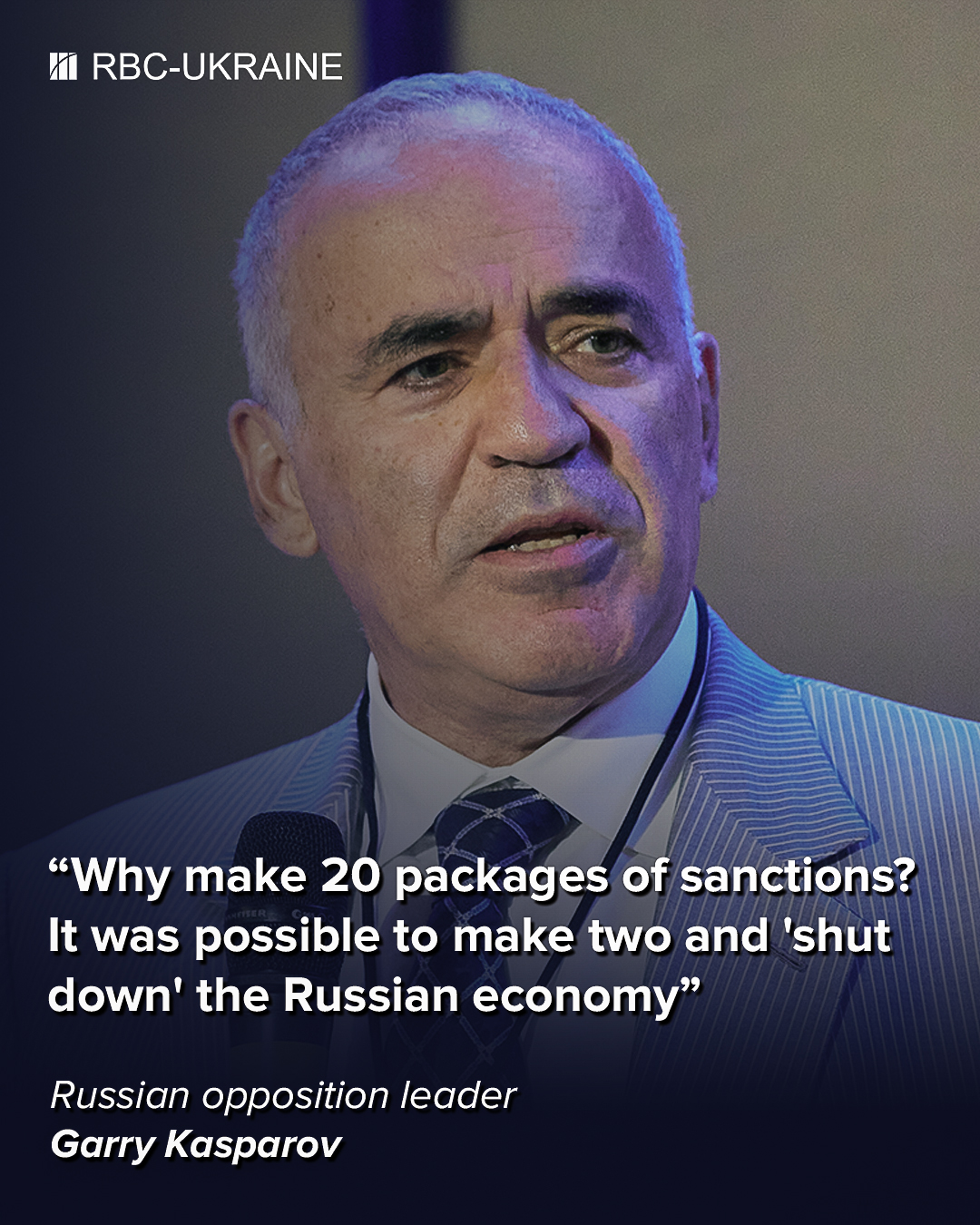
Europe has the resources to help. So much can be done. Even now. 19 packages of sanctions. Now there will be a 20th. Why make 20 packages of sanctions? It was possible to make two and shut down the Russian economy. They still can't stop Russia's shadow fleet. I understand there are economic problems. Sudden moves in trade with Russia will create an energy crisis.
When there is a war, you have to make very difficult decisions. Postponing these decisions inevitably leads to the price of stopping the aggressors going up.
So far, Ukraine has been paying this price. But it is absolutely clear that if, God forbid, Ukraine is unable to contain Putin's horde, the whole of Europe will pay this price.
 Kasparov on the indecisiveness of today's European leaders (source: RBC-Ukraine infographic)
The Europeans' attempt to delay the inevitable shows the microscopic caliber of today's European leadership.
Read also 'We will win every fight with Russia if they attack us now' - Rutte
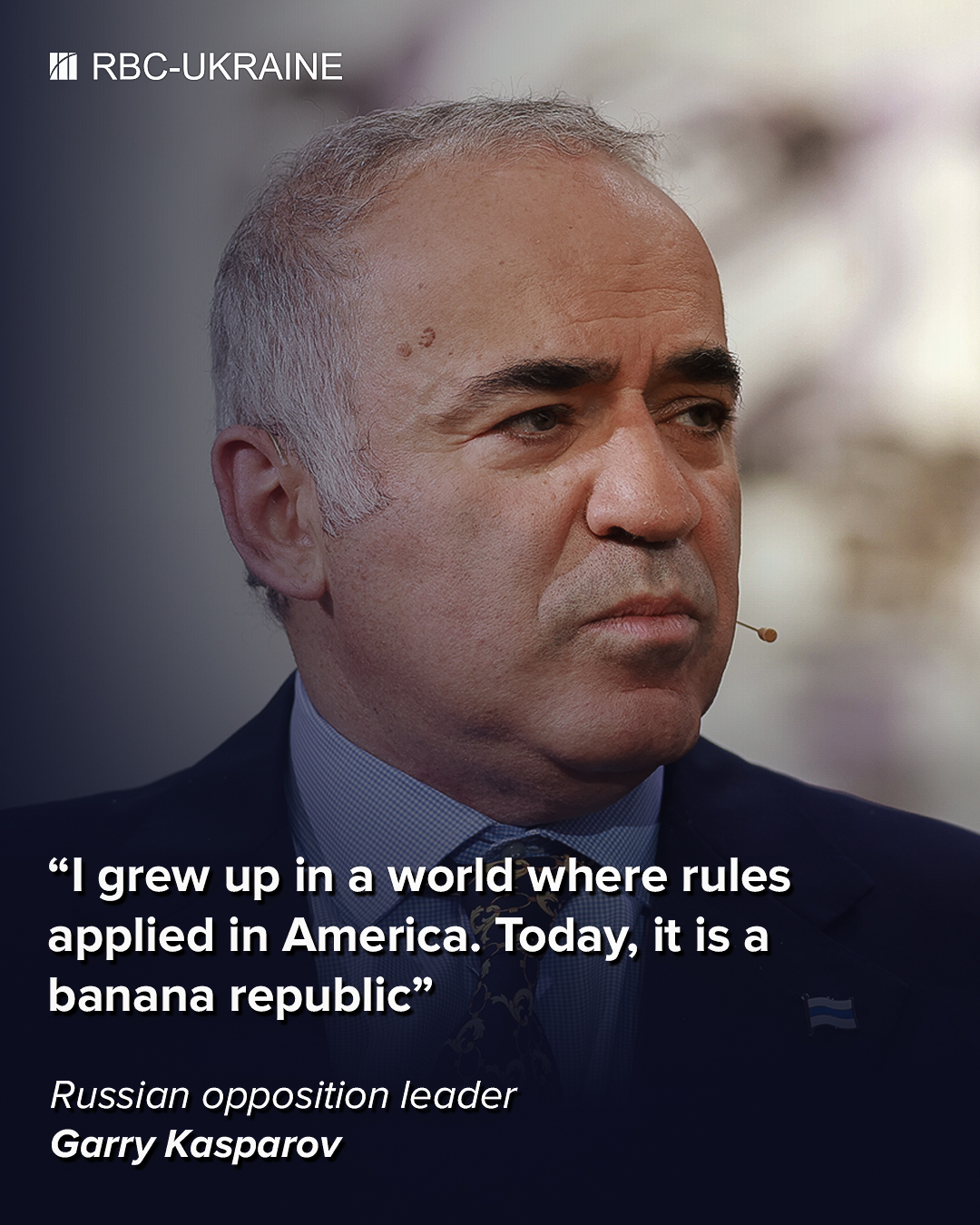
I have already talked about America. What is happening in America seems to me like a bad dream that must end. I grew up in a world where rules applied in America. There was the Senate, there was Congress. Today, it is a banana republic.
This nightmare will end. But for now, Trump is in a position to control foreign policy, and every day, he is making the overall situation in the world worse.
Ukraine is one story, but look at Iran. Trump tweets that help is on the way. Tens of thousands of Iranians have been killed in the streets. And now Trump is negotiating. He will agree. The scale of moral values has disappeared.
The only country defending the entire Western world is Ukraine. It's a paradox. The Western world is discussing whether to accept it into its company or not.
Threat of Russian invasion of Europe
— When you say that the vast majority of Europeans do not understand what threatens them, do you mean that Putin could resort to kinetic, ground-based aggression, for example, against Finland or the Baltic countries? In other words, we are not talking about hybrid warfare, but about tanks, artillery, drones, etc.?
— Hybrid warfare is already underway. It has been going on for many years. Putin is at war with Europe. Just listen to his propagandists. The only thing holding him back from a large-scale attack on Europe is the war with Ukraine. And the fact that his army is stuck in Ukraine.
Let's imagine a tragic situation for a second. The year is 2022. Zelenskyy, in accordance with the wishes of European leaders and at Biden's invitation, leaves, flees Kyiv.
And in fact, Ukrainian statehood collapses. Medvedchuk takes over, or maybe Yanukovych is brought back. And what would Putin stop? Would they divide Ukraine, and that's it?
Of course, he would continue his aggression. Aggression does not necessarily have to continue by crossing the border. Ukraine has been able to resist Putin's entire horde for four years.
Let's imagine that a 200,000-strong army arrives at the Latvian border. How long would Latvia resist? They say: Latvia is a member of NATO.
That's just a piece of paper. It's absolutely nothing. In my speech in Halifax (referring to Kasparov's speech at the Halifax International Security Forum, where he harshly criticized Europe's indecision, ed.), I asked a question that Europeans still don't want to answer: Do you have orders to shoot if Putin crosses the border? There is no answer. Because everyone knows the answer.
No one will shoot.
In fact, NATO membership has turned out to be a fiction. Because you can sign any document. Nice, shiny documents. But there must be people who are ready to follow the instructions in that document.
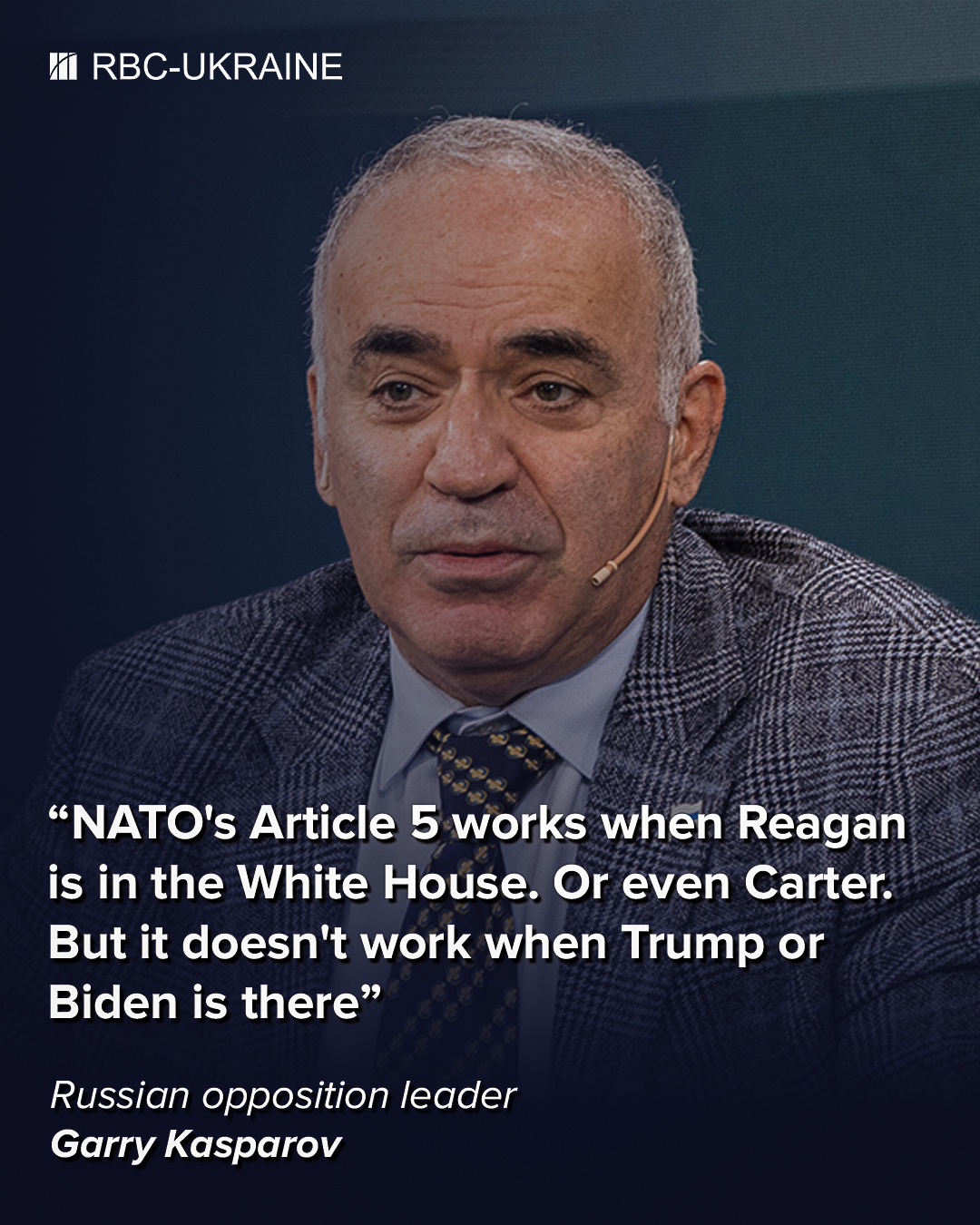
NATO's Article 5 works when Reagan is in the White House. Or even Carter. But it doesn't work when Trump or Biden is there. That's all.
Putin's plans did not come to fruition because Ukraine stood as an insurmountable wall. Let's imagine that there is a pause. You don't need to be an economist to understand this. Where will Putin's million-strong army go? Do you seriously believe that it can return to Russia?
Let's imagine for a second: there is a temporary peace, a truce, for a year, two, three. Where will he send them? Most of them are already sadistic killers. Back to Russia?
Every day we receive information about even these thousands who are returning. This is a huge problem for the country. Because they are returning, people with twisted psyches, to a country where there is a terrible gap between rich and poor.
The country is devastated. And this is a replenishment of crime.
Read also Russia enlists up to 180,000 prisoners for war against Ukraine - Intelligence
Now, let's imagine that hundreds of thousands will return. The question is: how long will it take for a new Prigozhin to emerge? Because this is a country where there are very rich and very poor people.
So Putin has no options here. We have to give him credit: he knows how to hold on to power. When people say that Putin made a mistake... Who are you? He came to power when Clinton was president. Clinton, Bush, Obama, Trump, Biden. Trump again. He's been in power for 25 years!
Don't say he made mistakes. Because he has a different frame of reference. He is still in power. He senses these things very well.
These people will never return to Russia. The army will have to continue doing what it can do: kill, rape, loot, seize territory.
Where will it go next? They took a map and looked at Russia's borders.
Finland, I think, is out of the question. Finland is too well prepared. It has a large army.
The Baltic countries are defenseless. Really defenseless. Moreover, there is no need to attack them to begin with. I have said many times that the most likely scenario is a border crossing.
Let's say a thousand special forces soldiers. Even five hundred cross the border. A square kilometer is captured in Latvia, in the Daugavpils area. Or in Estonia, in the Narva area.
And then they check: is there a fifth article or not? Unfortunately, we know the answer.
There is a restructuring of European consciousness. But the question is that Europeans need time.
Now, the most sensible Europeans, European politicians, are not talking about it, but they believe that Ukraine will hold out for at least another year, and they will have time to build up their defenses.
— If we are not talking about the Baltic countries, but about the larger countries of Europe, do they understand that they do not have time, that it ran out the day before yesterday?
— There is an axiom that aggression must be nipped in the bud. Because every day increases the price. This is a historical axiom. Hitler in 1935 was not the same as in 1936 and so on.
The same goes for Putin. In 2008, if Bush had been able to break through, first and foremost, Merkel, of course... Here, we need to deal with Frau Merkel. I would like to see the Stasi files to understand why her entire policy was actually working to subordinate Germany to Russia's interests. It is related to energy and to blocking Ukraine and Georgia's accession to NATO.
The world could have changed in 2008. If Bush had had the political will to push through then, he could have done so, and there would have been no war in Georgia either. 2007 and 2008 were the first turning points when Putin realized that there was a weak spot.
 Kasparov does not believe that NATO will implement the principle of collective defense (source: RBC-Ukraine infographic)
The situation is changing now, but very slowly. Europe is moving in the right direction. But it is moving at a snail's pace, not a cheetah's.
That is the difference. The direction is right, but is there time for it?
Many European politicians, some out of naivety, but based on their calculations, some directly out of their interests related to Putin, because many political parties in Europe are dependent on Putin, continue to say that somehow an agreement must be reached.
We hear this in Germany and France. And now we see that the Swiss minister is going to Moscow (the head of the Swiss Foreign Ministry, Ignazio Cassis, ed.). They are still trying to find some form of compromise. They think it is possible: even if they cannot postpone the war or stop it, they can shift the historical responsibility away from themselves.
Because tomorrow we will not be in the office, someone else will have to make these terrible decisions. Again, fear of making decisions. This is the problem we face in Europe.
Russian opposition
— A platform of Russian democratic forces was created in the Parliamentary Assembly of the Council of Europe (PACE). How can the creation of this platform help us, Ukrainians, first and foremost? And the second question: among the opposition-minded Russians who have left, in particular those who are more or less public figures and participate in some activities, are there many FSB-KGB conservatives among them?
— The problem of FSB agents, in my opinion, should not be limited to the Russian opposition. Of course, there are such people. I may have some suspicions, but I naturally do not rush to make accusations on the air.
The problem is that Putin's network of agents has gone far beyond the Russian opposition. I am much more concerned about Putin's agents in power, in Western countries, and in the Western media.
In general, one must always assess the enemy's forces objectively. Putin has achieved incredible success in undermining Western democracy. Literally from top to bottom. We understand that this is happening at all levels. We cannot say it directly, but in general, the US President is pursuing a policy that clearly serves Putin's interests.
And again, in almost every country, there is at least one major political party that openly works for Putin. The media. We see a constellation of bot factories and trolls. A colossal network that constantly creates tension. And in the process of decision-making and in the process of shaping public opinion, we have to fight this. Unfortunately, it has been allowed to get out of hand. Therefore, the war is being waged at all levels.
Read also Orbán defies all of Europe: Budapest seeks to assist Moscow with oil
Now, about the creation of this platform. In fact, I think this is an important step forward.
Because the Russian opposition is still quite fragmented. Because saying that I am simply against Putin is not enough.
Back in the spring of 2022, I proposed the simplest test: to say in 5 seconds, without stuttering, that the war is criminal, the regime is illegitimate, and Crimea is Ukraine.
A year later, this appeared in a more concise form in the Berlin Declaration (a program document of the Russian opposition signed in 2023, ed.). It should be understood that fewer than 40,000 people signed the declaration. Although the declaration seems to state reasonable things.
That is why the platform is important, because Europe has decided to take, again, a half-hearted step.
Russia was excluded from the Parliamentary Assembly of the Council of Europe in March 2022. Now we have been admitted, but without delegation status.
This platform is a kind of vague form. Formally, it is not even exclusively Russian. Because the head of the platform is the president of the PACE.
They still consider it a temporary arrangement. They are afraid to grant delegation status. They are keeping open the possibility of reaching an agreement with Putin.
Even though PACE makes tough resolutions on Ukraine, the criminal regime, and the tribunal. We couldn't have elections there now because there is no voter base. But there was an appointment.
They created a balanced structure. Moreover, there are ten people representing Russia. Five are indigenous peoples, as we half-jokingly call them, decolonizers.
I believe that we have managed to establish a certain algorithm for our work. Yesterday (February 6, ed.), a statement on Ukraine was adopted. I think you will like it. Overall, it fully reflects the most radical position of the group. Everything is clearly spelled out there. Fourteen out of fifteen people signed it. This is a step forward.
You might say it's just a statement. Yes, it's a statement. Nevertheless, the area of disagreement or conflict over Ukraine is gradually disappearing.
There are clearly defined points. Of course, Ukraine's territorial integrity. Definitely including Crimea. The 1991 borders. And a tribunal for crimes. Everything is specified there.
In my opinion, this is the most promising direction for Europe, and Europe is beginning to recognize that this needs to be done. If the war drags on, you need forms of organization for Russian citizens who are against Putin.
Several hundred people are fighting in the Freedom of Russia Legion. But that's a drop in the ocean.
The question is not even who is fighting. The question is that today, many people in Russia work for Putin's machine and could easily leave.
 According to Kasparov, the Russian empire is doomed (source: RBC-Ukraine infographic)
If you are waging war, you have to undermine the enemy on all fronts.
In my opinion, the most effective way is still brain drain. Putin has enough soldiers to throw them on the front line for now, but he may not have enough engineers, computer scientists, and financiers. We are talking about several hundred thousand people. We need to find a way to organize them, again based on the Berlin Declaration, to start creating a different Russia, under the white-blue-white flag (a symbol of Russian protest against the Russian invasion of Ukraine, ed.).
This is where I see potential, because it could really undermine the Putin regime's ability to wage war.
Of course, questions will immediately arise as to whether this will be used by the FSB to frame someone...
— That brings me to my previous question.
— Answer is it will. But, first of all, the West continues to issue visas.
Even last year, more than half a million visas were issued. Tens of millions of visas were issued earlier, and in principle, there were no checks. Putin has already infiltrated everything.
The situation here will change dramatically because, first of all, there is a different level of verification. Then we, the Russian opposition, can also check social networks, so the level of infiltration will be much lower. But again, okay, out of a hundred thousand people, there will be two thousand like that... But 98,000 is a gold reserve that Putin cannot compensate for.
— So that I fully understand your idea: these people must physically settle in Europe?
— Yes, they must leave; they must simply physically leave there. Yes, many of them left back then, in 2022. More than a million people, and some estimate up to three million, left and were forced to return because their passports expired.
Putin immediately said that to get a passport, you have to return to Russia. In other words, Putin realized that he couldn't let them go. The West did nothing.
Allow them to leave. It's just that this is a potential that Putin cannot replace with anything else. No Indians or Chinese that he brings in can do this.
I do not doubt that a significant number of these people generally have at least a negative attitude toward the war. I am not going to justify those who make missiles and drones.
But to condemn them, we must allow them to leave. Those who remain are criminals. But today, we have a situation where we are not utilizing this potential. Perhaps they will make drones in Ukraine. After all, someone in Russia is making rockets.
And, unfortunately, it must be said that they are making some progress. The brains are there. Get the brains out.
I have spoken with the Americans many times, and they say this is a very complicated issue. I say, in 1942 and 1943, you were told that you could give visas to German scientists and engineers. You took them out.
What's the difference now? Take the people out, give them a chance. This is where the platform (in PACE, ed.) can play a role. Because we have to start forming a Russian Taiwan.
Moreover, this is important for the future. Because if there is a collapse, which I very much hope for, after all, the regime will fall, who will replace it? So, in fact, we need to prepare personnel, people who, before leaving Russia, will sign everything, both about Ukraine and about the criminal regime.
We will need new potential personnel who will be able to build a Russia that will have normal relations with Ukraine and Europe. That is, a Russia that will be different.
Because today, Putin is gone. So what? Well, look who will replace him. People who are basically working for the war today.
Those for whom war has become the meaning of life. Today, all elements of Russian life, from the top of the pyramid to the kindergarten, are about war. And just like that, even if Putin were to be removed with a wave of a magic wand, the situation itself would not be resolved.
Navalny
— The last time we spoke was exactly two years ago, at the Munich Conference 2024. And that was the day Alexei Navalny's death was announced.
— The murder of Alexei Navalny.
— The murder of Alexei Navalny. Two years have passed. In your opinion, has Navalny's murder changed anything for Russia, for the Russian opposition, in general?
— One of the most charismatic, perhaps the most charismatic opposition leaders, was eliminated by the authorities.
Another thing is that some of Navalny's views on Russian reality, and especially on Russian foreign policy, differed greatly from mine. But still, he was a man who could potentially make Russia more civilized. Another thing is that at some point, Navalny failed to understand that the red line of what was acceptable in Russia had shifted.
He did not cross the red line himself; it was simply that the regime was changing. This is a process that became clear to me back in 2011-2012, when we lost what was perhaps our only chance to change something in Russia. The regime gradually reduced its territory, like shagreen leather, reducing the acceptable territory.
The first to be hit were those who opposed the empire. That basically included my supporters and me. We had to either go to prison or leave Russia in 2013.
Boris Nemtsov was the last anti-imperial politician. He was killed, simply dealt with radically. Because the imperial question was the most important thing for Putin.
Why was Navalny able to continue working in Russia? Because, on the whole, his supporters accepted Crimea. The strength of Putin's regime — I am saying this for the third time — is that we must respect their actions. Because much of what they did was correct, competent steps to expand their territory of power.
At that moment, the acceptance of this new imperial discourse was much more important than any opposition activity. Moreover, the activities of Alexei Navalny and his supporters, and indeed the entire Russian opposition, which was completely controlled by the Kremlin, helped to soften international condemnation. In other words, Putin managed to break out of isolation after 2014.
Let's not forget Navalny's interview in 2015 in the Washington Post, when he said not to give weapons to Ukraine, called for seeking some form of compromise, and not provoking further events.
I was running around shouting at the time, my book Winter is Coming was published in 2015. But I was generally seen by many Western politicians as a crazy city dweller, because there was a large group of people in Russia who criticized Putin, but at the same time said that the regime was changing after all.
I apologize for such a long, perhaps vague answer, but Navalny... Navalny's concept had exhausted itself at that point. That's why, yes, it was a tragedy. I still don't understand why he returned to Russia.
I want to find out for sure. I asked this question, but no one answered. Who persuaded him to return after an obvious attempt to kill him? Who convinced him that the worst he would face was house arrest? That's all.
There are many questions related to Navalny's activities that we still haven't received answers to, although we see, for example, Yulia Navalnaya and his supporters. They write books, but so far, there are no answers to these questions. But in general, the very concept of ennobling the regime has failed.
That is why now, if we look at it, the rather broad network of Navalny's supporters has no real influence on the actions of the Russian opposition. Moreover, it should be understood that Navalny's entire staff, all the people who worked with him, refused to sign the Berlin Declaration. That's just how it is.
No, they say that, in general, they are, of course, in favor, but they are not signing the declaration. That is why they are not in the PACE Platform.
As I said, 14 people on the Platform signed the declaration. Only one signature is missing, that of Lyubov Sobol. Yes, she has already broken with Navalny, but... Exactly one signature is missing.
Of course, I would like to have the opportunity to debate with Navalny here in the West. But the concept associated with his name has exhausted itself. And so, by and large, his tragic death has not affected the formation of a new core of the Russian opposition.
— Is the so-called beautiful Russia of the future that Navalny talked and wrote about so much actually possible? Is a normal, adequate Russia possible from any perspective? There are different opinions on this. In Ukraine, many believe that it is impossible.
— This is one of those rare occasions when I will say that I do not know. Precisely because one could spend a lot of time on a semantic argument about what Russia actually is. We are talking about the Russian Empire.
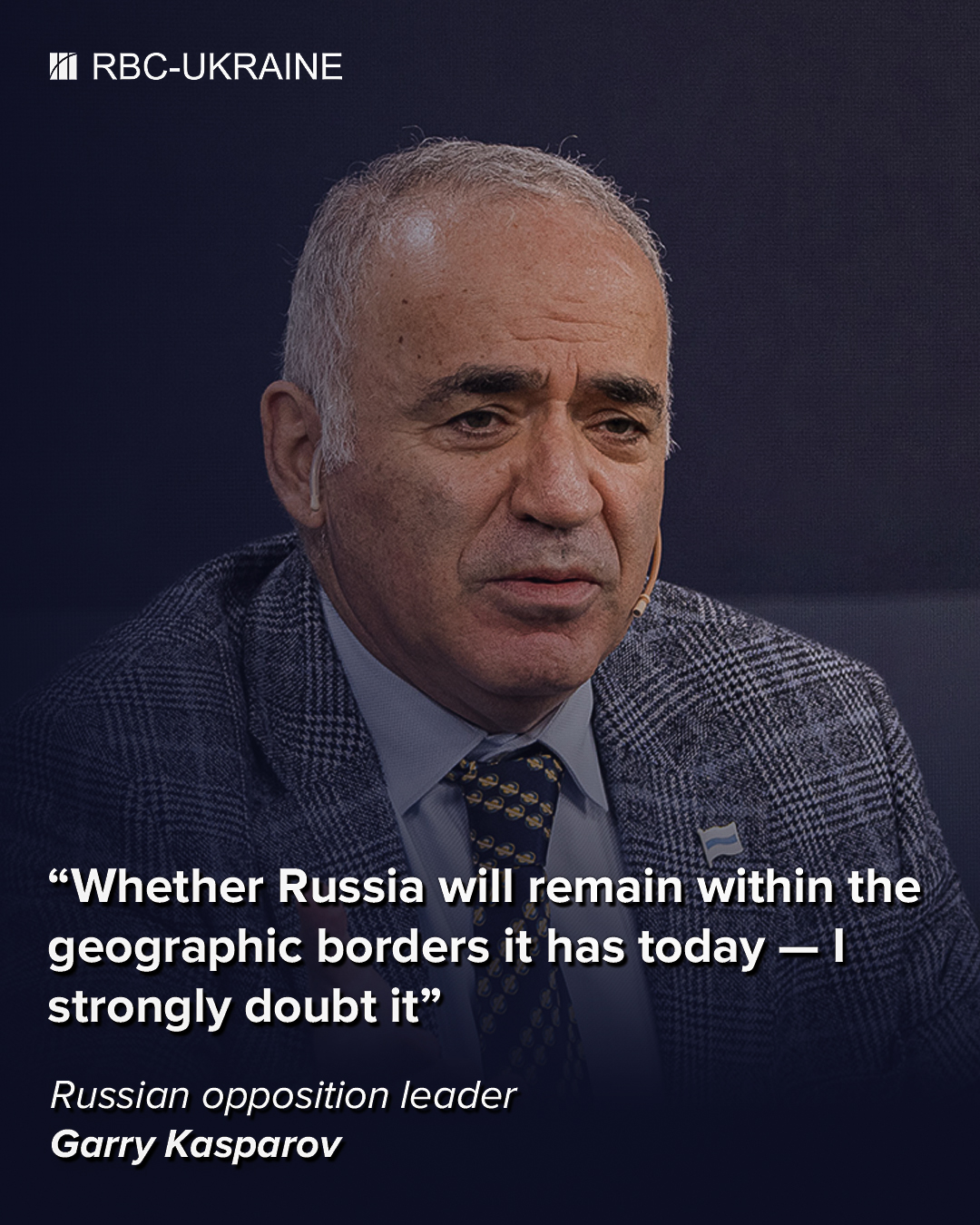
It is doomed, of course. The imperial nature of the state is doomed. Whether Russia will remain within the geographic borders it has today — I strongly doubt it.
I don't know what form the new state will take after the collapse of Putin's empire. From my point of view, it is wrong to give any prescriptions today.
This process will require maximum coordination of interests. It is interesting that in the group of fifteen people in the Platform, five represent these small indigenous peoples and decolonizers.
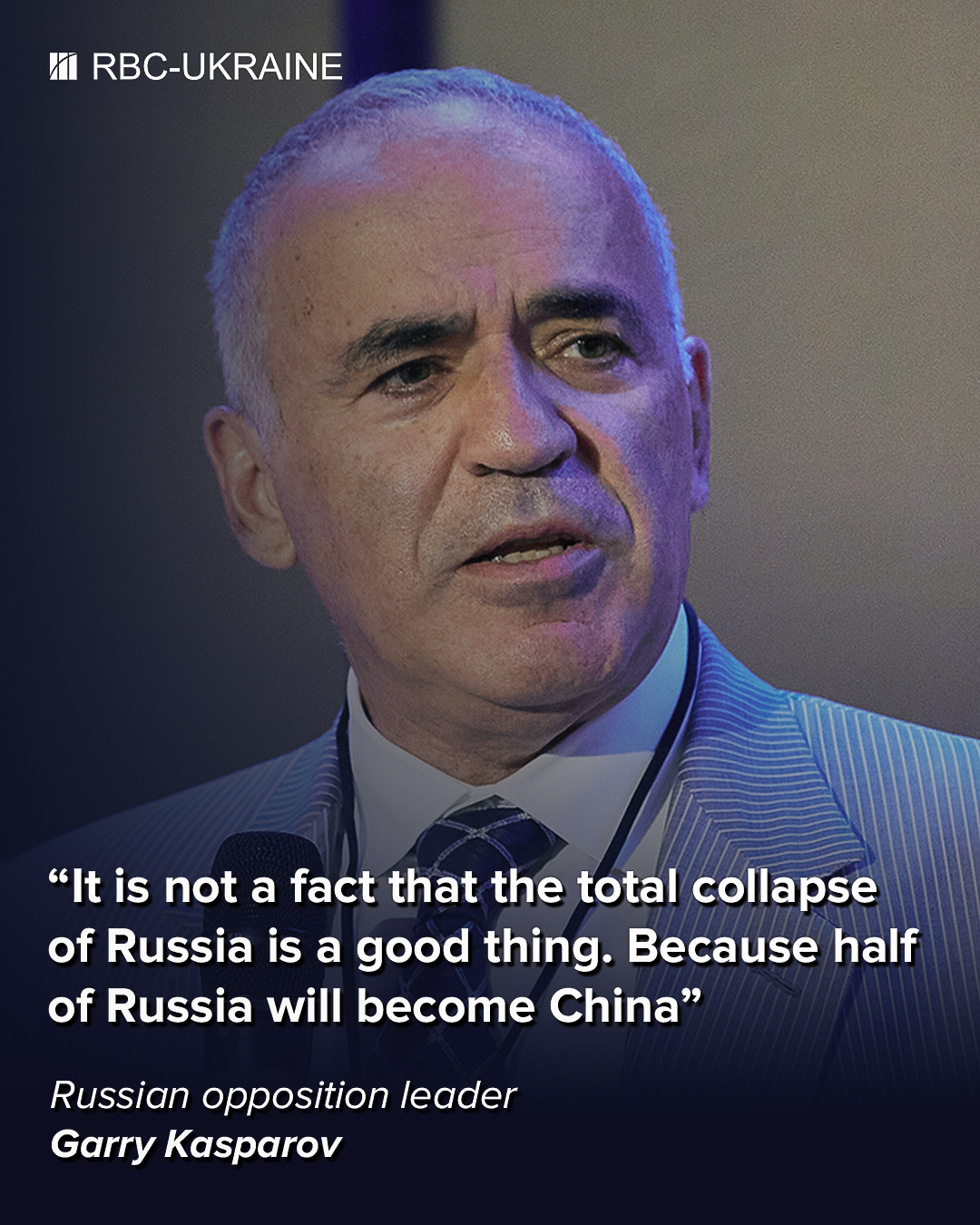 Kasparov warns about China's ambitions in the event of Russia's collapse (source: RBC-Ukraine infographic)
This is actually an interesting conversation. No one knows the exact answer. Let's say, Pavel Sulyandziga represents the Udege, the Yakuts, the peoples of the Far East.
There is an obvious question there. Yes, of course, Russia is not very good. But the alternative is China.
So it's complicated. This topic requires a very cautious approach.
Because today it's hard to predict. It is not a fact that the total collapse of Russia is a good thing. Because half of Russia will become China.
Do you want to have China there? By the way, China has huge territorial claims against Russia. China's claims are, in principle, practically everything from Lake Baikal to Vladivostok. This is what China was until 1860.
So everything is very complicated here. I proceed from the assumption that it must be voluntary. If some people of the North Caucasus want to leave, please do so.
In other words, Russia's future lies only in the creation of a normal federation voluntarily. Can this happen? I don't know. I can say that I will do my best to make it happen.
What I really dislike is when people talk about the so-called beautiful Russia of the future, ignoring all the difficulties I am talking about.
Engaging in Khlestakovism — 'we will build'... — is actually just empty talk.
But that's all in the future. For now, there is only one goal. The Russian opposition must do everything it can to ensure that Ukraine wins the war.
Because our Free Russia Forum flag says: 'Victory for Ukraine – freedom for Russia!' Only in that order.
There is no rearrangement of the components here. If Ukraine does not win the war, nothing will happen in Russia. Historically, we know from 200 years of experience that changes in Russia have been the result of geopolitical military defeat.
Quick Q&A
— Can the war end while Putin is in power?
— No, because the war has become the main mechanism for maintaining his power, and there are no alternatives under this regime.
— Will NATO's Article 5 work?
— No, this is fiction, because Western leaders do not have the political will to fight Putin in the event of his invasion, for example, of the Baltic states.
— What are Donald Trump's real goals?
— Trump's policies are dictated not by American interests but by his personal gain and his family's business interests.
— What has Navalny's assassination changed?
— The Kremlin has eliminated the most charismatic opposition leader, but Navalny's strategy had already failed at that point.
— What fate awaits Russia in the future?
— The empire is doomed to collapse, but there is a risk of Chinese territorial expansion from Lake Baikal to Vladivostok.