Historical lecture over compromise: Kremlin's new delegation heads to Geneva for Donbas talks


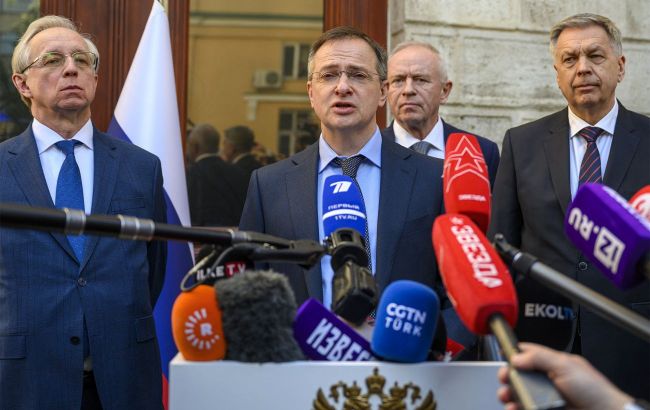 Foreground, left to right: Mikhail Galuzin, Vladimir Medinsky, Igor Kostyukov (photo: Getty Images)
Instead of talks about monitoring the ceasefire – lectures on the Rurikids? Ahead of tomorrow’s negotiations in Geneva, Russia has changed the composition of its delegation, which will again be headed by Putin’s aide Vladimir Medinsky.
RBC-Ukraine reports on what to expect from Medinsky and who else is part of the Russian negotiation team.
Key points:
- Key changes: more civilians, fewer military personnel;
- Vladimir Medinsky: a native of the Cherkasy region and Putin’s aide, is once again leading the delegation instead of intelligence chief Kostyukov;
- Mikhail Galuzin: a career diplomat authorized by the Kremlin to present the terms of external governance over Ukraine;
- Igor Kostyukov: admiral and head of military intelligence, was pushed into the background.
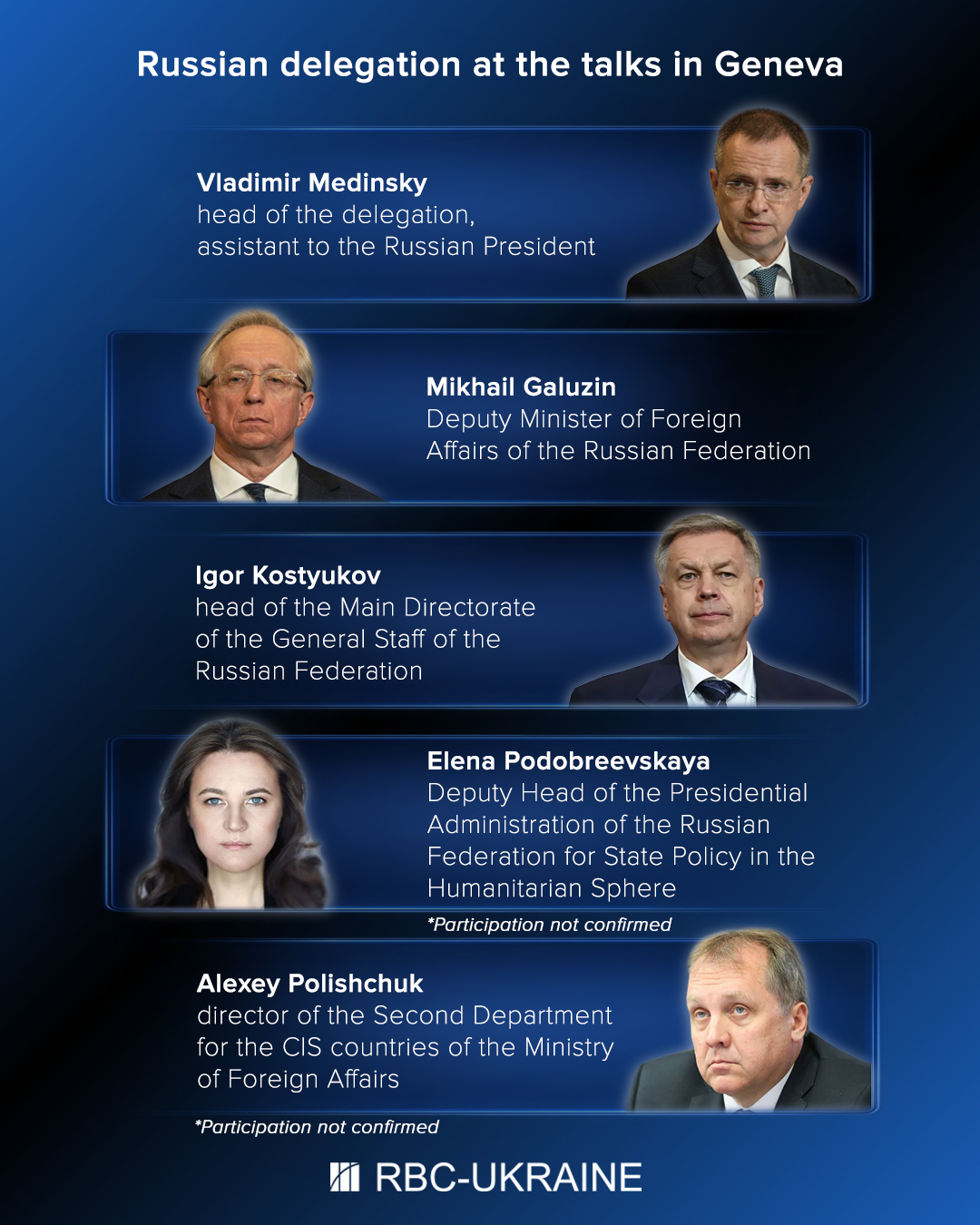 Who’s in the Russian delegation (infographic by RBC-Ukraine)
Who is Vladimir Medinsky
He previously led the Russian delegation during attempts at negotiations between Ukraine and Russia in spring 2022. He also represented Russia in talks in Türkiye last May.
In 2025, Medinsky mostly gave lectures on Russia’s historical claims to Ukrainian territories, tracing back to the times of Prince Rurik. This clearly showed that Russia was not seeking constructive negotiations. Apart from prisoner exchanges, the talks ended without results.
Medinsky has Ukrainian roots. He was born in the city of Smila in the Cherkasy region. In the 1990s, he worked in the advertising business. From 2003 to 2011, he was a deputy in the State Duma from Putin’s party, United Russia.
During that time, he gained a reputation as an ideologue of the regime. Medinsky wrote a three-volume work titled Myths about Russia, which sought to debunk negative stereotypes about Russia. From 2012 to 2020, he served as Russia’s Minister of Culture.
After resigning, he became Putin’s aide and head of the Russian Military Historical Society.
Who is Mikhail Galuzin
A career diplomat with over 40 years in the Russian Foreign Ministry. Galuzin previously focused on Asia and is a Japan specialist by education, so much of his career has been tied to Tokyo. He served as Russia’s ambassador to Japan and Indonesia.
After 2022, he began overseeing relations with post-Soviet countries, replacing Andrey Rudenko in that role. Rudenko, in turn, moved to the Asian direction that Galuzin previously managed, reflecting the usual rotation system in the Russian Foreign Ministry.
Galuzin participated in negotiations in Türkiye (May last year) and Abu Dhabi (January–February this year).
Read also: No fresh start for Russia in talks: Zelenskyy on new head of Russian delegation
He is one of the few officials authorized to comment on the Kremlin’s negotiation position publicly. On February 15, in an interview with TASS, he stated that Moscow is allegedly ready to guarantee a ceasefire on election day in Ukraine if Kyiv decides to hold a vote. He also said Russia is open to discussing with the US and other countries the idea of temporary external management of Ukraine under UN supervision.
Who is Igor Kostyukov
Head of Russian military intelligence—the Main Directorate of the General Staff of the Russian Federation (formerly GRU).
He received higher naval education and later graduated from the Military Diplomatic Academy of the Soviet Army.
Kostyukov spent many years in GRU, though little about his service is publicly known. In 2004, he served as military attaché at the Russian embassy in Greece. Since 2016, he has been the First Deputy Head of the directorate. After his superior died "following a long and serious illness," Kostyukov took over the agency.
He became the first head of Russian military intelligence with a naval background and was promoted to admiral in 2019.
In 2017, Kostyukov received the title Hero of Russia for participation in military operations in Syria. He is under international sanctions: the US added him to its lists for interference in the 2016 US presidential elections, while the EU and UK sanctioned him for the 2015 Bundestag cyberattack and the 2018 Novichok poisoning of Sergey Skripal.
In Ukraine, Kostyukov is officially recognized as a war criminal and is listed in the Myrotvorets database as an organizer of Russian aggression.
According to Kremlin spokesperson Dmitry Peskov, this time the Russian delegation includes more civilian specialists. Their full list is not public, but based on previous rounds under Medinsky’s leadership, it is highly likely that two other key figures will be present at the talks: Alexey Polishchuk and Elena Podobreevskaya.
Who is Alexey Polishchuk
A career diplomat. From 2017 to 2019, he served as deputy director of the Department of Pan-European Cooperation, where he oversaw relations with the OSCE, the Council of Europe, and other European institutions.
He later headed the Second Department for CIS countries, responsible for relations with Belarus, Moldova, and Ukraine. Like Galuzin, he was a member of the Russian delegation in negotiations with Ukraine in Türkiye.
Polishchuk actively promotes the narrative of "historical unity" between Russians and Ukrainians and justifies Russia’s actions in the war. He stated that Russia is willing to negotiate only if its key demands are met.
Who is Elena Podobreevskaya
She is a direct subordinate of Vladimir Medinsky in the Russian presidential administration.
Podobreevskaya serves as Deputy Head of the Presidential Administration for State Policy in the Humanitarian Sphere, a department created in 2024 to strengthen ideological control during the war. Before joining the presidential administration, she worked in the Russian government apparatus.
Like her superior, she participated in the May negotiations in Türkiye last year. Podobreevskaya specializes in culture, education, and historical memory. Within the talks, she is responsible for drafting Russia’s demands on issues such as changes to educational programs and the status of the Russian language.
What do the changes in the delegation mean
Officially, Medinsky’s return to the negotiations is linked to an expansion of the topics under discussion.
"This time, a wider range of issues is planned for discussion, including major territorial questions and everything else related to our demands," said Kremlin spokesperson Dmitry Peskov.
However, the real motives of the Kremlin are different, according to Iryna Pavlenko, an expert at the Institute of the Transformation of North Eurasia.
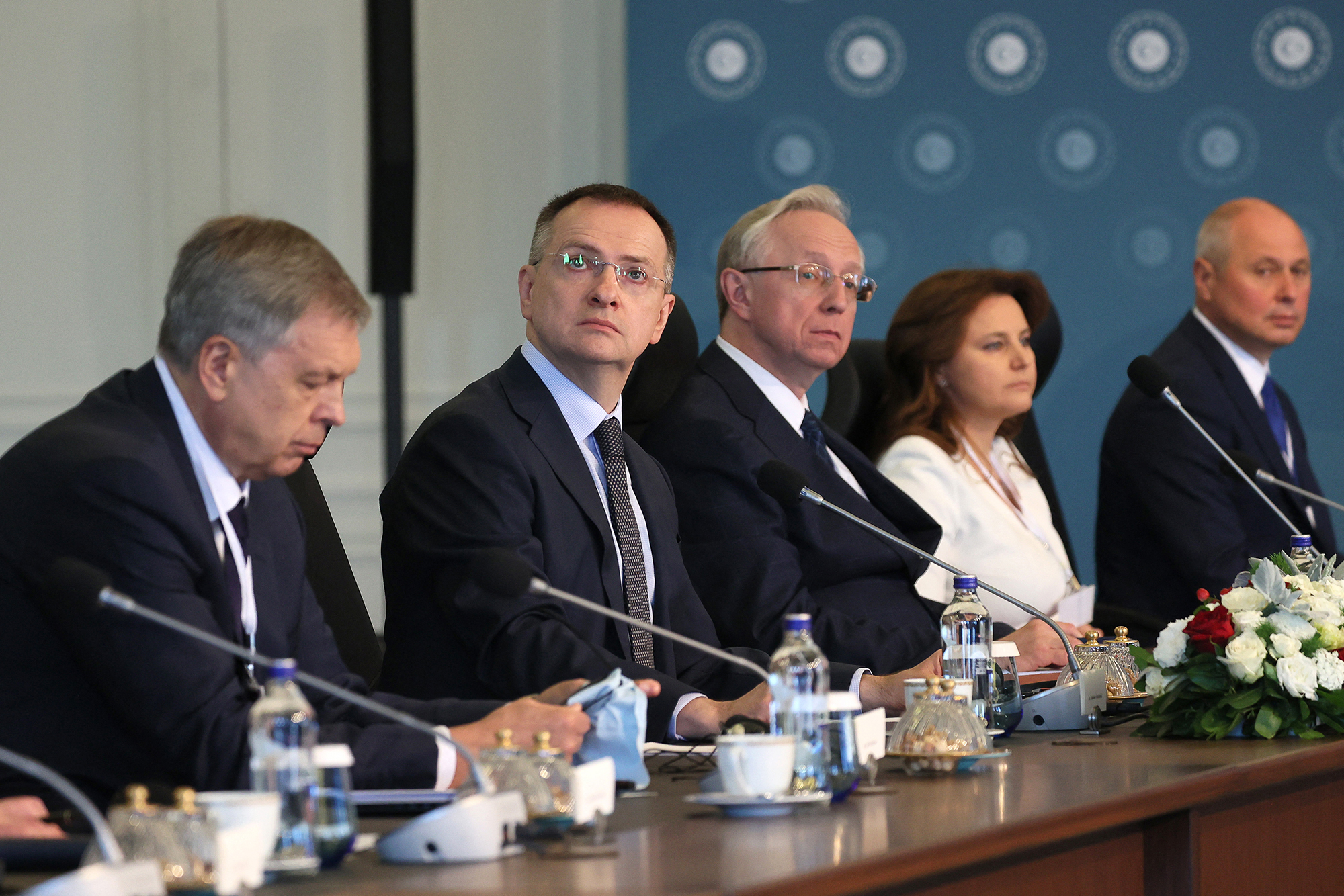
Russian delegation. Second from the right – Elena Podobreevskaya (photo: Getty Images)
"First, the constant rotation of delegates itself is a known tactic to drag out the negotiation process. Moreover, Medinsky, being less concrete—that is, not a military figure—is better suited to dragging out the negotiation process," Pavlenko said.
Read also: Zelenskyy meets with Rubio, Witkoff, Kushner in Munich ahead of Geneva talks
At the same time, Medinsky’s personal views play a secondary role here. After all, they differ little from the chauvinistic positions of Russian military officials. The key factor is his position within the administration of the Russian President.
"Medinsky goes to work in the Kremlin and is closer to politics. And the fact that he’s a lunatic and a chauvinist—well, Russian military officers are the same by mentality. The substance doesn’t change here," Pavlenko emphasized.
Meanwhile, keeping Kostyukov in the Russian delegation may be largely connected to Moscow’s desire to avoid escalation with the US.
"The fact that Kostyukov remains in the delegation may partly be a response to the wishes of the American side. The US did not want the Russian delegation to be completely reshuffled every month. This maintains the illusion of some continuity," the expert concluded.
FAQ
– Who leads the Russian delegation in Geneva?
The Russian negotiation team is once again headed by Putin’s aide, Vladimir Medinsky. The return of a civilian ideologue instead of a military chief signals Moscow’s shift from technical security matters to political bargaining over territory.
– Why did Russia replace Igor Kostyukov with Vladimir Medinsky as head of the delegation?
Officially, Moscow cites the expanded scope of the talks, now including territorial status and ideological demands. According to expert Iryna Pavlenko, this rotation is a tactic to stall, as Medinsky focuses on historical claims rather than concrete solutions.
– What role does Chief of military intelligence Igor Kostyukov play in the talks?
Admiral Kostyukov remains part of the delegation as the head of the security bloc. His presence provides the US with the illusion of continuity and allows Russia to conduct parallel closed consultations on demarcation lines.
– What authority does Mikhail Galuzin have in the Geneva rounds?
The Deputy Minister of Foreign Affairs is responsible for the diplomatic formulation of Kremlin demands. He is authorized to discuss with the US and other mediators the conditions for implementing external governance over Ukraine under international organizations.
Sources: official Kremlin documents, as well as publications by Reuters, CNN, and TASS.