'Lame duck' Trump and risks for Ukraine: What to expect from US midterms


 What to expect from the US congressional elections (collage by RBC-Ukraine)
In five weeks, on November 3, the US will hold midterm elections for Congress. Ukraine is already feeling the impact, and after the vote, the situation will change even more significantly for Kyiv.
Read the RBC-Ukraine article to learn about the shift in Trump's rhetoric ahead of the election, his party's chances of retaining at least one chamber of Congress, and the potential implications for Ukraine if Democrats win.
Key points:
- Ukraine in the US elections: Trump has not yet achieved a foreign policy victory in the form of an energy truce ahead of the congressional elections, but he continues to try to exploit Ukraine.
- Threat of defeat: Republicans may lose their majority in the House of Representatives, as Americans are growing increasingly dissatisfied with Trump.
- Opposition's comeback: A Democratic victory threatens Trump himself with a third impeachment, as well as trouble for his inner circle.
- Image blow: Losing support in Congress is already affecting Trump's global standing and his perception as a lame duck.
- Disputes among Democrats: Within the party, the left wing is skeptical of Ukraine and US foreign policy in general, and this poses an additional risk for Kyiv.
Simple solutions illusion
Ukraine has once again unwittingly become part of US domestic politics. But not because of direct military aid—since, with Trump's return to the White House, weapons for Kyiv are being purchased solely with European funds under the PURL program.
This time, the focus is on Trump's peace initiatives, through which he is attempting to influence first Ukraine and then Russia.
All of this was evident in September—first during the visit of US envoys Steve Witkoff and Jared Kushner, and then at the meeting between the Presidents of Ukraine and the US on the sidelines of the UN General Assembly.
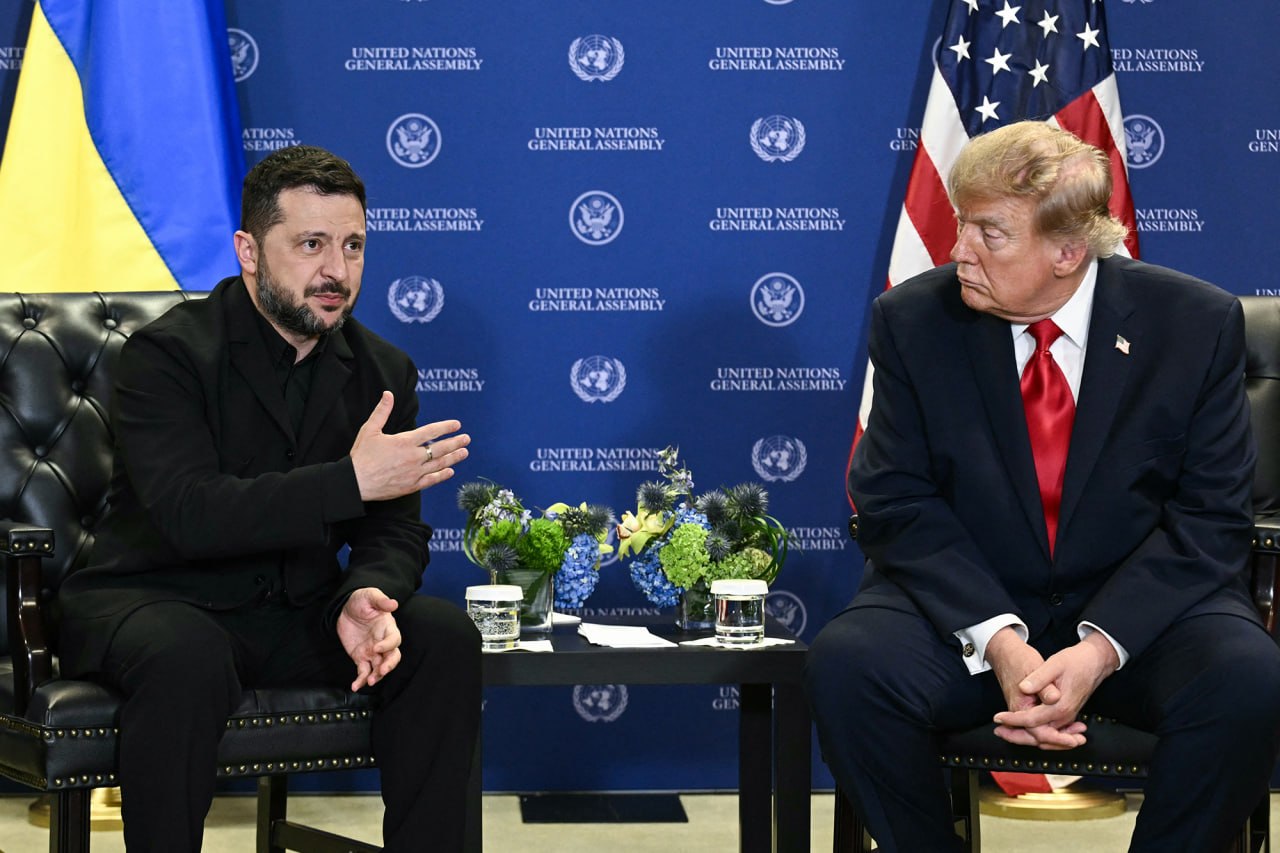 The meeting between Zelenskyy and Trump on the sidelines of the UN General Assembly (photo: Getty Images)
Donald Trump is increasingly seeking foreign policy victories to showcase to his electorate ahead of the congressional elections—especially when that electorate is dissatisfied with rising fuel prices.
"Prices are the worst. A majority of independent voters voted for Trump in 2024. He convinced them that prices would be lower, that their pay would be higher, and that the future of the American economy would be brighter. In all of this, support for Trump has vanished," Andrii Dobrianskyi, an expert at the US-Ukraine Relations Center in New York, tells RBC-Ukraine.
In the US, the cost of gasoline plays a much greater role than in other countries. Rail transportation in the country is underdeveloped. Road transport is key to intercity retail logistics. Because of this, any increase in fuel prices automatically raises the prices of all goods and fuels overall inflation.
Trump's adventure, which he recklessly launched at the beginning of the year by attacking Iran, has clearly spiraled out of control. All attempts to genuinely resolve the conflict with Tehran have reached a dead end.
In Iran, despite US pressure, they fully understand that control over the Strait of Hormuz provides significant leverage not only against the United States but also against Iran's rivals, such as Saudi Arabia and the United Arab Emirates. And recently, the conflict has expanded even further. Iran's allies, the Houthis in Yemen, have seized several islands in the Red Sea, which are now threatening shipping there as well.
As a result, instability in the Persian Gulf keeps driving up global oil prices. And this, in turn, prevents Trump from fulfilling his promises to lower prices.
However, unable to do anything about Iran, Trump blamed… Ukraine. On September 14, the US President stated that Ukraine must stop striking Russian oil refineries that produce diesel fuel.
"Mr. Zelenskyy has to do one thing. He has to stop knocking out diesel fuel in Russia. Let him go after targets but not diesel fuel because he's causing a shortage of diesel," Trump said.
However, the connection between strikes on Russian refineries and high diesel prices in the US is very tenuous. The US fuel market is not dependent on Russian diesel at all, since it has never been available there, except in isolated cases, explains Mykhailo Honchar, president of the Strategy XXI Center for Global Studies, in a comment to RBC-Ukraine. Moreover, the United States itself is a major producer of diesel fuel and accounts for up to 14% of global exports.
"Russia itself halted diesel exports as early as July 8. But Trump has no complaints against Moscow. His ignorance is also evident in the fact that he keeps harping on diesel, even though our strikes are primarily targeting facilities that produce gasoline and jet fuel—though diesel, of course, is also a target," Honchar notes.
Following his latest meeting with Trump on the sidelines of the UN General Assembly, Zelenskyy stated that Ukraine would cease strikes on Russian energy facilities if Russia refrained from striking Ukraine's energy infrastructure.
"If they (the Russians—ed.) don't want us to attack their oil refineries, then they shouldn't touch our power grid or water supply. If you don't attack ours, we'll leave yours alone," he says.
Zelenskyy added that there was no discussion at the meeting about Ukraine unilaterally halting attacks on Russia. Despite this, Trump continued to feed the American public with statements about an imminent ceasefire.
As a result, all these accumulated issues are inevitably becoming the main electoral backdrop ahead of the upcoming elections.
Party positions
Elections to both chambers of the US Congress are held under a first-past-the-post system, in which candidates compete not as part of a single list but in each district separately. This year, elections will be held in all 435 districts for the House of Representatives and for 35 of the 100 seats in the upper chamber (the Senate).
Currently, Republicans hold a slim majority in the House of Representatives—221 seats to the Democrats' 214. In the Senate, Trump's party also holds a narrow lead of 53 seats to 47.
Of course, each district has its own unique situation, depending on the specific candidate, their charisma, local issues, and ability to negotiate with local elites.
In addition, a significant portion of the districts are so-called safe. In these districts, Democratic or Republican representatives firmly hold their positions for one reason or another. However, Trump's shadow inevitably influences voters' preferences.
Even if the US manages to reach an agreement with Iran tomorrow and reopen the Strait of Hormuz, the fuel market is too sluggish, and prices won't have time to drop significantly before the election, says Honchar.
Meanwhile, the US is considering a ban on the export of American diesel. However, such a move by the White House could backfire in the long run, and there are already many opponents of this decision within Trump's team.
"Export restrictions will lead to refineries, while supplying the domestic market but lacking outlets for excess supply, cutting back on their refining output. And ultimately, this will have the opposite effect: it will create a shortage," Honchar notes.
Therefore, under current conditions, Republicans have very little chance of retaining their majority in the House of Representatives. No matter what Trump says about the Ukrainian attacks on oil refineries, fuel prices in the US are not falling.
According to the poll aggregator RacetotheWH, Democrats have an 86.1% probability of winning 233 seats, compared to 201 for the Republicans. The Cook Political Report notes that Democrats hold strong positions in 208 districts, Republicans in 205, and 22 districts are too close to call.
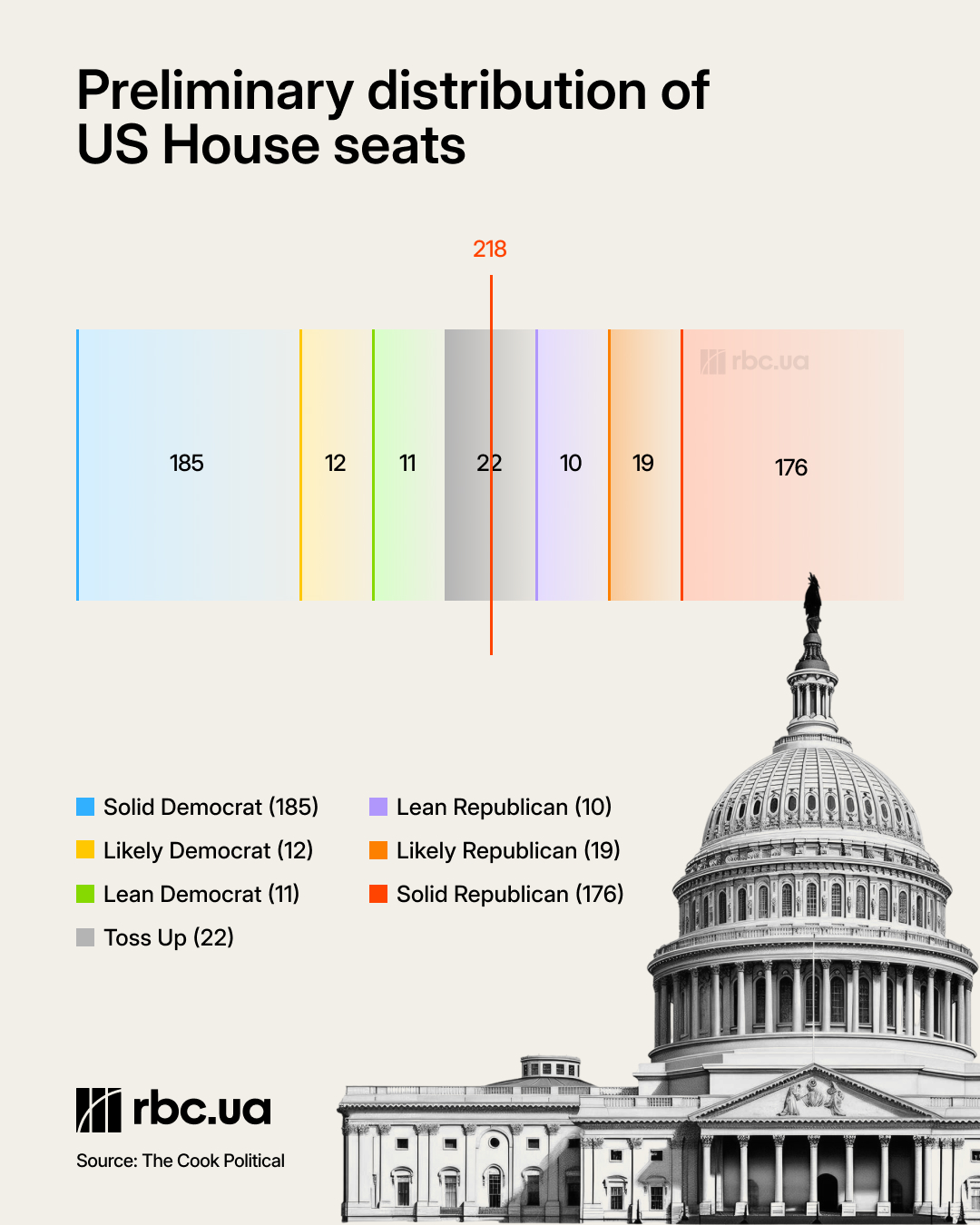 Photo: Projected seat distribution in the US House of Representatives (infographic by RBC-Ukraine)
"The Republicans are most likely to lose the House. But when it comes to the Senate, most of the seats up for reelection will be held by Democrats," explains Oleksandr Kraiev.
Given this, it is possible that the Senate will at least remain evenly split—50-50—but with the tie-breaking vote of Vice President JD Vance, who presides over the Senate by virtue of his office.
At the same time, the situation for Republicans in the Senate is also deteriorating. According to RacetotheWH, the odds that Democrats will win control of the Senate stand at 70.9%. Such a turn of events does not bode well for Trump.
Trump's new problems
Democrats have long promised to launch a new, and now third, impeachment proceeding against Donald Trump should they win the election. All the more so since he himself has already provided a whole series of grounds for this: from insider trading by Trump's inner circle to military actions against Iran not authorized by Congress.
However, the Democrats have other scenarios as well, perhaps more promising ones, since a successful impeachment, after all, requires a two-thirds majority in the Senate, which is nearly impossible to secure, regardless of the election results. So trouble awaits not only Trump but, first and foremost, his team.
"The main thing is that a change in the majority in either one or both chambers will trigger investigations that the Trump administration has not yet faced. And this is a problem for those Cabinet members who wanted to keep everything under wraps—whether it be corruption or simply incompetence," Andrii Dobrianskyi tells RBC-Ukraine.
A telling incident in this regard occurred in mid-September. During a US Senate hearing, FBI Director Kash Patel refused to comment in detail on the fact that the wedding of Trump's son, Donald Jr., was financed by Russian oligarch Umar Kremliov. Following this, Democrats announced they would initiate an official investigation, which could be carried out after the election.
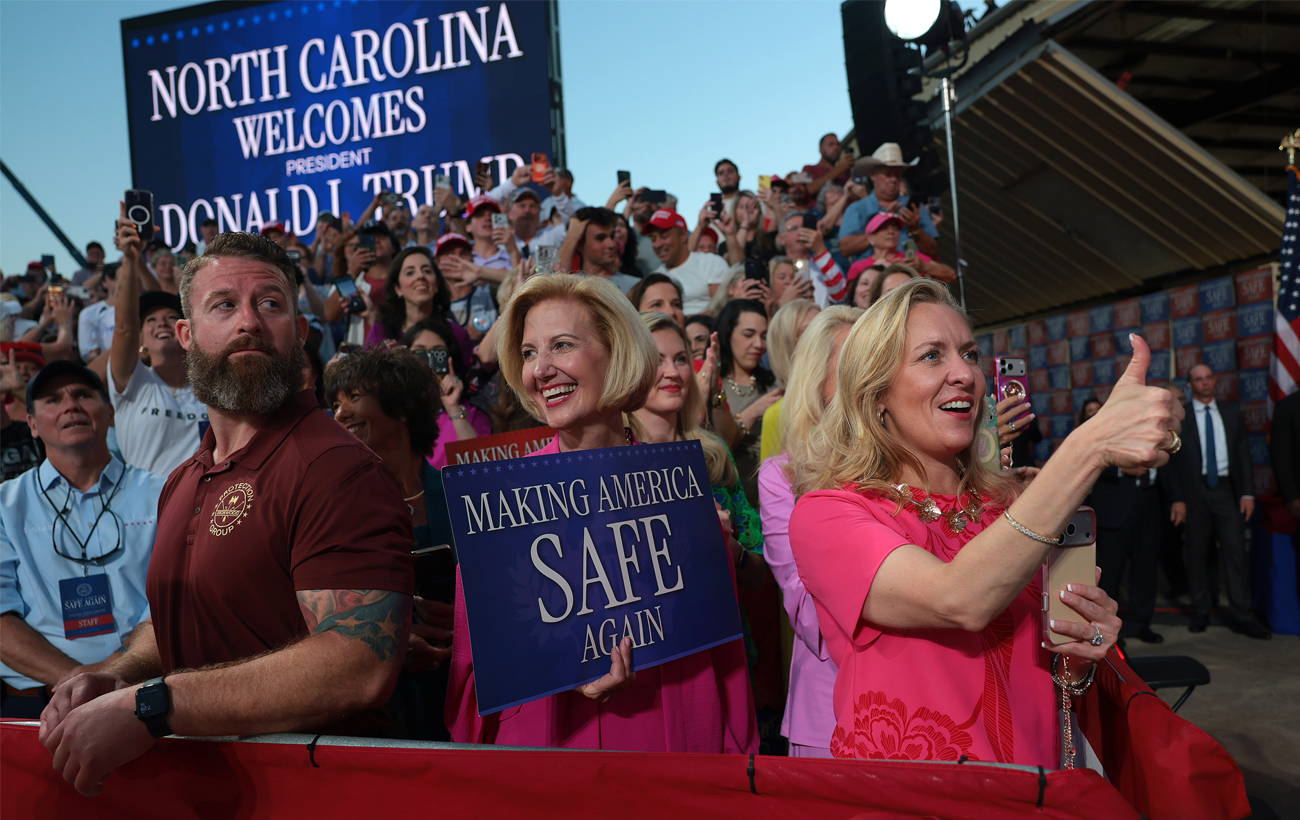 Trump supporters at a rally in North Carolina (photo: Getty Images)
However, under certain conditions, the election results could also bring some benefits to Trump. If the Republicans do manage to retain their majority in the Senate, a divided Congress could, to some extent, actually work in Trump's favor, at least in foreign policy.
"We see that, figuratively speaking, Trump already conducts nearly 90% of his foreign policy not through Congress, but through executive orders. In other words, he doesn't really need Congress for this. On the contrary, a divided Congress, one lacking unity and unable to rally around the idea of a new impeachment, is actually a plus for Trump," Kraiev emphasizes.
But what matters is not only what the US President can do in practice, but also how his capabilities are perceived by counterparts around the world, such as Putin or Xi Jinping. In this context, the Chinese leader's recent visit to the US was telling.
Instead of concrete decisions and agreements, Trump and Xi merely exchanged general statements about the benefits of trade over confrontation. Perhaps the biggest piece of good news for the US President personally was that the Chinese leader gifted the United States two giant pandas.
"From this perspective, it seems to me that Trump, to put it mildly, has fallen short, or, at the very least, is no longer perceived as a significant player with whom one really needs to negotiate. He is already in lame duck status," notes Oleksandr Kraiev.
Among other things, this is one of the reasons why Trump never managed to secure Putin's agreement to an energy truce with Ukraine, even though President Zelenskyy openly supported such an initiative.
Democrats are not what they used to be
Even the best-case scenario for the Democrats, if they win both houses of Congress, does not promise Ukraine a rapid improvement in relations with the US. Although the Democratic Party has consistently promoted support for Ukraine in Congress in recent years, the situation is currently up in the air.
"First, the party is internally divided. Second, we see that a significant portion of Democrats are not ready to support Ukraine as unequivocally as they did before. The example of the Graham-Blumenthal bill was quite telling," says Oleksandr Kraiev.
When the bill on severe sanctions against Russia was first being drafted, Democratic members of Congress supported it wholeheartedly. But as soon as a compromise version entered the home stretch, some of them opposed it, arguing that the bill would give Trump too much power. In the end, it was pushed through anyway.
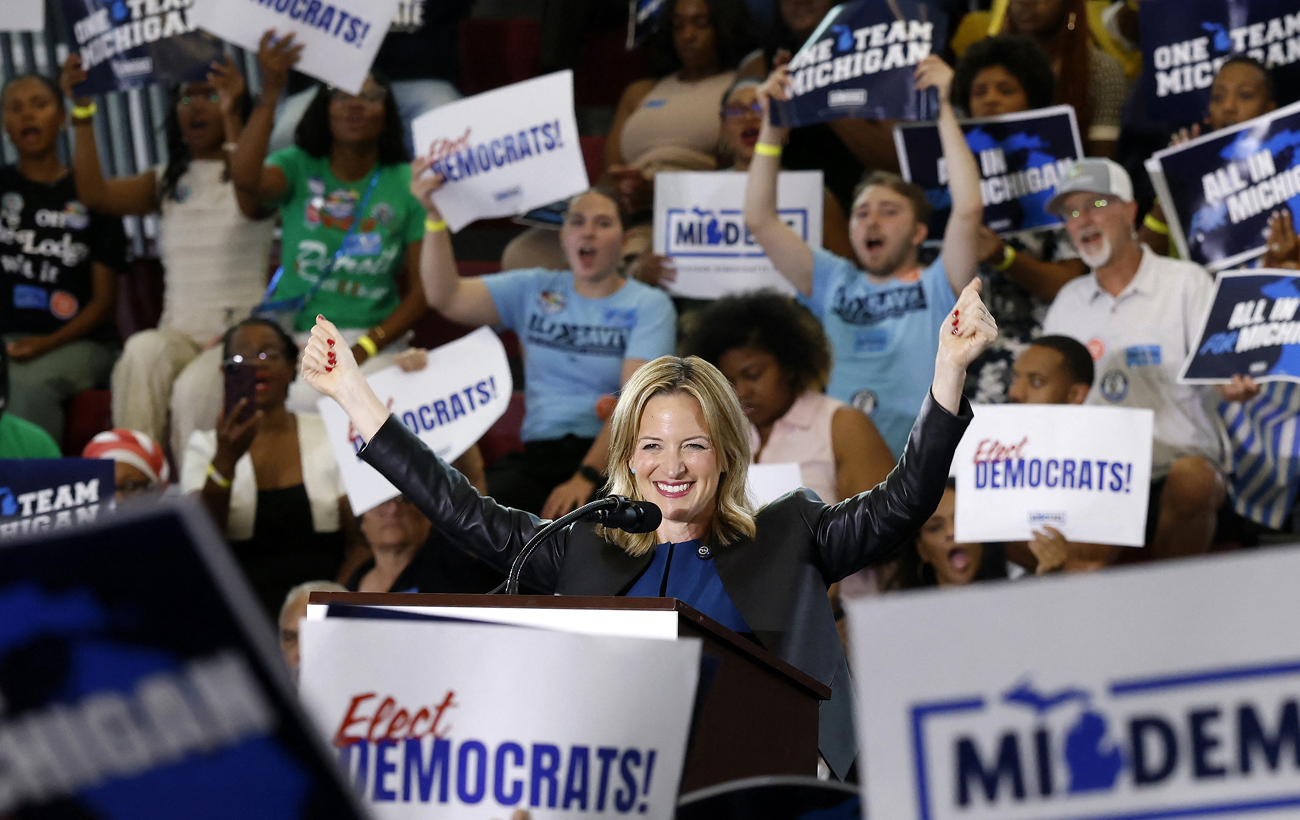 A rally for Democratic candidate Jocelyn Benson in Michigan (photo: Getty Images)
The Democratic Party is not monolithic. In particular, its left wing, the so-called progressives, is gaining influence. This faction within the party brings together socially oriented politicians, such as Bernie Sanders and Alexandria Ocasio-Cortez. Progressives advocate for sweeping domestic reforms, the expansion of social programs, the protection of minority rights, and the fight against climate change.
Volodymyr Dubovyk, director of the Center for International Studies at Odesa National University, does not expect a particularly large influx of people specifically from the radically progressive wing of the Democratic Party. Moreover, he says, not all members of this wing are skeptical about aid to Ukraine.
"Yes, there are some who do, but there are also those who consider Russia's actions unacceptable and, in fact, agree that this is a manifestation of imperialism on Moscow's part, so Ukraine must continue to be supported. The party and caucus leadership has not changed its position on this issue," he says.
According to him, despite the recent vote on the Graham-Blumenthal bill (when a majority of progressives voted against it), the position of the Democratic leadership still carries significant weight for them. At the same time, in Kraiev's view, the problem lies not in their perception of Ukraine, but in their general assessments of US foreign policy.
"For progressives, foreign policy is a terrifying manifestation of American imperialism and a source of fear, which is why they don't want to deal with it at all. For them, it's not just Ukraine; for them, it's Israel, it's issues with China. They simply don't see the prospects or the need to spend money on this that could be directed toward social programs," notes Oleksandr Kriev.
At the same time, according to Dubovyk's assessment, Democrats will continue to criticize Trump at the political level for his insufficient support of Ukraine.
As for the party's left wing, the humanitarian track may be a possible key to dialogue with them.
"The most we can capitalize on here, and what we can realistically use to build some kind of communication, are universal ideas such as the protection of life, the protection of children, and the protection of cultural heritage," adds Oleksandr Kraiev.
At the same time, Andrii Dobrianskyi points out another hidden danger. If the progressive wing of the Democrats tries to nominate its own candidate for Speaker, it could cause prolonged gridlock in the House of Representatives.
In the US, unlike in most other countries, the Speaker has the authority to single-handedly bring bills to a vote or block their consideration. That is why there is constant competition for this position.
This is what happened in the fall of 2023, when the far-right wing of the Republican Party (MAGA) succeeded, for the first time in US history, in ousting their own party's Speaker, Kevin McCarthy. As a result, the work of the House of Representatives came to a complete standstill for an extended period.
"It could be like when the Republicans had a falling-out with Kevin McCarthy, ousted him, and then took six months to elect a new Speaker. The Democrats wouldn't want that to happen, but this is a moment when radical factions can exert the greatest influence," says Andrii Dobrianskyi.
Overall, the current situation demonstrates once again that Ukraine needs systematic cooperation at all levels in its relations with the US, rather than a piecemeal approach or relying on individual figures. It is important for Kyiv to build strong institutional ties with various political forces and factions—from moderate centrists to more radical groups, both among Republicans and Democrats.