Finally peace? Who really won Iran war


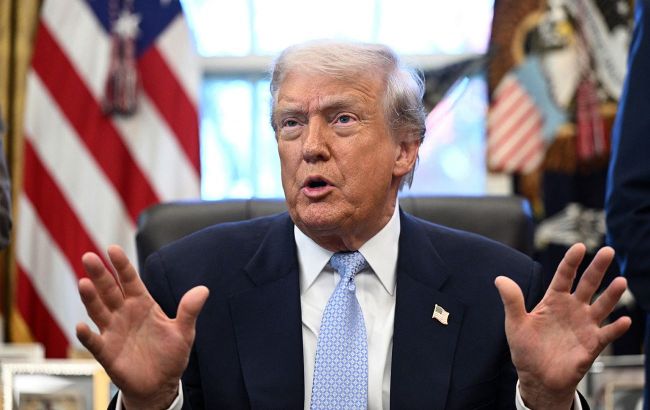 Photo: US President Donald Trump (Getty Images)
After more than a month of war, the United States and Iran have announced a two-week ceasefire. During this period, they are expected to work out a peace agreement.
RBC-Ukraine explains why the fighting has paused and who can actually be considered the winner in the confrontation.
Key points:
Illusion of victory: The US and Iran have declared a two-week truce, while both sides publicly declared victory.
Tehran’s losses: Israel and the US eliminated Iran’s top leadership, including Ayatollah Khamenei, but power has already been taken over by his son Mojtaba.
Asymmetric response: Despite the killing of key leaders, the regime has held, and effective control over the Strait of Hormuz has become a de facto substitute for nuclear weapons.
Stalemate: The US failed to force Tehran to make concessions, while Iran’s new leadership faces internal challenges.
Iran’s incomplete defeat creates risks for Israel, which remains the main advocate for continuing the war.The Israel factor:
The night of Wednesday, April 8, was one of the most tense moments for the world since Donald Trump returned to the White House. After threats to destroy Iranian civilization with strikes on civilian infrastructure and similar responses from Tehran, the US and Iran announced a two-week ceasefire.
Both sides declared victory. "Total and complete victory. 100 percent. No question about it," Trump said.
Iran also claimed success. "We convey glad tidings to the great nation of Iran that nearly all of the war’s objectives have been achieved, and your valiant sons have driven the enemy into a state of historic helplessness and enduring defeat," Iran’s leadership said in a statement obtained by CNN.
Even the United Arab Emirates declared victory. "The UAE triumphed in a war we sincerely sought to avoid, and we prevailed through an epic national defense that safeguarded sovereignty and dignity and protected our achievements in the face of treacherous aggression," presidential adviser Anwar Gargash said.
The reality, however, is more complex. British military theorist Basil Liddell Hart once noted that the aim of war is to achieve a better state of peace — at least from your own perspective. And that is exactly where both sides face problems.
US and Israel’s gains
With Israel’s backing, the United States eliminated much of Iran’s political and military leadership, including Supreme Leader Ayatollah Ali Khamenei. This has led to a loss of expertise, institutional memory, and personal networks across the Middle East.
New leaders, led by the killed leader’s son Mojtaba Khamenei, are now forced to rebuild all of this.
Iran’s military capabilities have also been seriously degraded. However, it is still impossible to fully assess their current state. Bold claims about the destruction of most of Iran’s military capabilities run up against an uncomfortable fact — ballistic missiles and drones are still hitting Israel and Iran’s Arab neighbors.
Another negative consequence for Iran is that Gulf Arab monarchies have abandoned their neutrality after the war. Previously, despite tensions, they maintained contacts with Tehran, providing it with various benefits — from sanctions evasion to hiding assets of its elite.
What matters more is what Israel and the US failed to achieve because it can be counted as gains for Iran.
The advantages of asymmetric warfare
Despite the elimination of its old leadership, Iran’s Islamic Republic regime held firm. Those who replaced the eliminated figures are more radical — something that became evident within just weeks of the conflict’s start.
Moreover, the psychological barrier to war that had still existed among previous leaders has now been fully removed.
Importantly, Iran still retains material for nuclear weapons — more than 440 kg of uranium enriched to 60%. This is slightly below the 90% level considered weapons-grade. Its current location is unknown.
According to US intelligence, the uranium may be buried under the rubble of one of Iran’s nuclear facilities. The United States even developed a special operation to retrieve and remove it, but seems to have dropped the idea.
This uranium was one of the factors that prompted Israel and the United States to launch the war against Iran. But now this material is no longer as essential. Iran has effectively obtained another deterrent — the ability to block the Strait of Hormuz.
Iran needs nuclear weapons to ensure impunity during aggressive actions in other Middle Eastern countries. Now, to some extent, that impunity can be provided by the blockade of the Strait of Hormuz. Previously, this threat was largely theoretical, but now it has become very real.
In turn, the United States and its partners still have not found a way to reopen the strait without excessive escalation and significant resources.
End or continuation
Both sides have reached a deadlock, according to Oleksii Melnyk, co-director of foreign policy and international security programs at the Razumkov Centre.
"Trump, clearly, has not achieved what he intended to achieve. Domestic opposition to the war is growing within the United States, along with dissatisfaction among virtually all allies. Naturally, this creates a climate that is not conducive to continuing the war," he said.
Iran’s new leadership is more radical, but certainly not suicidal. "Despite all the bold statements and trolling, which the Iranians do very skillfully, they do not want to see the country pushed back into the Stone Age if bridges and power plants start being destroyed. And again, any serious deterioration of the internal situation would also pose a threat to the regime," Melnyk added.
In his view, from the proposals that have been publicly voiced, it is possible to construct a framework that would allow each side to declare success to its domestic audience, regardless of the actual substance.
Iran has presented the United States with a 10-point proposal, claiming that Trump has accepted it. Among other things, it includes reopening the Strait of Hormuz, full compensation to Iran for reconstruction costs, a commitment to lifting sanctions, and the unfreezing of Iranian funds and assets.
At the same time, the proposals also include maintaining Iran’s control over the Strait of Hormuz, recognizing Iran’s right to enrich uranium, and terminating all UN Security Council and IAEA resolutions.
"If both sides are willing to make compromises, then we can conclude that the active phase of hostilities will not resume," Melnyk stressed.
At least publicly, such signals are already coming from the United States. Trump said he would work closely with Iran’s new leadership.
The situation is further complicated by the position of US allies. While Gulf Arab monarchies support ending the war, the situation is very different when it comes to Israel.
According to several US media outlets, the Israeli Prime Minister was the main lobbyist for launching the war and ultimately persuaded Trump by promising a quick victory. Iran’s incomplete defeat, without a change in the ruling regime, creates long-term risks for Israel.
In essence, the situation is repeating last year’s scenario after the 12-day war. At that time, Israel unilaterally attacked Iran in an attempt to destroy its nuclear program. That goal was not achieved, even though the United States joined the war at the final stage. As a result, Israel and the US had to launch the current war.
Now the cycle is repeating. But the problem is that with each round, Iran becomes more aggressive (though still weakened), while the US shows less willingness to join new operations pushed by Israel.
Quick Q&A
– Who won the 2026 war between the United States and Iran?
– Officially, both sides declared victory, but there is no clear winner. The US eliminated the regime’s top leadership, while Iran retained control over critical infrastructure and drained allied resources, forcing them to agree to a ceasefire.
– What conditions did Iran set for ending hostilities?
– Tehran is demanding the implementation of a 10-point plan, with key demands including the unfreezing of all assets in the US and full financial compensation for the damage. Iran also insists on formal recognition of its right to enrich uranium.
– What will happen to the Strait of Hormuz after the ceasefire?
– For now, the strait remains under Iran’s effective control, which it uses as a deterrent instead of nuclear weapons. The US and its partners have not found a way to reopen this maritime route without risking global escalation.
– Why could the war in the Middle East resume soon?
– The main risk lies in divisions among allies: Israel sees the ceasefire as an incomplete defeat of Iran and is pushing for continued strikes until regime change. At the same time, domestic opposition to the war is rapidly growing in the US, while Donald Trump has failed to achieve his objectives, creating a political deadlock and raising the risk that Israel could launch a new attack on its own.