Noose tightens on Trump: How Iran war became sudden disaster for US


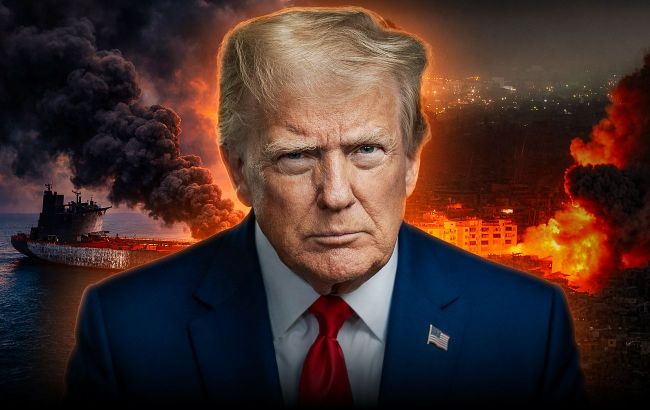 Donald Trump (collage: RBC-Ukraine)
The US has found itself in a strategic deadlock: despite thousands of strikes, Iran has blocked 20% of global oil, while internal divisions in White House are growing ahead of autumn elections.
How the war against Iran has created a series of new problems for Trump, whether he can solve them, and what this means for Ukraine – read in the RBC-Ukraine article.
Key points:
- Strategic trap: US and Israel strike thousands of targets, but the regime in Tehran is not falling, only becoming more radicalized, with uranium reserves enough for 10–11 nuclear warheads.
- Economic noose: Iran has imposed a partial blockade of the Strait of Hormuz, through which 20% of global oil and 30% of fertilizers pass.
- Blow to allies: Arab monarchies are losing the status of a haven, while US military bases in the Middle East cannot fully protect them.
- Crisis in the US: Trump's rating has fallen, and prices are rising. Behind-the-scenes struggle continues in White House between hawks and isolationists.
- Search for exit: Due to a weak position, Trump may look for victory in other directions or increase pressure on Ukraine for a quick peace.
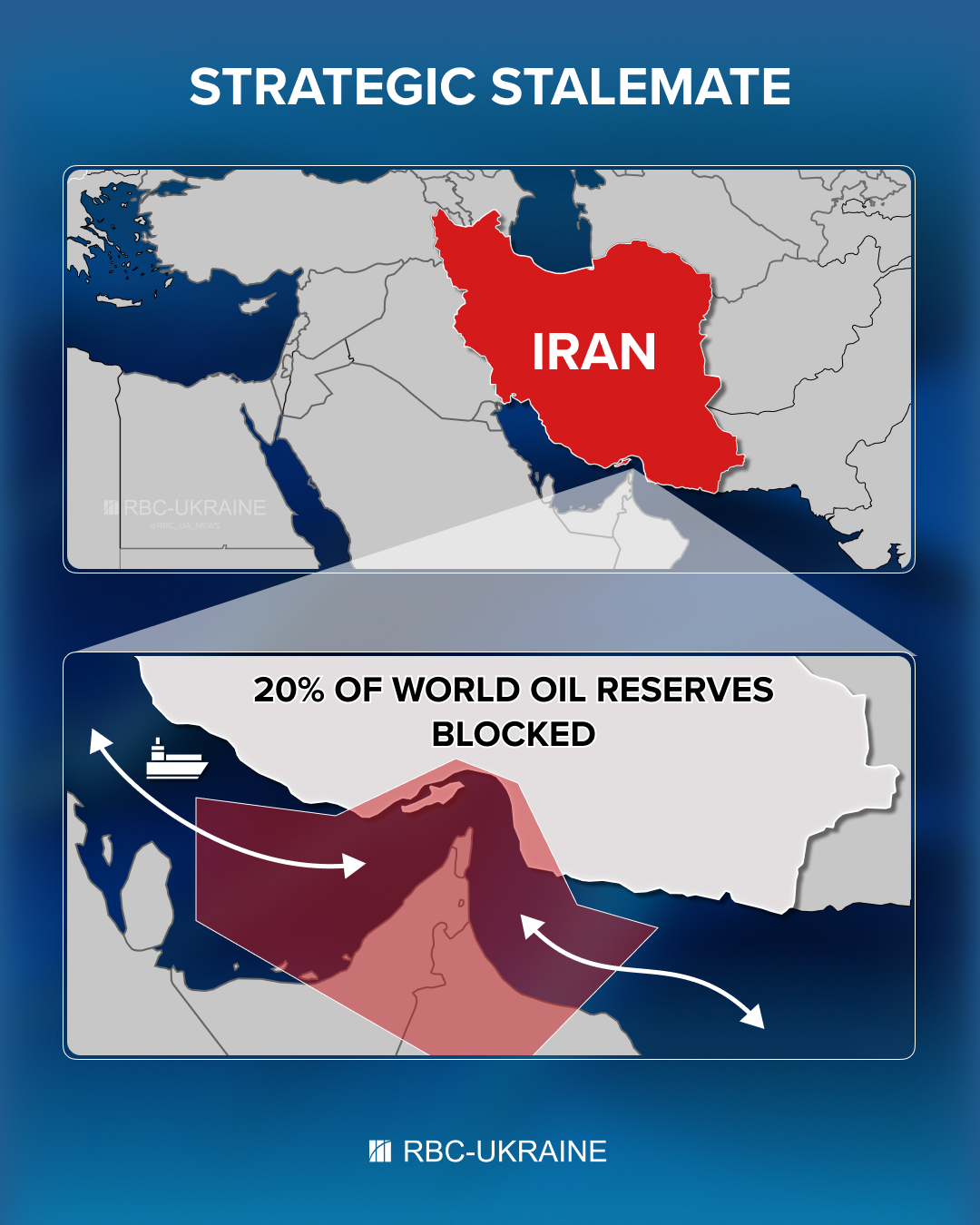 US still cannot unblock Strait of Hormuz (infographic: RBC-Ukraine)
"It's a little unfair. You win a war, but they have no right to be doing what they're doing," – these words of the US president are the most vivid illustration of the situation unfolding around Iran.
The fourth week of war between the US and Israel against Iran is underway. The number of targets hit has already reached tens of thousands, at least according to the US military. However, the Islamist regime in Iran is not collapsing. Moreover, it continues to respond aggressively, attacking critical facilities across the region.
Trump's statements yesterday about the alleged start of peace negotiations with Iran rather indicate that he is trying to quickly exit the war. Earlier, the US president spoke about the complete defeat of the Ayatollah regime and its rapid collapse. Judging by official statements, this is how the Iranian leadership also perceives it.
"The battle continues… and another defeat for the devil. Trump and the United States have once again been defeated," said spokesperson of Iran's Commission on National Security and Foreign Policy Ebrahim Rezaei.
In reality, things are not so good for Tehran. But the US also cannot achieve an acceptable result. It is about a strategic trap for the US, believes the director of the Center for Middle Eastern Studies, Igor Semyvolos. Pressure has not broken the Iranian system of power – it has radicalized it. This is a classic effect of hardening of the opponent.
The problem of enriched uranium in Iran's possession has not disappeared. According to various data, Tehran has about 440 kilograms, from which 10–11 warheads can be produced. Without resolving this issue, any freezing of conflict will be only temporary.
To all this, Trump for now responds that if the US stops military operations now, Iran will need 10 years to recover. And the US is not yet ready to leave, but "we'll be leaving in the near future."
Against this background, negotiations with Iran announced by Trump, even if they temporarily stop the conflict, will not solve the problems of the US president. And he has accumulated many of them due to the war.
Captive of illusions
During planning, the Pentagon and the National Security Council significantly underestimated Iran's readiness to close the Strait of Hormuz in response to a US operation, CNN reports, citing several sources familiar with the matter.
Trump's national security team did not fully take into account the potential consequences of what some US officials called the worst-case scenario that the administration is now facing.
According to The New York Times, in the first days of the war, the US and Israel were counting on an internal uprising in Iran, which was expected to erupt after the elimination of the ruling elite. After that, the war was supposed to end quickly.
The timing of the start of the war also points to this. The first strike on Iran was carried out on Saturday morning, when markets are closed. Thus, the US and Israel had time until Monday to finish everything without a significant rise in oil prices, as was the case with Venezuela. But Iran's resilience was clearly underestimated.
"This happened because the administration is incompetent, dismissive of planning, and superficial in its actions. Improvisation occurred, in particular because Trump was encouraged by success in Venezuela," said Volodymyr Dubovyk, director of the Center for International Studies at Odesa National University, in a comment to RBC-Ukraine.
According to him, Trump does not see a difference between the contexts of Venezuela and Iran. And there are no people around him who could offer an alternative point of view, because everywhere there are only those who say yes.
All other problems Trump faces in the context of Iran stem from this inadequate perception of reality.
Hormuz dilemma
The biggest challenge now is that Iran has imposed a partial blockade of the Strait of Hormuz. Through it passes 20% of global oil consumption and more than 30% of gas.
In addition to hydrocarbons, about 30% of nitrogen fertilizers come from region – and this is already a potential blow to global food security.
This is the key problem, first of all, for the economies of Western countries. Iran allows its own tankers heading to China and India to pass, and these countries suffer mainly from high prices.
At the same time, tankers heading to other destinations risk being attacked at any moment. The worst part is that it is unclear how long this can last.
"First of all, this is ongoing uncertainty. If you listen to Donald Trump, it is hard to understand: one day he says everyone has been 'defeated', and the next day he asks for help in this war," said Ivan Us, expert at the National Institute for Strategic Studies, in a comment to the outlet.
As Trump stated, most NATO allies have informed the US that they do not intend to join the operation to escort oil tankers in the Persian Gulf. Only the United Arab Emirates clearly supported the initiative.
At the same time, it is difficult for the US to organize escort operations on its own. Even a successful escort would restore only 10% of pre-war traffic, would require weeks of preparation, constant air cover, and significant resources, Stratfor notes.
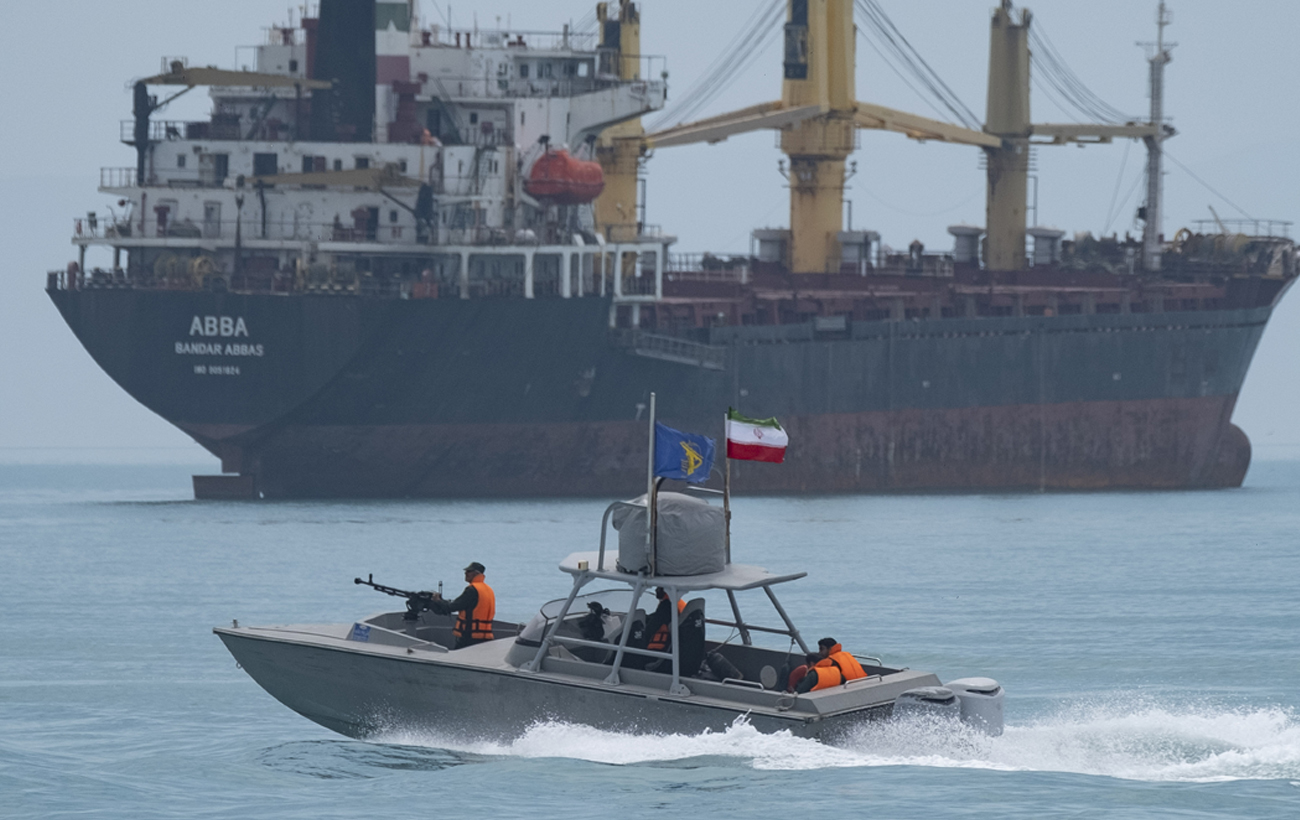
Iranian military next to tanker in Strait of Hormuz (photo: Getty Images)
According to estimates by the Center for Strategic and International Studies, the cost of such an operation may amount to about 15 million dollars just to maintain vessels in the region. Moreover, it will likely be necessary to take control of part of Iran's territory. And this means potential losses among the US military.
At the same time, risks for American vessels remain extremely high – Iran still retains the capability to attack the US fleet by various means.
Therefore, for now, Trump can only threaten Iran. Over the weekend, he stated that he would strike Iran's power plants if it did not stop blocking the Strait. However, later, Trump canceled the strike, citing negotiations.
Allies brace for impact
Whatever Trump does next, his allies in the Persian Gulf among Arab monarchies – Saudi Arabia, United Arab Emirates, Kuwait, Qatar, Bahrain, and Oman – are currently suffering the biggest losses.
In just the past week, Iranian strikes hit one of the world's largest liquefied natural gas complexes in Ras Laffan, the SAMREF oil refinery in Yanbu port, and the UAE oil port of Fujairah.
Loss of revenue from hydrocarbon exports is only one problem. Gulf Arab monarchies have spent decades building an image of a tourist hub and haven for international financial flows.
Now this narrative is collapsing with each Iranian strike. Importantly, even US military bases no longer provide full protection. As early as March 12, The New York Times, based on satellite images, identified at least 17 damaged US facilities and other structures in the Middle East.
Although US air defense systems manage to intercept more than 90% of drones and missiles, the psychological effect is more important here.
For now, they are trying to close gaps in their own air defense with the help of Ukraine and other partners. But a strategic solution to this problem still has to be found. Nevertheless, several conclusions are already emerging for US allies in the region.
First: All agreements with Iran are not worth the paper they are written on. Despite attempts by Gulf states to maintain neutral relations with Tehran, this did not save them from attacks.
Second: It is necessary to build export routes bypassing the Persian Gulf. Such projects had been prepared for a long time, partly even implemented in practice, and now they will accelerate.
Finally, third: US security guarantees are also largely ineffective. As this war has shown, America is not ready for modern warfare against an opponent ready to act with asymmetric methods. Moreover, there is no guarantee that Trump will not simply abandon his allies for the sake of ratings.
How this works now can be clearly seen in the example of another US ally in the region.
Challenges for Israel
The war against Iran has brought US and Israeli leaders even closer than before. Benjamin Netanyahu and Donald Trump hold phone calls almost daily.
However, it is obvious that as the war drags on, the goals of both states are increasingly diverging. Three of Trump's advisers told Axios that, in their opinion, he will want to end the operation earlier than Israeli Prime Minister Benjamin Netanyahu.
According to Ynet, Washington has set April 9 as the desired date. Ending the war by this date could allow Trump to visit Israel on Independence Day to receive the Israel Prize. All this creates direct risks for the future.
"In the Israeli General Staff, this scenario is being fully considered, and they understand there is a window of opportunity that can close at any moment. Therefore, they are adapting their military plans in terms of targets and objectives," said diplomat and former Israeli ambassador to Russia Arkady Mil-Man in a comment to RBC-Ukraine.
According to him, the goal is to inflict maximum damage on Iran so that it will "lick its wounds" for a long time. This should give Israel time to prepare for the next round.
"If this regime is not finished off, there will still be a next round. Because the psychological barrier of war has already been overcome," he said.
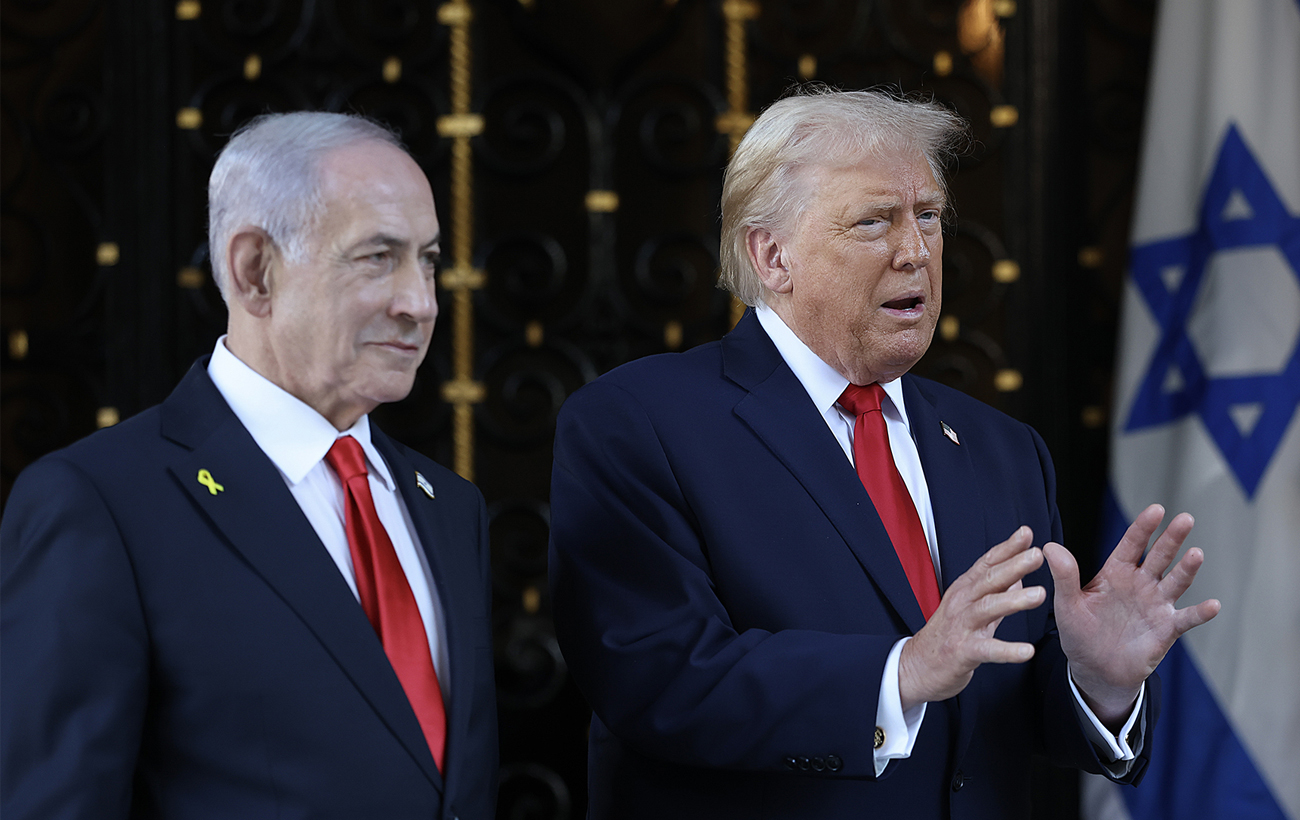 Donald Trump and Benjamin Netanyahu (photo: Getty Images)
Differences in the approaches of the US and Israel are already visible in the skies over Iran. While the US strikes mainly military targets, Israel also targets the Iranian leadership and takes other steps that may create a basis for regime change.
If this crisis in relations with US allies in the Middle East deepens, consequences for Trump will be quite practical: from a possible reduction of investments in the US to a decrease in the number of military bases.
Ultimately, it should not be forgotten that Gulf monarchies previously invested heavily in companies of the Trump family. And even more so, the US president may forget about expensive gifts such as a personal aircraft worth 400 million dollars.
Domestic problems
According to an Economist/YouGov poll, 37% of Americans fully or partially approve of Trump's performance, while 56% do not approve.
War with Iran has undoubtedly played its role. It is supported by 36% of Americans, while 56% do not support it. The situation is similar for a number of other issues relevant to the US.
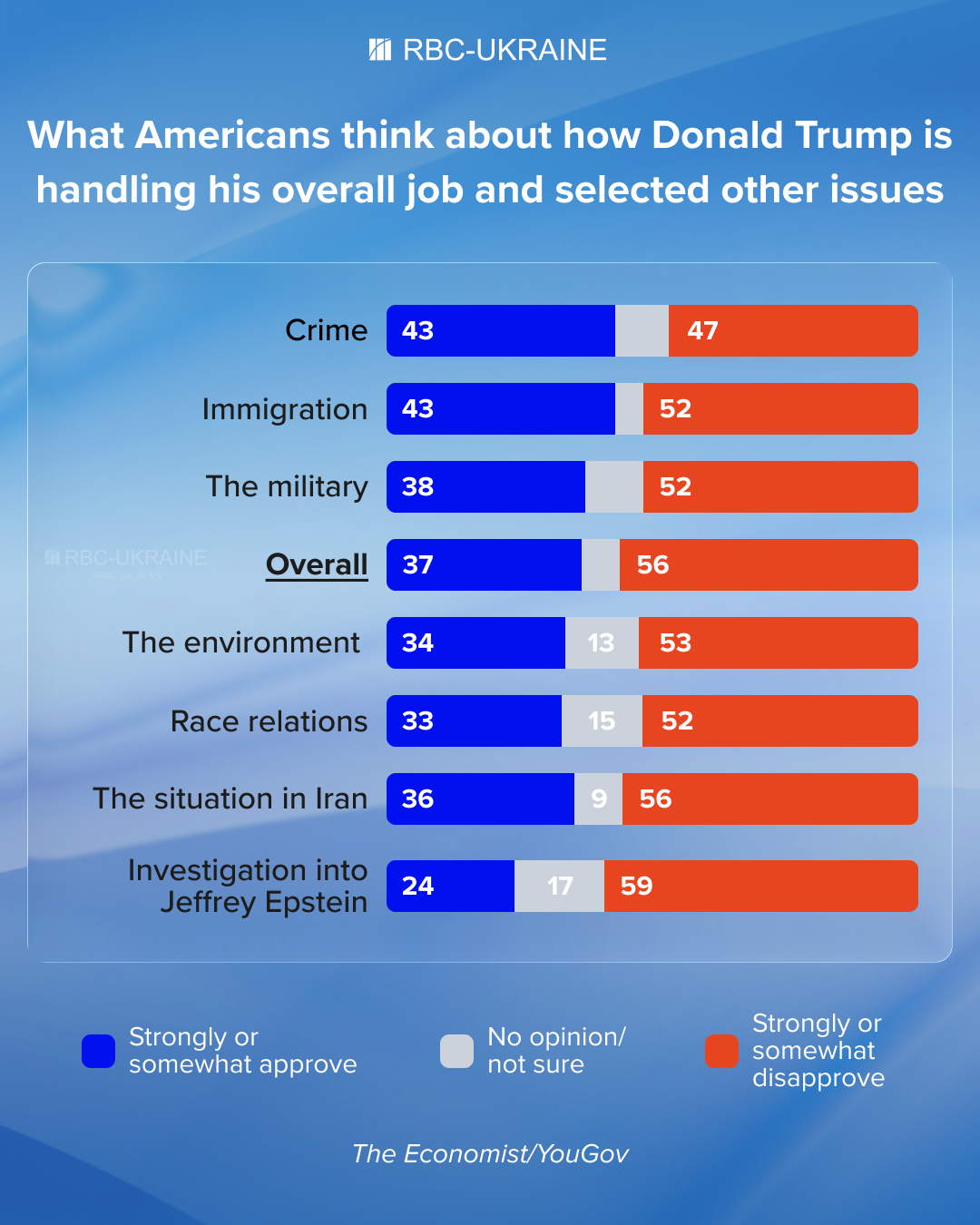 Most of Trump's actions divide Americans into two camps (infographic: RBC-Ukraine)
"Now the state budget is spending money on military operations. Then global oil prices are rising, and there is a direct connection with fuel prices in the US," Ivan Us highlighted key factors in a comment to the outlet.
For example, diesel prices in the US have jumped by 40% and, for the first time since 2022, exceeded 5 dollars per gallon. Most transportation in America is by road, so this will inevitably affect the cost of consumer goods for ordinary Americans.
According to polls, war is currently supported by Republican voters. At the same time, they want a quick victory and are strongly against sending ground troops to Iran.
Opposition Democrats, of course, are sharply critical. But the key point is that support for war is very low among so-called independents, who do not associate themselves with any party.
Such unfavorable dynamics for Trump may worsen depending on the duration of the war. In the longer term, this means problems in Congressional elections to be held in November this year.
Against this background, a behind-the-scenes struggle is unfolding in White House between isolationists and hawks.
The former are represented by US Vice President JD Vance. As Politico reports, he opposed war with Iran at the discussion stage, but remains a team player. Hawks are rallying around US Defense Secretary Pete Hegseth.
Both camps have supporters in the state apparatus, the media, and among millionaire bloggers. For example, controversial TV host Tucker Carlson has spoken out strongly against war.
This is already affecting the functioning of the state machine. Recently, the director of the US National Counterterrorism Center, Joe Kent, a retired Green Beret who served 20 years in the US Army, resigned in scandal. This is most illustrative, but far from the only case.
In his resignation letter addressed to Trump, Kent stated that he cannot, in good conscience, support the ongoing war in Iran.
"Iran posed no imminent threat to our nation, and it is clear that we started this war due to pressure from Israel and its powerful American lobby," Kent wrote.
At the same time, opposition to the face of Democrats has not disappeared. If earlier, Trump was mainly criticized in Congress by opposition Democrats, with the start of the war in Iran, voices of moderate Republicans have also begun to sound loudly.
How Trump may respond
"Now it seems that Trump has driven himself into a dead end. From a foreign policy perspective, it is unclear what he should do – new adventures or, on the contrary, reduce activity to a minimum," Volodymyr Dubovyk noted in a comment to the outlet.
If Trump chooses the idea of showing some kind of victory elsewhere, he has several directions, Ivan Us said.
First of all, this is Cuba. After success in Venezuela, Trump openly says that this country will be next. But there are still many risks here, in particular regarding the readiness of Cuban authorities to put up serious resistance.
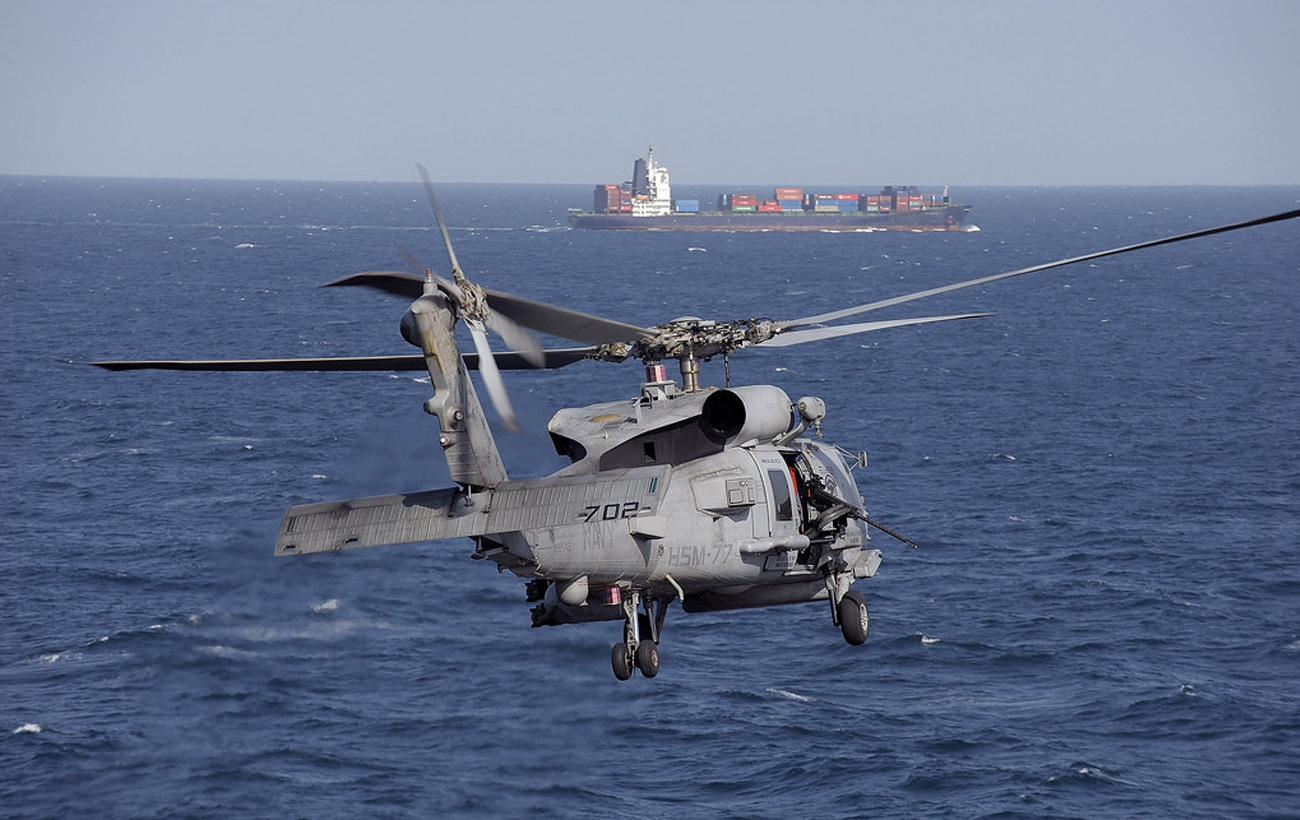 US helicopter in Persian Gulf area (photo: Getty Images)
As for Ukraine, the main concern is pressure from the US on Kyiv in the context of peace negotiations. However, President Zelenskyy has shown that he is able to resist Trump's pressure. Moreover, the situation on the front is clearly not in Russia's favor.
"I do not think there can be any new initiatives in our direction. There may be even more pressure on Ukrainian leadership to agree to Russian territorial demands. But even this now looks unpromising," Volodymyr Dubovyk emphasized.
At the same time, Arkady Mil-Man points out that the US first needs to free up resources for this.
"Such a scenario is quite possible, but not in the coming weeks. They (US – ed.) are not capable of acting on two fronts right now in terms of attention. Those who make decisions in the US are now fully focused on Iran," Mil-Man said.
Another direction is agreements with China. After a series of trade wars between the US and the rest of the world, Beijing was the only one that did not make concessions.
A meeting between Trump and Chinese leader Xi Jinping was planned for the end of March this year, but it was postponed. The US president is now in too weak a position to expect success.
"It seems to me that China and others are already starting to think that they should wait until November, when elections may lead to changes in the US. And then Trump will definitely have no time for foreign policy, because he will need to preserve his position and avoid a third impeachment," Ivan Us said.
In any case, the coming months will be among the most difficult for Trump across both of his presidential terms. On one hand, this may make him even more unpredictable. On the other hand, there is a chance that Trump will put less pressure and issue fewer threats toward his own allies.
Quick Q&A
– Why did the US and Israel's strategy not lead to the collapse of the regime in Tehran?
– Instead of internal collapse, large-scale military pressure only radicalized the Iranian system of power, creating the effect of hardening the opponent. Despite significant losses, the regime retains the ability to attack neighboring countries and maintains control over 440 kg of enriched uranium, enough to produce 10–11 nuclear warheads.
– How did war affect Donald Trump's ratings in the US?
– According to polls, only 37% of Americans approve of the president's performance, while 56% oppose war with Iran. Dissatisfaction must be observed among independent voters, which creates serious risks for Republicans ahead of Congressional elections in November 2026.
– Why do Gulf Arab monarchies no longer consider the US a reliable security guarantor?
– Despite the work of US air defense systems, Iranian attacks have already damaged at least 17 US facilities in the region and hit the real estate market in the UAE. This leads allies to the conclusion that America is not ready for asymmetric warfare, and agreements with Tehran do not guarantee protection from strikes.
– Can Trump increase pressure on Ukraine due to failures in the Middle East?
– There is a risk that, due to a weak position in conflict with Iran, Trump will look for a quick victory in other directions, including by pressuring Kyiv for territorial concessions to Russia. However, for now, resources and attention of White House are fully focused on Iran, which limits Washington's ability to act on two fronts simultaneously.