Why the Strait of Hormuz matters and how Iran's blockade threats sent oil prices soaring

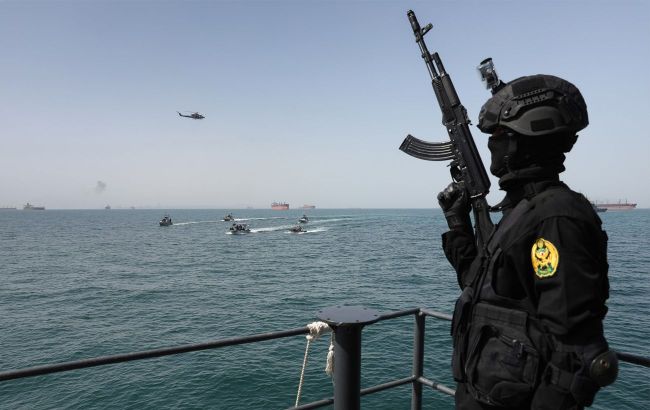 Joint exercises of Iranian and Russian navies in Strait of Hormuz before war (photo: Getty Images)
Iran threatens not to allow a single liter of oil through the Strait of Hormuz, and the US, in response, promises unprecedented consequences for Tehran.
RBC-Ukraine explains the importance of the Strait of Hormuz and how the US and allies plan to counter Iran.
Key points:
- International reaction: Europe is preparing a military mission to protect shipping, while China is trying to negotiate with Tehran for separate security guarantees for its tankers.
- Price swings: Against the backdrop of conflict, the oil price jumped to 120 dollars per barrel, but after White House statements about the quick end of the war fell to 92 dollars. However, it remains very unstable.
- Trump's ultimatum: US President promised to strike "twenty times harder" if Tehran does not stop mining waters and unblock tanker movement.
- Mining tactics: Due to the destruction of aviation and fleet, the Islamic Revolutionary Guard Corps is likely using naval mines (stockpile from 2 to 6 thousand units) as the main deterrence tool.
- Threat of energy collapse: Iran is trying to block the Strait of Hormuz – a key artery through which 30% of global oil trade and more than 25% of liquefied gas pass.
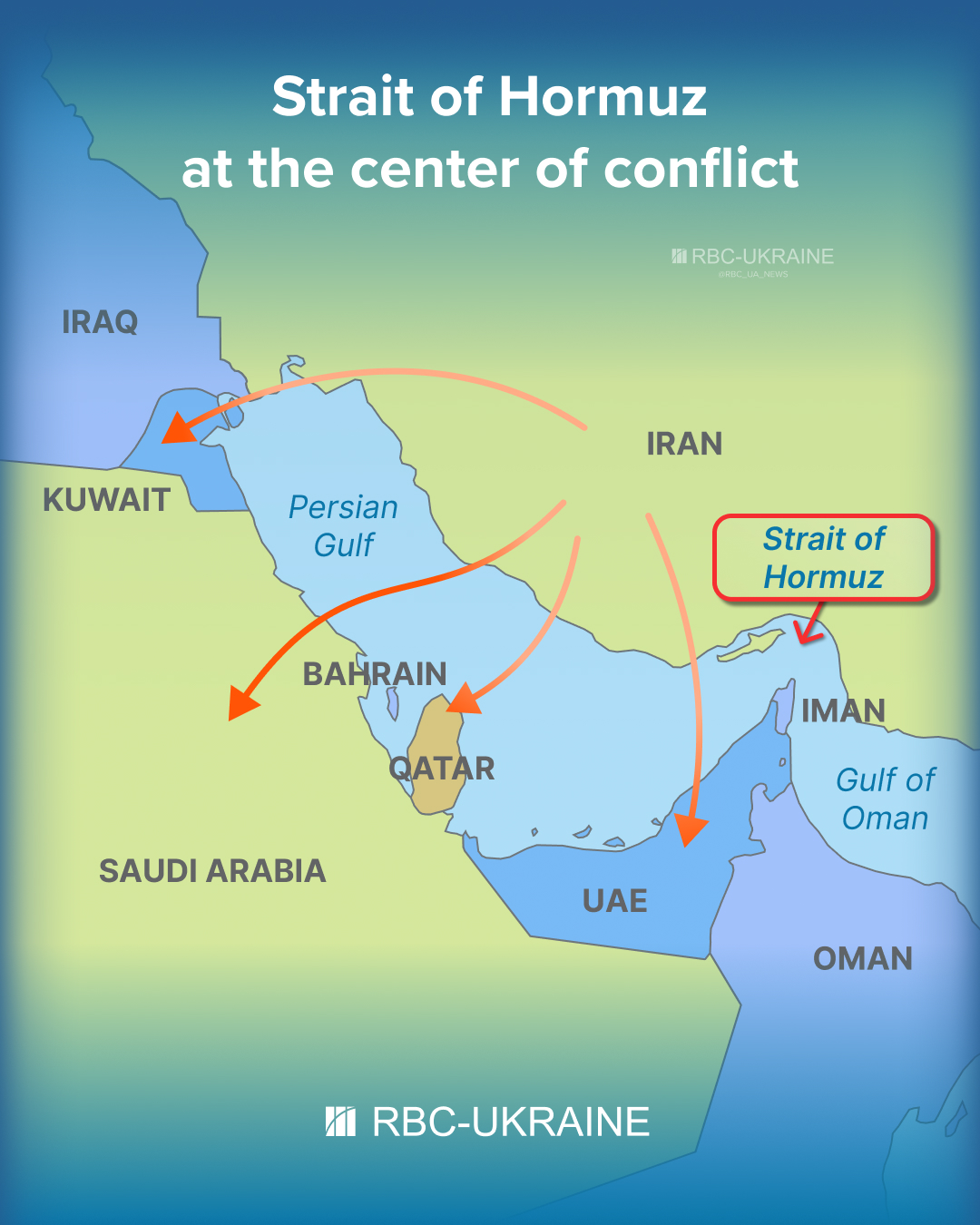
Map of the Persian Gulf, Strait of Hormuz, and directions of Iranian strikes (photo: RBC-Ukraine infographic)
"They will be hit by the United States of America twenty times harder" – this is how the President of the United States, Donald Trump, reacted to Iranian attempts to block oil transport through the Strait of Hormuz.
The American-Israeli operation in Iran has already been ongoing for more than a week. Neighboring Arab countries are suffering from Iranian retaliatory strikes, and together with this, the global energy market is also suffering. Oil and gas prices are going up, pulling price increases for other goods around the world.
But the potential for escalation has not yet been exhausted. Because in addition to the oil and gas infrastructure of neighboring countries, an important transport artery is also within Iran's sights – the Strait of Hormuz.
Importance of Strait
The Strait of Hormuz, more than 50 kilometers wide at its narrowest point, is a waterway that connects the Persian Gulf with the Gulf of Oman and further exit to the Indian Ocean. It is the main transport artery for the Arab monarchies, Iraq, and Iran.
About one-third of the global oil trade and more than a quarter of the liquefied gas trade pass through the Strait. Monthly traffic is about 3000 vessels.
All the above-mentioned countries, except Oman and Saudi Arabia, have no alternative trade routes. This makes the Strait of Hormuz vital not only for the economies of Middle Eastern countries, but also for the energy security of almost the entire world.
On March 3, 2026, reports appeared that the Islamic Revolutionary Guard Corps had blocked the Strait for tankers.
Similar situations have happened before. Iran threatened to block the Strait during every conflict with Israel or the United States, for example, last summer. However, the current blockade may have much larger consequences.
Is Iran capable of blocking the Strait?
Iran's real ability to block the Strait remains in question. Iranian naval and air forces were practically destroyed by American-Israeli strikes, and capabilities for missile launches have also significantly decreased. Iran has a limited number of tools at its disposal.
One of the most widespread means that Iran can use to blockade the Strait is naval mines. According to approximate estimates, Tehran may have from 2 to 6 thousand naval mines at its disposal. Sources of CBS News among American officials have already said that Iranians have begun to act.
"If Iran has put out any mines in the Hormuz Strait, and we have no reports of them doing so, we want them removed, immediately," Trump wrote yesterday on social network Truth Social.
Mining may also be a major problem because mines will pose a threat even after the end of the conflict. Elimination of mine barriers will require time and effort, which will slow restoration of normal shipping.
There is currently no specific data about mining or any other actions aimed at blocking the strait. Only vessels known to have been affected are tankers of the Iranian shadow fleet.
Iranians themselves likely blew them up to intimidate. However, large maritime insurance companies have already reacted.
According to CBS News, last week, NorthStandard, London Club private insurance club, and American Club warned that they would suspend insurance coverage for vessels operating in Iranian waters and parts of the Persian Gulf, citing the growing risk of ships becoming involved in conflict.
Global consequences
The main consequence of the blockade of the Strait is already visible even at Ukrainian gas stations due to rising prices.
Expecting the blockade to be prolonged, traders reacted with a significant increase in prices for oil products. Prices for crude oil, which had been trading around 60 dollars a few days before the start of the military operation, jumped above 100 dollars per barrel. At peak, the price reached 120 dollars.
On Tuesday, the price sharply fell to 92 dollars after President of the United States Donald Trump said that the war in Iran will end "very soon."
Despite the drop, the price remains significantly higher than the pre-war level. Recent statements of the President of the United States somewhat calmed markets, but it is still too early to relax.
Alberto Bellorin, founder and managing director of investment company InterCapital Energy, said in a conversation with the BBC that energy markets remain in a state of "total tug-of-war." According to him, the oil trade will "remain incredibly twitchy," and prices will rise sharply again if conflict escalates.
Problems in the energy sector may also spread to interconnected markets. The United Nations Conference on Trade and Development says there is a threat of economic shocks in developing countries. However, developed countries such as Australia and the People's Republic of China are also at risk.
In addition, it is not only about oil and gas, but also about other raw materials. For example, due to problems in the Strait of Hormuz, there is also a shortage of sulfur on the market, and it is used in metallurgy, the chemical industry, and so on.
How the world responds to the threat of a Strait blockade
On March 6, the United States promised to compensate insurance risk payments for all vessels that continue trade through the strait. However, this did not lead to a significant increase in shipping activity, so in recent days, mostly threats have been coming from the US.
To Trump's promises to deliver a strike "twenty times harder," Iran responded rather boldly, promising not to target tankers of countries that break ties with the United States and Israel.
European states, which initially remained neutral in the operation against Iran, are now considering expanding their military presence in the Middle East to protect shipping. This was stated in particular on Monday by French President Emmanuel Macron while aboard the aircraft carrier Charles de Gaulle. According to him, France and its allies are preparing a defensive mission to restore shipping in the Strait of Hormuz.
What European mission may include is currently unknown. However, European countries could likely take on the role of escorting ships and clearing naval mines. The United States had earlier declared readiness to send a fleet to escort commercial vessels, but this did not produce a visible effect on traffic through the strait.
China, which is highly dependent on Middle Eastern oil, is trying to reach an agreement with Iran on the security of its vessels. There is no exact information about possible agreements, but it is known that some tankers are trying to reduce risks by raising the Chinese flag.
Some vessels are also passing through the strait by turning off transponders and hiding their routes of movement. As during the Tanker War of the 1980s (during the war between Iran and Iraq), military risks do not stop some companies from chasing profits.
Despite everything, shipping in the Strait has not completely stopped yet. However, each additional risk affects its volumes and operational costs. This, in turn, affects prices and market stability.
Uncertain prospects
The second week of operation, Epic Fury is coming to an end, and its consequences have already become global. Oil markets are feverish due to unpredictability and risks. Against this background, politicians are trying to find a solution. The spectrum of proposals ranges from escorting tankers by naval forces to lifting part of the sanctions imposed on Russia.
Iran realizes that the blockade of the Strait of Hormuz is one of the most effective levers of pressure, but it will seek to maintain the threat for as long as possible. Breaking the blockade will require time and additional resources. At the same time, prospects for the end of the war, despite Trump's statements, still look extremely uncertain.
Quick Q&A
– Why is the Strait of Hormuz so important?
– It is the only sea route from the Persian Gulf to the ocean. For most Arab countries and Iraq, it is an oil-export-free route for oil exports. About 3000 vessels pass through it every month.
– How can Iran block movement if its fleet is destroyed?
– The main instrument has become naval mines. They are difficult to detect, and the mine-clearing process can last months even after the end of hostilities. Iran also uses intimidation by attacking its own shadow fleet tankers.
– How does conflict affect fuel prices?
– The global rise in oil prices has already affected energy prices. Despite the recent fall in prices on exchanges, the market remains unstable, and fuel prices directly depend on the intensity of fighting.
– Are tankers protected by military forces?
– The United States promised to compensate for insurance risks and offered an escort. However, insurance companies are still massively suspending coverage. France and other European countries are considering the possibility of conducting a defensive mission with their naval forces.