World's ballistic missile club: Can Ukraine join exclusive ranks of missile powers?


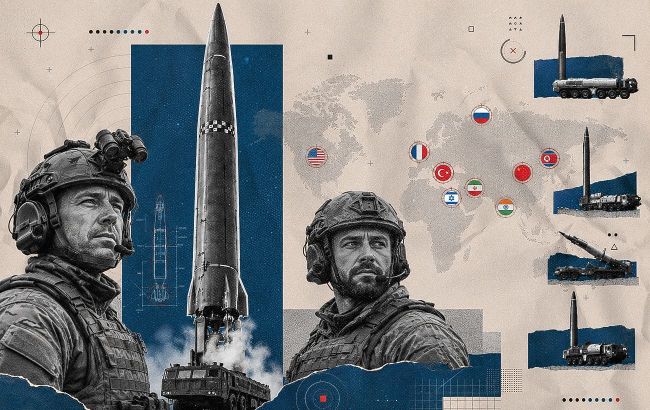 Photo: Will Ukraine be able to create its own missile sword? (Collage by RBC-Ukraine)
Russian ballistic missiles remain the most dangerous weapons, posing a constant threat to both the rear and the front lines.
Find out which countries in the world have developed their own versions of such weapons, and what Ukraine can learn from their experience as it develops its own ballistic capabilities in the RBC-Ukraine article.
Key points:
- Strategic arsenal: Possession of intercontinental ballistic missiles remains the privilege of a few nuclear powers worldwide, which use them as a deterrent.
- Missile axis: Russia is deploying operational-tactical systems on a massive scale in the war, drawing on regular ballistic missile supplies from North Korea.
- Western response: The United States is ramping up mass production of the latest PrSM systems, while France is rolling out its own sovereign mobile ballistic missile program.
- Asian march: China is building its doctrine around unique anti-ship missiles, while Türkiye and South Korea have successfully imported technologies to develop autonomous systems.
- Ukrainian shield: Establishing independent domestic production of long-range weapons requires a long-term state strategy, funding, and the involvement of the private sector in the defense industry.
"Ukrainian ballistic missiles will change everything in this war. It will fundamentally change Ukraine’s status in the world. We’ve changed it many times before, but this is an entirely different league," this statement by Defense Minister Mykhailo Fedorov clearly outlines one of the main technological challenges facing the country.
Over four years of full-scale Russian invasion of Ukraine have proven that most conventional military technologies are either rapidly becoming obsolete or radically changing their role.
Ballistic missiles remain perhaps the only exception. In the hands of Russia, they are the most destructive weapon—the amount of explosives carried by a single such missile is incomparable to that of any drone.
At the same time, intercepting ballistic missiles remains the most difficult and costly task for air defense. The chronic shortage of scarce and expensive anti-missile interceptors for the Patriot systems is one of Ukraine’s biggest problems.
While Russia has been operating and upgrading its Soviet-era missile legacy for years, Ukraine has been forced to build its sovereign arsenal practically from scratch, right under fire.
So RBC-Ukraine examines how missile doctrines work in different parts of the world and which lessons from this experience are most important for Kyiv.
Across continents
Only a very limited number of countries possess their own ballistic missiles. Developing a single prototype missile is relatively straightforward. The challenge lies in making the missile mass-producible, accurate, and suitable for serial production.
"It’s not just the engine, but a whole host of other components: guidance and navigation systems, high-precision gyroscopes, accelerometers, software, and the warhead. And here we’re talking about mass-producing all of this," Anatolii Khrapchynskyi, director of development at a defense enterprise and a reserve Air Force officer, tells RBC-Ukraine.
The first ballistic missiles appeared toward the end of World War II, when German V-1 rockets were striking London. However, this weapon became widespread during the Cold War.
Intercontinental ballistic missiles became the key means of delivering nuclear weapons. That is why the world’s largest arsenals are still held by the former leaders of the two opposing blocs.
Today, the backbone of US strategic forces consists of about 400 Minuteman III silo-based missiles and more than 200 Trident II missiles on submarines. Russia, the main heir to the Soviet arsenal, possesses 300 mobile and silo-based ICBMs (primarily of the Yars type), as well as about 190 submarine-launched ballistic missiles.
Subsequently, driven by their own regional and global ambitions, other players have joined the so-called exclusive club.
China is systematically expanding its strategic capabilities, which already exceed several hundred intercontinental missiles of the Dongfeng family. France, meanwhile, seeking independence from the US defense umbrella, maintains about 48 M51 ballistic missiles. These are deployed exclusively on nuclear-powered submarines.
Regional leaders have also established their own classified strategic programs. North Korea possesses several dozen operational ICBMs of the Hwasong family, capable of reaching the American continent.
Israel does not officially disclose its capabilities, but estimates place its arsenal of Jericho missiles at around 50.
By the end of the 20th century, India and Pakistan had also developed their own long-range weapons. New Delhi has more than 50 Agni-V missiles in service, while Islamabad has deployed about 60 missiles—albeit medium-range ones from the Shaheen and Ghauri series.
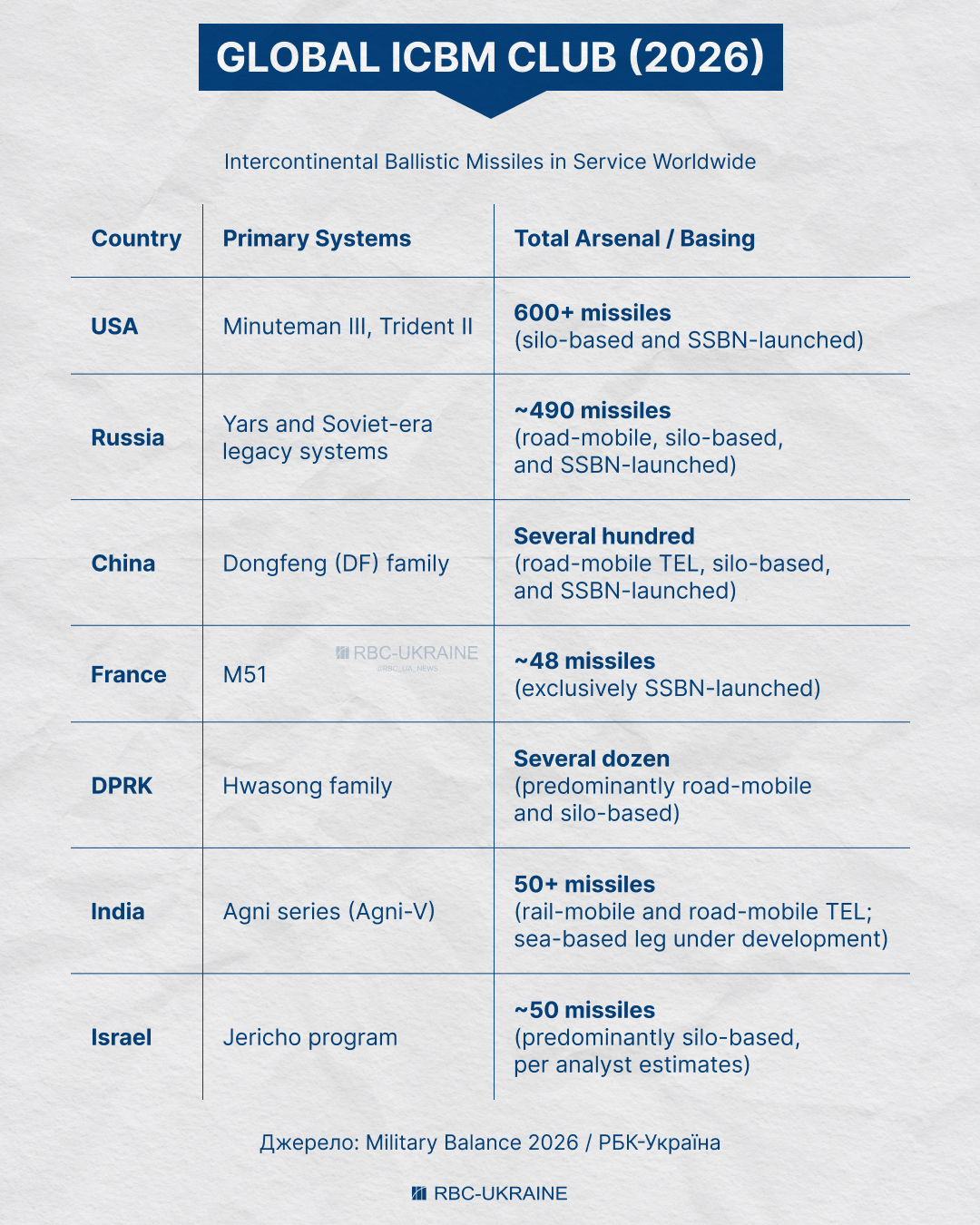 Photo: ICBM arsenals around the world (infographic by RBC-Ukraine)
The main feature of these weapons is that all of the heavy missiles listed have so far been used only at test ranges. Together with a nuclear warhead, they serve primarily as a tool for political pressure and deterrence against an adversary.
At the same time, it would be unwise to assume that states have spent billions over the years simply to have their missile systems sit idle in silos, gathering dust. Long-range ballistic missile technology has now moved to a lower operational level.
Russia and its allies
When it comes to the practical application of ballistic missiles, this primarily refers to operational-tactical missile systems (OTMS), as well as medium- and short-range missiles (from 300 to 5,500 km).
Unlike intercontinental ballistic missiles, these weapons were designed for actual conventional warfare—to destroy command centers, logistics hubs, airfields, and air defense systems deep behind enemy lines. Moreover, the Russian-Ukrainian war has become the first conflict in history in which tactical ballistic missiles are being used on a massive scale and daily.
For decades, Russia’s missile program at this level has been built around the Iskander-M operational-tactical missile systems and their airborne counterparts, the Kinzhal.
These were later supplemented by the Zircon anti-ship missiles. Although the latter are hypersonic cruise missiles, their extremely high speed creates the same critical challenges for air defense systems during land strikes as conventional ballistic missiles do.
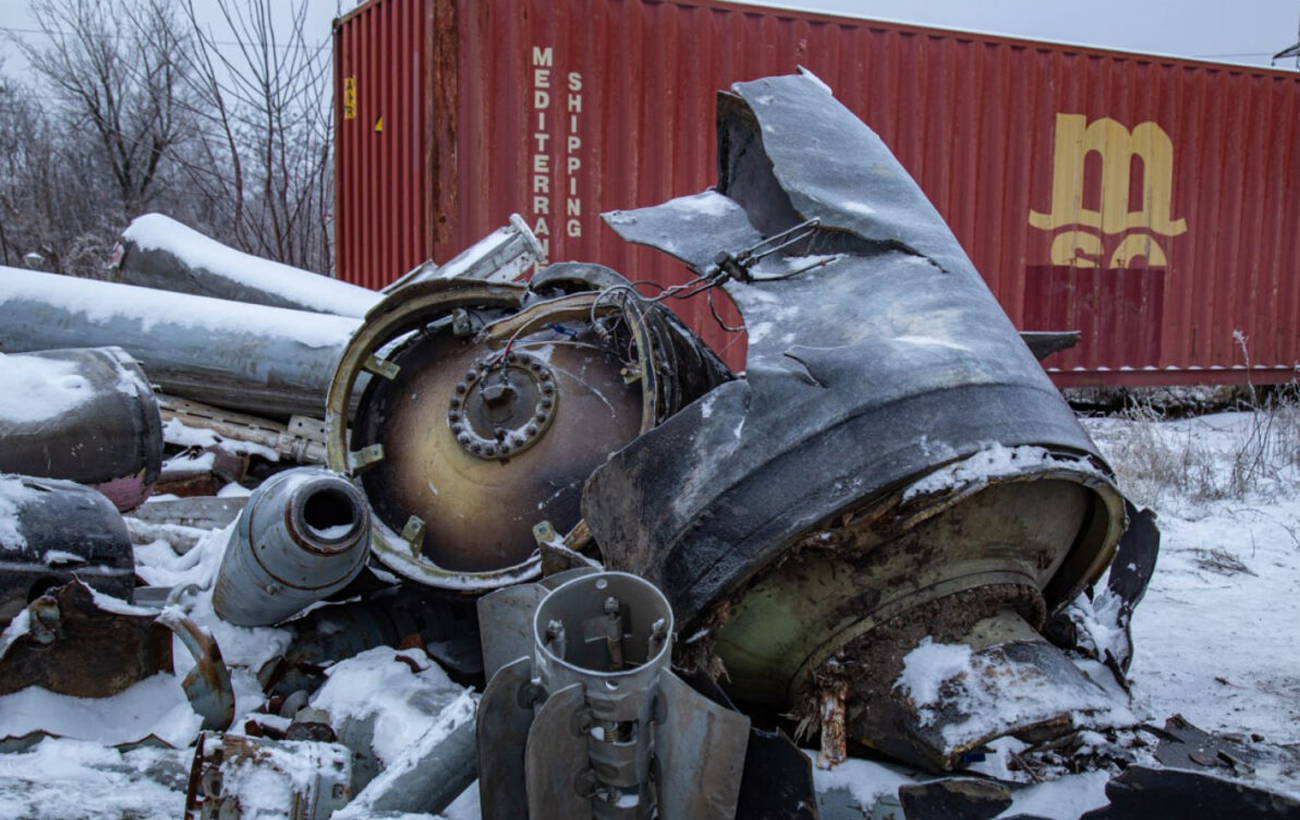 Photo: Debris from a North Korean KN-23 missile (armyinform.com.ua)
The Kremlin is trying to ramp up its production as much as possible. However, regular strikes by Ukrainian long-range drones on key facilities of the Russian defense industry are increasingly undermining the stability and scale of their production.
Due to this pressure and the protracted war of attrition, Moscow is forced to seek reinforcements from abroad, primarily from North Korea.
Pyongyang is actively cooperating with Russia, supplying hundreds of its KN-23 missiles for strikes against Ukraine. The Russians first used them in December 2023. However, these missiles have not been mentioned in Ukrainian Air Force reports over the past few months.
The potential of this cooperation is not limited to just one model. North Korea has a wide range of short- and medium-range ballistic missiles.
Specifically, these include the supersonic KN-24 systems with a range of up to 410 kilometers, the Hwasong-9 medium-range missiles with a range of 1,000 kilometers, and the Pukguksong family of solid-fuel missiles with ranges from 2,000 to 2,500 kilometers, all of which are potentially suitable for transfer to Moscow.
"In general, North Korea’s defense industry has essentially become a branch of Russia’s—at least as far as ballistic missiles are concerned. The Russian influence is very evident there in the form of the transfer of ready-made technology," says Oleh Katkov, editor-in-chief of the specialized agency Defense Express, in a comment to RBC-Ukraine.
Another key element of this axis is Iran, which possesses the largest and most diverse ballistic missile arsenal in the Middle East. In March of this year, Khorramshahr missiles even reached the US base at Diego Garcia, 4,000 km from Iranian territory, not to mention the regular strikes on Israel.
However, Tehran’s capabilities were weakened during the recent war. Iran now has about 1,000 operational missiles capable of reaching Israel, whereas before the spring conflict it had up to 3,000.
"According to estimates by the Israeli and US militaries, all production lines for ballistic missiles of all ranges were destroyed. If anything remains, they are unaware of it. But the fact is that Iran’s production capabilities are currently in poor shape," Israeli military expert David Sharp tells RBC-Ukraine.
However, with the war effectively over, Iran may take advantage of this respite to restore some of its capabilities.
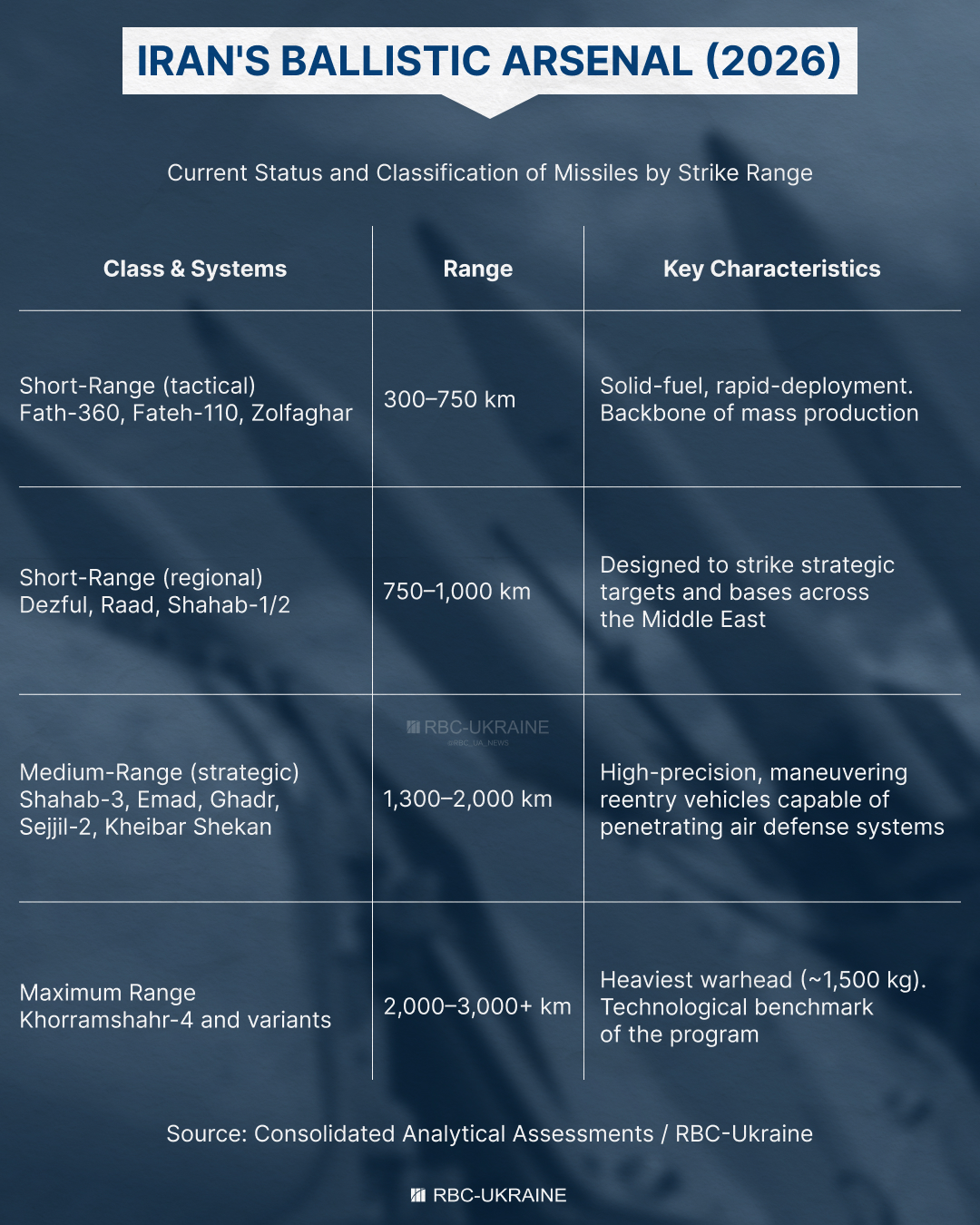 Photo: Iran's arsenal (RBC-Ukraine infographic)
In January, Bloomberg, citing an anonymous security official, reported that Iran had supplied Russia with ballistic and anti-aircraft missiles worth approximately $2.7 billion.
Among other things, this included hundreds of Fath-360 short-range ballistic missiles and nearly 500 other short-range ballistic missiles. However, no launches of these missiles into Ukrainian territory have been recorded.
As Andrii Yusov, a representative of the Defense Intelligence of Ukraine (HUR), noted in January, the reasons may include possible technical or political constraints.
West's response
The United States has developed a completely different philosophy regarding the use of ballistic missiles. While Soviet, and later Russian doctrines relied on massive strikes delivered by individual large systems, the Americans have long developed this segment within the framework of the concept of mobile and high-precision artillery.
The Pentagon’s primary tool at this level has been the ATACMS ballistic missiles, launched from the HIMARS wheeled platforms or the M270 tracked launchers, now familiar to every Ukrainian. They played an extremely important role at the turn of 2024–2025.
Ukraine has demonstrated in practice the critical effectiveness of even older cluster-warhead variants of the ATACMS, with ranges from 165 to 300 km, which were capable of destroying Russian helicopter landing zones and air defense systems deep within Russian territory in a single strike.
However, available ATACMS stockpiles in the US itself are limited, and the production line is backed up with orders for years to come. Because of this, the Pentagon is transitioning to the newest PrSM (Precision Strike Missile) system. In March, it was tested for the first time in combat conditions during the war with Iran.
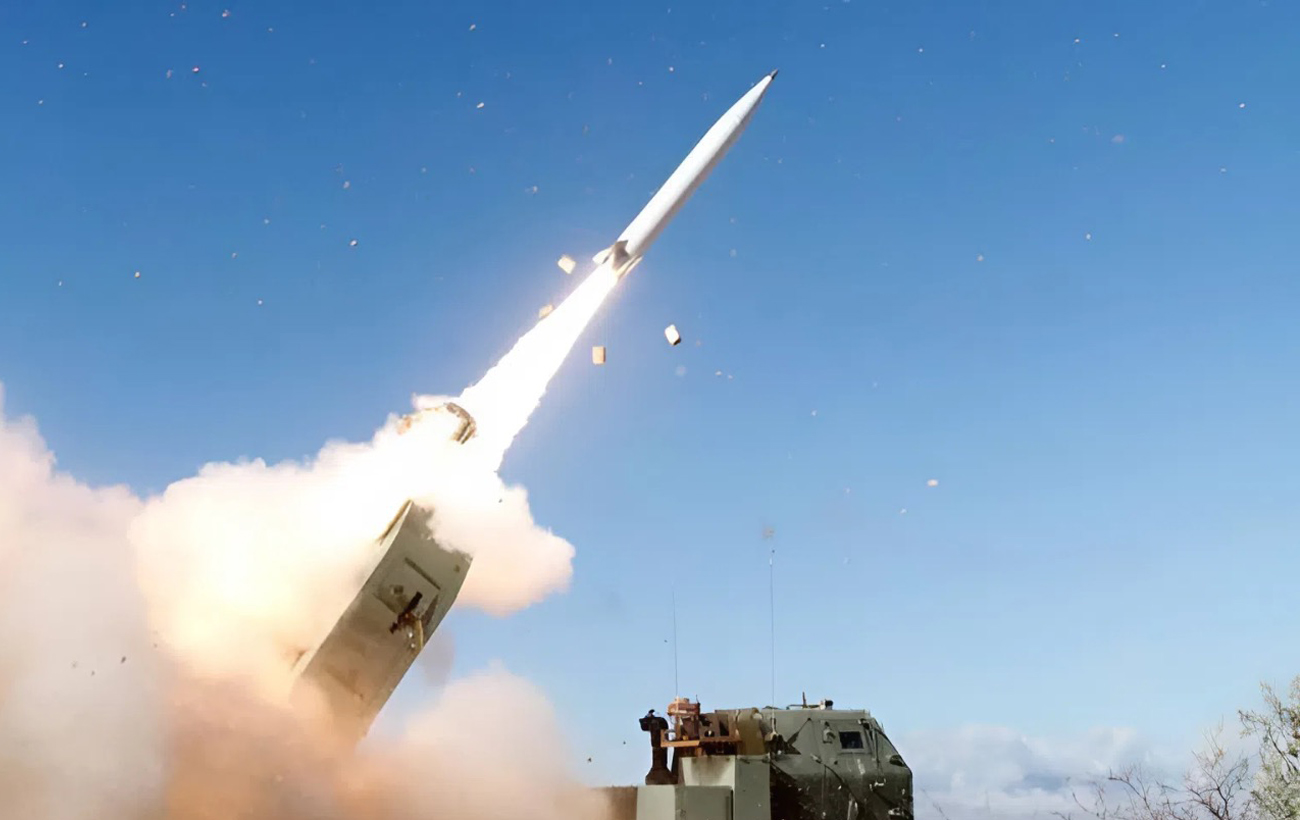 Photo: Test launch of the American PrSM missile (wikipedia.org)
"The US did not need such weapons. The war in Ukraine has shown that they are relevant, and, accordingly, the United States, having understood and received all this information, is beginning to take action," emphasizes Anatolii Khrapchynskyi.
The new missiles are more compact, have a significantly longer range, from 500 to 700 kilometers, and are designed for high-intensity conventional warfare, where it is critically important to have large arsenals of high-precision weapons.
In the summer of 2025, the US Army officially approved the launch of full-scale production, and this spring, Lockheed Martin and the Pentagon signed a large-scale framework agreement to quadruple the production rate.
Unlike the US, European countries had ignored the development of conventional ballistic missiles for decades, relying instead on air-launched cruise missiles. However, the lessons of the major war in Europe and the threat of US stockpiles running low forced a paradigm shift.
France has traditionally taken the lead in this process. In May, the first successful test launches took place of two new high-precision missiles with a range of over 150 km—the FLP-t 150 (jointly developed by Thales and ArianeGroup) and its direct competitor, the Thundart (from MBDA and Safran).
Based on these results, Paris selected Thundart (Safran-MBDA) as the winner on June 15 and is now negotiating a contract with the company.
At the same time, France officially launched the long-term MBT (Missile Balistique Terrestre) program to develop a mobile medium-range ballistic missile with a range of up to 2,000 km. According to the plans, it is to be equipped with highly mobile maneuvering warheads to ensure a breakthrough of the enemy’s missile defense deep behind enemy lines.
Asian push
Asia has emerged as a distinct and highly dynamic arena for the development of ballistic missiles, with China as the key player. Beijing has formulated a unique missile doctrine, relying on the so-called A2/AD (anti-access/area denial) strategy.
This is a military strategy aimed at preventing the enemy from entering a specific territory, airspace, or maritime space, or from maneuvering freely within them
The key feature of the Dongfeng family in China’s arsenal is the development of anti-ship ballistic missiles, such as the DF-21D and DF-26. They are capable of striking US aircraft carriers at a range of several thousand kilometers.
Indeed, a scenario in which the United States attempts to blockade China’s coastline with its navy is one of the most likely outcomes in the event of a war between the two countries.
At the same time, for conventional land warfare, China has at its disposal the DF-11 and DF-15 operational-tactical systems. These mobile solid-fuel systems are designed to instantly destroy airfields, command centers, and air defense systems of potential adversaries on the mainland.
It was Chinese technology that, in its time, gave impetus to the Turkish missile program, which became one of the most striking examples of how to catch up with world leaders. In the 1990s, Ankara, faced with the West’s refusal to share technology, entered into secret agreements with China.
"It’s like a millionaire talking about his millions. He’ll tell you about all the others, except the first one. Türkiye began its cooperation with China in the ’90s, and its first missiles were Chinese ballistic missiles," says Oleh Katkov.
The first Turkish Yıldırım systems were based on Chinese B-611 missiles, and later, in cooperation with Beijing, the Bora system was developed.
Today, Ankara has achieved technological autonomy in the field of ballistic missiles. In May 2026, the Turkish army officially adopted the latest Tayfun Block-2 system, with a range of over 500 km.
Ankara has become a fully independent player, successfully combining the strengths of both state-owned and private defense companies.
At the same time, other regional players were developing their own ballistic missile programs based on a slightly different logic—in response to a direct military threat and the need to deter a specific neighbor.
A striking example is South Korea, which, in response to threats from North Korea, deployed its own line of high-precision Hyunmoo medium-range ballistic missiles. Seoul opted for a radical increase in payload mass.
The Hyunmoo-5 systems carry the world’s heaviest 8-metric-ton warhead, designed specifically to destroy the North Korean leadership’s underground reinforced concrete bunkers. South Korea’s experience shows that the path to developing one’s own sovereign weapons always begins with adapting foreign licensed designs.
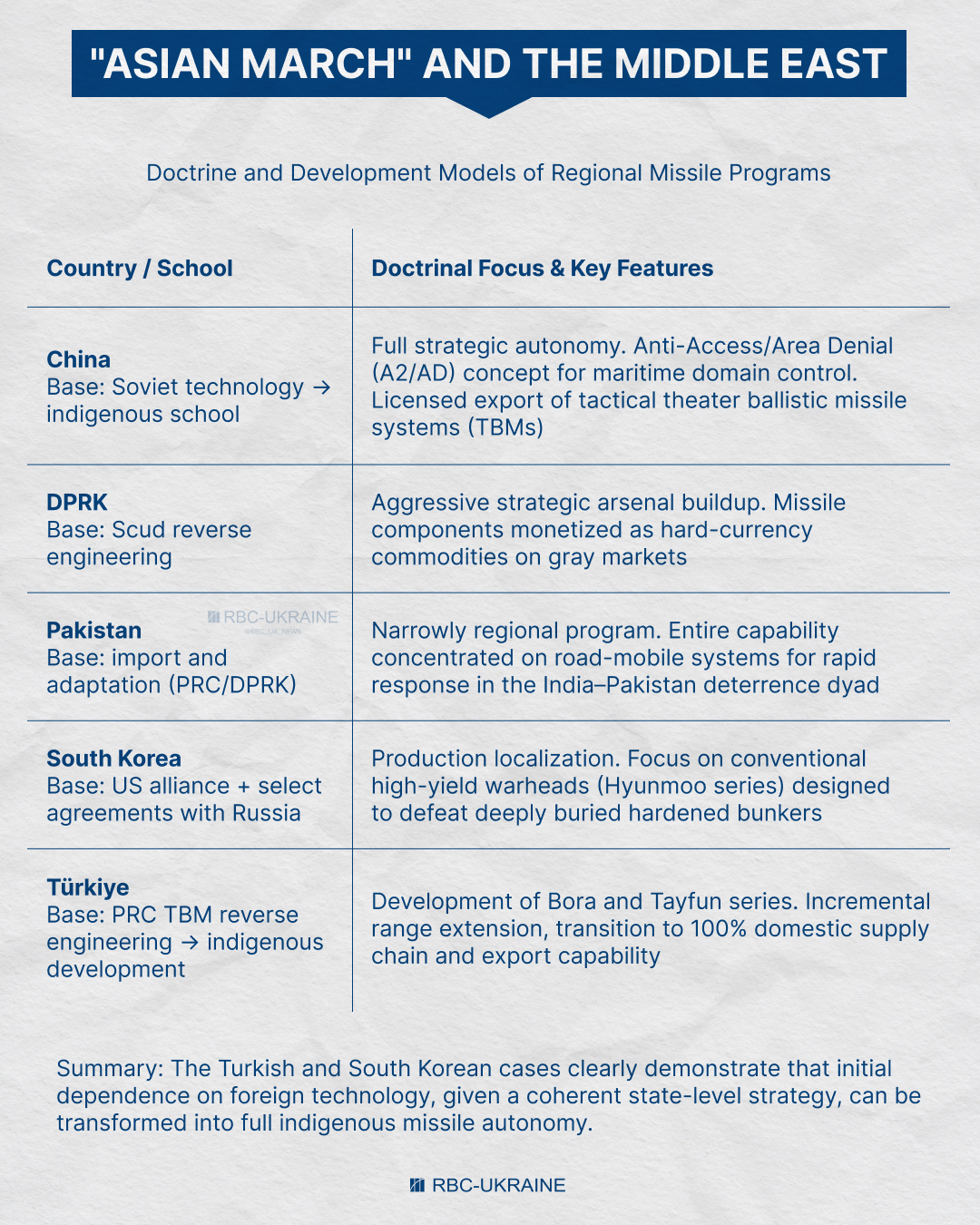 Photo: Asia's ballistic capabilities (infographic by RBC-Ukraine)
The same motive, ensuring survival amid a constant military threat, has driven missile programs in the Middle East and South Asia.
Israel, surrounded by hostile proxy forces, is developing the Jericho family of ballistic missiles in addition to strategic delivery systems, though information about them is contradictory. At the same time, the country exports the LORA mobile system with a range of up to 400 km.
In addition, there are reports of the use of Israeli air-launched ballistic missiles.
"According to open sources, Israel made extensive use of aeroballistic missiles both in the 2025 war with Iran and during the strikes on Iran in 2024," David Sharp tells RBC-Ukraine.
At the same time, India and Pakistan have confined their short- and medium-range ballistic missile programs (India’s Prithvi and Pakistan’s Ghaznavi) to the framework of bilateral competition. For these countries, ballistic missiles are, alongside nuclear weapons, the primary means of mutual deterrence.
Lessons for Ukraine
Global experience shows that sovereign missile defense systems have been built according to various scenarios in different countries.
South Korea started by legally copying American models until it learned to do everything on its own. Türkiye purchased its first technologies from China and handed them over to private companies for further development.
Israel, on the other hand, developed its own missiles due to the constant risk that allies would cut off supplies in the heat of another war, and this experience of surviving in isolation is the most important lesson for Ukraine.
"Everything in the industry revolves around three pillars: money, people, and hardware. Money is needed to purchase equipment, to pay people, and to train and educate them," emphasizes Oleh Katkov.
But then the nuances come into play, specifically, how exactly to use these funds. State-owned enterprises tend to receive direct funding for the development of certain weapons systems.
Private companies typically develop products using their own funds, and the government procurement process kicks in only after the equipment has proven its effectiveness on the battlefield.
According to Anatolii Khrapchynskyi, private manufacturers would benefit significantly from the creation of a specialized government agency that would serve as the chief architect of procurement contracts.
The US DARPA (Defense Advanced Research Projects Agency) and the European EDA (European Defense Agency) operate on this principle. They do not manufacture anything themselves, but rather seek out breakthrough ideas, fund their development by private companies, and guarantee the purchase of successful prototypes for the armed forces.
In general, the development of a missile program should be a state policy spanning 10–20 years, rather than a short-term project.
"Once we have a state program, let’s say, enacted at the legislative level that aims to develop and become a 70% independent manufacturer in the defense sector within 20 years, then, accordingly, it will work," says Khrapchynskyi.
According to him, there is still no unified strategy for the development of the defense industry. Instead, there are individual defense companies that, amid fierce domestic competition, are actively trying to survive or independently develop products that the military needs right now.
Ukraine needs a systematic, strategic approach that will allow it to establish a high-quality domestic market and clearly distinguish between which technologies it develops on its own and which Ukraine purchases from partners.
And having our own long-range ballistic capabilities is the best indicator of whether a state is capable of taking a long-term view and systematically ensuring its security, rather than simply putting out fires here and now.
Quick Q&A
– Which countries in the world have their own intercontinental ballistic missiles?
– Today, only a very limited number of states possess strategic nuclear delivery systems. The United States and Russia have the largest ICBM arsenals, while China, France, North Korea, Israel, India, and Pakistan have also developed their own long-range programs.
– How do American ATACMS missiles differ from the latest PrSM systems?
– The new high-precision PrSM missiles are more compact than the ATACMS, allowing for a greater number of warheads to be loaded onto launch platforms.
In addition, they have a significantly greater range, between 500 and 700 kilometers, and are designed specifically for high-intensity conventional warfare.
– What tactics has China employed to develop its own ballistic missile arsenal?
– Beijing has relied on a unique anti-access/area denial (A2/AD) strategy, developing anti-ship ballistic missiles to take out aircraft carriers at long range.
For land operations, China uses high-tech mobile solid-fuel systems capable of instantly destroying enemy airfields and command centers.
– What experience from other countries is most important for developing a missile program in Ukraine?
– Ukraine should look to the experience of Israel, which has learned to produce missiles under the constant threat of isolation and the suspension of supplies from allies.
In addition, for the effective implementation of a 10- to 20-year program, Kyiv needs a unified national strategy, the launch of a specialized agency modeled after the US DARPA, and funding for private developers.