Poland's emotions, Hungary's bargaining and Slovakia's balancing: What Ukraine should expect


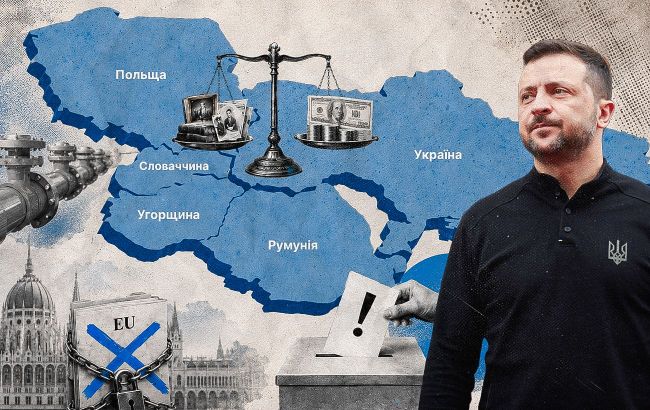 Photo: What to expect from Ukraine's western neighbors (collage by RBC-Ukraine)
In the context of a full-scale war with Russia, the importance of Ukraine's western neighbors—the EU and NATO countries—to Ukraine’s survival cannot be overstated. Yet serious problems arise regularly with nearly every one of them.
Read the article by RBC-Ukraine to find out what is currently happening in Ukraine’s relations with Poland, Slovakia, Hungary, and Romania, and whether there are serious threats from the West as well.
- Poland – Shift toward pragmatism: Warsaw and Kyiv are smoothing over historical disputes through diplomatic measures and formalizing strictly practical cooperation, particularly in the defense sector.
- Hungary – Blocked path to the EU: Despite a change in government and compromises regarding minorities, Budapest is blocking four negotiation clusters on Ukraine’s EU accession while bargaining with Brussels.
- Slovakia – Compromises over money: Robert Fico is avoiding an escalation with Kyiv due to the threat of frozen European subsidies and domestic difficulties.
- Romania – Threats due to a political crisis: Bucharest remains a reliable partner for Ukraine, but the main risk to cooperation is the possibility of early elections and the rising popularity of the far right.
In addition to repelling Russian aggression and constantly seeking funds for defense, Ukraine regularly has to divert its attention to putting out diplomatic fires with its western neighbors—Poland, Hungary, or Slovakia. Even with relatively calm Romania, there are nuances.
Their importance to Ukraine cannot be overstated, both in terms of the logistics of military shipments and their impact on European integration. Moreover, the role of these western neighbors is growing against the backdrop of Russia’s blockade of Ukrainian ports and the likely need to reroute trade to land routes, as was already the case in 2022.
Despite a shared European orientation, Kyiv has its own specific dynamics in relations with each of these countries, along with its own set of hidden risks.
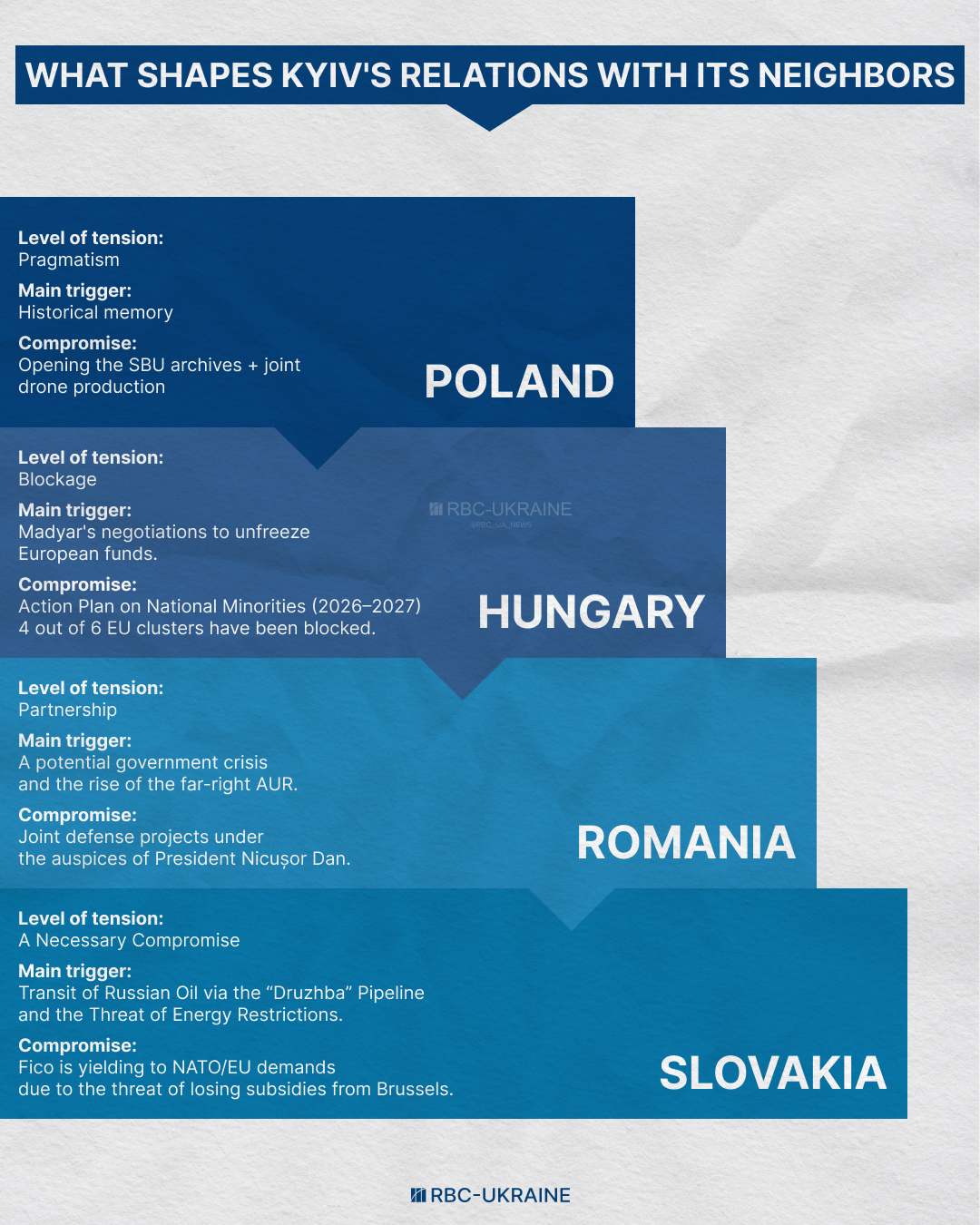 Photo: What determines Ukraine's relations with its western neighbors (RBC-Ukraine infographic)
Poland's emotional reaction
Relations with Warsaw have hardly been warm of late. In June, the most serious escalation in many years occurred—completely unexpectedly for Kyiv—triggered by the decision to name one of the Ukrainian Armed Forces' military units after UPA heroes.
The emotional storm sparked by this move resulted in a war of orders. First, Polish President Karol Nawrocki stripped Volodymyr Zelenskyy of Poland's highest state award, the Order of the White Eagle.
Following this, a number of top Ukrainian officials renounced their Polish orders and medals. All of this was accompanied by anti-Ukrainian hysteria on Polish social media, as well as isolated physical attacks on Ukrainians in Poland.
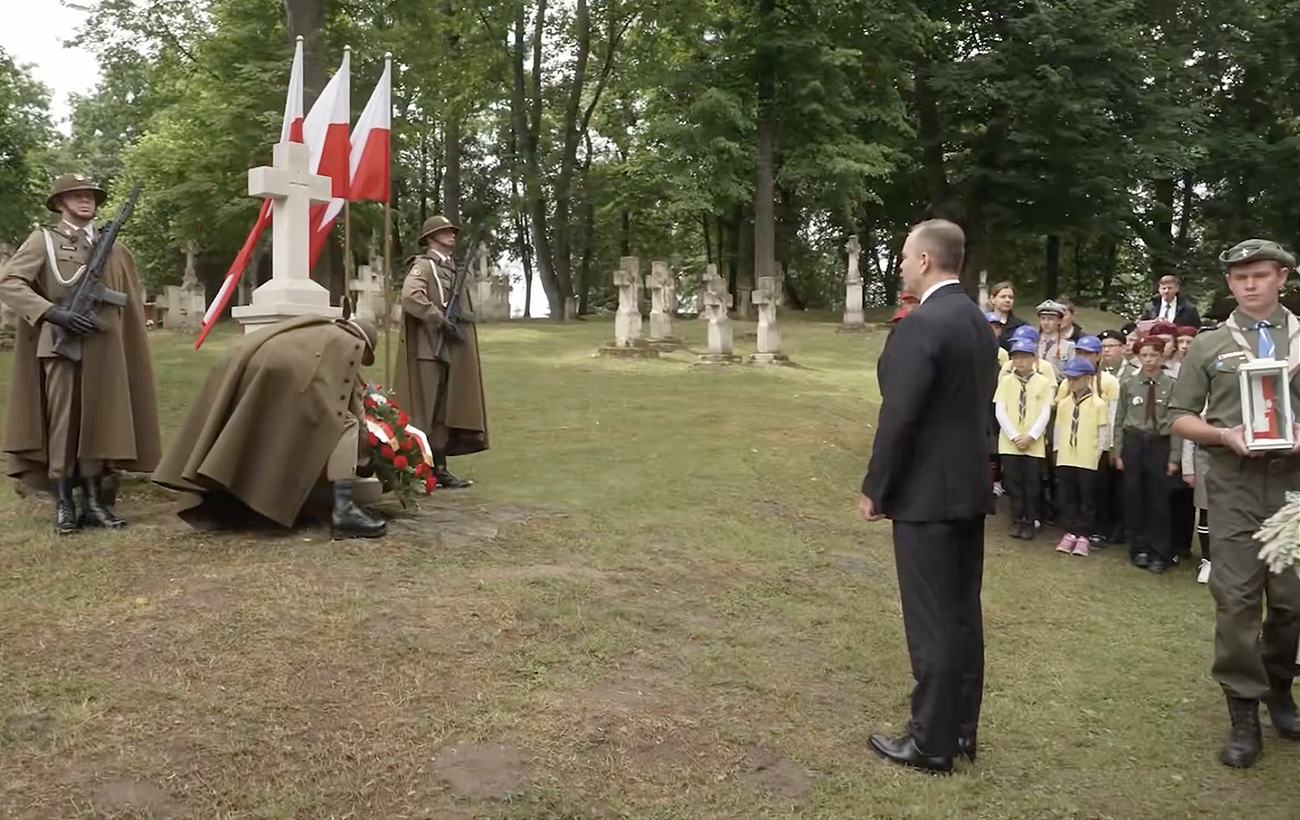 Photo: Karol Nawrocki during a commemoration of the victims of the Volhynia tragedy (video screenshot from x.com/NawrockiKn)
Another wave of escalation was expected on July 11—the day of remembrance for the victims of the Volhynia tragedy in Poland. Kyrylo Budanov, head of the Office of the President of Ukraine, explicitly warned in an interview with RBC-Ukraine that Poland was preparing a series of immature escalatory steps.
However, the Polish leadership decided against provoking a new escalation. In his speech marking the anniversary of the Volhynia tragedy, President Karol Nawrocki limited himself to calling on parliament to legislatively ban the red-and-black flag of the Organisation of Ukrainian Nationalists and Ukrainian Insurgent Army (OUN-UPA).
A combination of factors contributed to this position, says Serhii Herasymchuk, deputy executive director of the Ukrainian Prism Foreign Policy Council, in an interview with RBC-Ukraine.
On the one hand, Ukraine’s relations with the US have warmed, and the Polish president is largely guided by the mood in the White House. On the other hand, there is European influence, the prospects for participating in Ukraine's reconstruction, and the economic benefits this would bring to Poland.
For its part, Ukraine is also emphasizing a constructive approach. On July 17, President Zelenskyy announced five steps to resolve historical disputes. Among other things, all archives of the Security Service of Ukraine (SBU) and the Foreign Intelligence Service of Ukraine regarding 20th-century events in Volhynia will be opened, and the number of permits for exhumation work will be increased.
Such gestures, seemingly minor for Ukraine, nevertheless carry great weight for the Polish political establishment. Consequently, the reaction to them has been commensurate.
"I welcome with satisfaction and hope the words and decisions of Volodymyr Zelenskyy regarding relations between our countries, which must be based on mutual respect and truth," said Polish Prime Minister Donald Tusk.
The Polish President did not personally comment on Zelenskyy’s decision, but his adviser Alvin Gajadhur stated that words alone are not enough.
In any case, Ukrainian-Polish relations will no longer be the same as before.
"Neither the Ukrainian nor the Polish side will show any particular sentimentality in bilateral relations and will try to shift them to a transactional basis. In other words, if we want to get something from Poland, then, accordingly, we have to offer Poland something in return," says Serhii Herasymchuk.
An example of this is defense cooperation. In early July, the Polish state-owned conglomerate PGZ signed new contracts with the Ukrainian company TAF Industries regarding the joint production of drones and the maintenance of fighter jets.
On top of everything else, pragmatism is one of the factors that will, to a certain extent, deter Polish politicians from further escalations. This is further reinforced by the Russian threat and incidents such as the Kh-101 missile landing near Lublin on July 30.
Such provocations compel Poland and NATO to ensure their own security, and the most effective step toward strengthening defense capabilities is precisely deepening the partnership with Ukraine.
"Understanding this should change Poles' views on the situation and on our bilateral relations. And this means there is hope that Warsaw will, after all, agree to closer cooperation in various areas, but first and foremost we are talking about the defense sector,” says Stanislav Zhelikhovskyi, a candidate of political sciences and an expert on international relations.
However, it is likely that entirely new escalations will be unavoidable as Poland's parliamentary elections approach next year. Obviously, every political force will try to play the Ukrainian card, because Polish society responds to it for various reasons.
According to a CBOS poll, the number of Poles opposed to accepting refugees from Ukraine has surpassed the number of supporters of such a policy—52% versus 48%. This is the first time such a result has been recorded since the start of Russia’s full-scale invasion.
Furthermore, the objective economic contradictions remain. "Ukraine is perceived by many European farmers, including Polish ones, as a competitor in the agricultural sector. This was demonstrated by the farmers’ protests in 2023 against duty-free imports of Ukrainian grain," says Snizhana Diachenko, an analyst at the Ukrainian Center for European Policy, in a comment to RBC-Ukraine.
The only question is whether such attempts at escalation will remain merely at the level of statements or whether they will once again translate into concrete actions.
In addition, over the past few weeks, Polish politicians have managed to stir up public sentiment against Ukraine to such an extent that reports of yet another ethnically motivated attack on Ukrainians in Poland come in almost daily. Fortunately, none have been fatal.
New processes in Budapest
Under Viktor Orbán, Hungary was Ukraine’s most problematic neighbor. When the controversial prime minister suffered a crushing election defeat, Kyiv immediately sensed a shift in sentiment. Péter Magyar, who succeeded Orbán, is clearly determined to resolve the disputes with Ukraine. The main issue concerns the Hungarian minority.
Almost immediately after Magyar was sworn in, Ukrainian and Hungarian officials began technical consultations. Based on the results of these talks, the new Hungarian prime minister announced significant progress.
Kyiv and Budapest have agreed that Ukraine must implement the Action Plan on National Minorities, which was approved as part of the broader process of European integration.
Importantly, this plan applies not only to the Hungarian minority but also to other national minorities in Ukraine, with the exception of the Russian minority. No special provisions are envisaged for the Hungarian community.
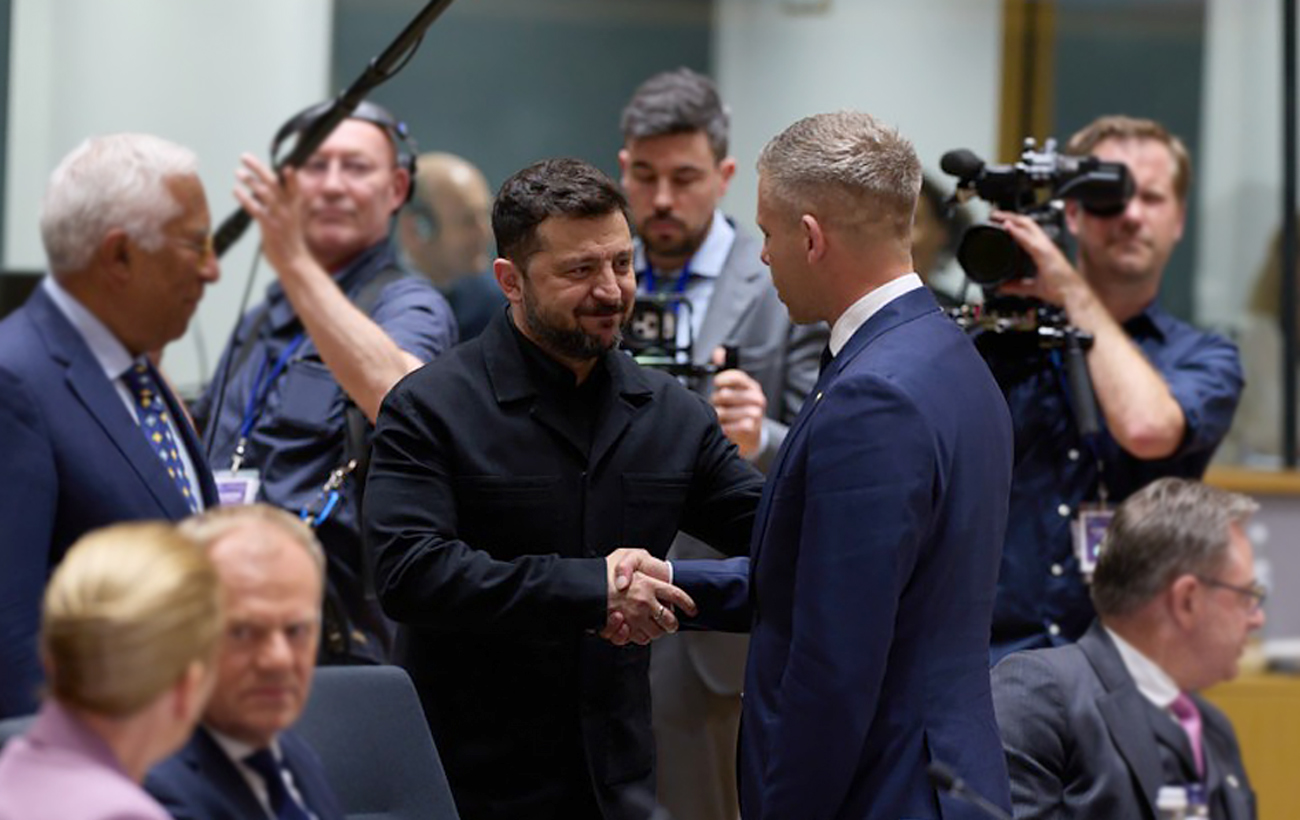 Photo: Volodymyr Zelenskyy and Péter Magyar at the summit in Ankara (president.gov.ua)
Hungary has agreed to proceed within the framework of the plan; however, according to Magyar, it needs to be revised. These are merely technical amendments, as some of the provisions are outdated. According to Taras Kachka, then-Deputy Prime Minister for European Integration, the agreements provide for phased amendments to Ukrainian legislation during 2026–2027.
These include the definition of minority settlement areas, as well as linguistic and socio-political rights. Kyiv intends to implement some of these commitments as early as this year. First and foremost, these relate to education. At the same time, Oksen Lisovyi, Ukraine's former Minister of Education and Science, stated that there were no fundamental innovations in the agreements with Hungary.
It would seem that, as a result, the problem of the Hungarian veto in the European Union should have disappeared. In July, the EU could very well have opened all six negotiation clusters—the legislative areas that Ukraine must reform to join the European Union. This is a technical procedure, but without it, further European integration is impossible. And importantly, opening the clusters requires the consent of all EU member states.
Contrary to expectations, Hungary agreed to open only the first cluster, and—after additional consultations—the last one. The other four remain closed.
On July 17, Hungary refused to begin the process of opening clusters 2 (Internal Market) and 3 (Competitiveness and Inclusive Growth).
This refusal is not related to the content of the chapters under negotiation, where, in theory, the interests of Ukraine and Hungary might conflict, notes Snizhana Diachenko in a comment to RBC-Ukraine.
- Cluster 2 covers issues such as the free movement of goods, labor, and capital; financial services; company law; intellectual property; consumer protection; and more.
- Cluster 3 covers taxation, digital transformation, customs, social policy, education, and culture.
"Hungary has not publicly raised any objections regarding Ukraine’s readiness to begin negotiations on any of these issues. The opening of Clusters 2 and 3 has become hostage to the problematic bilateral relations between Ukraine and Hungary, as well as Hungary’s own policy regarding Ukraine’s accession to the EU," Diachenko emphasizes.
According to her, although the new government appears more accommodating toward Ukraine compared to Orbán, Magyar still cannot be called a pro-Ukrainian politician. During his election campaign, he stated that he does not support Ukraine's rapid accession to the EU.
Furthermore, anti-Ukrainian sentiments in Hungarian society—which were particularly actively cultivated by pro-government media during the Orbán era—have not gone away. Therefore, the new Hungarian prime minister must maintain the image of a resolute politician.
"Magyar needs to prove to everyone that he continues to defend Hungary’s interests, and the issue of Hungarians abroad is a ‘sacred cow’ for any Hungarian administration, regardless of the prime minister’s last name," emphasizes Serhii Herasymchuk.
At the same time, the European Commission plays a key role in this situation, as it retains significant leverage over Hungary. Magyar will press the European Commission to unfreeze all funds. It is also important for him to extend the deadlines for using these funds. The main negotiations, however, will center on the new EU budget for 2028–2034.
This affects Ukraine in two ways. The European Commission itself, recognizing Hungary's vulnerability, may pressure it on the Ukrainian issue. At the same time, Hungary is trying to sell its veto power for the highest possible price.
A meeting between Volodymyr Zelenskyy and Péter Magyar could shift the situation somewhat. They had a brief conversation on the sidelines of the NATO summit in Ankara, but that setting was not conducive to a substantive discussion. A full-fledged meeting between the two leaders is planned for Kyiv or Budapest, but the timing remains unknown.
Bureaucratic challenges in Slovakia
Bratislava is taking a somewhat different approach. Prime Minister Robert Fico, despite his harsh rhetoric toward Ukraine, is in practice trying not to create critical problems for Kyiv. A telling example is the transit of Russian energy resources to Slovakia through Ukraine.
At the beginning of the year, Russian strikes damaged oil infrastructure, physically halting the flow through the Druzhba pipeline. This even forced Bratislava to threaten Kyiv with power cuts, as Fico's team claimed that Ukraine was deliberately blocking the transit.
Kyiv and Bratislava formalized an agreement to resume transit on April 23, coinciding with electoral changes in neighboring Hungary.
The Slovak side will likely continue to raise the issue of further guarantees from Ukraine regarding the transit of Russian oil. As an exception for Slovakia and Hungary, this oil currently passes through Ukraine. However, the EU intends to completely phase out Russian energy resources by 2027.
Ukraine, for its part, may raise the issue of guarantees regarding the transit of electricity and gas through Slovakia. In particular, reducing the gas tariff is a priority for Kyiv. Slovakia promised to do so as early as 2025. But so far, no such decision has been made.
To seek compromises, Volodymyr Zelenskyy and Robert Fico held a brief meeting in Yerevan on May 4, and continued their talks on the sidelines of the EU summit in Brussels on June 18. Intergovernmental consultations were planned for July to facilitate substantive discussions. However, a sudden change in Ukraine’s government has led to their postponement.
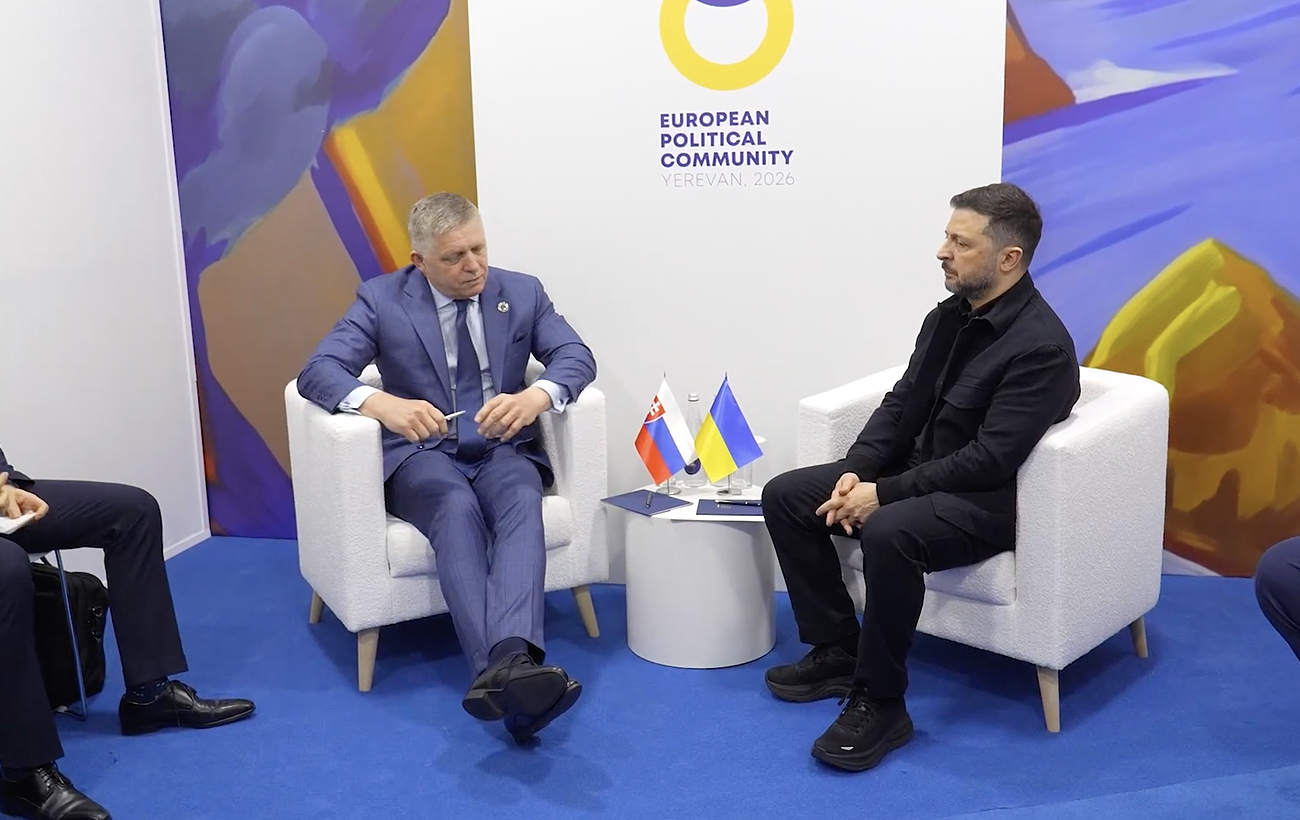 Photo: Volodymyr Zelenskyy and Robert Fico at the summit in Yerevan (video screenshot from t.me/V_Zelenskiy_official)
At the same time, this does not prevent the parties from reaching pragmatic agreements. Even on the issue of NATO's support for Ukraine—where the Slovak prime minister has traditionally remained skeptical—Bratislava ultimately aligned itself with the pan-European position.
At the Alliance’s July summit in Ankara, Fico agreed to fund an aid package for Kyiv in exchange for exempting Slovakia from direct military deliveries.
Fico's flexibility is dictated by harsh domestic realities, says Serhii Herasymchuk. According to him, Slovakia is currently in a very difficult socioeconomic situation, and the government is frantically searching for ways to plug the holes in the budget.
The European Commission has already made it clear to Bratislava: if the country does not change its political course, Brussels may apply the Hungarian scenario from the Orbán era—simply freezing European funds and cutting off access to billions in subsidies.
"That’s why Fico is now caught in a geopolitical bind. On the one hand, he wants to retain the support of those Slovaks who approve of his current policies; on the other, he understands that this is unrealistic if the European Union cuts off funding," explains Herasymchuk.
Under these conditions, Bratislava cannot afford any escalation with Kyiv. This is all the more true given that the Slovak government itself is currently quite unstable. It is held together by a slim parliamentary majority, where Fico’s partners constantly blackmail him by threatening to leave the alliance.
Hidden threat in Romania
Unlike most of Ukraine's other western neighbors, there are no critical issues in relations between Ukraine and Romania. There was no pro-Russian resurgence in the elections there; Bucharest remains a reliable partner, and many joint defense and infrastructure projects are already underway between the two countries.
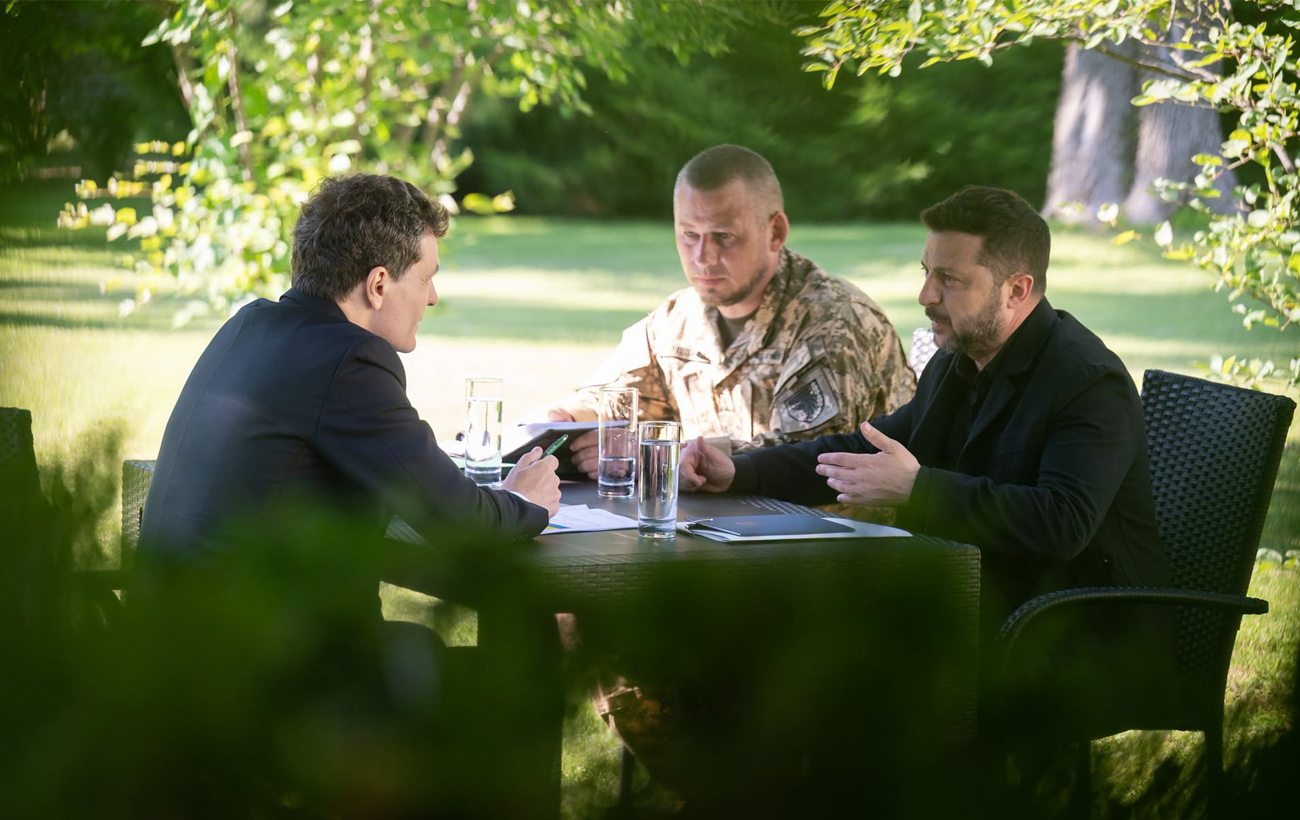 Photo: Volodymyr Zelenskyy and Nicușor Dan during a visit to Kyiv. In the background is Pavlo Palisa, Deputy Head of the Presidential Office (facebook.com/zelenskyy.official)
Romanian President Nicușor Dan said during a recent visit to Kyiv that through their partnership with Ukraine and their shared trust, they would like to work together to develop the capabilities of their armed forces.
The partnership has not been shaken even by the fact that Romania is being unwittingly drawn into the war due to regular incidents involving Russian drones flying into its territory and increasingly frequent air raid alerts in cities along the border with Ukraine.
However, the main risk for Kyiv in this regard remains the political turmoil within Romania itself. The country has effectively plunged into yet another political crisis, and President Nicușor Dan is currently the key figure in maintaining the course of support for Ukraine.
"If circumstances were to unfold such that a new government could not be formed and Romania were to hold early parliamentary elections, the risks would increase exponentially," Serhii Herasymchuk explains to RBC-Ukraine. "It is highly likely that the far-right AUR party would win. This would lead to the formation of a government hostile to Ukraine, and its confrontation with the president would plunge Romania into a spiral of crises."
However, such a scenario has so far been avoided. Romanian lawmakers are well aware that early elections would mean the loss of their seats for most of them.
Overall, internal crises and electoral races in neighboring countries will continue to pose risks for Kyiv. However, the combination of Brussels' financial leverage and the flexible, pragmatic work of Ukrainian diplomacy is currently keeping these relations on a constructive track. Maintaining this status quo will continue to require Ukraine to focus not so much on emotional appeals for support as on identifying mutual benefits.