'You don't talk to us with ultimatums.' Zelenskyy's top aide Budanov on war, Trump and Poland


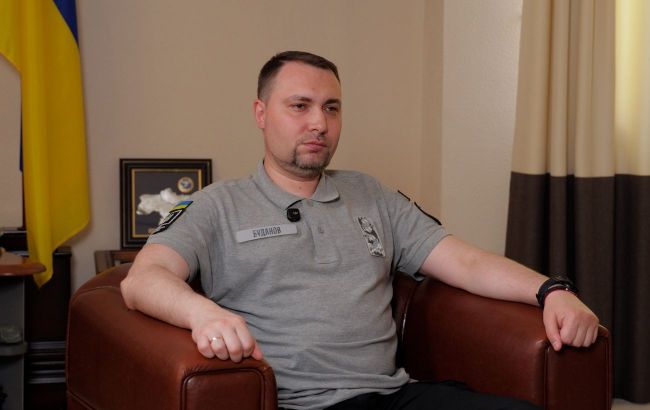 Photo: Kyrylo Budanov, Head of the Office of the President of Ukraine (RBC-Ukraine)
In Ukraine's power structure, the Head of the Office of the President is often the second-most-important job in the country — especially when the person holding it is ambitious and exceptionally well-informed.
Six months after taking over the office, Kyrylo Budanov sat down with RBC-Ukraine to discuss his working relationship with President Volodymyr Zelenskyy, the state of peace negotiations, Ukraine's strategic plan, Crimea, the campaign against Russian military logistics, Donald Trump, the escalating rift with Poland, Belarus, and more.
Key takeaways:
- Relationship with Zelenskyy: Budanov says the early friction with the president has passed, and describes how his own style of engaging with Zelenskyy differs sharply from that of his predecessor, Andriy Yermak.
- Path to peace through escalation: There is a real chance the active phase of the war could end this year — but expect the fighting to intensify before any return to the negotiating table.
- No territorial concessions: Any compromise on Ukraine's territory or borders remains completely off the table.
- No ultimatums: Ukraine will not bow to pressure from Poland any more than it bowed to demands from a far more powerful Russia.
- Backing from Washington: Donald Trump, Budanov says, respects winners — so Ukraine's task is to keep producing real results on the battlefield.
July 2 marked six months since Budanov took charge of the President's Office. RBC-Ukraine has previously reported on why Zelenskyy offered him the post, the challenges he has faced since, and how his relationship with the president has evolved.
Budanov answered questions in his characteristically terse style — sometimes turning a question back on the interviewer rather than answering it directly. Even so, a close reading yields plenty between the lines.
Relationship with Zelenskyy and new job
Budanov describes the transition from battlefield command to the presidential bureaucracy as almost anticlimactic. Nothing about the job, he insisted, has caught him off guard, and the shift itself felt "completely smooth" — though he was quick to reject the premise that his new role is purely civilian. Ukraine remains a country at war, he said, and the work of running the President's Office "still overlaps heavily with military work." Much of what fills his days, in fact, is the same unglamorous administrative grind he says he knew well in his previous job, at the helm of military intelligence: "There was no less of it in my previous job, believe me."
He is similarly unsentimental about the moment Zelenskyy offered him the post, describing it as a handful of conversations rather than any single dramatic exchange — "a normal, technocratic discussion," as he put it, with nothing memorable enough to recount.
A career military officer, Budanov calls himself the president's subordinate without qualification and says he has "no problem with that." Their contact, he added, is overwhelmingly transactional — "there are so many of these work matters that, believe me, there's plenty to go around" — and his schedule follows no fixed shape beyond an 8 a.m. start. When it ends, he said, simply, "however it ends."
As for the reports of an early chill between Budanov and Zelenskyy, followed by a clearing-the-air conversation, Budanov waved off the narrative's drama while conceding its substance. Zelenskyy, he said, had grown accustomed to one model of working with his chief of staff; Budanov operates by another. "That's normal — it's a transitional period," he said, agreeing when it was put to him that the two men were simply, in his phrase, "getting used to each other." Six months in, he believes they largely have.
War, negotiations and Ukraine's plan
Ask Budanov whether Russia would have gambled on its full-scale invasion in 2022 had it known the war would still be raging years later, and he calls it a philosophical question — then answers it anyway. "In my view, no, they wouldn't have started it," he said, adding that most Russians he has encountered through his intelligence work share that assessment.
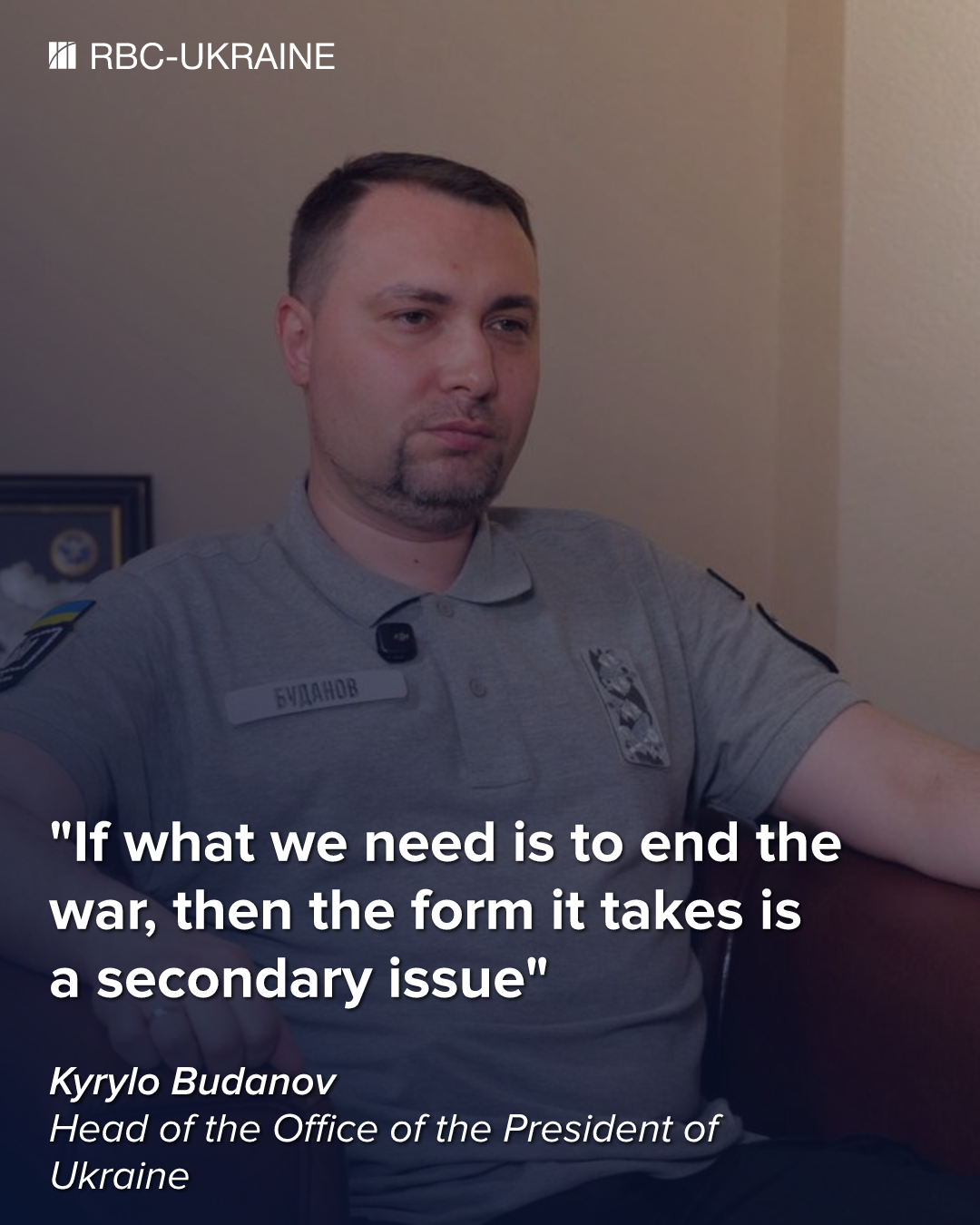
The peace process itself, he describes with something between fatalism and patience. Even the long-delayed visit to Kyiv by the American envoys Steve Witkoff and Jared Kushner draws only a shrug from him. "As long as you're alive, you hope," he said. "Every war eventually ends — there's never been one that didn't." The visit, in his framing, is a distraction from the only question that matters: not how the war ends, but that it does. "If what we need is to end the war, then the form it takes is a secondary issue."
Asked how Ukraine's recent moves fit together — a decree permitting a military parade in Moscow, a letter addressed to Vladimir Putin, the operation known as "Crimea Island," and an intensified campaign against Russian logistics — Budanov described not a new strategy but an old one finally executed at scale. Ukraine has tried for years to choke off Russian supply lines, he said, with uneven results; what has changed is capability. "The volume of our own production has become substantial enough, let's say, to allow us to increase the intensity," he said. "And intensity allows us to achieve certain results." The second pillar, alongside the logistics campaign, is simpler still: stabilizing the front line, which he called "nothing new" but which depends entirely on making Russian supply chains difficult enough to sustain that Moscow's momentum stalls.
Crimea and the fuel crisis
Crimea draws out something closer to an appeal than analysis. Budanov wants Ukrainians still living under occupation there to understand that their homeland has not been written off — "Crimea is Ukraine, and this bond can never be severed by anyone," he said — even as he acknowledged the toll daily life under occupation has taken, beyond the strikes on Russian military targets. Fuel shortages, rolling blackouts, and the water outages that follow from them are, in his words, simply facts of life there now. He frames the hardship as the price of a larger goal. "All these inconveniences are for the sake of a larger goal, and that larger goal is coming home," he said, describing the current priority as severing the peninsula's southern supply routes, which sustain Russia's "Dnipro" troop grouping.
Russian forces, meanwhile, seem to be borrowing from Ukraine's own playbook, striking gas stations in front-line regions more deliberately than before — "a huge problem," in Budanov's assessment, though not one he believes will spread into a broader fuel crisis. Told that some fear shortages reaching Kyiv itself, he was unequivocal: "I don't see any signs of that."
Trump and the 'spirit of Anchorage'
Donald Trump's recent run of pro-Ukrainian statements, including his signature on a G7 statement with favorable language, has raised an obvious question in Kyiv: how long will it last, and how did Ukraine earn it in the first place? Budanov reframes the question before answering it. The priority now, he said, is not explaining the shift but preserving it — "how not to lose the support he's shown during this time, because that's genuinely important for us." His theory of the American president is almost aphoristic: Trump, like "everyone in the world," loves winners and has no patience for those who lose. The task in front of Ukraine, then, is not persuasion but performance — proving results on the battlefield rather than showcasing them. "Not showing it — actually having it," he said. "That will give us a chance to hold onto his favor, which, in the end, we need not as some symbol, but as concrete steps." Asked whether that meant literally showing American officials things like photographs of destroyed refineries or front-line maps, he brushed the specifics aside: Ukraine, he said, is no longer in the business of showing anyone anything — only of winning.
Whether that goodwill survives Trump's difficult midterm elections is, in Budanov's view, the wrong question to worry about. He does not entertain the possibility that Washington's attention drifts; he returns, instead, to his central conviction that the US commitment is tethered to results, not politics.
He is fluent, too, in the vocabulary Moscow has built around the war's likely endgame — including the phrase "spirit of Anchorage," Russia's own gloss on the outcome of its summit with the United States in Alaska. As Budanov describes it, the Russian interpretation rests on what officials there call "3 plus 2": full sovereignty over Crimea, Donetsk, and Luhansk, plus the Russian-held portions of Kherson and Zaporizhzhia, with the war ending on those terms and the world recognizing Moscow's claim outright. Whether American officials use the same language themselves, he suggested, matters less than what Ukraine thinks of it — and what Ukraine thinks is unambiguous: unacceptable, full stop. He was equally dismissive of the question of whether Russian demands have shifted over the past six months, arguing that the negotiating process itself is beside the point. "What matters is how it all ends," he said. "We'll see how it ends." The battlefield and the negotiating table, in his view, are never truly separable — "that's just how it is," except in the case where one country simply ceases to exist.
Nowhere is Budanov more categorical than on the question of territorial compromise. "Territorial compromises are, in principle, impossible," he said. "Completely, without any variants." He extended that same rigidity to softer concessions, dismissing the idea that legal changes — enshrining Russian as a second state language, for instance — could move Moscow to hand back Crimea. They would not, he said flatly, and so such gestures are, in his assessment, beside the point entirely: "Everything is decided on the battlefield and at the negotiating table together, as a whole."
What could ultimately force Putin's hand is coordinated pressure — Ukraine and the United States above all, with Europe playing a secondary but still consequential role, since Moscow discounts European opinion even as it depends on European resources. China, he said, occupies a category of its own: self-interested, and therefore unlikely to tip decisively toward either side, which he considers a mercy rather than a triumph. Beijing's neutrality, he noted, spares Ukraine a far graver problem. "It would be far worse if China openly took a pro-Russian stance," he said. "That would have been a problem for us, and a serious one, with all the consequences that come with it."
Russia's plans and the chances the war ends this year
Budanov sees no evidence that Moscow's underlying strategy has shifted from simply pushing forward. "There aren't even other ideas," he said of the Kremlin's current thinking — no serious internal debate, in his telling, about changing course. The once-floated idea of a referendum on any peace deal, potentially bundled with Ukrainian elections, has quietly vanished from consideration on both sides, he said, each now simply pressing its own demands. As for whether anyone inside Russia might sway Putin personally, Budanov's answer carries a note of resignation: plenty of people already try to influence him, he said, but none of it touches "the level of changing his strategic decision-making paradigm."
Pressed on the odds that the war's active phase ends this year, he allowed himself something close to optimism. Negotiations moved at a genuinely promising pace this past spring, he said, before both sides slid into the current cycle of escalation — a cycle he believes will have to peak before it breaks. "To break out of an escalation, you usually have to escalate to the maximum," he said, describing a sequence he expects to play out in stages: escalation, then de-escalation, then a return to dialogue, assuming both sides remain interested. He expects Russia, too, to eventually reach that point of interest, though he cautioned against reading too much into the timing of America's November midterms — "one factor... but not the main one, though fairly significant."
On the theory that Moscow feels pressure to strike a deal with Trump specifically, wary of what a successor administration might offer instead, Budanov largely agreed, with one correction: Trump's political clock, in his estimation, still has considerable time left on it. "He has at least two more years," Budanov said, dismissing outright the notion that the American president becomes a lame duck after the midterms — whatever domestic complications follow, he said, will stay domestic. Nor, he insisted, does Ukraine feel squeezed by its own allies to hurry the war to a close: "I don't feel it. I don't see pressure on us."
Conflict with Poland
Few relationships have curdled as visibly this year as Ukraine's ties with Poland. About a week before this interview, Budanov had warned publicly that the standoff's worst moment might still be ahead — a forecast he repeated without softening. With the July 11 anniversary of the Volyn tragedy now less than a week away, he said his information points to a "whole series of, as I see it, immature escalatory steps" still being prepared in Warsaw, and expects the friction to continue accordingly.
It was here that Budanov delivered the interview's sharpest line, returning to that word — immaturity — before drawing a comparison few Polish officials would welcome. Ukraine, he said, has already refused an ultimatum from an adversary far more formidable than Poland. "The last one who tried to give us an ultimatum was the Russian Federation," he said. "No offense to Poland, but it's somewhat more powerful than Poland — and we didn't accept its ultimatum either. Yes, it was hard, it was bad, there was a lot of blood. But we didn't accept even their ultimatum. So why would anyone think we'd accept something else from another side? You don't negotiate with us through ultimatums." His prescription for Ukraine's own conduct is restraint rather than preemption — absorbing what he calls Poland's immature steps without matching them, while reserving the right to respond once Warsaw actually acts. Whether the standoff ends in catastrophe or de-escalation, he said, is still an open question, though he professed hope for the latter.
Belarus
Ukraine's other hostile neighbor draws a notably calmer response. Budanov believes Alexander Lukashenko has taken Kyiv's warnings seriously, and argues Ukraine has no interest in escalating a second front regardless. "We shouldn't be creating another enemy for ourselves," he said, adding that Minsk's apparent restraint is "a very correct step" that deserves to be read as exactly that. He sees little strategic logic in a Belarusian attack on Ukraine in any case, arguing Lukashenko would lose either way: crushed by Russia's "brotherly embrace" if he fails Moscow, and outmatched by a Ukrainian military he considers "capable of quite a lot" if he doesn't. As of now, Budanov said, he sees no sign of an imminent threat from Belarus — on the ground or otherwise.
Russia's resources
Should the peace process collapse entirely, Budanov is confident Ukraine can sustain the fight indefinitely — "we'll manage, believe me" — though he resists attaching several years to that endurance, arguing the right timeframe depends entirely on which metric one uses to measure it. He does not dispute the old assumption that Russia's raw resources — territory, manpower, industrial base — dwarf Ukraine's own. In a purely bilateral contest, he conceded, that imbalance would matter enormously. What changes the equation, in his view, is everything outside that binary: the durability of Ukraine's alliances, which he rates unevenly across Europe. "Some are ready," he said. "Some definitely aren't."
A fresh Russian mobilization on the scale of 2022 remains well within Moscow's technical capacity, Budanov said, even though the Kremlin never declared a general mobilization that year, only a partial one that still yielded roughly 450,000 recruits. Whether Russia repeats that scale again is, in his telling, a matter of will rather than capacity — one the Kremlin will exercise the moment it concludes there is no alternative. He is equally clear-eyed about Russia's parliamentary elections in September, pointing to the 2024 precedent as proof that domestic turmoil poses no real threat to the Kremlin's electoral machinery: even as residents fled Belgorod in long columns during Ukraine's incursion there, the city still posted the country's highest voter turnout. "They'll produce whatever results they need," he said. Popular discontent inside Russia, in his assessment, remains far short of the threshold that might translate into unrest, and he declined entirely to guess whether Putin's eventual fall — if it comes — would arrive by palace intrigue or popular uprising, calling that "a philosophical question" better left to philosophers.
Looking further ahead, Budanov acknowledged that Russia's own assumptions about a wider war in Europe appear to be shifting — Moscow once believed it needed to finish the fight in Ukraine before considering anything further, an assumption he says is now being revised. Russian planning documents, he noted, call for combat readiness by early 2027, though he was careful to separate readiness from intent. "This is about being ready for such actions," he said. "It doesn't mean they've decided to do it."
Restoring ties with aggressor
Asked to imagine a decade or more into the future, Budanov does not rule out a Ukrainian political movement someday campaigning on restored ties with Russia — nor does he see that prospect as unusual by historical standards. He points to West Germany, fully reintegrated into the international community within a decade of a war whose death toll and devastation, by his account, far exceeded anything Russia has inflicted on Ukraine. "Ten years later, everyone was cooperating with them at full speed," he said, expressing hope that Ukraine will approach any similar reckoning with more restraint, even as he concedes the historical pattern may simply repeat itself.
He is similarly candid about Europe's own appetite for normalization, suggesting the desire to resume "business as usual" with Moscow runs deeper than most officials publicly admit. "Quite a few of them don't just want to restore economic relations — they almost suffer from the fact that they don't have them," he said. Asked whether that outlook troubles him, Budanov redirected the concern outward rather than inward: Ukraine's task, in his view, is to tend to its own affairs rather than measure itself against how others are watching. "We need to think about our own affairs," he said, "not about who's looking at us and how."