Trump's team between Miami and Moscow: What to know about this week's peace talks

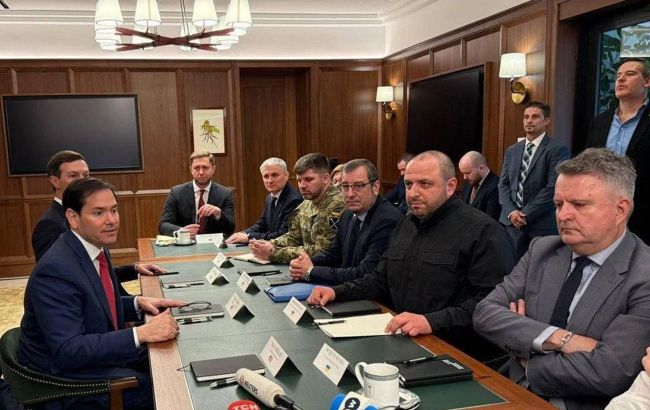 Delegations of Ukraine and the United States in Miami (photo: Getty Images)
This week, active negotiations on ending the Russian-Ukrainian war continued. First, Ukrainian and US delegations met in Miami. Then American envoys flew to meet Putin in Moscow — before returning to Florida for another round with the Ukrainians.
RBC-Ukraine outlines the key developments and trends of this latest week of talks.
Key questions:
-
What was discussed in Miami?
-
What response did the US deliver in Moscow?
-
What leverage is Washington using over Ukraine and Russia?
First meeting in Miami
On Sunday, November 30, Ukrainian and US delegations met in Miami. They continued working on the peace plan whose foundation had been shaped last week. The talks lasted roughly four to five hours. According to Axios, the main issue was the line of territorial control within a future peace agreement.
According to the outlet, after an hour of talks in an expanded format, the negotiations continued in a smaller group: from the US side, special envoy Steve Witkoff, Secretary of State Marco Rubio, and the US President's son-in-law Jared Kushner took part. From Ukraine, the participants were National Security and Defense Council Secretary Rustem Umerov, Deputy Chief of the Defense Intelligence Vadym Skibitskyi, and Chief of the General Staff of the Armed Forces of Ukraine Andrii Hnatov.
Sources of RBC-Ukraine report that the US, acting as mediator, conveyed to Ukraine Russia's position, which still insists on the full withdrawal of Ukrainian forces from Donbas and seeks to secure control over the occupied territories.
Ukraine, in turn, explained that such concessions are impossible due to constitutional constraints, public sentiment, and the actual situation on the frontline. Kyiv maintains that any discussions about territory can start only from the current line of contact.
Following the talks, US President Donald Trump stated that there is a "good chance" of reaching a peace deal.
According to The Wall Street Journal, the negotiations also addressed potential new elections in Ukraine and the prospects of a "territorial exchange" between Russia and Ukraine. At the same time, at least one issue remained unresolved. A source from the White House told the outlet that it concerns security guarantees, as well as the question of whether the Kremlin will continue to demand international recognition of the occupied territories.
A source for RBC-Ukraine familiar with the course of the talks said that the American side confirmed its readiness to provide Ukraine with security guarantees. However, Ukraine and the US view this issue from somewhat different angles.
"They say: we understand that without security guarantees, none of this potential can be realised," the source said.
For the Ukrainian side, however, the issue of security guarantees is more existential in nature, and it was not discussed in detail during this round of negotiations.
After the talks, Ukrainian President Volodymyr Zelenskyy held a joint conversation with Steve Witkoff. French President Emmanuel Macron and UK Prime Minister Keir Starmer also took part. Zelenskyy later stated that the peace plan "has become better."
Visit to Moscow
On Tuesday, December 2, US envoys — Steve Witkoff and Trump’s son-in-law Jared Kushner — traveled to Moscow. Their talks with Putin lasted nearly five hours.
Following the meeting, Yuri Ushakov, an aide to the Russian dictator, said the conversation had been "useful, constructive, and substantive." However, no compromises have been reached yet. According to Ushakov, Russia is ready to agree to some parts of the peace plan, while "some things drew criticism."
Specific wording of the US peace plan was not discussed; the sides spoke "about the essence." At the same time, in addition to the initial 28-point plan, Russia received four more documents.
Just before the visit, Russian dictator Vladimir Putin declared the need to "create a security zone along the border with Ukraine." Russian media explain that this allegedly refers to the need to take control of parts of the Kharkiv, Sumy, and Chernihiv regions bordering Russia.
The US side did not release details on the course of the talks. As an unnamed White House representative told Reuters, the US and Russia took part in a thorough, productive meeting.
"Special envoy Witkoff and Mr. Kushner briefed the President and the Ukrainians afterwards," the source told the agency.
At the same time as Witkoff and Kushner, China’s foreign minister Wang Yi also arrived in Moscow. He held a meeting with his Russian counterpart Sergey Lavrov. There is currently no information on whether Russia coordinated its position with China during the talks with the American representatives. However, such a "coincidence" does not appear accidental.
The US president also commented on the visit of his envoys to Moscow only in general terms.
"I don't know what the Kremlin's doing. I can tell you that they (Witkoff and Kushner) had a reasonably good meeting with President Putin," Trump said.
He also emphasized that the Russian dictator "would like to end the war" — at least that is the impression Trump’s team somehow formed.
However, Putin later said that the "peace plan" had now expanded again to as many as 27 points. It is worth noting that the initial draft consisted of 28 provisions and included maximalist demands toward Ukraine, but Kyiv and Washington later reduced it to two dozen points.
According to Putin, the American side allegedly "divided the 27 points of its plan into four separate packages and proposed discussing them one by one."
Russia rejected some of the US peace proposals. Putin did not specify which ones.
Sources of The New York Times report that the US divided its "peace plan" into four "packages." Each of them is intended to be discussed with the Russians. One of the "packages" concerns issues of Ukraine's sovereignty; the others relate to US–Russia economic cooperation and European security. The outlet, citing its sources, writes that negotiations on the four "packages" are taking place in parallel.
Miami again
After Witkoff and Kushner's trip to Moscow, two more rounds of Ukrainian-American talks took place. On the Ukrainian side, National Security and Defense Council Secretary Rustem Umerov and Chief of the General Staff of the Armed Forces of Ukraine Andrii Hnatov participated in the negotiations. Unlike the previous rounds, the results of this meeting are less public. And overall, after Witkoff and Kushner's visit to Moscow, the number of substantive leaks about the essence of the talks has noticeably decreased.
In general, it remains extremely difficult to bring the positions of Ukraine and Russia to a common denominator due to incompatible interests. At the same time, this week the US for the first time resorted to tools of pressure and incentives.
On December 2, it became known that the US had suspended the delivery of certain weapons to Ukraine and had also cut one of its direct contacts with German generals who coordinated support for Kyiv. Christian Freuding, commander of the German Army, said this in an interview with The Atlantic. He noted that he had previously been able to exchange text messages with the Pentagon on a regular basis, but now this communication channel is closed.
On the other hand, the US Treasury extended the special license that temporarily exempts the foreign gas station network of Russia's Lukoil from sanctions. The document will remain in effect until the end of April 2026. Trump imposed sanctions on the Russian company in November.
In addition, according to Bloomberg, the US is pressuring the EU to suspend providing Ukraine with a "reparations" loan financed from frozen Russian assets. US officials are privately persuading the leadership of EU member states that these funds could play a role in a future settlement between Russia and Ukraine.
Despite the complexity of the negotiations, the US is not giving up attempts to bring the process to some kind of peace agreement — while not publicly employing the full range of possible leverage.
Sources: statements by Ukrainian, American, and Russian officials, comments from RBC-Ukraine's sources involved in the talks, publications by The New York Times, Bloomberg, Axios, The Wall Street Journal, and Reuters.