Strategic bridge from mainland Ukraine to Crimea now critically damaged, military says

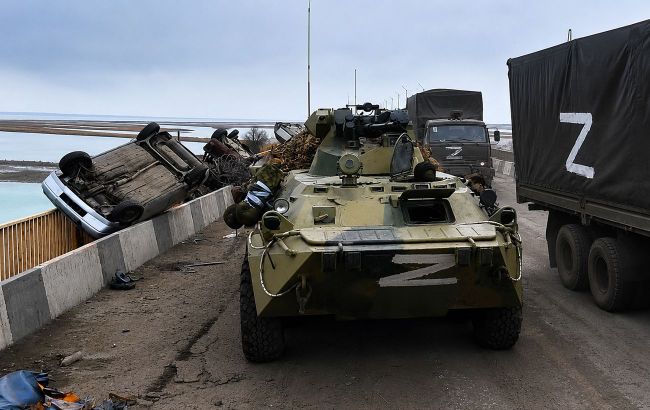 Photo: The Chonhar Bridge sustained critical damage during attacks by the Ukrainian Armed Forces (video screenshot)
The Chonhar Bridge in the temporarily occupied territory of the Kherson region sustained critical damage during Ukrainian drone attacks on June 7 and 9. It is currently completely impassable to traffic, according to Dmytro Filatov, call sign Perun, commander of the First Separate Assault Regiment named after Dmytro Kotsiubailo, speaking on Suspilne Studio.
The Chonhar Bridge has sustained damage that is critical to its structural integrity.
Currently, neither trucks nor passenger vehicles are using the bridge, and the bridge itself requires extensive restoration work.
Filatov notes that the Russian troops are now setting up pontoon crossings nearby, have changed their logistics, and have begun moving through Armiansk. However, Ukrainian troops are fully in control of the situation.
"We carried out another operation. We’ll share details later on how it went. Because the Chanhar Bridge was damaged, Russians concentrated a large number of trucks carrying military cargo, which were moving specifically through Armiansk. Consequently, during the strike, we managed to hit the trucks carrying fuel and ammunition. There were about 50 vehicles, and some of them were destroyed," the soldier says.
According to him, these actions were carried out thanks to a joint command post established by the First Separate Assault Regiment named after Dmytro Kotsiubailo together with the 475th Assault Regiment. It was named the Epicenter of Multidomain Operations.
At its core is a cyber intelligence unit that conducts very in-depth analysis of Russia. This allows us to obtain insider information and make the right decisions.
"As for the Chonhar Bridge, we decided because we had information that Russia would be using it to transport fuel. It took six hours from the moment the decision was made to its execution. We planned the operation on the Armiansk Bridge in advance, as we anticipated that this route would also be used. That’s why we were better prepared," adds Perun.
He explains that such actions yield both immediate and long-term results. Currently, Russia cannot properly supply its units, and in the future, it will have to spend significant resources on restoring these routes.
Meanwhile, commanders on the front lines have to focus more on logistics and find ways to improve supply lines.
"This operation would not have been possible if other units had not struck Mariupol and the road to Berdiansk. This is precisely what led the units stationed in the Huliaipole sector to begin receiving supplies not via the roads of Mariupol, but via Crimea. That is, they began using pontoons to ferry trucks to Crimea and then drive from Crimea to here. We realized this, blocked those routes fairly quickly, and continue to weaken the Russian troops," Filatov says.
Strikes on Chonhar Bridge
The first strike on the Chonhar Bridge was carried out on Sunday, June 7. After that, traffic across the bridge resumed in a two-way mode.
On June 9, the bridge was attacked again by drones, causing traffic to be suspended once more. Following this, the so-called Russian occupying authorities recommended using alternative routes via Armiansk and Perekop.
Ukraine's Center for Countering Disinformation reported that the Chonhar Bridge had been destroyed following several drone strikes.
In addition, on the morning of June 10, the bridge between Henichesk and the Arabat Spit was blocked in the temporarily occupied part of the Kherson region. This is already the second major crossing that the Russian troops have blocked in recent days, following the Chonhar Bridge.
And on the night of June 11, explosions were heard in Crimea, and social media reported fires in Simferopol and Sevastopol. There are also reports of damaged bridges at land entry points.