Range up to 320 km: Russian Su-35 jets armed with new missiles raising concern for NATO

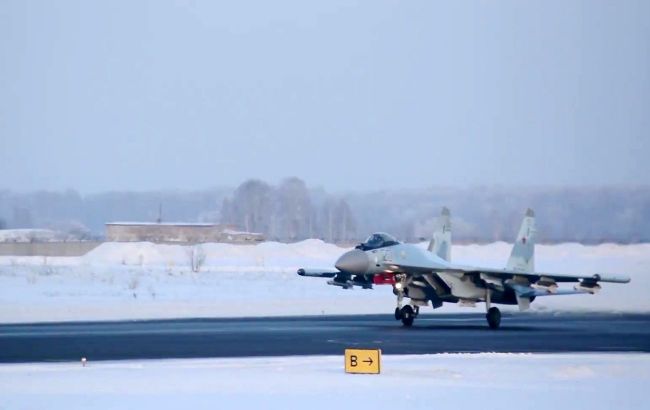 Russian Su-35 jets armed with new missiles (illustrative photo: Getty Images)
Russian Su-35 and Su-30SM2 fighters are increasingly being equipped with R-37M air-to-air missiles. Their range reaches up to 320 km and significantly exceeds the capabilities of previous R-77-1 missiles, expert Justin Bronk of the Royal United Services Institute said, Business Insider reports.
According to him, earlier R-37M missiles (in NATO classification — RS-AA-13 — ed.) were used mainly on MiG-31 interceptors. However, they are now regularly installed on Su-35S fighters as well, which Russia considers a key aircraft for achieving air superiority.
Main characteristics:
- Maximum launch range — more than 300 km;
- Flight speed — 6M;
- Speed of targeted aircraft — 2500 km/h;
- Missile length — 4.2 m;
- Fuselage diameter — 0.38 m;
- Launch weight — 600 kg;
- Warhead weight — 60 kg;
Guidance system — inertial with radio correction and active radar homing in the terminal phase.
The expert notes that the integration of these missiles with ground-based air defense systems increases the complexity of air operations for Western air forces.
In addition, combat experience gained by Russian pilots during the war against Ukraine has increased their level of training and potential effectiveness in future conflicts.
Despite the loss of some aircraft during the full-scale invasion, according to his estimates, Russia currently has approximately 135–140 fighters. The long range of R-37M missiles and their integration with air defense systems make these aircraft a significant factor in possible conflicts, especially in air-to-ground interaction.
At the same time, experts emphasized that Western countries retain a significant advantage in air, however new Russian capabilities significantly complicate the tactical situation for NATO.
Risk of NATO–Russia clash
Recently, NATO Secretary General Mark Rutte stated that Russia will remain a threat to the entire Alliance even in the event of a peace agreement with Ukraine.
A few days earlier, he also noted that NATO would be able to achieve victory in a possible confrontation with Russia if Moscow decided to attack the bloc right now.
At the same time, several Western officials believe that Russia may be preparing for conflict with NATO, and the question of a possible attack is only a matter of the timeframe of the coming years. In particular, the Minister of Defense of the Netherlands, Ruben Brekelmans, admits that such a threat could materialize by 2030.
In German military command, it was also suggested that a potential Russian attack on Alliance countries is possible within the next 2–3 years, and one of the key directions of risk could be Germany.