China heads to the Moon: What this mission could unlock for humanity

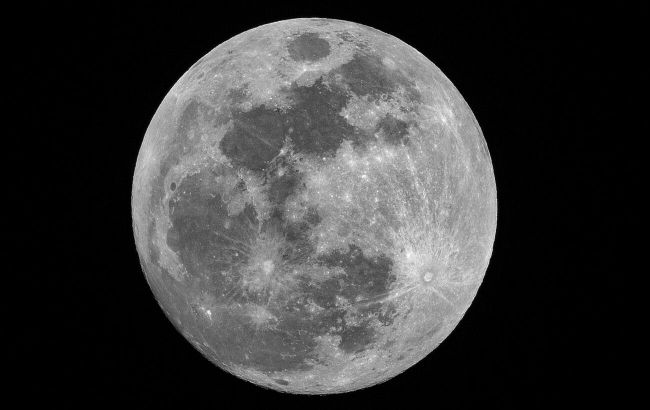 China plans to reach the Moon’s south pole faster than the US (photo: Unsplash)
The China National Space Administration (CNSA) is finalizing preparations for the launch of the robotic mission Chang’e-7. The main goal of the expedition will be the first-ever direct attempt to detect and analyze water ice deposits in the Moon’s permanently shadowed regions, according to BGR.
Why is everyone searching for water on the Moon?
Earth’s satellite has long been a key target for major space agencies. While NASA is developing plans to build a permanent base under the Artemis program, China is mirroring these efforts by focusing on the same region — the Moon’s south pole.
The search for water is a priority not simply to confirm its existence — the presence of ice in permanently shadowed craters has already been confirmed by remote observations and data from the James Webb Space Telescope. The goal is precise mapping of these deposits for future practical use.
Scientists say that access to liquid water on the Moon would radically transform space exploration. Here’s how:
- Reducing launch mass. Water is heavy. If astronauts do not need to carry it from Earth for drinking and technical needs, it frees up space for scientific equipment.
- Fuel production. By splitting water into oxygen and hydrogen, future settlers could refuel rockets directly on lunar bases for deep-space missions, such as trips to Mars.
- System cooling. NASA, in particular, plans to deploy a nuclear reactor on the Moon, which would require a reliable cooling system based on local water resources for stable operation.
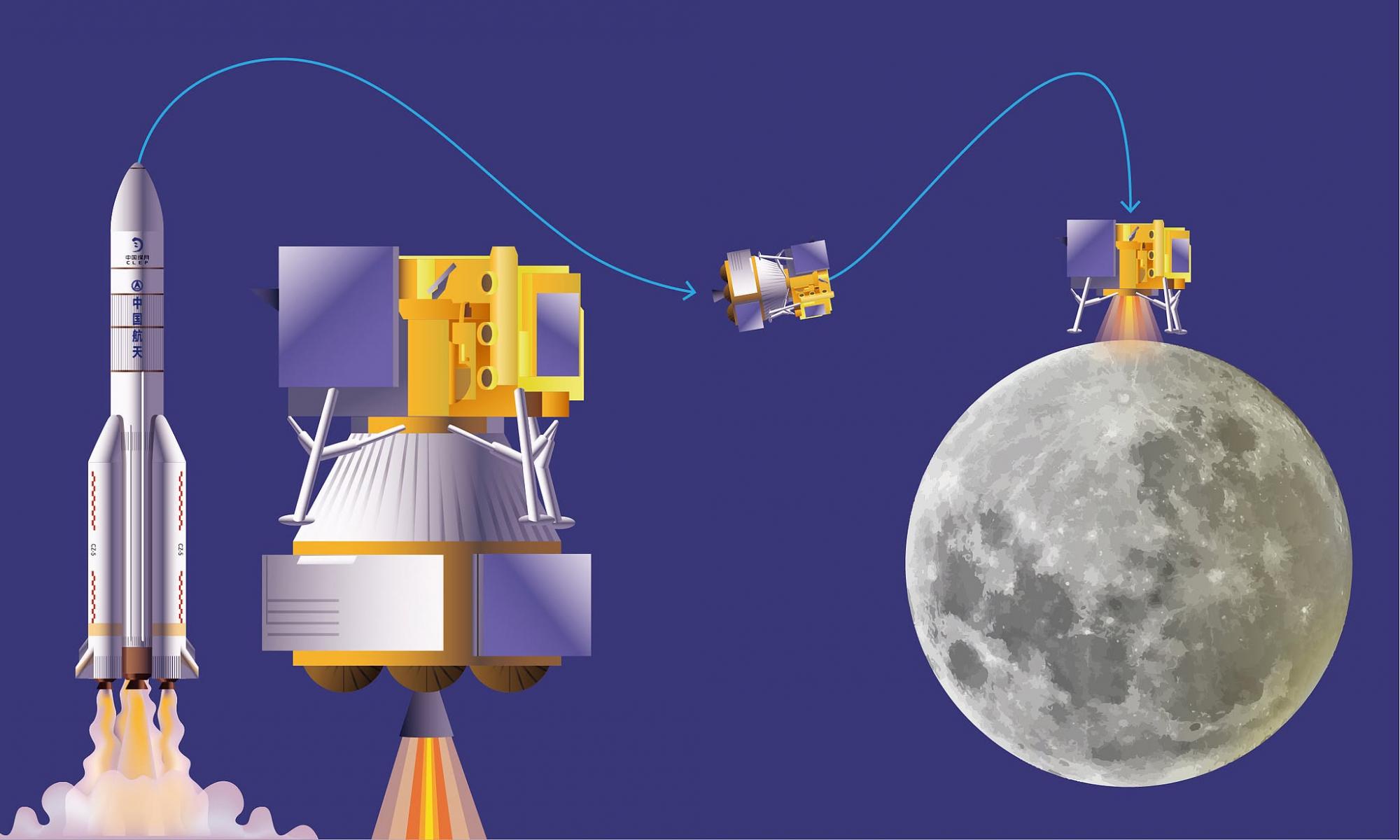 A spacecraft will include a lander module, an orbiter, a lunar rover, a hopping drone, and a relay satellite (diagram: CGTN China24).
How will Chang’e-7 work?
The Chinese spacecraft is heading toward the Shackleton Crater region. To succeed, engineers must solve a highly complex technical challenge — landing the module in extremely rugged terrain with an accuracy of less than 100 meters from the target point.
Building on the success of the previous Chang’e-6 mission, which for the first time in history returned soil samples from the far side of the Moon, this new launch will feature a significantly more advanced research system.
To scan the permanently shadowed areas that never receive sunlight, the orbiter and lander will use a combination of instruments:
- ultra-high-resolution mapping cameras
- wide-band infrared spectrometer
- hyperspectral imager for determining the chemical composition of lunar regolith
The key engineering feature of Chang’e-7 will be a special flying mini-probe. Since the lander’s solar panels require sunlight — which at the lunar pole arrives only at a very low angle near the horizon — this mini-device will be able to literally hop from place to place.
It will dive into dark crater floors, perform direct soil drilling, analyze samples for water ice molecules, and then return to illuminated areas to recharge and transmit data back to Earth.
In addition, the mission will carry a lunar seismograph to detect internal vibrations (moonquakes).
NASA is preparing a similar concept mission with its VIPER rover, but China’s schedule indicates that Chang’e-7 may launch earlier.