SpaceX wants to build factories in Earth orbit: Details about new Starfall spacecraft

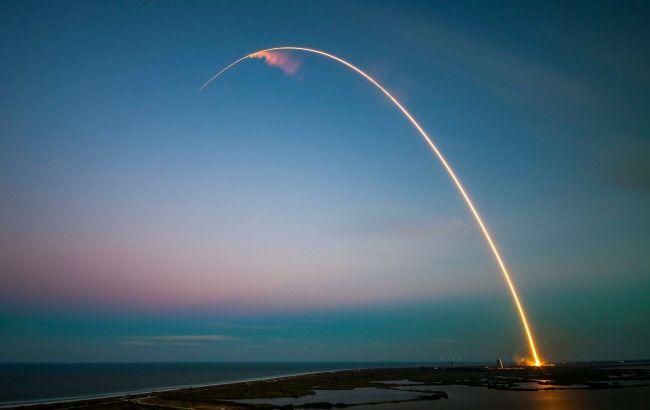 SpaceX launches a potentially commercially successful Starfall project (photo: Unsplash)
The U.S. Federal Aviation Administration (FAA) has approved test flights of a completely new SpaceX spacecraft called Starfall. The specialized capsule will not only enable the rapid return of valuable cargo from orbit to Earth, but also help create a fully autonomous space-based economy with factories directly in space, according to Interesting Engineering.
Read also: US military tracks UFO with physics-defying capabilities
Technical specifications of Starfall
The FAA has officially authorized SpaceX to conduct two Starfall capsule reentry tests in the Pacific Ocean, approximately 1,300 kilometers off the coast of California.
Dimensions: The capsules are circular, with a diameter of 3.1 meters and a height of 0.75 meters.
Weight: The total mass of the vehicle, including the upper panel and a heavy heat shield, is 2,100 kilograms. The heat shield will be jettisoned just before splashdown.
Payload capacity: The module is capable of delivering up to 1,000 kilograms of cargo back to Earth.
Soft landing: To slow down in the atmosphere, the capsule is equipped with a parachute system (a drogue parachute, a pilot chute, and one main parachute), as well as cold-gas thrusters for orientation in space.
After splashdown, the capsules will be recovered by the company’s specialized maritime vessels.
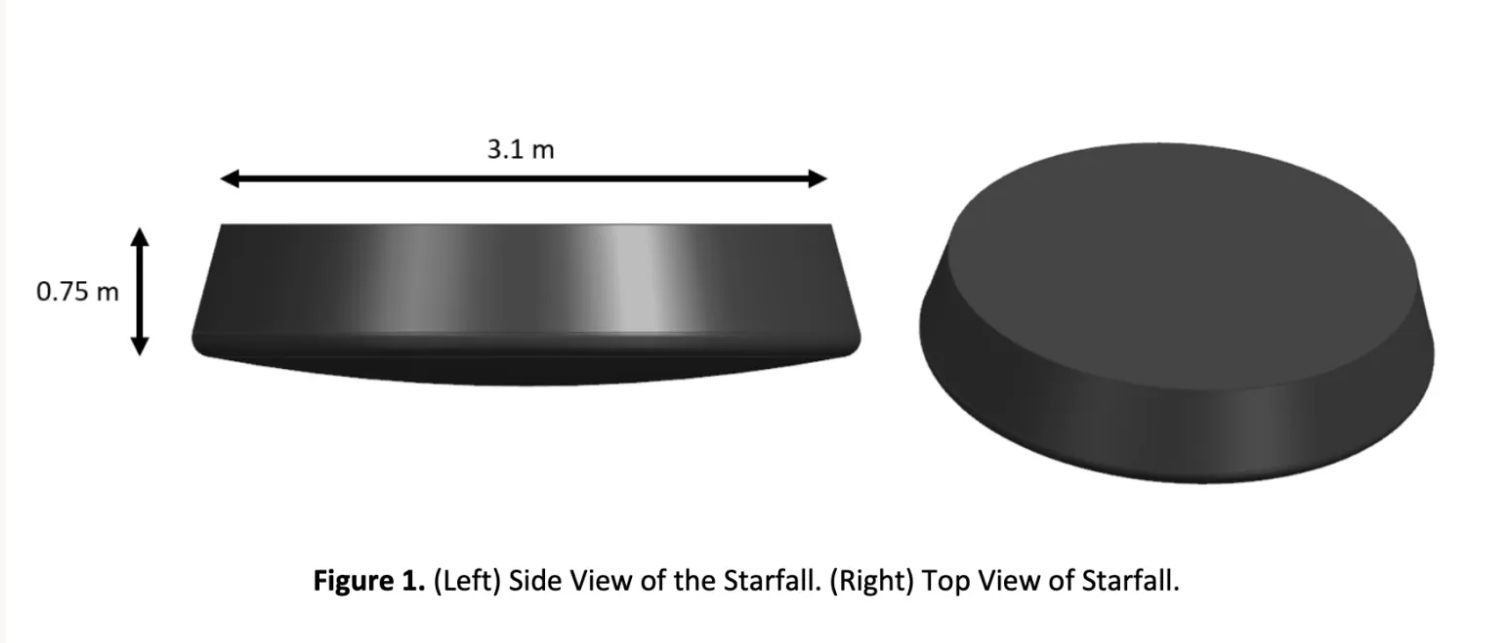
Illustration of the SpaceX Starfall capsule, included in the Federal Aviation Administration (FAA) environmental assessment (FAA screenshot)
Factories in microgravity and military logistics
The main value of Starfall lies in scaling commercial services.
First, the vehicles are expected to support the development of the so-called “orbital manufacturing” market. Microgravity and vacuum conditions are ideal for growing unique crystals, high-precision semiconductors, or pharmaceuticals that cannot be produced on Earth.
The capsules will be able to remain in orbit for extended periods as mini-factories and then safely return finished products to customers. In the long term, SpaceX sees this project as a mass “successor” to the International Space Station (ISS).
Second, the system is planned to be integrated into a rapid delivery network for military cargo for the Pentagon. Using Falcon 9 or Starship rockets, the capsule could be launched on a suborbital trajectory to any point on Earth within minutes.
A blow to competitors?
The launch of the Starfall project could fundamentally reshape the rules of the space services market. Most notably, SpaceX would become a direct competitor to its own current customers.
Companies such as Varda Space Industries, Inversion, and Amos Space Cargo purchase Falcon 9 launch slots to send their own small capsules for orbital experiments. If Elon Musk begins serial production of similar devices and offers a lower “end-to-end” cargo return price, startups will struggle to compete with the tech giant.
The exact date of the first test flight has not yet been disclosed, but given the approval of documentation, testing could begin in the near future.
You might also be interested in: