Earth could lose 50% of its population: Scientists find humanity’s survival limit

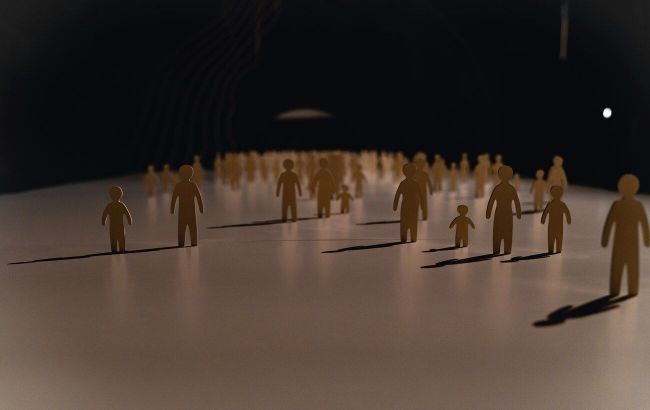 Overpopulation of Earth is unlikely (photo: Magnific)
An international group of scientists has created a new mathematical model showing humanity’s high sensitivity to sudden environmental or social shocks. The researchers simulated a hypothetical scenario in which the global population could be halved in just forty years, according to research results published in the scientific journal Chaos, Solitons & Fractals.
Read also: Scientists revive human brain after death: What's behind the lab experiment
What is Earth’s carrying capacity and why could it decline?
Scientists explain that every planet has its own carrying capacity — the maximum number of living beings it can sustain with food, water, and safe living conditions without harming the environment.
Currently, about 8 billion people live on Earth. However, due to the climate crisis, resource shortages, large-scale wars, or pandemics, this limit could sharply decrease.
Physicists calculated that if, due to a global catastrophe, the planet’s carrying capacity suddenly dropped to 2 billion people, then by 2064 the world population would be reduced by half. Instead of the expected 8–10 billion, only 4–5 billion people would remain on Earth.
“This is not an exact forecast and not an announcement of an apocalypse. It is a mathematical model showing how strongly we depend on environmental stability. The real situation on the planet remains relatively stable,” said Professor of Physics at the University of Milan Alessio Zaccone, one of the study’s authors.
Revisiting the old Doomsday prediction
Scientists decided to re-examine the famous 1960 analysis developed by Heinz von Foerster. At the time, researchers claimed that if humanity continued to grow at the same rapid pace as over the past two thousand years, then Doomsday would arrive in 2026 — meaning population growth would become infinite and uncontrollable.
This scenario did not come true, as global birth rates eventually began to decline. However, according to Zaccone, the mathematics of such “unrestrained growth” could still apply under certain conditions.
New calculations show that if humanity ignores the ecological limits of the planet, we could reach another dangerous threshold by 2078, when nature would no longer be able to replenish resources fast enough for human needs.
Why can this scientific model be trusted?
Scientists are confident in the accuracy of their mathematical formulas because they have tested them against human history over the past 12,000 years. The model accurately reproduced both the rapid demographic explosion during the Industrial Revolution and the gradual slowdown in population growth that began around 1970.
“Of course, a scenario in which the planet can support only 2 billion people is unlikely. It would require something extreme — for example, a nuclear winter or a complete collapse of the climate system,” the researchers clarified.
Nevertheless, scientists hope their work will help world leaders better understand future risks and respond in time to global threats.