Putin's ballistic terror could be his own trap — is a truce possible this year?


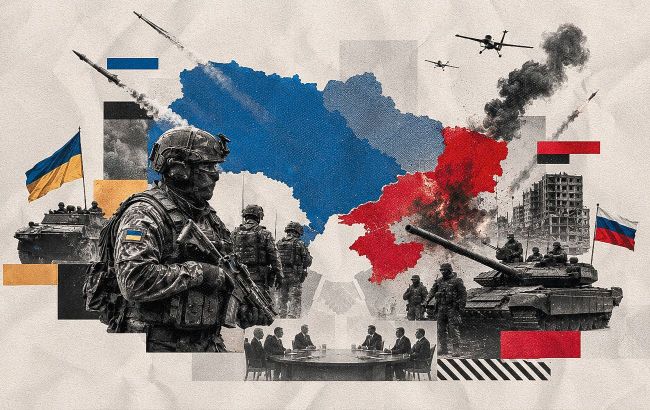 Russia cannot achieve breakthroughs at the front, but is intensifying missile terror (collage: RBC-Ukraine)
Putin is entering the second half of the year without victorious breakthroughs, but also without readiness to stop the war. Ukraine, for its part, is trying to contain the pressure at the front and increasingly deepen combat operations into the Russian rear.
What to expect from the war by the end of the year and whether chances for negotiations remain – in this RBC-Ukraine article.
Key points:
- The pace of the Russian offensive has slowed. Russian forces are advancing more slowly than in previous spring-summer campaigns, but Moscow is not abandoning pressure in key directions and still wants to take all of the Donetsk region by the end of this year.
- Where the threat lies. The most difficult situation is developing around Kostiantynivka, and by the end of the year the risks may increase for Lyman and Dobropillia.
- Threat in the north. If Moscow carries out a limited operation in the Chernihiv or Kyiv region, it would want to use this to force Ukraine to redeploy forces there from Donbas.
- A new mobilization in Russia is not a settled matter. If the Kremlin does go ahead with it after the September elections, it could involve 100,000–300,000 people, and the call-up itself will most likely be stretched out over several months.
- The air war will intensify. Ukraine is increasing strikes on Russia's military economy, while Moscow is relying on ballistic missiles, jet-powered Shahed drones, and attacks on Ukraine's energy infrastructure.
- Chances for peace. Previous compromise formulas have not worked, and Putin is not ready to stop without a result he can present as a victory. New ideas are now being sought.
Expectations of a quick end to the war are increasingly diverging from the reality on the front. Russia is trying to continue its offensive, accompanying it with strikes on our rear. Ukraine is looking for ways to raise the price of Moscow's aggression, expanding the scale and geography of strikes on military, industrial, and logistics facilities.
"A few months ago the president instructed [officials] to look for every way to force Russia to stop by the end of the year and sit down for negotiations. The idea was that if we enter the winter still at war, the Russians will hit us hard and this winter will turn out even harder than the last one. That task has not been cancelled, and everyone continues to carry it out," one source familiar with the matter told RBC-Ukraine.
What is happening at the front
Unlike previous years, when in the second half of spring the pace of the enemy's advance noticeably increased and peaked in summer, this year it is several times lower than in the corresponding periods, and even lower than it was in winter.
The offensive in the Zaporizhzhia region, which Moscow had earlier tried to intensify, has slowed under the impact of Ukrainian counterattacks. There, the Russians' goal was to get as close as possible to the city of Zaporizhzhia. This, however, does not mean that the Russians have completely abandoned this direction: even limited activity there forces Ukraine to keep forces that could be needed in Donbas.
Donetsk region remains the main theater of combat operations. The enemy's current goal is to capture the Kramatorsk-Kostiantynivka agglomeration — the foundation of Ukrainian defense in the north of Donetsk region. The Russians are trying to get as close as possible to Sloviansk and Kramatorsk — key fortresses there under Ukrainian control.
The most threatening situation remains in Kostiantynivka. According to the outlet's sources, enemy troops are already being recorded in most of the city — they (the South Group of Forces) are not only infiltrating it but also trying to cut it off from roads and logistics.
Further south, the enemy's Center Group of Forces is trying to break through to Dobropillia to bypass Kostiantynivka, Druzhkivka, and Kramatorsk from the west. Another dangerous section is the Lyman area, where the occupiers want to push through from the east.
Sources in military-political circles interviewed by RBC-Ukraine do not see grounds for a rapid operational breakthrough of the entire Ukrainian defense line in the Donetsk region, but they suggest that in the coming months Ukraine may lose control of Kostiantynivka. And, in their assessment, the same risk may loom over Lyman and Dobropillia by the end of the year.
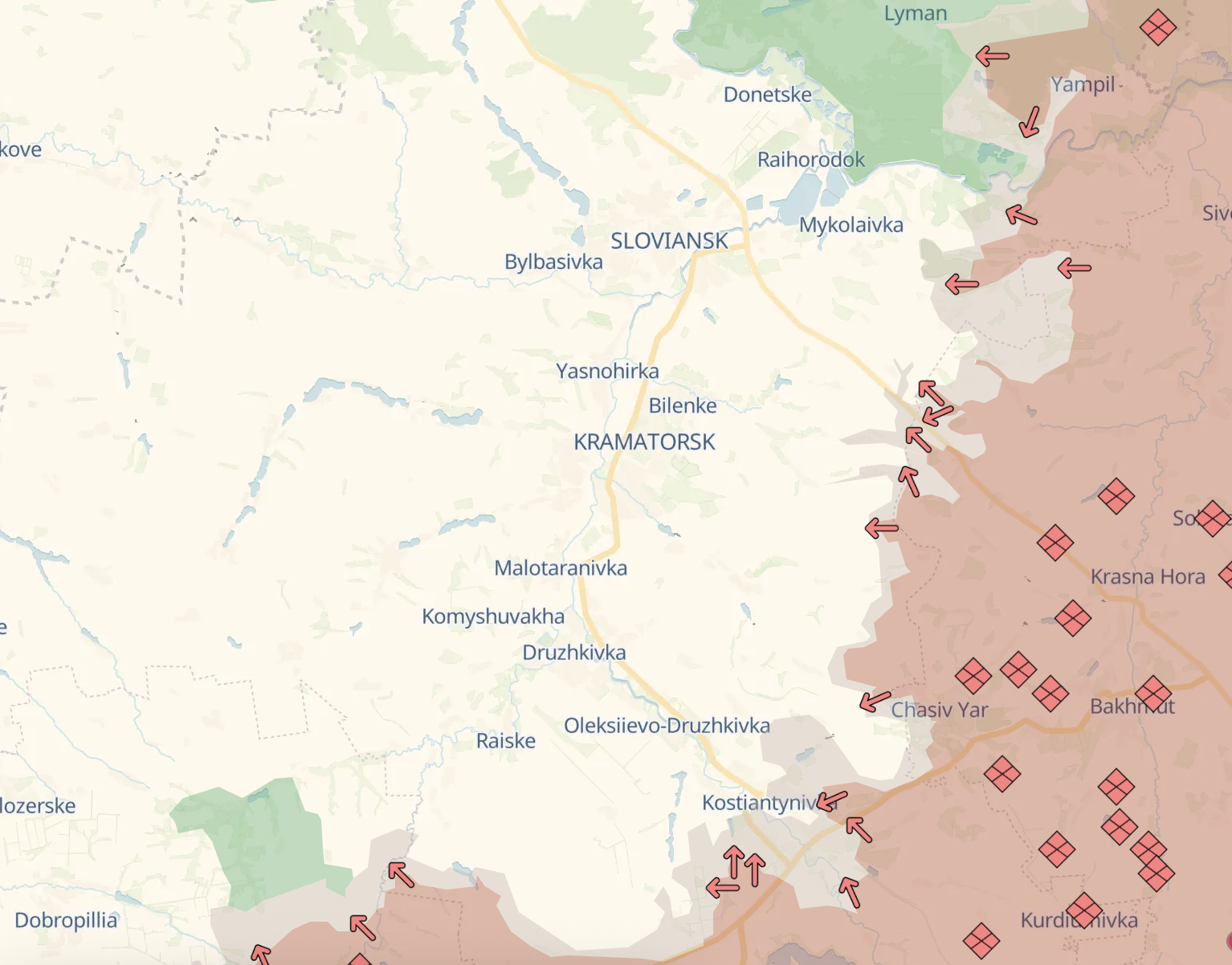 Russia will concentrate its efforts in the coming months around the Kramatorsk-Kostiantynivka agglomeration (map: Deepstate)
"If events develop unfavorably for Ukraine, by the end of winter Russian forces could come right up to Sloviansk and Kramatorsk. However, to reach these cities, it is not enough for the Russians to slowly push the front line forward. They will have to consistently overcome prepared defensive lines, extend their flanks, and bring up logistics, all while constantly being under fire from Ukrainian drones," one of the sources believes.
A possible new Russian operation from the north remains an open question. The sources lean toward the view that Russia could conduct an operation with limited forces, attempting to breach the border in the Chernihiv region or even the Kyiv region. Bryansk region could serve as the staging ground for offensive actions in that case. Direct participation by Belarus is not currently considered mandatory.
Even under such a scenario, the goal of a possible offensive in the north is unlikely to be a deep breakthrough toward Kyiv. Russia may officially call it an "attempt" to create a so-called buffer zone along our border. But even that would rather be a tool for a broader plan — to stretch our defense along the border and force Ukraine to pull forces away from where the Russians are trying to achieve their main result — in the Donetsk region.
Whether they will have enough forces for such an operation will depend above all on the Kremlin's mobilization decisions. Even now, the enemy army is experiencing a shortage of personnel. And although the plan for recruiting contract soldiers is being fulfilled almost 100%, this is not enough either to form new units and formations or to fully replenish losses. Over the past month, according to RBC-Ukraine's information, these losses have already reached 40,000, more than 60% of them killed.
Moscow's biggest shortfall is in recruitment for its unmanned systems forces: students and young people are offered service in UAV units as a supposedly safer and more prestigious option. However, there is still no flow of volunteers.
Sources in military and political circles are not prepared to confidently predict that after the September elections in Russia, the Kremlin will already conduct a new wave of mobilization this autumn. If Putin does take such a step, according to informed sources' estimates, it could involve 100,000–300,000 people, in parallel with the continuation of contract recruitment.
Most likely, such a mobilization will be stretched out over several months. This would, on one hand, allow the Kremlin to avoid a single-moment public shock, and on the other, reduce the burden on training centers: the Russian system simply is not capable of simultaneously receiving, clothing, arming, and training hundreds of thousands of people. As a result, the effect of this new wave of mobilization may show up as early as winter, or even next year.
Escalation in the sky
The fighting on the ground is accompanied by a more intense exchange of strikes. Since spring, Ukraine has been increasingly carrying the war into the deep rear, building up strikes on Russia. Their geography keeps expanding, and the attacks themselves are gradually turning from isolated operations into a systematic campaign against the enemy's war economy. This is precisely an element of the Ukrainian plan for how to force Putin into real peace talks.
"Right now something is flying toward Russia every day. If nothing is reported about it publicly, that's only in the case when they failed to hit what they wanted to hit," one of RBC-Ukraine's informed sources clarified.
The main targets of Ukrainian strikes remain defense industry enterprises and oil refining facilities. In early July, Ukraine's General Staff reported that strikes had taken 42.74% of Russia's total design oil-refining capacity out of operation. Since mid-spring, Ukraine has begun blocking the occupiers' logistics routes in front-line regions to simultaneously create supply problems for the enemy army and make life harder for Russians in Crimea. Large logistics complexes — hubs of Russian marketplaces — have now been added to this list as well.
In terms of the volume of long-range drone use, Ukraine has already essentially caught up with Russia, the outlet's sources claim. According to them, Kyiv still retains a technological edge as well: solutions that Ukraine applies first often appear in Russia about four months later.
Moscow, for its part, is also escalating, building up its attacks. The enemy has begun systematic attacks on Ukrainian defense enterprises, logistics facilities, and port infrastructure to make the grain corridor's operation impossible. Gas stations have become a separate target in order to complicate fuel supply and everyday life in regions near the front.
The tactics of strikes on the Ukrainian capital have also changed. The enemy is increasingly relying on ballistic missiles, knowing about the acute shortage of PAC-3 interceptor missiles for Patriot systems.
"The Russians saw, using Iran's example, how it terrorized the Middle East mostly with ballistic missiles and drones. And they took that as a lesson. Why would they plan a complex combined strike with different routes and different times of arrival for targets? Now they simply launch 10-20-30 ballistic missiles at the capital, understanding that some portion of them will get through given our shortage," one officer says in conversation with the outlet.
This trend will likely continue in the fall: Moscow will keep relying on ballistics, combining it with cruise missile strikes and massed Shahed drone raids, RBC-Ukraine's sources predict. Currently, according to the outlet's information, the Russians are producing about 66 9M723 missiles for the Iskander-M system and approximately 10 hypersonic Zircon cruise missiles per month. Both types of weapons have recently been used frequently by the Russians against Kyiv and the surrounding region. In addition to these, the enemy also periodically uses S-400 system missiles and North Korean KN-23 ballistic missiles for strikes.
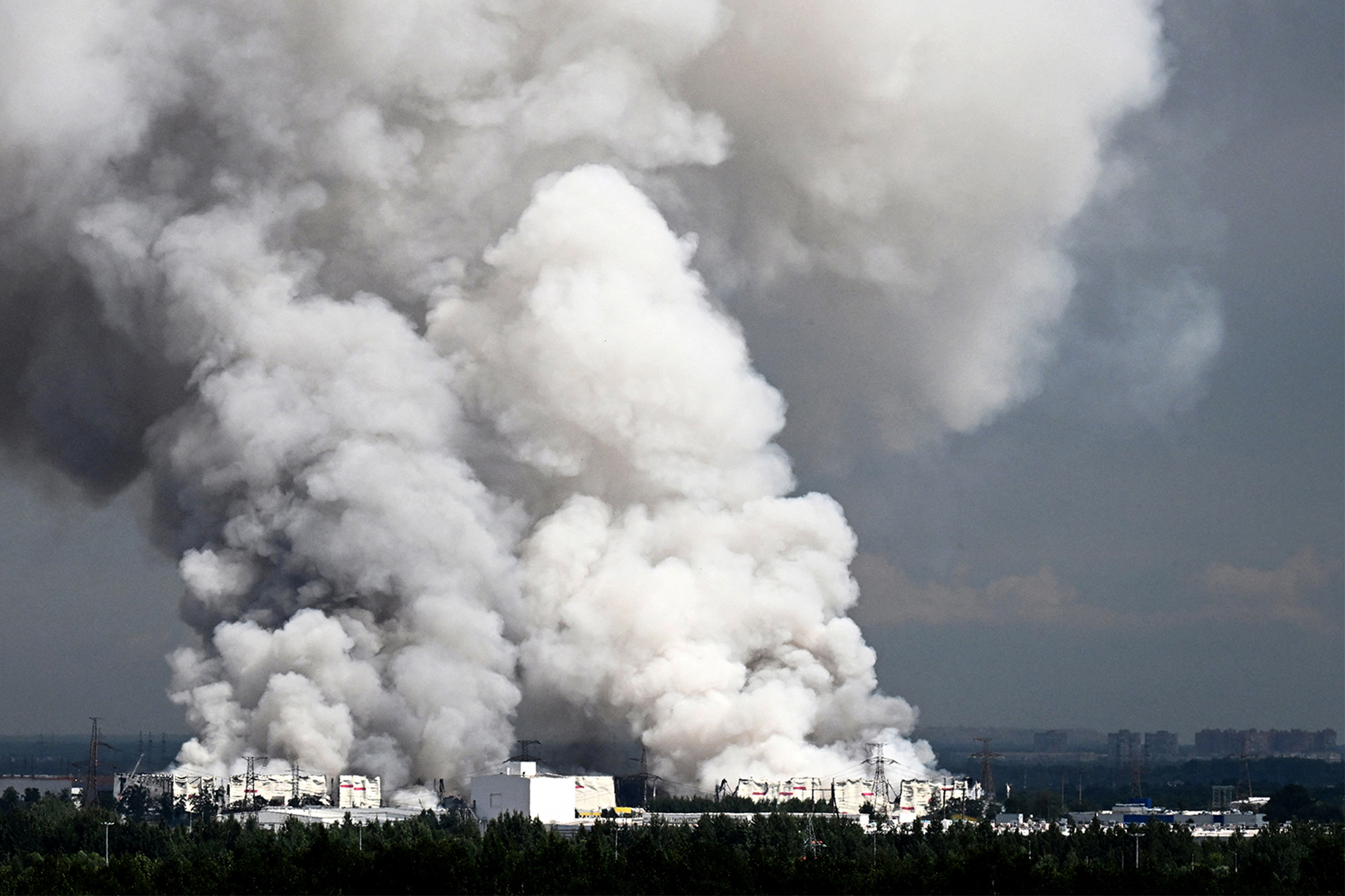
The aftermath of strikes on one of the hubs of the Russian marketplace Wildberries (photo: GettyImages)
According to rough estimates, in July the enemy launched more ballistic missiles than it is capable of producing in that period. So, without ramping up production, Moscow is unlikely to consistently sustain the same number of missiles in a salvo during ballistic missile strikes.
According to the outlet's information, the Kremlin is now trying above all to increase production of jet-powered UAVs — as a response to Ukraine's active development of its own drone interceptors designed to shoot down conventional Shaheds.
In the air war, both sides have their vulnerabilities. Russia is physically incapable of reliably covering its vast territory and all the enterprises scattered across it. Ukraine, meanwhile, has to defend a much smaller space, but faces a shortage of the most critical missile defense assets.
The problem is not only the political readiness of partners to hand over Patriot missiles to us. Globally, objectively fewer of them are produced than Ukraine, the United States, and allies in the Middle East currently need. According to CSIS estimates, the United States had about 759–827 PAC-3 family interceptors remaining as of the end of July. In contrast, before the start of the war with Iran, it had about 2,330 such missiles.
The Pentagon's new multi-year contract envisions increasing PAC-3 production to 2,000 units, but Lockheed Martin expects to triple its capacity only by the end of the decade. In other words, a solution for the future is already being formed, but it will not eliminate the shortage this fall.
The prospects for Ukraine's own missile defense remain unclear for now. The Franco-Italian SAMP/T NG system is meant to become an alternative. The first systems were promised to be handed over to Ukraine this year, but the main question is not only the appearance of the systems themselves, but whether partners will be able to supply enough missiles for them consistently.
Ahead of winter, the exchange of strikes will most likely only intensify: Russia will again try to hit Ukraine's energy sector, counting on using the cold as an additional tool of pressure, while Ukraine will respond in kind with attacks on Russian energy, military-industrial, and logistics facilities.
Kyiv bets that a firm defense at the front combined with large-scale strikes on Russian territory should demonstrate to the Kremlin the real price of continuing the war. This is not only physical destruction, but also the need to redeploy air defense, cut exports, finance repairs, and explain to Russians why the war, which was presented to them as a distant "special military operation," is increasingly arriving in their own regions.
However, long-range strikes alone are not enough for a turning point. They can wear down the enemy, limit its capabilities and resources, but their effect becomes decisive only in combination with resilience at the front, economic exhaustion, and political pressure.
What about negotiations
There are almost no real prospects for a peaceful settlement this year — that is the assessment RBC-Ukraine has heard in recent weeks from many sources in the Ukrainian government and foreign diplomats.
At the same time, just a few months ago the situation looked somewhat different. Ukraine had just begun noticeably increasing the intensity of its middle and especially deep strikes. The absence of the aggressor's operational breakthroughs at the front and the growing discontent inside Russia itself gave some hope that Putin might finally sit down seriously at the negotiating table.
In reality, it turned out that these actions had the opposite effect on the Russian leadership — to grit their teeth and fight to the end. This is visible even in the sharpened rhetoric of Putin himself and his subordinates. Sources informed about the mood in Moscow confirm this to RBC-Ukraine: the aggressor intends to arrange another hard winter for Ukrainians, counting on the home front finally breaking this time.
"Both sides lack an exit strategy (from the war)," states a source in the Ukrainian government in conversation with RBC-Ukraine.
This refers to the fact that previously proposed compromise options are unacceptable either to Kyiv or to Moscow.
For example, it took almost a year to bury the "spirit of Anchorage." As Head of the Office of the President Kyrylo Budanov explained in an interview with RBC-Ukraine, the Russians put into this vague concept the preservation of their control over Crimea, parts of Kherson and Zaporizhzhia regions, as well as control over the entire territory of Donbas.
And, according to numerous reports by Western media, Donald Trump promised to secure such peace terms for Putin in Anchorage. But he ran into fierce resistance from Ukraine.
"The Americans asked us many times: well, why are you so stuck on this little piece of Donbas that you can't even find on a map?.. Give it up — and you'll have peace," one Ukrainian negotiator told RBC-Ukraine. According to another, some interlocutors on the American side were especially puzzled by the fact that Donbas doesn't even have oil and gas deposits. So they wondered, what was there to fight for?
Ukraine, for its part, explained that simply handing over part of its territory to the enemy, along with the people who live there, is simply not an option at all. This would only be a senseless concession to Russia, which would be able to seize part of the territory without losses, after which it would continue its aggression either immediately or after a short pause.
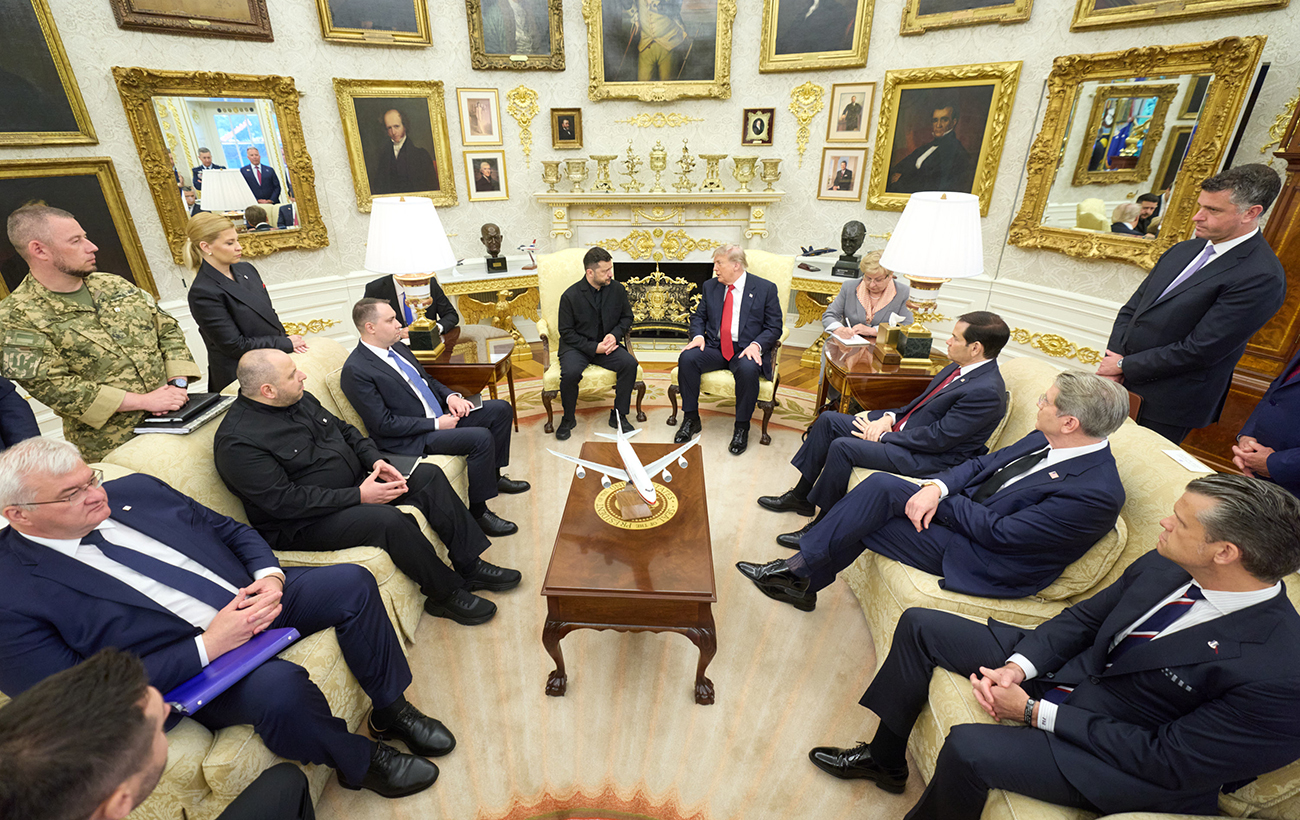
Ukrainian sources believe the old formulas voiced during negotiations don't work, and a search for new ideas is underway (photo: president.gov.ua)
Separately, according to RBC-Ukraine's information, the Americans had to be convinced that it wasn't only Zelenskyy personally who saw the situation this way, but that on this issue there was, if not an absolute consensus in Ukrainian society, then at least a confident majority: both in society and in the political class it is believed that land and people cannot simply be given away.
In the end, the death of the "spirit of Anchorage" was publicly stated by US Secretary of State Marco Rubio. Still, as one of the outlet's sources noted, for greater certainty it would be good to hear the same words personally from Trump.
Another idea also didn't go through — creating either a free economic or a demilitarized zone in Donbas, which, at the suggestion of one Ukrainian negotiator, began to sometimes be called "Donnyland," counting on Trump's vanity and his mania for naming all sorts of objects after himself. For example, the project of a route to connect Nakhchivan exclave with the rest of Azerbaijan as part of the peaceful settlement of the Karabakh conflict officially received the name "Trump Route for International Peace and Prosperity."
The concept of "Donnyland" was discussed for some time in various formats between Ukraine, Russia, and the US, until Putin banned his negotiators from such discussions, setting the main task — full control over the entire territory of Donetsk and Luhansk regions.
"We are now searching for new ideas, since the old ones don't work," one Ukrainian negotiator tells RBC-Ukraine. Certain hopes in this regard are being placed on the visit of Steve Witkoff and Jared Kushner to Kyiv expected in August, after which — or on the way back — they will also stop in Moscow.
"When they come to us, we'll sit down and put something together out of various options," a source on the Ukrainian side vaguely describes the plans to the outlet.
According to him, during Zelenskyy's last visit to Washington, "it was possible to revive the negotiating track," but so far there are no specifics whatsoever.
Other sources assess the prospects for peace rather skeptically. All the more so because the lion's share of Trump's attention, as before, is taken up by Iran, and negotiations effectively went on pause at the end of winter due to the start of another war in the Middle East.
***
For now, Moscow is not demonstrating readiness to end the war without a result it can call a victory. Several informed sources, when asked the question "Doesn't Putin want to end the war?" — answer the same way: "He can't."
"He has defined for himself something he will be able to present as a victory. Now this isn't even the capture of Kyiv or the overthrow of Ukraine's government — the minimum victory in his worldview, his picture of the world, in his head — call it whatever you like — is the seizure of the whole of Donetsk region, in addition to Luhansk. He is not ready to settle for anything less right now," one of the outlet's sources muses.
It's worth noting that both this source and other interviewed sources of RBC-Ukraine in military-political circles disagree on whether this is indeed the very victory after which Putin will want to stop.
"He talked so much about denazification and other abstractly absurd things that the Russian people cannot measure — whether it's been achieved or not. He talked no less about the so-called liberation of Donetsk and Luhansk regions, and that is something people there can actually assess, unlike all the other goals of the special military operation. And that is a trap he has driven himself into," another source of the outlet explains.
The problem is also that the Russian president may have a distorted picture of the real state of affairs at the front. According to RBC-Ukraine's sources, over the past year he has been shown maps on which the entire gray zone is already marked as occupied, as are settlements that even a single Russian soldier has entered, even if he was subsequently eliminated.
Because of this, the staff maps that land on Putin's desk may be about ten kilometers ahead of the real line of contact. On some of them, occupation forces are supposedly already standing right outside Zaporizhzhia. In such a system, each successive level of command embellishes the result.
If Putin is indeed making decisions based on such a picture, this only strengthens his belief that Russia needs to continue the offensive and that the desired result is closer than it actually is.
This also explains why the Kremlin keeps setting deadlines that it fails to meet each time. According to Moscow's plans, the Russian army was supposed to reach the administrative borders of the Donetsk region once again by the end of the year. The outlet's sources doubt not only the realism of these deadlines — they are not prepared to predict whether the Kremlin will be able to achieve this goal even by 2027.
It is with exactly this contradiction that both sides entered the second half of the year. Russia has no quick path to the victory it wants, but Putin is not yet ready to give it up. Ukraine cannot instantly force the Kremlin to stop, but is trying to make every subsequent month of war more costly for it. The question is not so much who will deliver more strikes, but whose system will be the first to stop withstanding their cumulative cost.