Wildberries under attack: How Ukrainian strikes are crippling Russia's logistics


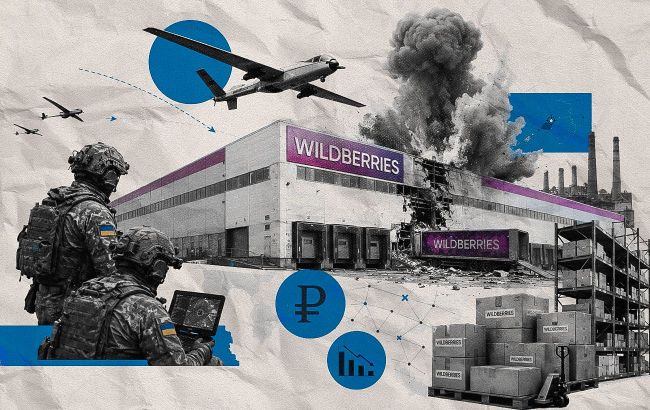 Russia's Wildberries has become a military target for Ukraine (photo: collage by RBC-Ukraine)
After targeting Russian oil refineries, Ukraine has opened a new front in its long-range campaign by striking the logistics infrastructure of Russia's largest online marketplace, Wildberries (Russia's biggest e-commerce platform).
Why Wildberries warehouses have become a military target for the Armed Forces of Ukraine, and how these strikes could affect supplies to the Russian military, the country's economy, and the daily lives of ordinary Russians, is explored in this RBC-Ukraine report.
Key points:
- Ukraine is now targeting marketplace logistics. After striking oil refineries and defense industry facilities, it has begun hitting Wildberries logistics hubs in several Russian regions.
- Wildberries has become a military target. The platform is used to sell military gear, drones, and components that can be purchased by Russian military personnel.
- The company's main vulnerability is its large centralized warehouses. Damage to a single hub overloads others, delays deliveries, and increases operating costs.
- A rapid collapse is unlikely. But sustained attacks could disrupt Russia's domestic distribution network, deepen shortages, and put additional pressure on prices.
- Some of the losses are being passed on to sellers. Wildberries has attempted to classify drone strikes as force majeure in order to limit compensation for destroyed merchandise.
- The objective is not only military. Ukraine aims to complicate supply chains for the Russian military while also making the consequences of the war more tangible for Russia's civilian population.
Over the past week, Ukrainian drones have struck several logistics complexes belonging to Wildberries, Russia's largest online marketplace. The attacks targeted the company's distribution hubs in the Moscow, Tambov, Krasnodar, and Sverdlovsk regions, the Stavropol Territory, Russian-occupied Crimea, and the area near St. Petersburg.
President Volodymyr Zelenskyy said that the Armed Forces of Ukraine consider Wildberries warehouses to be legitimate military targets. In addition to buying and selling everything from food, clothing, and cosmetics, Russians have used the platform to trade military equipment and even unmanned aerial vehicles (drones), which have subsequently been used on the battlefield in Ukraine.
As a result, all major Russian online marketplaces are now expected to face a continuation and expansion of Ukraine's campaign targeting their logistics facilities.
The mechanics of parallel imports: From clothing to drone components
To understand the scale of the business, Wildberries reports annual turnover of more than $78 billion, equivalent to roughly 3% of Russia's gross domestic product (GDP). The company accounts for 47% of Russia's e-commerce market, giving it a larger share than Ozon and Yandex Market combined.
After Western brands largely withdrew from Russia, Wildberries and similar platforms became the country's main channel for so-called parallel imports — the importation of genuine branded goods without the authorization of the intellectual property owner. Products from brands that officially left the Russian market are brought in through intermediaries and third countries such as Türkiye, the United Arab Emirates, Kazakhstan, and India.
Alongside clothing and household appliances, however, the marketplace openly offers dual-use goods. According to media estimates, the platform listed more than 18,000 types of body armor alone. It also sells fiber-optic cable for first-person view (FPV) drones, drones themselves and their components, thermal imaging and red-dot sights, and two-way radios.
According to Ukrainian President Volodymyr Zelenskyy, this is precisely what makes Wildberries' logistics hubs legitimate military targets.
"Marketplaces play a role in the sanctions evasion system. And that may be one of the reasons why they have become targets," Ivan Us, chief consultant at the National Institute for Strategic Studies of Ukraine, told RBC-Ukraine.
According to Us, the platform's main advantage is its scale and speed in the business-to-consumer (B2C) segment, meaning the direct sale of goods to end consumers. For consumer goods, online marketplaces have become the primary distribution channel, allowing small and medium-sized traders to quickly import products through third countries without maintaining their own distribution networks.
"Marketplaces may account for 30% to 40% of total imports of mass-market consumer goods," Ivan Us added.
What Ukraine hopes to achieve
Following the series of attacks, Wildberries removed its "Everything for the Special Military Operation" section (referring to Russia's official term for its war against Ukraine), which had contained hundreds of thousands of military-related products. However, the items themselves were not removed from sale — they were simply redistributed across other product categories.
Russian media estimate that between six and nine Wildberries facilities may have been damaged. According to analysts, up to 10% of the company's warehouse capacity has been temporarily taken offline.
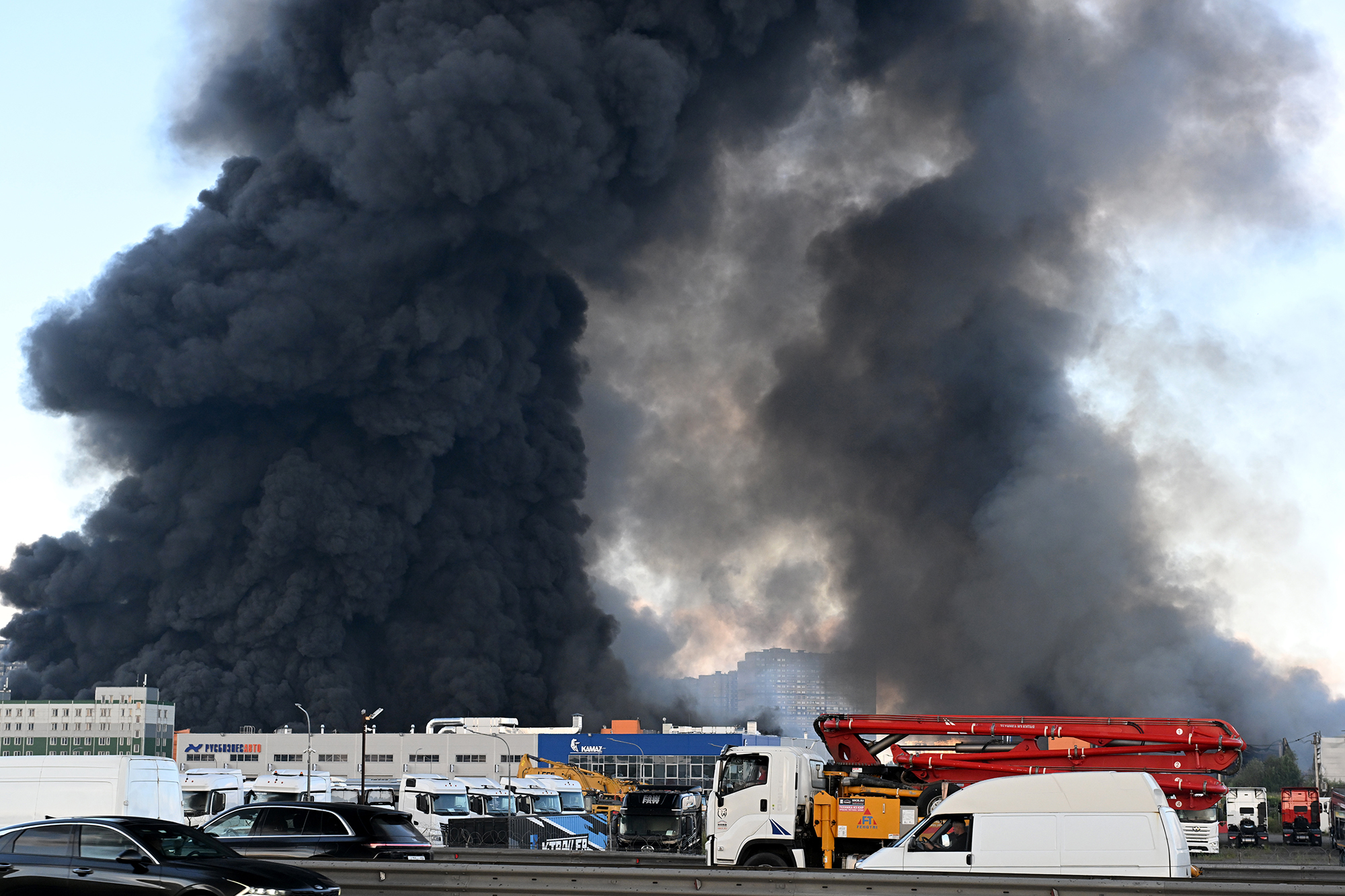 A fire at one of Wildberries' warehouse facilities in St. Petersburg (photo: Getty Images)
Sources within the Ukrainian Defense Forces told the media outlet that Wildberries operates 10 logistics hubs of strategic importance, six of which had confirmed damage as of July 28.
Earlier, President Volodymyr Zelenskyy described the strikes on the Russian marketplace's warehouses as a response to Russia's attacks on Ukraine's civilian infrastructure. One widely discussed explanation is that the strikes were intended as retaliation for attacks on Nova Poshta (Ukraine's largest private postal and parcel delivery company).
According to the media outlet's sources, attacks on Wildberries do not replace Ukraine's other military targets, including Russian oil refineries — more than 40% of Russia's oil refining capacity has already been put out of operation, according to Ukrainian officials — and defense industry enterprises. Instead, they are intended to produce a separate strategic effect.
"These strikes are part of our objective of paralyzing Russian logistics. We targeted oil refineries, creating fuel shortages and disrupting gasoline deliveries and petroleum exports. Now the goal is to make it more difficult for the Russian military to obtain drone components. And not only that — the war started by Russia, and its consequences, should also be felt by civilians inside Russia," one informed source told RBC-Ukraine.
In essence, the objective is not only military but also socio-economic: when consumers fail to receive their orders — whether clothing, electronics, or other goods — on time, or at all.
When company employees begin to question whether it is worthwhile and safe to continue working at such facilities.
When small and medium-sized businesses that sell through the marketplace lose their inventory and complain about receiving little or no compensation for destroyed goods.
When the owners of the marketplace are forced not only to absorb financial losses but also to rethink their logistics model.
And when both sellers and the company itself become unable to meet their bank loan obligations.
The logistics front: Why Russia's civilian e-commerce infrastructure is vulnerable
Ukraine has no direct equivalent to Wildberries' business model. To imagine a company with comparable market reach and daily transaction volume, it would have to combine the functions of Nova Poshta (Ukraine's largest private parcel delivery company), Rozetka (Ukraine's largest online retailer), while also owning its own bank and advertising business.
"In Ukraine, everything is much more decentralized. The marketplace, logistics, and warehousing are all separate. Wildberries combines everything under one umbrella — its marketplace, fulfillment operations, proprietary logistics network, pickup points, bank, advertising business, taxi service, and hotel booking platform," financial analyst Andrii Shevchyshyn told RBC-Ukraine.
The greatest vulnerability of this model is its high level of centralization. Wildberries' large distribution centers function as key logistics hubs. Even the temporary loss of a single facility increases pressure on the remaining warehouses, extends delivery times, and raises the company's operating costs. Ukrainian logistics real estate analysts say this assessment is consistent with how such infrastructure operates.
"These facilities are far more than ordinary warehouses. They are central logistics hubs responsible for receiving, storing, assembling, and dispatching goods. For the e-commerce sector, they are critical infrastructure supporting thousands of small businesses at the same time. If one such hub goes offline, a significant share of operations is disrupted, and replacing its capacity quickly is virtually impossible," Nataliia Sokyrko, Head of the Warehouse and Logistics Real Estate Department at EXPANDIA, the representative of CBRE in Ukraine and Moldova, told RBC-Ukraine.
According to Oleksandr Bondarenko, Chief Executive Officer of the Investment Programs Bureau and founder of GreenInvest, even partially restoring a modern logistics complex with an area of about 100,000 square meters would require at least six to eight months of work and investments totaling tens of millions of dollars. If a facility is completely destroyed, rebuilding it alone could cost more than $70 million, excluding the value of the goods that were stored inside.
Wildberries: The "national Amazon" under Kremlin patronage
In June 2024, Wildberries merged with Russ Outdoor, Russia's largest outdoor advertising operator. The deal was personally approved by Russian President Vladimir Putin and was presented as an effort to create a global competitor to Amazon, Alibaba, and Google. The merged company was renamed RVB.
According to Russian media reports, the merger was overseen by officials from the Kremlin administration, including Sergei Kiriyenko, First Deputy Chief of Staff of the Presidential Administration. Officials associated with Anton Vaino, the Kremlin Chief of Staff, and Alexei Gromov, the former Kremlin official responsible for media policy, were also reportedly involved.
The merger was accompanied by a high-profile corporate conflict. After Wildberries founder Tatyana Kim (formerly Bakalchuk) divorced Vladislav Bakalchuk, a deadly shooting occurred outside the company's Moscow headquarters. Ramzan Kadyrov, the Kremlin-backed leader of Russia's Chechen Republic, attempted to intervene in the dispute. Ultimately, nominal control of the company passed to Suleiman Kerimov, a Russian senator widely regarded as having close ties to the Kremlin.
At the same time, Wildberries expanded its own financial ecosystem around Wildberries Bank. In April 2026, the bank was placed under European Union sanctions. Just one month later, Russia's state-owned VTB Bank agreed to acquire a 5% stake in the institution.
The developments suggest that Wildberries has become increasingly integrated with Russia's state and political structures. At the same time, the company's ties to the Kremlin have effectively eliminated its investment appeal for most potential Western partners.
Legal trap: How Wildberries shifted wartime risks onto sellers
Perhaps the most revealing aspect of the story is not the strikes themselves, but what happened beforehand. In late June 2026, Wildberries updated its standard seller agreement. The 98th revision took effect on July 7 — less than two weeks before the first attacks.
Under the new Clause 11.3.4.1, the consequences of the use, impact, or crash of weapons, military equipment, and unmanned aerial vehicles (drones), as well as attacks and explosions, were explicitly classified as force majeure events. As a result, the marketplace exempted itself from financial liability for goods lost under such circumstances. The company insisted that the changes merely "clarified" provisions that were already in place.
The Financial Times highlighted the timing of the amendment as particularly noteworthy. After a wave of criticism, Wildberries co-founder Tatyana Kim said insurance companies had refused to cover losses caused by drone attacks. She later announced that the company would nevertheless compensate 88,000 of its smallest sellers.
According to financial analyst Andrii Shevchyshyn, eliminating compensation primarily affects microbusinesses. The median annual revenue of a Wildberries seller is about 575,000 rubles (approximately $7,500). Most of these entrepreneurs have little or no financial cushion to absorb the loss of their inventory.
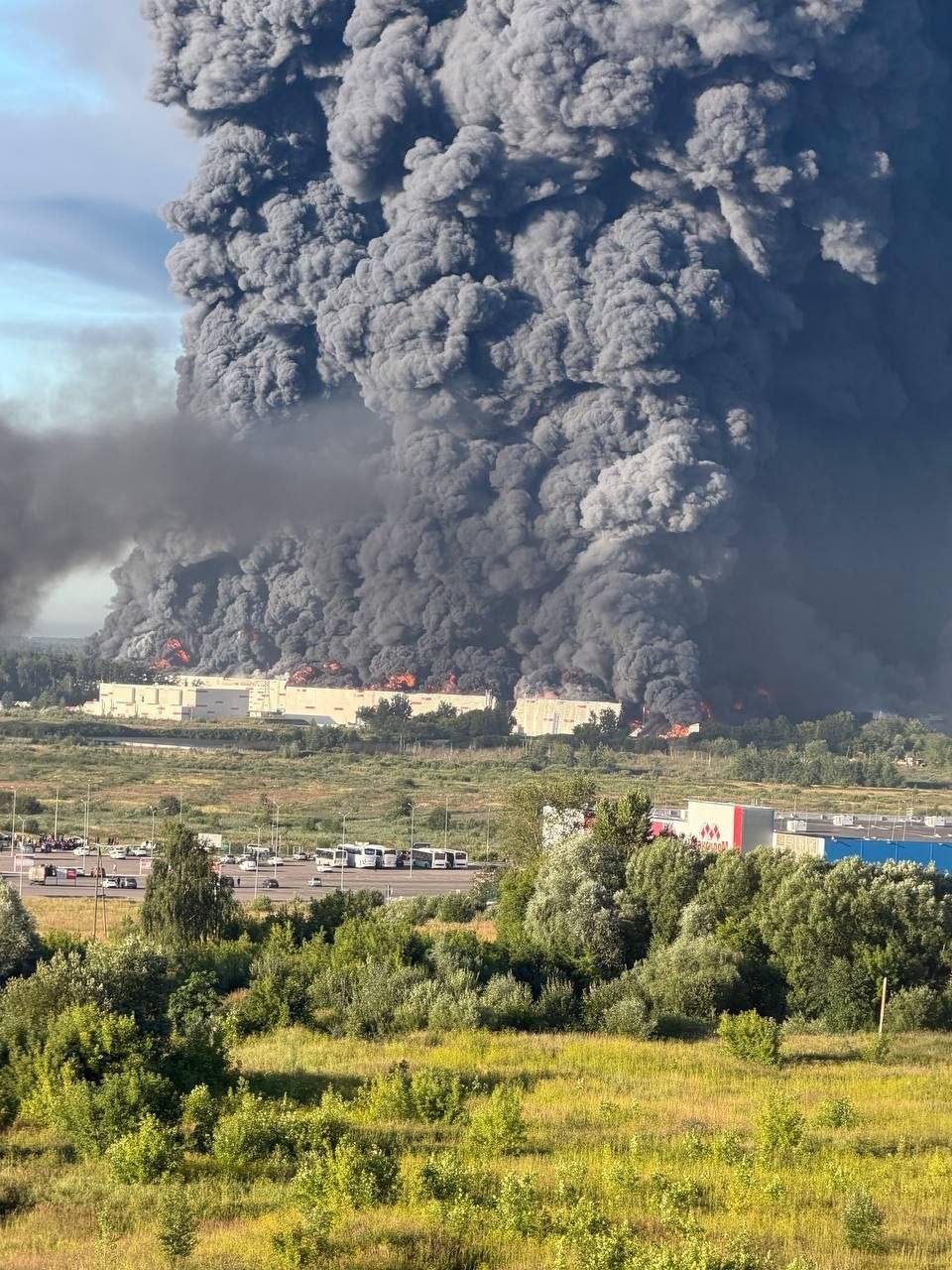 Fire following an attack on a Wildberries facility in the Moscow region (photo: via social media)
Only 5% to 7% of sellers carry insurance policies covering wartime risks. Such coverage typically costs 0.5% to 2% of the value of a shipment. For traders dealing in parallel imports with profit margins of just 10% to 20%, that can consume up to one-fifth of their earnings.
"It is impossible to fully protect a company's capital against the risk of assets being destroyed during a war. The government may compensate some losses, but there is no way to comprehensively insure against risks of this kind," Borys Kushniruk, Chairman of the Expert and Analytical Council at the Ukrainian Analytical Center, told RBC-Ukraine.
Adding to the pressure, some sellers financed their inventory with bank loans. Losing that inventory means they are left with obligations both to their lenders and to the marketplace.
Analysts say the more significant impact may come from long-term changes in seller behavior.
"After attacks like these, sellers will try to reduce the amount of inventory stored at any single warehouse, spread goods across multiple logistics centers, and invest much more cautiously in new shipments. That makes the system less efficient but more resilient to the loss of individual hubs," Oleksandr Bondarenko told RBC-Ukraine.
According to financial analyst Andrii Shevchyshyn, of the roughly $2 billion in total losses attributed to Wildberries, sellers account for approximately $1 billion to $1.3 billion in lost inventory. The remainder includes marketplace commissions and infrastructure costs that sellers had already paid, some of which the company is now attempting to offset at their expense.
"There could be temporary regional shortages of certain product categories lasting several months, but I don't believe this will become a catastrophe for the market as a whole. Restoring supplies typically takes 30 to 90 days, provided businesses have the funds to purchase new inventory. And I believe that is where the biggest challenge lies," Shevchyshyn said.
Experts do not expect the situation surrounding Wildberries to trigger an immediate wave of bankruptcies among small and medium-sized businesses. They do, however, believe it will significantly weaken the sector's financial position.
"This comes on top of accelerating inflation, currency depreciation, falling household and business incomes, and shrinking access to working capital. The share of non-performing loans will undoubtedly increase, while the risk of household bank deposits being frozen is becoming quite real," Kushniruk added.
The cumulative effect: Why Russia cannot quickly rebuild its logistics network
The key question is whether Russia can rapidly reorganize its supply chains if strikes against major logistics hubs in the country's central regions continue on a sustained basis. Ivan Us of the National Institute for Strategic Studies of Ukraine considers such a scenario extreme, but plausible.
"Alternative routes do exist. Russia has already redirected part of its trade flows south and east through the Caucasus and Central Asia. But the real challenge is the last mile. The main difficulty is not bringing goods into the country — it's distributing them once they arrive. Moscow and St. Petersburg are Russia's largest consumer markets and its principal logistics hubs," Us told RBC-Ukraine.
According to him, disrupting these hubs would create a bottleneck in domestic distribution. Goods would accumulate at border crossings or regional logistics centers such as Kazan, Yekaterinburg, and Rostov-on-Don, none of which has the sorting and distribution capacity of the Moscow or St. Petersburg facilities.
"Replacing logistics hubs of this scale in the short term is impossible. Building new distribution centers takes years. Moscow and St. Petersburg cannot be quickly substituted, meaning Russia could face a deep logistics crisis, rising inflation, and even disruption to its integrated domestic economic space," Us said.
At the same time, companies themselves are beginning to rethink how they organize their logistics networks.
"Businesses are increasingly moving away from relying on a single large warehouse and instead developing multiple logistics hubs across different regions. This reduces the risk of a complete operational shutdown. Companies are also placing greater emphasis on backup capacity, facility security, and the ability to transfer operations quickly to another site," Nataliia Sokyrko told RBC-Ukraine.
Changing the logistics model also means changing the way companies invest in large distribution facilities.
"Without a government-backed system to insure or compensate for wartime risks, private investors will be reluctant to finance the construction of new large-scale logistics complexes. That also applies to Chinese capital, which has become one of the main sources of investment in the Russian economy in recent years," Oleksandr Bondarenko told RBC-Ukraine.
In other words, the strikes are affecting not only the operation of existing warehouses but also the prospects for developing new logistics infrastructure.
In practice, attacks on major logistics hubs are forcing the market to move away from the highly centralized model that has long underpinned the efficiency of large online marketplaces. What was once a competitive advantage — concentrating inventory and distribution in a small number of massive facilities to reduce costs and speed up deliveries — is increasingly becoming a strategic vulnerability.
There is also a second, less obvious consequence of disrupting Russia's domestic logistics network: its impact on the international community's ability to monitor sanctions evasion.
According to Ivan Us, chaos within domestic transportation networks and a growing reliance on numerous smaller carriers make it more difficult to analyze trade flows, which are central to enforcing international sanctions.
When goods become dispersed across countless domestic shipments, identifying the ultimate recipient becomes significantly more challenging. A logistics crisis may also push businesses toward more opaque distribution networks that are harder for international authorities to monitor, Us argued.
"If goods become physically difficult to transport because of damaged infrastructure, the threat of secondary sanctions against intermediaries in third countries becomes less important than the risk of losing the cargo altogether. That makes the sanctions mechanism itself a less effective deterrent," Us said.
***
Taken together, the picture is fairly clear. Strikes on Wildberries warehouses are unlikely to halt parallel imports or immediately disrupt supplies to the Russian military. What they can do is gradually undermine the very model the Kremlin sought to make resilient to sanctions — a closed ecosystem combining its own bank, logistics network, and political backing.
The cost of maintaining that resilience is now increasingly being borne by thousands of small businesses, alongside rising inflation and the increasingly visible consequences of the war for ordinary Russians.
Disrupting online marketplaces alone is unlikely to drive Russians into the streets to demand an end to the war. But it may force more people to confront the economic costs and everyday inconveniences associated with its continuation.
Quick Q&A
Why is Ukraine targeting Wildberries warehouses?
Ukraine says Wildberries is more than a civilian online marketplace. In addition to consumer goods, the platform has been used to sell dual-use products, military equipment, drone components, and unmanned aerial vehicles that can be used by the Russian military. For that reason, Ukrainian officials consider the company's logistics centers to be legitimate military targets.
What does Ukraine hope to achieve with these strikes?
Beyond making it more difficult for the Russian military to obtain certain goods, the strikes are intended to disrupt Russia's logistics network, increase operating costs for businesses, reduce the efficiency of major online marketplaces, and make the economic consequences of the war more tangible for Russian consumers.
Why is Wildberries so important to Russia?
Wildberries controls nearly half of Russia's e-commerce market and has become one of the country's primary channels for parallel imports since Western sanctions were imposed. The company also operates its own logistics network and financial infrastructure, both of which have become increasingly integrated with Russian state institutions.
Could these strikes paralyze Russia's logistics network?
Experts do not expect an immediate collapse. They do, however, believe that sustained attacks on major logistics hubs could lengthen delivery times, raise costs for businesses, force companies to redesign their supply chains, and gradually erode the efficiency of Russia's highly centralized e-commerce logistics model.