Odesa ports go quiet: How Russia's attacks are putting Ukraine's trade at risk


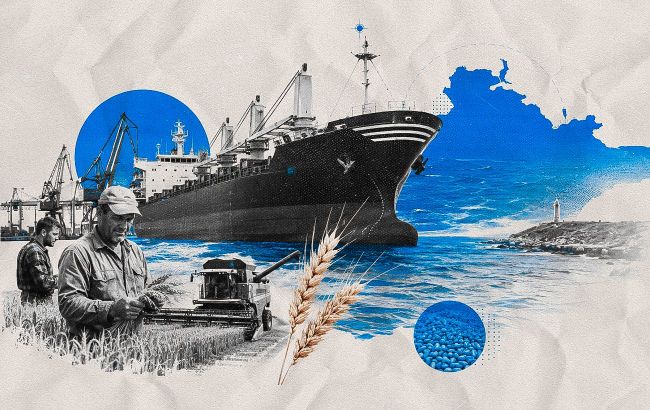 Photo: Why did the ports stop operating and what will the consequences be for Ukraine? (RBC-Ukraine collage)
Russia's targeted attacks have effectively brought shipping to Ukraine's Greater Odesa ports to a halt. More than 60% of Ukraine's exports and key import supply chains are once again at risk.
Read the RBC-Ukraine article below – how could this affect the Ukrainian economy, what alternatives are available, and how can shipping be restored.
Key points:
De facto blockade: Constant attacks have forced foreign carriers to completely suspend calls at the Greater Odesa ports.
Falling farmer revenues: The halt in maritime exports during the peak harvest season has already caused grain prices on the domestic market to drop sharply.
Higher import costs: The cancellation of direct container services and rerouting cargo through neighboring countries will put upward pressure on retail prices.
Scenarios for reopening: Shipping could be restored only through a combination of air defense protection and active diplomatic pressure.
Limits of land routes: Alternative rail and road routes can prevent a total logistics collapse but make transportation more expensive and slower.
Shipping through Ukrainian ports has once again been put on hold. In recent weeks, Russia has dramatically changed its attack tactics, intensifying strikes not only on port infrastructure but also directly targeting vessels. At least six attacks on civilian ships were recorded in July, killing or injuring 44 crew members.
A turning point came with the July 19 attack on the Golden Leo, a bulk carrier flying the flag of Guinea-Bissau. Nine foreign sailors and a Ukrainian pilot were killed, and the vessel later sank.
In response to the threat, shipowners effectively halted services, and no new vessel has entered the Greater Odesa ports since July 22.
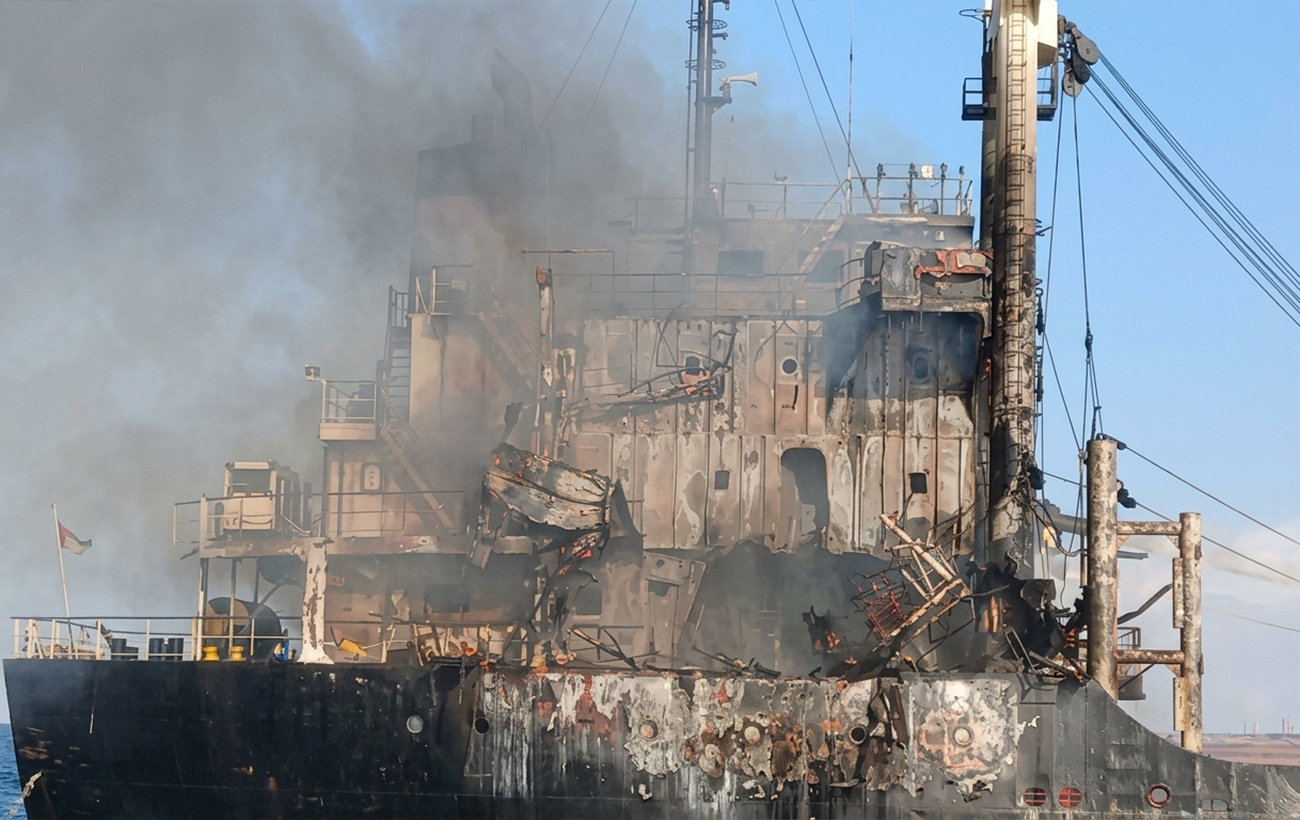
Photo: The bulk carrier Golden Leo (navy.mil.gov.ua)
According to Ukraine's Economy Ministry, more than 60% of the country's total merchandise exports pass through Ukrainian seaports, including the Greater Odesa and Danube ports. Their share in agricultural exports reaches 89%.
International container carriers were among the first to respond to the heightened risks. Maersk has already canceled calls at the Greater Odesa ports and redirected cargo flows through the Romanian port of Constanta. CMA CGM announced a similar decision.
The Ukrainian Sea Ports Authority told RBC-Ukraine that Russia's continued attacks are affecting individual shipowners' decisions on whether to call at Ukrainian ports.
"At the same time, Ukraine has not imposed any restrictions on the operation of the Ukrainian maritime corridor. It continues to function, and seaports continue to handle cargo," the authority told the media outlet.
In effect, Russia is copying a tactic that its ally successfully tested this spring in another region of the world.
"Russia is doing to the Black Sea and food security what Iran did to the Strait of Hormuz and energy security," Ukrainian Foreign Minister Andrii Sybiha said.
At the beginning of the full-scale invasion, Russia first blockaded Ukrainian ports. In September 2022, Turkey and the UN brokered the so-called "grain deal," which lifted the blockade. But Moscow withdrew from the agreement in 2023 and has since intermittently attacked vessels heading to Ukrainian ports. Why, then, have the attacks intensified now?
The current attacks on shipping are, on the one hand, part of the broader escalation this summer, particularly during the most critical period for farmers. On the other hand, Russia has accumulated sufficient capabilities to carry them out.
"I think the Russians have increased the number of resources available for carrying out such attacks. They are increasingly using Banderyl drone missiles and jet-powered Shaheds, against which we have limited capabilities. Accordingly, the enemy is taking advantage of our weakness," military expert and former Ukrainian General Staff spokesman Vladyslav Seleznov told RBC-Ukraine.
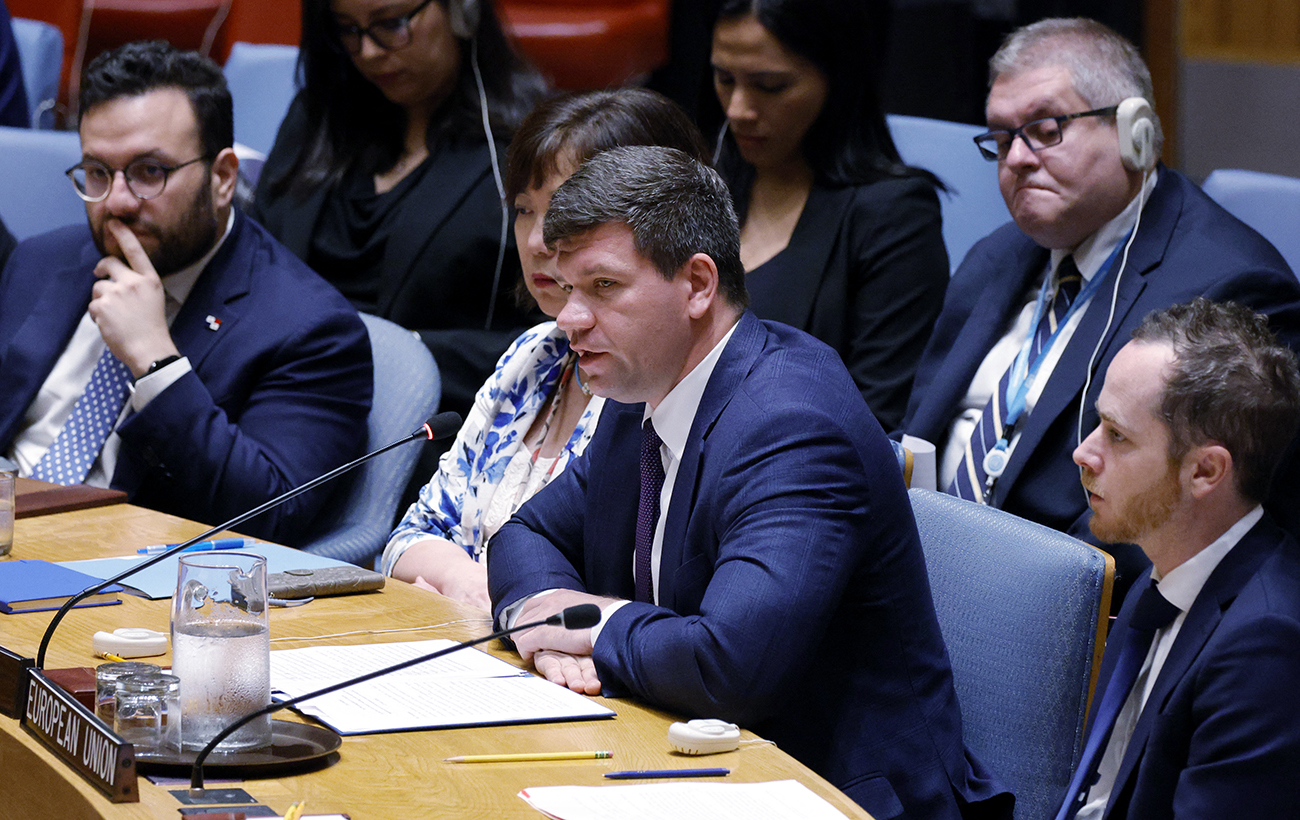
Photo: Volodymyr Pavlichenko, Deputy Permanent Representative of Ukraine to the UN (Getty Images)
Impact on farmers
The current port shutdown is hitting the agricultural sector particularly hard. The forced pause in exports has prevented farmers from fully selling their new harvest, Denys Marchuk, deputy head of the All-Ukrainian Agrarian Council, told RBC-Ukraine.
The main problem is that the maritime shutdown coincides with the peak of the harvest season. A significant portion of the new grain should already have been contracted and shipped.
The disruption could leave farmers short of funds to repay spring loans and finance the upcoming fall planting season.
The situation is further complicated by stocks from last year's harvest. As of early July, Ukraine had around 10 million tons of last year's grain in storage. However, Agriculture Minister Taras Vysotskyi says there is no shortage of storage capacity.
"There is enough storage space. The projected harvest of spring crops can be accommodated. We have not even reached the halfway point of harvesting some crops, partly because of weather conditions," the official said during a conversation with journalists on July 23.
Despite this, the domestic market has already reacted.
"Purchase prices have already fallen by more than 30%. As a result, producers' financial cushion is, at most, around two to three months," Marchuk warned.
To save the sector, the All-Ukrainian Agrarian Council is proposing government support mechanisms, including possible loan restructuring and state guarantees for agricultural loans.
The government is already working on anti-crisis measures. According to Vysotskyi, these could include lending programs and working-capital support so farmers are not forced to sell grain immediately at discounted prices. However, there are currently no plans to directly compensate farmers for price differences or higher logistics costs.
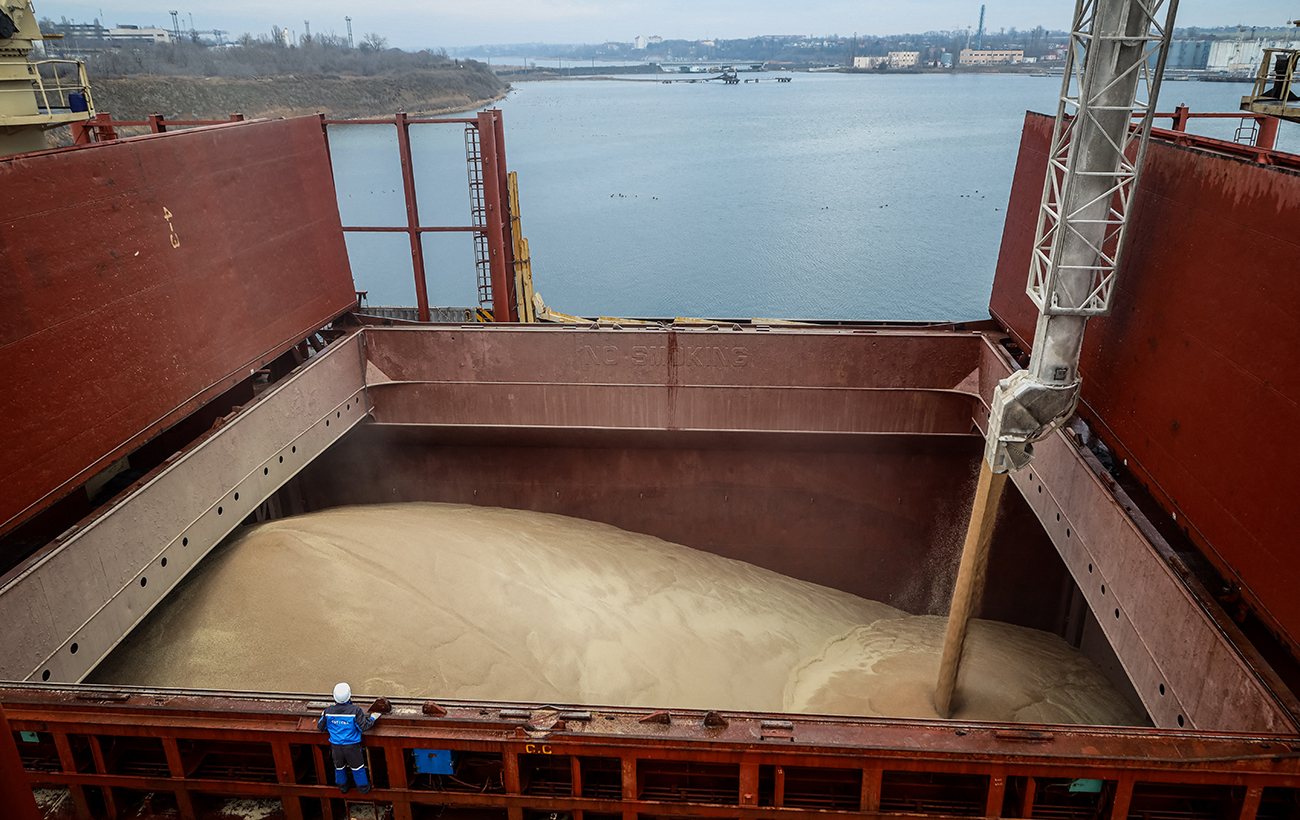
Photo: Loading a grain bulk carrier (Getty Images)
Containers, logistics and prices in stores
For transportation companies, it is still too early to estimate the total losses, but the impact already goes beyond idle ships and port terminals.
For ordinary Ukrainians, the disruption could mean higher import prices. Household appliances, electronics, auto parts and equipment enter the country largely by container, and any complication in logistics ultimately puts upward pressure on consumer prices.
International carriers' refusal to call at Ukrainian ports is also hurting domestic exporters of finished goods, from sunflower oil and food products to furniture.
"We are talking about thousands of containers that were awaiting shipment or arrival, additional storage, rerouting, changes to bookings and routes," Viktor Berestenko, president of the Association of International Freight Forwarders of Ukraine, told RBC-Ukraine.
Container carriers are particularly sensitive to security risks because of how their services operate.
"Container lines operate on strict schedules, so even a short period of uncertainty leads to service cancellations and ships being redirected to other destinations," Berestenko said.
This explains the decisions by Maersk and CMA CGM to temporarily suspend calls at Greater Odesa ports and redirect cargo to Constanta, Romania. The bigger concern is that a return to normal operations will not happen quickly.
"If the security situation stabilizes, services can return within several weeks. But repositioning empty containers, bringing back vessels and restoring the equipment balance could drive up costs for months," Berestenko added.
At the same time, the current situation is significantly different from the full maritime blockade of 2022. According to Mykhailo Nepran, first vice president of the Ukrainian Chamber of Commerce and Industry, alternative transport corridors through Romania and Ukraine's western border have already been developed and tested.
The number of border crossings has been expanded, an additional rail link through Moldova to Constanta has been built, and logistics routes through Danube ports and coastal shipping have been established.
"Yes, there are certain risks, and we understand how the factor of increasing our exports could play into domestic political processes in Poland. On the other hand, there is already a clear understanding of how to negotiate this," Nepran said.Finding a way out
Overall, Ukraine has two ways to reopen its ports, and they do not exclude each other but rather complement one another: a military approach and a military-diplomatic one.
"The key prerequisite is strengthening the protection of port infrastructure and civilian shipping from Russian air attacks. The security factor is what currently determines shipowners' decisions about whether to operate routes," the Ukrainian Sea Ports Authority said in response to an RBC-Ukraine inquiry.
However, solving this problem through air defense alone is difficult. It is technically almost impossible to fully cover both the ports themselves and the surrounding waters with an air-defense umbrella. And as the experience of the Strait of Hormuz has shown, hitting even a single vessel periodically can be enough to have a psychological impact on carriers.
Analysts at the Institute for the Study of War say Russia has deliberately resorted to combined attacks to create a critical "risk environment" for the foreign commercial fleet.
At the same time, Ukraine certainly cannot be accused of inaction at sea. The Defense Forces are carrying out systematic strikes against Russian military facilities and logistics in Crimea and the European part of Russia.
"This is a delayed effect. Our attacks on Russian defense-industrial facilities are slowing the production of the same missiles and drones. But this does not produce an immediate result; it takes time. In addition, the enemy is adaptively using the resources it already has available," Vladyslav Seleznov explained.
Against this backdrop, a major diplomatic campaign is also underway. As in 2022, Ukraine is appealing to global food security.
According to Andrii Sybiha, if Moscow does not stop its attacks, another spike in global food prices will hit the most vulnerable countries in Africa, Asia, the Middle East and Latin America.
On July 27, at Ukraine's request and with the support of European partners, the UN Security Council held a meeting. However, the organization remains passive for now. This situation is likely to continue until the end of the vacation season.
Ukraine is not the only country taking action. During his visit to Kyiv in mid-July, Turkish Foreign Minister Hakan Fidan proposed a moratorium on hostilities in the Black Sea and the energy sector. However, no concrete steps have followed.
Even if diplomatic and military measures produce results, Ukraine will still have to communicate with those directly involved in port operations.
"Restoring shipping requires protection of ports and approaches to them, functioning war-risk insurance, and constant communication with shipowners, shipping lines, port operators and insurers," said Viktor Berestenko, president of the Association of International Freight Forwarders of Ukraine.
Alternative routes
While the Greater Odesa ports remain on hold, export and import flows are being redirected to alternative land and river routes.
The alternatives differ depending on the type of cargo. For container shipments and high-value imports, the key routes remain through Central and Northern European ports.
According to Viktor Berestenko, around half of Ukraine's container traffic was already being handled through Romanian and Baltic ports even before the latest attacks. Reasons include security risks, businesses relocating to western Ukraine and the specifics of certain customs procedures in the Odesa region.
The market is therefore effectively returning to supply chains established in 2022. They are already familiar, so a complete collapse is not expected.
"But it is longer and more expensive: additional road or rail legs, transshipment, border crossings and more complicated repositioning of empty containers," Berestenko said.
According to him, alternative routes will allow foreign trade to continue, but Constanta, Gdansk, Gdynia, Klaipeda and the western border cannot fully replace the Greater Odesa ports.
It is currently difficult to calculate the final cost because additional expenses vary considerably depending on the rail distance, the road route chosen and queues at border crossings.
"The main component is gasoline and diesel. And as you can see, prices are currently fluctuating depending on the military and political situation in the Persian Gulf. So it is too early to talk about any figures," Mykhailo Nepran added.
For farmers, meanwhile, rail logistics play a crucial role. And there is some bad news here: starting August 1, Ukrainian Railways announced a 30% increase in freight transportation rates.
At this point, the most important thing the government can do is pursue diplomatic efforts and reach agreements with neighboring countries on the most favorable possible logistics arrangements.
"On the other hand, the state must also take responsibility and monitor exporters so that the situations of 2022-2023 are not repeated. We also bear some responsibility there, when grain that should have gone to Baltic ports was instead unloaded in Poland," Nepran said.
Under these circumstances, time is becoming a critical factor for Ukraine. The longer it takes to find security guarantees in the Black Sea, the greater share of their profits businesses will have to spend covering logistics risks. In other words, the fight for Ukraine's ports is now a fight for the resilience of the entire Ukrainian economy during wartime.
Quick Q&A
– Why have foreign vessels stopped calling at Odesa's ports?
The suspension was caused by a series of targeted Russian attacks directly against civilian vessels and port infrastructure, resulting in sailors being killed. Due to critical security risks and the threat of losing ships, international carriers and insurance companies have temporarily suspended services.
– How will the halt in maritime exports affect prices for ordinary Ukrainians?
The suspension of container shipping is forcing importers to transport household appliances, electronics and auto parts through ports in neighboring EU countries. Longer transport routes and more complicated logistics increase delivery costs, inevitably putting pressure on retail prices in Ukrainian stores.
– What will happen to grain prices inside Ukraine because of the shortage of ships?
Because of the forced shutdown during the peak harvest season, farmers cannot fully ship their new crops for export. The excess grain on the domestic market has already caused purchase prices to fall by more than 30%, putting farmers at risk of lacking working capital for the next planting season.
– Can land corridors fully replace Ukrainian ports?
Land routes by road and rail through EU borders can prevent a complete trade blockade, but they cannot fully compensate for the volumes handled by the Greater Odesa ports. Such logistics are significantly more expensive, constrained by border-crossing capacity and require more time for transportation.