NASA prepares groundbreaking Mars mission: Powered by nuclear energy and AI

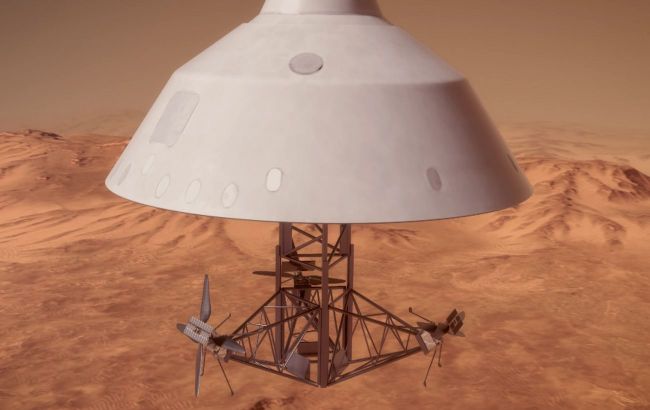 NASA devises new way to land on Mars (screenshot: NASA Jet Propulsion Laboratory)
The Ingenuity drone proved that flight in Mars’ thin atmosphere is possible, but its design did not allow it to carry heavy scientific equipment. For the next mission, Skyfall, scheduled for the end of 2028, NASA engineers have developed a more powerful version of the aircraft, according to BGR.
According to NASA, the new Skyfall mission will combine advanced aviation engineering, artificial intelligence for navigation, and the first nuclear electric propulsion system in the history of interplanetary flight.
Why is supersonic speed necessary?
Scientists explain that Mars’ atmosphere is extremely thin—its density is only 1% of Earth’s. Due to the lack of air molecules, rotor blades struggle to generate enough lift, so developers had to increase their rotational speed dramatically.
During simulations of Martian conditions at NASA’s JPL laboratory, the new drone’s rotors reached speeds of up to 870 km/h, breaking the sound barrier in a Martian environment.
The previous Ingenuity aircraft operated at around Mach 0.7 (up to 2,700 rotations per minute) to avoid unpredictable airflow behavior.
The successful test confirmed that the design can withstand supersonic loads, enabling helicopters to carry heavy scanners and cameras to map areas for future crewed missions.
Aerial deployment and AI autopilot
Instead of traditional complex landing systems, such as large inflatable airbags or cable-based “sky crane” systems (used for Curiosity and Perseverance), NASA will use a new approach:
- Three Ingenuity-class helicopters will enter the atmosphere inside a mother spacecraft.
- During descent, the deployment platform will release the drones in mid-air, and they will activate their rotors, detach, and fly independently to the surface.
- Landing safety will be controlled by an intelligent onboard system called Autonomy. In case of malfunctions or sandstorms, the AI will stabilize the aircraft and find a safe landing site on its own.
First nuclear engine in deep space
The Skyfall mission will become the first interplanetary flight to use nuclear electric power instead of solar panels. Researchers explain that conventional photovoltaic cells become ineffective beyond Jupiter’s orbit due to the lack of sunlight, while fuel tanks significantly limit spacecraft mass.
The use of nuclear energy will remove distance limitations for robotic missions — mission duration will depend solely on the durability of the hardware itself.
The technology will also serve as the foundation for NASA’s future permanent base on the Moon. The developed nuclear reactor, Lunar Reactor-1 (LR-1), is expected to provide the outpost with continuous power during extreme lunar nights, which last for 14 Earth days at a time.