€90 billion setback: Outcome of EU summit for Ukraine and search for plan B


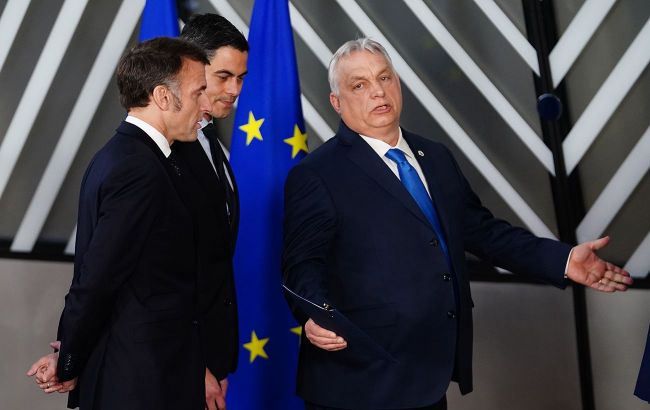 Photo: Viktor Orbán with EU leaders in Brussels (Getty Images)
EU member state leaders gathered in Brussels on March 19 to discuss urgent issues such as the war in Iran and aid for Ukraine. However, despite "heated" debates, they were unable to convince the Hungarian prime minister to lift his veto on the €90 billion loan.
Here’s what happened today in Brussels, what the EU is hoping for, and whether there is a plan B in RBC-Ukraine's material.
Key points:
-
Orbán’s oil leverage: the Hungarian prime minister refuses to lift his veto on financial aid for Ukraine until the flow of Russian oil is restored.
-
Aid in doubt: the EU’s final communiqué expressed hope for the first payments to Ukraine as early as March–April, but offered no guarantees.
-
Behind closed doors scandal: during a 90-minute dispute, the European Council president accused Orbán of crossing "red lines."
-
Plan B illusion: the idea of providing Ukraine with bilateral loans from individual EU countries faces very low chances of implementation due to internal legislative hurdles.
Unrealistic expectations
Before the Brussels meeting, European media reported that Viktor Orbán, who had become the main obstacle to aid for Ukraine, had greatly angered EU leaders.
On the eve of the summit, European Council President António Costa called Orbán to remind him that Hungary had already agreed to the loan and therefore could not block it now.
Costa told the Hungarian prime minister that he expected him to respect his commitments
As Politico reported, Orbán was expected to face intense pressure during today’s European Council session. However, he appeared very confident upon arriving in Brussels.
"The position of Hungary is very simple. We are ready to support Ukraine when we receive our oil, which has been blocked by them," Orbán told journalists at the European Council meeting.
In doing so, the Hungarian prime minister effectively set the tone for the entire subsequent discussion in Brussels.
What happened at the European Council meeting
According to Politico sources, behind closed doors, a 90-minute dispute unfolded between Costa, the 20 EU leaders, and Orbán. Orbán persistently refused to lift his veto on aid for Ukraine, while Costa accused him of crossing a "red line."
Four diplomats and officials reported that the European Council president called Orbán’s behavior "unacceptable" and in violation of the cooperation principles on which the EU is founded. Costa stressed that no leader had ever before crossed "this red line."
President Volodymyr Zelenskyy also spoke before the EU leaders. He emphasized that delays in providing financial assistance to Ukraine strengthen Russia’s negotiating positions — just as delays in European sanctions against Moscow do.
"We count on you to unblock the 90 billion euro package of financial security guarantees for this year and the next. Ukraine, for its part, is doing what is needed, including on the oil pipeline. But the decision is yours whether you want Russian oil to be imported by Europe, knowing that it helps the aggressor?" the president said.
However, unlike his recent public statements, Zelenskyy was measured: he did not mention Orbán in his speech, nor did he personally blame him for blocking the funds. The Ukrainian president also did not refer to Ukraine’s desire to join the EU in 2027.
Still, no one was able to sway Orbán toward a constructive stance.
What the European Council meeting concluded
Following the meeting, a communiqué appeared on the European Council’s website in which EU leaders expressed hope that the first tranche of the €90 billion loan to Ukraine would reach the country as early as March.
"The European Council welcomes the adoption of the loan by the co-legislators and looks forward to the first disbursement to Ukraine by the beginning of April. In this context, it also calls for intensified outreach to third countries to help close the remaining gap of €30 billion in Ukraine’s finances," the communiqué stated.
However, the EU leaders gave no guarantees that this would actually happen. Notably, neither Orbán nor his Slovak counterpart, Robert Fico, signed the communiqué.
According to Politico, despite heated one-and-a-half-hour discussions behind closed doors at the European Council meeting, EU leaders were unable to force or persuade Orbán to lift his veto. As a result, financial assistance remains uncertain.
Is there a plan B?
Recently, Politico reported that the EU has a plan B in case it fails to convince Orbán to unblock the loan. The Baltic countries, Northern Europe, and the Netherlands could directly provide Ukraine with the first €30 billion in the first half of the year.
This would not require a unanimous EU decision, as these would be bilateral loans.
At the same time, some informed sources of RBC-Ukraine believe that the total amount of such "backup financing" could be significantly less than €30 billion.
Potential donor countries could include the Scandinavian states and Germany. The purpose of this funding would simply be to help Ukraine hold on for a while until the main loan issue is resolved.
According to another RBC-Ukraine source, the likelihood of this plan being implemented is "very low," since bilateral loans would require certain legislative changes within these countries, which, as the source noted, could present difficulties.
"Thus, apart from the already agreed loan, the EU has no plan B to finance Ukraine," the source concluded.
Read also: