'There will be something the enemy won't expect.' Ukrainian general Komarenko speaks in major interview


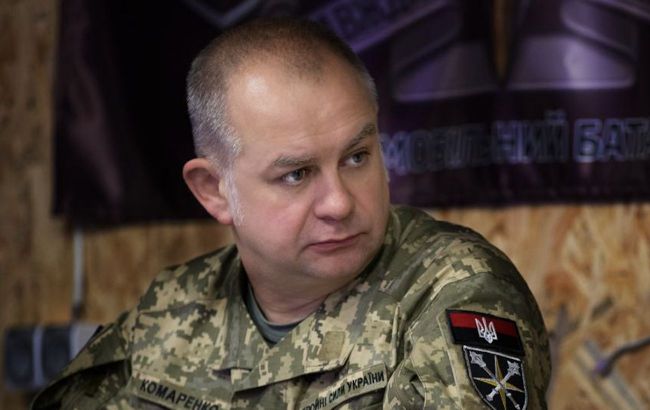 Head of the Main Operational Directorate of the General Staff of the Armed Forces of Ukraine, Major General Oleksandr Komarenko (photo: General Staff of the Ukrainian Armed Forces)
"Just reacting to the enemy's actions will not bring success," says Major General Oleksandr Komarenko, head of the Main Operational Directorate of the General Staff.
In an interview with RBC-Ukraine, he spoke about how sections for Ukrainian offensives are selected, revealed new details about the 2023 counteroffensive, and discussed operations in the Kursk, Belgorod, Donetsk, and Dnipropetrovsk regions.
Key points:
- Preemptive action. The idea of the Kursk operation emerged to repel a Russian offensive toward Sumy and reduce pressure on the eastern front.
- The 2023 counteroffensive plan. The Khortytsia operational-strategic group was tasked with securing enemy forces and improving the tactical position of Ukrainian troops in the Bakhmut direction.
- The offensive that never happened. An offensive toward the Melitopol direction had been planned as early as 2022, but it was canceled due to the battles for Kherson.
- Russian personnel as expendables. The enemy has switched to infiltration tactics, but only about 10% reach their target.
- Successes at the front. Almost the entire territory of the Dnipropetrovsk region has already been liberated.
- Ukraine's action plans. The General Staff has at least four operational concepts for the Defense Forces' actions.
Major General Oleksandr Komarenko has headed the Main Operational Directorate of the General Staff of the Armed Forces of Ukraine since 2024. Before that, he served together with Commander-in-Chief Oleksandr Syrskyi in the Khortytsia Operational-Strategic Group of Forces.
The Main Operational Directorate is responsible for planning operations and organizing offensive actions by Ukraine’s Defense Forces on the battlefield. In the interview, Komarenko spoke about the results of Ukraine’s active military operations in 2025, revealed some details about the latest advances by Ukrainian forces in the Oleksandrivske direction — at the junction of the Dnipropetrovsk and Zaporizhzhia regions — and outlined the army’s plans for 2026.
Here is the abridged version of the conversation with the major general.
How Ukrainian military operations are created
The head of the Main Operational Directorate of the General Staff of the Ukrainian Armed Forces is not a public figure. His directorate is responsible for planning military operations. General Komarenko explains that any operation begins with continuous monitoring. The team tracks enemy regrouping, searches for weak points in the defense, as was the case during the Kharkiv operation in 2022, and then develops ideas for their actions.
Planning is always a joint effort. Ideas can originate within the directorate and move to the Commander-in-Chief, or the Commander-in-Chief Oleksandr Syrskyi may assign the task of working out a specific direction.
Counteroffensive 2023: New details
Komarenko, who was directly involved in the events — at the time he served as Chief of Operations of the Ground Forces Command headquarters and of the Khortytsia operational-strategic group — explained the logic behind the 2023 counteroffensive. It was a concept developed by the then Commander-in-Chief, General Valerii Zaluzhnyi, and approved by the Supreme Commander-in-Chief in early May.
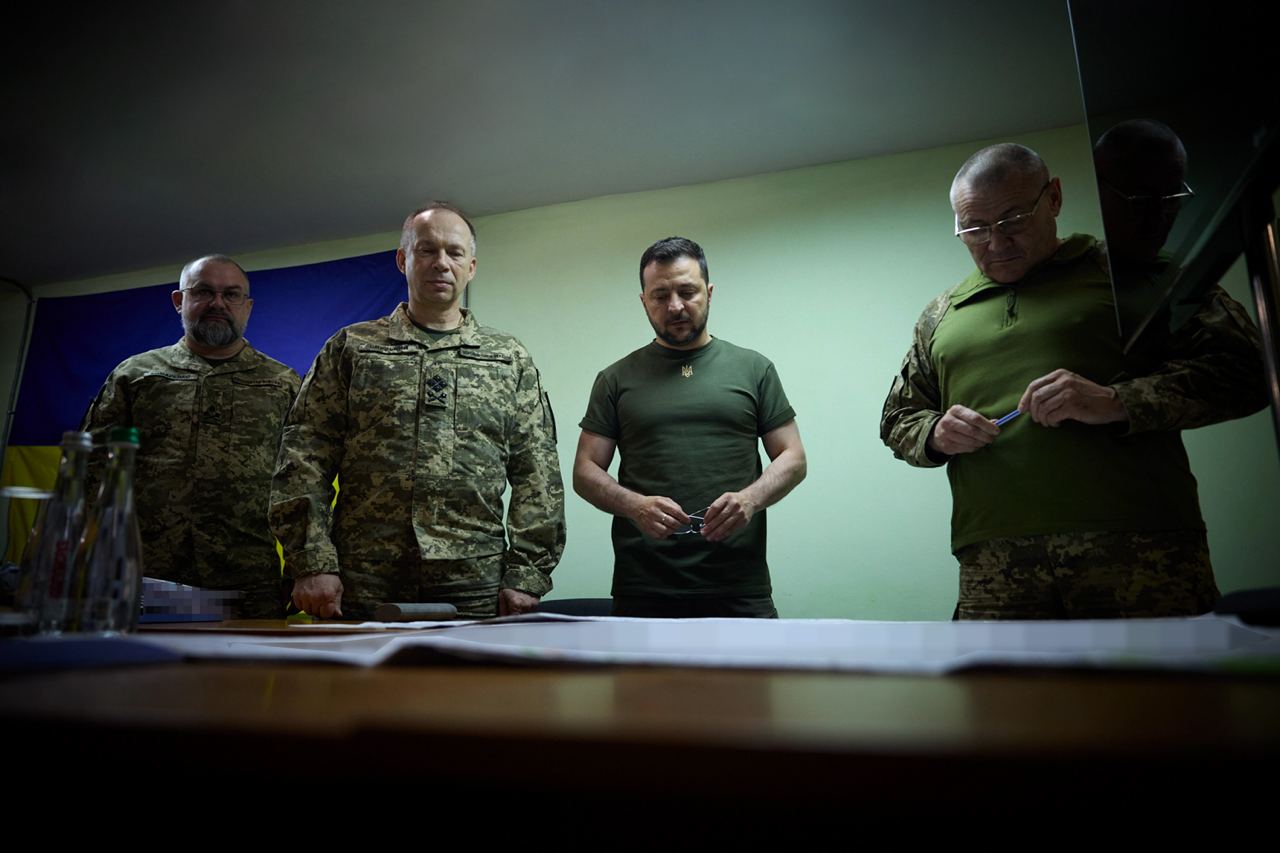
President Volodymyr Zelenskyy, Oleksandr Syrskyi, Oleksandr Komarenko, and Oleksandr Tarnavskyi (Photo: Zelenskyy’s Telegram channel)
First, the Khortytsia group was to begin operations. Their task was to conduct offensive actions to improve the tactical position in the Bakhmut direction in order to mislead the enemy and to contain Russian forces and prevent them from regrouping. Then a group led by General Sodol was to enter the fight near Velyka Novosilka. Only after that would operations begin in the main direction — Tokmak–Melitopol.
He rejects claims that forces and resources intended for the offensive in the south were allegedly diverted to the operation near Bakhmut. According to him, troop groupings were formed specifically for the operation, both for actions in the main direction and for operations in other directions.
"The grouping created for the offensive operation in the south consisted of 10 brigades of the Armed Forces and three brigades of the National Guard in the main Melitopol direction, five brigades in another direction near Velyka Novosilka, where General Sodol advanced, and one brigade in reserve," Komarenko explained.
He added that at the start of the offensive, all these troops were concentrated in staging areas and placed under the command of the relevant commanders, except for one mechanized brigade that was not specifically designated in the concept and was to operate as part of the 9th Army Corps.
"The composition of the groupings remained the same. We should also keep in mind the brigades that were defending in the offensive zones of the groupings. Khortytsia operated with the forces it had. No additional brigades were transferred from other groupings," the general said.
Regarding ammunition, Komarenko clarified that Khortytsia received only a few percent of the shells compared with the amount allocated to the main direction of the offensive. According to him, the problem in the south arose because the operation there lasted much longer than planned.
"Accordingly, there came a moment when what had been accumulated at the start of the operation ran out. There was a need to provide additional resources — ammunition and everything else. What was planned for a month of fighting will not be enough for half a year. Not all operations go according to plan, and success is not always achieved. In this case, a direction was chosen where success was not achieved," the general explained.
Komarenko also noted that the Ukrainian Armed Forces had originally planned to conduct an offensive in the Melitopol direction as early as 2022. At that time, the troops that would take part in it had already been determined.
"But Kherson had to be finished off, so the offensive was canceled, and at that time Khortytsia even transferred four brigades to neighboring units," Komarenko said.
Ukrainian offensive actions in 2025
The Kursk operation was planned as a preemptive action to disrupt Russia’s planned offensive toward Sumy and reduce pressure on the eastern front. At that time, the enemy was also attempting to advance toward Kharkiv. Work on the concept of the operation began in May, and from June, the direct executors — commanders of airborne assault brigades — were involved. To ensure the operation’s success, it was kept under strict secrecy.
"At that time, only a very limited number of people were working with the documents. Thanks to this, we managed to keep the operation plan and the intent behind it secret. As I said, we involved brigade commanders in June, and before we told them anything, they signed non-disclosure commitments regarding the information they would receive. So only a minimal number of people actually knew about this operation. And it was never discussed anywhere, unlike what happened during the offensive in the Melitopol direction," Komarenko explained.
He believes the Kursk operation achieved its goal, as the Defense Forces managed to move the war onto the enemy’s territory and forced Russia to redeploy troops from other directions to the Kursk direction.
After the fighting in the Kursk region ended, the Russian troops that had been opposing Ukrainian forces — naval infantry and airborne assault units — were supposed to move to the Pokrovsk and Zaporizhzhia directions. To prevent this, the Defense Forces decided to launch offensive actions in a neighboring sector — at the junction of Russia’s Kursk and Belgorod regions.
"We conducted offensive actions there for almost two months. When certain tasks were completed, we withdrew our troops and moved to the Tyotkino and Glushkovo direction. Accordingly, enemy troops from the Kursk direction were supposed to move south in April–May, but as a result, they only began withdrawing them at the end of August. In other words, we managed to contain the enemy’s forces there for some time," the general said.
After that, in the second half of 2025, the Defense Forces began counteractions in the area of the Dobropillia salient. At the time, Russian forces were trying to reach the Dobropillia area, cut logistics for Ukrainian troops defending Myrnohrad and Pokrovsk, and encircle them from the north.
"At the same time, they planned to bypass Pokrovsk from the west through Kotlyne and Udachne — toward Dobropillia (not the city, but the village located slightly south of it). In other words, they planned to encircle our troops in Pokrovsk and Myrnohrad from two sides. Again, they were reporting in advance that they had supposedly encircled 15 of our battalions at the same time when they once again supposedly 'captured' Kupiansk," the Komarenko explained.
On the enemy side, naval infantry units were operating there — all those that had come from the Kursk direction, except for the 810th Crimean brigade, which remains in the Kursk direction. Now, all these enemy units are being withdrawn for reorganization and restoration of combat capability because they suffered extremely heavy losses. Komarenko added that the offensive phase of the operation near Dobropillia has now been completed and the defensive phase is currently underway.
Another successful operation by the Defense Forces in 2025 was the clearing of Kupiansk and its surrounding areas. The planning, execution, and implementation of this operation were carried out by the 2nd Corps of the National Guard, known as Khartia. To maintain control of the city, an additional tactical group called Kupiansk was created. Its area of responsibility includes the western part of the city. Alongside Khartia, the 13th National Guard Brigade (also Khartia), units of the 92nd Brigade, Special Operations Forces, and units directly subordinated to the General Staff took part in the operation.
"They cut off the enemy’s routes of entry from the north into Kupiansk and then focused on searching for and destroying them directly in the city. This operation was also conducted quietly, gradually, without any publicity, and they achieved success as well," Komarenko said.
New realities of war: kill zones, infiltration, and 'credit captures'
Over the past four years of the war, the nature of combat has changed drastically, notes General Komarenko. At the beginning of 2022, Russian forces advanced in columns with vehicles, but now this is impossible due to the development of UAV capabilities. On the front line, there is a so-called “kill zone” — 20–25 kilometers where everything can be observed and fired upon.
“That’s why we now wait for unfavorable weather conditions — fog, rain, snow, or strong wind — when drones cannot fly. In such conditions, there’s an opportunity to act. When the weather is more or less normal, it’s very hard, almost impossible to operate. If you talk less and act more, that’s when surprises for the enemy appear. They shouldn’t know where to focus their attention,” the general explains.
Because of this “kill zone,” the enemy has also changed its tactics — moving to infiltration. Their troops sneak in, consolidate, and gather at designated points to operate behind Ukrainian lines. This tactic is extremely costly for the enemy, as 90% of their personnel are eliminated before they even reach the target.
“They allow themselves to expend personnel like expendables,” Komarenko notes.
Another characteristic of enemy behavior is disinformation about the real situation on the front, which they report to their command.
“We have their maps showing how they depict their positions and what they report to their superiors. On these maps, under their control, are settlements that are actually far behind our lines — I’ve read a term for this: ‘captured on credit.’ And they report to their leadership that they’re already there. In reality, maybe one soldier got in and was neutralized — that’s it,” the general explains.
Because of these lies in maps and reports, troops often hesitate to inform their command about losing control of certain settlements.
“And so, when we begin our operations quietly, just doing our work instead of focusing on publicity, they slowly get pushed back. But they don’t report it to their leadership because they’d be told, ‘Why are you telling me you’re under attack in Danylivka when yesterday you reported your front line was in Vasylivka, 20 km ahead?’ But once they retreat far enough, there’s nowhere to go. And then their superiors are forced to act too,” the general says.
New realities of the war: kill zones, infiltration, and captures on paper
Over the past four years of the war, the nature of combat has changed drastically, notes General Komarenko. At the beginning of 2022, Russian forces advanced in columns with vehicles, but now this is impossible due to the development of UAV capabilities. On the front line, there is a so-called kill zone — 20–25 kilometers where everything can be observed and exposed to fire.
"That’s why we now wait for unfavorable weather conditions — fog, rain, snow, or strong wind — when drones cannot fly. In such conditions, there’s an opportunity to act. When the weather is more or less normal, it’s very hard, almost impossible to operate. If you talk less and act more, that’s when surprises for the enemy appear. They shouldn’t know where to focus their attention," the general explains.
Because of this kill zone, the enemy has also changed its tactics — moving to infiltration. Their troops sneak in, consolidate, and gather at designated points to operate behind Ukrainian lines. This tactic is extremely costly for the enemy, as 90% of their personnel are eliminated while still approaching.
"They allow themselves to expend personnel like expendables," Komarenko notes.
Another characteristic of enemy behavior is disinformation about the real situation on the front, which they report to their command.
"We have their maps showing how they depict their positions and what they report to their superiors. On these maps, under their control, they show settlements that are actually far behind our lines — I’ve read a term for this: captured on paper. And they report to their leadership that they’re already there. In reality, maybe one soldier got in and was eliminated — that’s it," the general explains.
Because of these lies in maps and reports, troops often hesitate to inform their command about losing control of certain settlements.
"When we begin our operations quietly, just doing our work instead of hyping, they slowly get pushed back. But they don’t report it to their leadership because they’d be told, 'Why are you telling me you’re under attack in Danylivka when yesterday you reported your front line was in Vasylivka, 20 km ahead?' But once they retreat far enough, there’s nowhere to go. And then their commanders force them to act too," the general says.
Counteroffensive in the Dnipropetrovsk region and plans for 2026
The Ukrainian Defense Forces continue their offensive operation along the Oleksandrivka direction, at the junction of Dnipropetrovsk and Zaporizhzhia regions. According to Major General Oleksandr Komarenko, Russian forces attempted to advance on the Dnipropetrovsk region to create a buffer zone near the Donetsk region, which they also aim to occupy. However, Ukrainian counteractions have already liberated over 400 square kilometers.
"Almost the entire territory of the Dnipropetrovsk region has been liberated. Only three small settlements remain to be finished, and two more to be cleared. Thanks to these active actions, in February, we have a positive trend — more territory was liberated than lost," said the head of the Main Operational Directorate of the General Staff.
He added that the situation on the front is currently difficult but under control. The most challenging remain the Pokrovsk and Oleksandrivka directions, where the enemy concentrates its main efforts. These two directions, along with the Zaporizhzhia direction, will remain priorities for Russia during the spring campaign.
"We are gradually stabilizing the situation through our active measures. Currently, enemy attacks in the areas of Pokrovsk and Myrnohrad have decreased slightly due to the redeployment of their forces to the Oleksandrivka direction," explained the general.
The General Staff plans its own actions in response to the enemy, not just defensive ones. Simply reacting to the enemy’s actions will not bring success, Komarenko said. He revealed that there are already at least four developed scenarios for Ukrainian actions across different directions, "which can be implemented and are waiting for the right moment."
"If we do not maintain the initiative and only defend ourselves, sooner or later, we will be crushed. That is why we plan actions that will force the enemy to change their plans and act in ways they did not expect — to impose our initiative on them. Where the enemy advances, defensive actions are planned. In other directions, there will be operations designed to make the enemy act in ways advantageous to us. And these will not necessarily be direct military actions — asymmetric measures are also planned. There will be something the enemy does not expect," said the head of the Main Operational Directorate of the General Staff.
Quick Q&A:
How are military operations planned in the General Staff?
There is constant monitoring of the enemy's actions: where its forces are concentrated, where they are stretched thin, and where vulnerable sectors exist. Based on this, different operational scenarios are developed and then coordinated at all levels. The General Staff currently has at least four operational options prepared for actions in various sectors of the front.
What offensive actions did Ukraine’s Defense Forces carry out in 2025?
These included the continuation of the Kursk operation, aimed at preventing a Russian offensive on Sumy and easing pressure on the eastern front. Later, to prevent the redeployment of Russian troops from the Kursk region to the Pokrovsk and Zaporizhzhia directions, Ukrainian forces conducted offensive operations in Russia's Belgorod region for two months. In the second half of the year, the Ukrainian Defense Forces eliminated the Russian wedge near Dobropillia and cleared the city of Kupiansk.
What tactics are Russian troops using now, and how is the nature of the war changing?
If at the beginning of 2022, Russian forces advanced in columns using armored vehicles, this is now impossible on the battlefield due to the development of drone warfare. There is what is known as a kill zone on the front line — about 20–25 kilometers where everything is visible and within firing range. If the weather is clear — without fog, rain, snow, or strong winds — it is practically impossible to operate there. Because of this kill zone, the enemy has switched to infiltration tactics: soldiers move in small groups, infiltrate, entrench themselves, and build up forces at certain points before operating in the rear of Ukrainian positions. This tactic is very costly for the enemy, as about 90% of personnel are destroyed before even reaching the line.
What is the current situation on the front line?
The most difficult situation remains in the Pokrovsk and Oleksandrivske directions, where the enemy is concentrating its main efforts. These two areas, along with the Zaporizhzhia direction, are expected to be priorities for Russian forces during the spring campaign. At the same time, Ukrainian troops are conducting active operations, particularly in the Oleksandrivske direction, where almost the entire territory of the Dnipropetrovsk region that the enemy had advanced into has already been liberated.