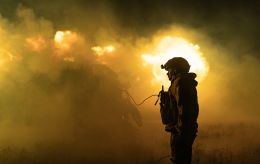
'Putin set out to make Russia great again. Instead, he made NATO great again,' ex-CIA chief David Petraeus


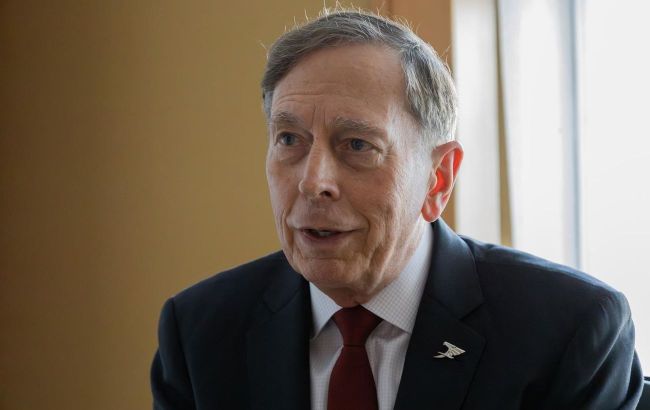 Photo: David Petraeus, ex-Director of the CIA (2011-2012) (RBC-Ukraine)
The optimism of the first half of the summer, fueled by Ukraine's systematic destruction of Russian logistics, has now given way to more pessimistic expectations for the fall and winter. But David Petraeus, one of America's most respected military figures, believes Ukraine still holds the strategic initiative.
"This is my eleventh trip out here since the full-on invasion," David Petraeus told RBC-Ukraine during an interview on the sidelines of the annual YES meeting in Kyiv.
Petraeus is a highly experienced military leader who previously commanded US and NATO forces in Afghanistan, the US-led multinational force in Iraq, headed US Central Command, and served as director of the CIA.
Unlike many high-profile foreign guests visiting Ukraine, Petraeus does not limit his trips to formal events in Kyiv. He visits frontline areas, meets with commanders, and takes a keen interest in how modern warfare is actually being waged on the ground, as well as in AI technologies and autonomous weapons systems.
"Ukraine is literally defining the future of warfare," Petraeus told RBC-Ukraine. He is calling on the United States and other NATO countries to immediately begin a sweeping overhaul of their entire military systems — so they can keep pace with the demands of the moment and the incredibly rapid development of military technology.
– In your opinion, who currently holds the operational initiative on the front, if anyone does?
– I think on the front, Ukraine has the initiative because Russia is unable to achieve what it set out to achieve. Contrary to Vladimir Putin's assertions that they're making great progress, that is just not the case. I think it's increasingly clear that Ukraine will deny the Russians their objectives for the spring and summer campaign, which include, of course, taking the rest of the Donetsk region, taking the so-called fortified cities.
They're not even at the fortified cities yet; they're just at the approaches to them. And moreover, not only is Ukraine denying Russia its objectives, they are inflicting extraordinary losses on the Russians. Over 1,000 killed and wounded per day for me is just incomprehensible, actually.
As you know, I had five commands as a general officer, including three as a four-star general: Iraq, Afghanistan, and Central Command. And I can't actually comprehend the losses. Now, these are killed and wounded, well over 1,000 per day.
And for those who doubt these statistics, they need to understand the system that Ukraine has that validates the reports. It's all full-motion video. As you know, the Unmanned Systems Forces and the other forces have to document what they have done in order to get the points in the E-points system.
So not only is this fiercely fought on the front lines, but there is a fierce competition between units for this point system that is a very real means of allocating scarce resources through the Delta.
– So that's a good invention, isn't it?
– It is very significant, as is the Brave One system, sort of the Amazon web store for military components and drones and so forth. But the point, the only reason I explain that, is that these are hard numbers. This is not Ukrainian math or something like that, as some folks assert.
So, again, these losses, these killed and wounded, a recent estimate was that for a single month it was over 35,000. The overall killed and wounded sustained by the Russians now are over 1.5 million, which is more than the US sustained in all of World War II, to put this into context.
So on the front lines, I think the Ukrainians are achieving something very significant by denying the Russians the achievement of the objectives set out publicly by Vladimir Putin.
Beyond that, the Ukrainians have the initiative, I don't argue even strategically, by isolating occupied Crimea from the Russian Federation. The Unmanned Services Force alone has taken out over 275 boats, tankers, ferries, and barges that are normally used to resupply Crimea. They can take out anything they want on the Kerch Strait Bridge and on the road that goes into Ukraine from the Russian Federation along the southern coast and then north into Crimea.
And basically, the lights are going out, and the heat's going to be off, and the water is going out in occupied Crimea. And then in the Russian Federation, the Ukrainians have hit every single Russian oil refinery within 3,000 kilometers at least once, many more than once. And Russian refineries are dramatically or significantly reduced to the point that Russia is not exporting any refined fuel products at all anymore, no gasoline, no diesel.
They are exporting more crude, but it's because they can't use it in their own refineries, and they're actually having to import refined fuel products from Kazakhstan, Belarus, and India, among others. Also, the Ukrainians are going after the air and ballistic missile defense architecture painstakingly, you know, S-400 system by S-400 system, all these others. And they're taking that down, which means that in the coming months, they'll be more successful with the attacks on the Russian Federation.
Putin will have to put them all around this or that critical infrastructure, which will increase vulnerabilities elsewhere. And they're going after the logistical infrastructure of the Russian Federation, essentially these Amazon warehouses on steroids called Wildberries and Ozon and so forth that are dual-use. They are part of the military and defense logistics system as well as of normal commerce.
The economic problems are mounting for Putin, and he's facing a need to mobilize even larger forces from a population that is no longer as large as it was for those positions, which means that the labor force is now challenged as well. Any country that has to have an app to help you find a gas station that actually has gasoline or diesel – there's something wrong.
– Still, one talks about the possibility of mobilization in Russia after the elections.
– There's a very good, characteristically incisive op-ed by Eric Schmidt in The Washington Post. He points out that Russia is very likely going to mobilize over 300,000, who knows how many more it can muster, and throw them into the fight in the hopes of achieving incremental gains that might accumulate, which hasn't been the case so far. But then, more worrisome is what's happening in the air. The jet-powered Shaheds are problematic, more difficult to intercept with the traditional drone interceptors.
I've been out on a mission with them. I met with four of the core commanders, the Unmanned Systems Forces commander, the Alpha group commander, the air defense architect, and so forth. And the big worry, of course, though, is the Russian missiles.
They're hitting Ukraine hard with these, and in the past, these would have been intercepted at a higher percentage. Now Ukraine has dwindling numbers of missile interceptors, and that is a big concern. Russia once again will try to turn off the lights and turn off the heat in Ukraine this winter.
Ukraine has, of course, over the past six to eight months, tried to build out a more distributed energy generation and distribution system. But it is still going to be hit hard this winter. And that, I think, is the concern, in the sense that each side is trying to bring all that it can into this fight.
This is my eleventh trip out here since the full-on invasion, so I've been coming about three times a year. And again, this one was particularly valuable because of the ability to go to the core headquarters again in the really critical areas.
And there's a realignment of command and control; they're creating groups of forces because the number of corps now is so substantial. I think all of that is well advised, but it's challenging because each new headquarters requires more people, requires more capability, communications assets, fiber optic, and so on.
So, again, this is another critical moment in this war, and I think it's a time for Western countries to do everything they can to help Ukraine with the areas in which there are vulnerabilities, particularly ballistic missile defense, and then actually in their fiscal situation. I think those would be the two top challenges.
To enable Ukraine to deal with the one threat, they cannot organically manufacture systems to help, and then to build out faster and further the systems that are so very capable. And I should note here that there are advances. We're on the threshold of truly autonomous systems.
There's already experimentation ongoing with this: you launch it, and it moves to the target without any further human involvement. You can maintain it if you can, fine, but if you can't, it's going to do what it's programmed to do, and already it's beginning to prove itself.
And that's going to be introduced in much greater numbers during the course of later this year. Beyond that, there will be a more efficient launch, and that's another issue. So instead of an individual or a couple of guys in a pickup truck having to launch this thing through some kind of system, you're going to see more efficient launchers: you know, a black box, and it pops up along those lines.
So you can do it remotely. The combination of more efficient launch and autonomous systems will increase the limits that currently exist based on the number of available pilots. That's a significant limit, as is how quickly you can launch them. Keep in mind that Ukraine will produce something like 8 million drones this year, ultimately, and it is using over 10,000 per day of all types. Keep in mind that maritime drones, and those are very active as well.
Now the Russians are into the port in Novorossiysk, where the Black Sea fleet is tied up because it doesn't dare set sail on the Black Sea, as over a third of the ships were sunk while it was still on the Black Sea by aerial drones and maritime drones. The developments in the Unmanned Systems Forces continue to be nothing short of breathtaking. I spent time with Commander Magyar, and it's just extraordinary to see. I visited his intelligence center, which has all of the displays and so forth.
It just continues to progress in ways that are truly the best in the world. I think they're incomparable, as is the air picture. There's a fusion of radars of all types.
Keep in mind, there are US radars, European radars, and old Soviet style or Soviet era radars. All of this is fused together with acoustic sensors, which are very simple but very, very effective in the thousands across the front, which provides the lower-flying. I've looked at this air picture, both in air defense centers and out on a mission with the counter-drone team in February, in the middle of winter.
Then they also have signals intelligence and all other forms of intelligence that are being, in essence, reduced to data and producing a very, very high-fidelity air picture, essentially autonomously, all automatically, it's all machine. You don't need humans to do this. And then increasingly, you're going to start to see automated direction to the various air and ballistic missile defense systems in terms of direction.
So this is all playing out. It's very, very impressive to see what the Ukrainians have done and are doing, but it's also alarming to appreciate what is happening through the air.
– With all these sophisticated intelligence systems and all these drones, does it all mean that the classical concept of a massive armored offensive is already totally outdated? Is it a thing of the past?
– Well, I mean, I can conceive of ways to restore some degree of maneuver. I mean, right now you can still do it in a heavy fog. Ukrainians know the Russians are going to try this when the fog sets in and the drones can't fly and can't be effective.
So if you have a whiteout, tanks are going to come back, and the Russians are ready with their tanks. They're actually refurbishing, maintaining, and conducting gunnery and so forth with their tanks so that they're ready for that. But as long as there's visibility, it's impossible to move without being seen.
And even with all the protection that the tanks have, eventually they're going to immobilize it. So what happens first is you have what's called a mobility kill. You hit a road wheel; you just won't move. So now you have 60 or 70 tons of iron, and eventually it's going to be blown up.
I watched multiple occasions in the past two days of drone feeds.
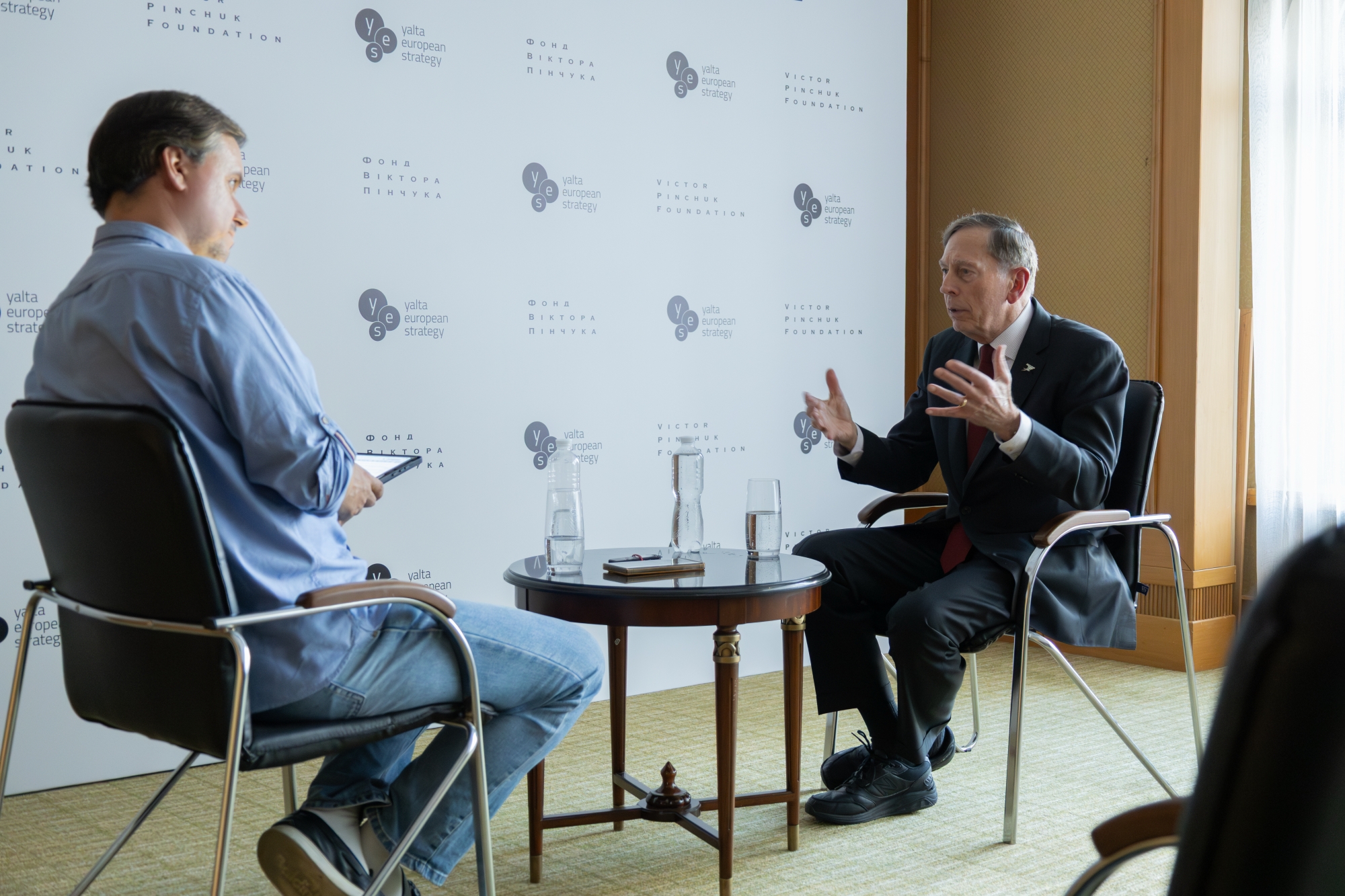
David Petraeus (Photo: RBC-Ukraine)
So you have a whole wall of drone feeds, and there are certain ones that are in red, and you know that they're observing a Russian. There's something, you focus on that, and all of a sudden you see there is a Russian. He's trying to infiltrate as an individual soldier.
And it doesn't end well because within minutes, certainly less than 10 minutes, maybe as little as five minutes, first-person-view drones are going to be attacking that soldier, or bomber drones, or whatever it is that they have available. And you can just watch that till its conclusion. And that's happening again.
Artillery still can play a role, but it's not the central role that it was a year and a half or two years ago.
If you have a death zone that depends on the area, anywhere from 25 to as many as 35 kilometers, then artillery can barely get in range, get off in a number of rounds unless it's in a very, very well-concealed position or something like that, and there are lots of decoys.
There's a lot of other complexity here, but no combined arms warfare of tanks and infantry fighting vehicles and engineers and artillery and mortars and air defense and electronic warfare and command and control and logistics, that is not on this battlefield now because it can't survive. Maybe in the future, you have high-powered microwaves or lasers or something that protects them, but that's not in the foreseeable future.
– You mentioned that our attacks on the Russian logistics, and Russia strikes back. So if you're having a war of attrition, if you're having a total war, whose resources are going to run out first? Who does time play for?
– Well, it depends. Look, Russia has five times the manpower, and it has 12 times the economy.
So are they going to prevail? No, not necessarily. Ukrainian innovation on the front lines is denying the Russians their objectives.
And beyond that, it is hammering their infrastructure. And keep in mind that the Ukrainians are taking down the air and ballistic missile defense architecture of Russia, painstakingly. Commander Magyar and others in Alpha Group are taking this out. And as they become indefensible or as their defenses are degraded, the opportunities for the Ukrainians will increase.
But there's no question that there is a degree of war of attrition that is being introduced. But then the other equalizer is the enormous support by the US at the outset of the war, the first two or three years, and now very much by European countries and the EU Commission. You know, 90 billion euros is an extraordinary commitment to Ukraine's fiscal and economic situation.
The other support given individually by all the countries is significantly important. The hardware that the Ukrainians can't yet make, particularly air and ballistic missile defense systems and so forth, all of that is very significant.
Then, if the pressure on Russia's economy can be increased, especially with the US Lindsey Graham sanctions package, which needs to be passed in the House expeditiously, you add all of that, and Russia is under enormous pressure. There is a limit at some point where Putin has to realize that he can mobilize all that he did before and another 100,000 or 200,000 soldiers, but it's not going to enable him to achieve even his tactical objectives.
– Like Donbas?
– Like Donbas. Again, he's not even at the fortified cities. They aren't even at Sloviansk. Even though they say they are, and they're trying in all different ways. And that's just not happening.
And now you have a degree of realignment of the battlefield as well by General Drapatyi, which I think is very wise also, so the creation of groups of forces. And I talked to one of the future group of forces commanders and so forth.
So, okay, they have another 100,000-200,000. Does that guarantee any success? No.
Again, can Putin continue the economy the way it is? Again, when you have an app to find gasoline, there's something wrong. When you can't maintain elevators, believe it or not, it is a huge concern for the Russian population now.
You know, I have a data miner and a bunch of other AI enablers that can search in Russian for me. I can say, okay, how are they doing on elevators? Well, they're, you know, 200,000 behind, and it's getting bigger.
You can see trends. What these show you – they don't show it's about to collapse, but they show that the pressure is increasing in ways that are very meaningful to the people.
Russia is not going to run out of money. There are ways they can keep from running out of money, but they will run out of their national welfare fund. So theшк disposable, their liquid financial assets are being reduced.
So there's increased pressure. And again, interest rates are up, inflation's up, GDP growth is way down. And the traditional sources, particularly refined fuel products, obviously are very, very considerably down.
This is the first time since 2009 that the Russians have produced less than 10 million barrels per day.
– But still, Putin clearly believes in his resource advantage. He clearly believes that he'll be able to outlast Ukraine or the entire West. We'll have French elections, German elections, and other black swans are possible. So he truly believes he does have enough time that we don't.
– That's what he says. Though his commanders lie to him. I mean, the Institute for the Study of War has shown repeatedly that what Gerasimov says is beyond exaggeration. These are outright lies. Absolutely. They are not at Sloviansk.
– They haven't captured Sviatohirsk, as Putin himself reported.
– Exactly. He tells Witkoff that "We are winning. We will win."
But he didn't get where he is by not having some degree of intelligence, however brutal that may be. But he's never going to betray any worry. He's going to assert that they are winning. And what Ukraine has to do is show that it cannot win. And then, and only then, will Putin realize that he needs a cessation of hostilities. That is Ukraine's theory of victory.
It has to stand up to everything that Russia is throwing at it. We need to help them do that in every way that we can. Look, Ukraine is essentially fighting NATO's war for it. This is our common enemy. The whole reason NATO has been reinvigorated is because of Vladimir Putin.
Putin set out to make Russia great again. And what he's really done is make NATO great again. In fact, he's even added two more countries to it.
– Do you think that NATO, as a transatlantic – I emphasize this word – alliance, is still alive?
– I do. And I think that the support for NATO in the US Congress in particular is as strong as it's ever been. But I also recognize reality. And the reality is that the commitment at the very top is not as fulsome as it has been in the past.
In part, by the way, to get Europeans to do what they should have done all along, which is a lot more for themselves. Look, there are two leaders who are most responsible for Europe actually now shouldering more of its own defense: Vladimir Putin and Donald J. Trump.
I'm sure that Putin will also say, " Ah, look at the AFD. Look at Le Pen." He can't say look at Hungary anymore. There are going to be various developments that will give him some degree of hope. But I think in the end it will not prove to be what he has hoped for.
Keep in mind, even in Hungary, where it was, the EU Commission still approved a 90 billion euro loan to be repaid when Russia pays reparations to Ukraine.
– Is it fair to say, or is it an exaggeration, that nowadays Ukraine is the only country in the world, except Russia, that is able to fight a true modern-day war, that Ukraine is well ahead of NATO?
– There are two points I'd make. First and foremost is that Ukraine is literally defining the future of warfare. Number two is that every NATO country, my own included, urgently needs to undertake revolutionary institutional change.
So this is not just traditional modernization. It's not incremental change. This is where you sit down, and you say, " We have a new concept of war, which is informed by what's going on here."
But then obviously you have to apply it to the context of, I don't know, the Pacific, the Western Pacific, or the Middle East, et cetera. Because you see little glimpses of this, small use of drones by Iran, some use of missiles, and so forth, but nothing like what you're seeing here. This is the future of war, but it's evolving.
So you have to think about the future of war, which is going to be more autonomous. Eventually, we're not too far from autonomous systems fighting with each other and agentic AI that will be enabling all of this and actually giving directions.
You'll have a lot of hardware still, but the software is going to fuse all of the sensors and give you a very high-fidelity air picture. There will be a battle management system operating autonomously.
A human will be watching all of this, but it's going to be moving very, very quickly. And it will have full knowledge of the air picture, what's coming in, and what the assets are to defend, et cetera. It will give direction. You take this one; you take that one. The machine is going to be doing this.
That's just one element of this, but you're going to see this in all different domains. That's the air and ballistic missile defense domain, but you'll see it on the ground.
 So the point would be, yes, this is the future of war is being written in Ukraine, and Russia is very much responding to this as well. And all NATO and Western countries urgently need to undertake revolutionary institutional change. Go look at an address I gave to the House of Lords last Tuesday.
It's online at the House of Lords, and you'll see what I'm laying out there. Institutional change means you have a whole new concept of war. You change your force structure dramatically.
You don't need all the tanks, infantry fighting vehicles, ships, and manned aircraft. Some you still need. You still need stealth aircraft.
You still need ballistic missile defense. You still need, but you're going to need lots of additional stuff and less of the traditional stuff, weapon systems and so forth, and far fewer manned systems. You therefore have to overhaul completely how you train and how you educate your leaders.
You have to change, obviously, dramatically what you buy and how you buy it. And it has to have the ability to make software changes every week and hardware changes every three or four weeks, the way Ukrainian manufacturers do. And then you have to change literally personnel policies and even your facilities and bases and lessons learned and everything else.
It is a total overhaul.
We did do this. I led it for the Army during the counterinsurgency wars. Remember, between my three- and four-star tours in Iraq, the new big idea was the counterinsurgency field manual, which I oversaw the drafting of. We changed how we trained at the National Training Center.
No more tanks. We weren't using those. We didn't deploy them. We've put counterinsurgency into the professional military education system, bought a lot of different stuff, more drones, a lot of things, changed some personnel policy, changed our force structure, advisor teams, provincial reconstruction teams, all of this. But that was modest compared with what we're doing now.
– All in all, do you think that in all these conditions, any diplomacy led by Witkoff and Kushner will make the difference and help end the war?
– It could make a difference, any difference. I think it is very important to pursue further negotiations.
They're establishing a foundation for what might be possible when, in particular, Vladimir Putin realizes that he cannot achieve his objectives in Ukraine at an acceptable cost. And he's willing to take a very high cost, but even what he's willing to do, I think, will not be successful, assuming that we help Ukraine further with the ballistic missile defense and also with financing. I'm sure you've heard that there's more than a $20 billion defense budget shortfall.
– We see that Russia practices all sorts of hybrid aggression against the EU countries. Could it turn from a hybrid one to something way bigger?
– We have seen Russia inside Ukraine since the beginning, recruiting people and practising essentially criminal activities, violent, damaging, and destructive criminal activities. And you're seeing more of that in NATO countries as well. So this is the gray zone warfare.
So this is way beyond just drones flying through the airspace or manned aircraft violating airspace or these other incursions. These are actually destructive, criminal, terrorist activities carried out in the countries, whether it's an explosion or a drone into airspace. There's a whole menu of these that the FSB is orchestrating for Russia on a considerable scale.
Russia is going to try to do whatever it can do. And its success, frankly, will depend on the responses by NATO countries to detect, prevent, and mitigate the risks of these activities.