Denying protection to all Ukrainian men in the EU would be discrimination - Commissioner O'Flaherty


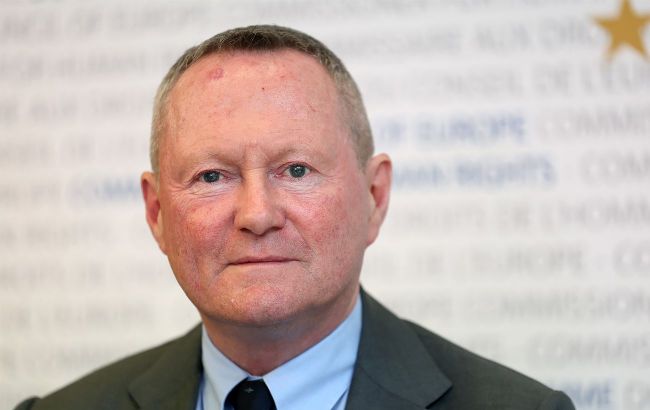 Photo: Council of Europe Commissioner for Human Rights Michael O'Flaherty (Getty Images)
Five years into Russia's full-scale war, the situation of millions of Ukrainian refugees across Europe has become increasingly uncertain. Calls to scale back the support and protection they receive are growing louder in several countries.
In an interview with RBC-Ukraine, Council of Europe Commissioner for Human Rights Michael O'Flaherty discusses how serious these trends are, whether Ukrainian men of military age can still qualify for protection in the EU, and growing attempts to push Ukrainians out of Europe.
Key points:
- Risk of legal chaos: Europe's willingness to host Ukrainian refugees is weakening, with some countries independently cutting financial assistance and housing programs.
- Absurdity of regional restrictions: Attempts by some governments to deny protection to refugees from specific regions of Ukraine make little sense. According to the UN, there is no truly safe part of Ukraine.
- No blanket ban for men of military age: Automatically stripping all Ukrainian men of military age of protection would be discriminatory. While Ukraine has the legitimate right to mobilize its citizens to defend the country, European governments are required to assess each asylum case individually.
- Pressure to push out and rising far-right rhetoric: There are isolated attempts in Europe to pressure Ukrainians into leaving, while refugees are increasingly becoming targets of anti-immigration narratives promoted by far-right populist movements.
Russia's full-scale invasion forced millions of Ukrainians to flee to Europe. Today, around five million Ukrainian refugees are living across the continent. Many have built new lives, establishing careers, social networks, and, in many cases, families. That said, this is far from everyone's experience.
Across Europe, governments are increasingly debating the future legal status of the new Ukrainian diaspora. Although Ukrainian refugees have integrated into local labor markets and, compared with many other refugee groups, have generally adapted well to their host societies, some countries are calling for limits on the level of protection and support they receive.
Earlier this month, the European Commission proposed extending temporary protection for Ukrainians fleeing the war by another year, until March 2028. The proposal, however, could include exceptions — for example, for Ukrainian men who would be subject to military mobilization, although only those arriving after the new rules take effect.
At the same time, some European countries are seeking to introduce their own rules governing Ukrainian refugees.
That was where RBC-Ukraine began its conversation with Council of Europe Commissioner for Human Rights Michael O'Flaherty, whose recent report urges European governments to maintain protection for Ukrainian refugees and refrain from discriminatory policies.
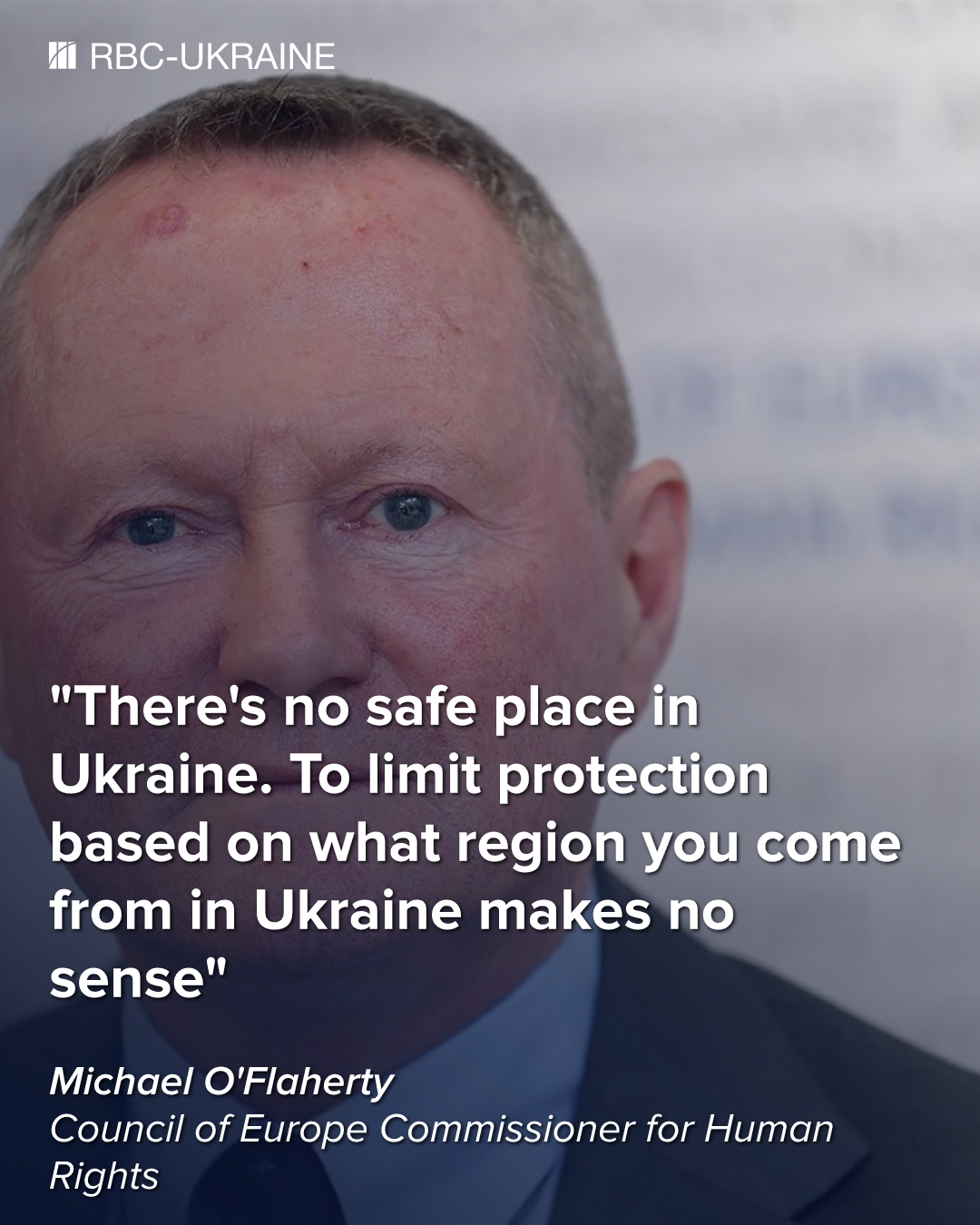
Photo: Council of Europe Commissioner for Human Rights Michael O’Flaherty on restricting protection for Ukrainian refugees (RBC-Ukraine infographic)
— Commissioner, in your conclusions, you say that you have a proposal to prolong the Temporary Protection Directive for Ukrainians till 2028. Still, at the very same time, some individual countries impose their own permits and legislation. So, won't this gap in approaches lead to legal chaos in Europe regarding Ukrainian refugees?
— A starting point of any answer to your question is that I think that Europe has done a good job of welcoming Ukrainians since 2022. Nearly 5 million people at the current time; we're not sure of the exact figure. And overall, the story of temporary protection has been a decent one.
But the welcome has been weakening in recent times, and that worried me greatly. It's what you say. It's about different countries imposing different restrictions, cutting back social welfare benefits, cutting back access to housing, and even excluding certain categories of people.
In that context, I very much welcome the Europe-wide or at least the EU-wide initiative coming now from the European Commission to do an extension of temporary protection, which will create (if it's properly implemented and properly overseen) a more or less common picture across the EU member states that buy in, as well, of course, as other countries that basically copied the Temporary Protection Directive.
But there is a concern right now. Individual countries are adopting limiting problematic initiatives.
For example, we've heard of a couple of situations where countries want to limit protection on the basis of what region you come from in Ukraine. This makes no sense. There's no safe place in Ukraine. You know that. People of Ukraine know that. The UN is repeatedly saying that.
The way in which civilians are targeted, the way in which drone warfare is conducted, means that there is no safe corner of the country. And so that makes no sense.
Then there's this issue of some kind of blanket exclusion from protection of men of conscription age. I'm not getting into the business of conscription. That's a legitimate area for any government. But at the same time, it has to be done in accordance with international law.
And international law provides for exceptions to conscription in certain categories. People with disabilities, people who are legitimate conscientious objectors for, let's say, faith reasons and things of this nature. And what that means at a minimum is that in any country or across the EU, if that's what's going to happen, that excludes such people. There has to be a chance for any impacted individual to make their case and to argue that they are beneficiaries of the exceptions.
So there was a great initiative last week from the Commission promoting an extension of temporary protection and a necessity to make sure that it's without inappropriate conditions and that it's implemented consistently across the EU member states.
— Commissioner, you mentioned two approaches that some individual states are applying to exclude certain groups from protection, either based on the area they come from in Ukraine or their age. How popular are these approaches in Europe? And strictly from a legal standpoint, is it possible to establish different rules for people based on their age, their sex, etc.?
— Let's go first with the geographic exclusion of certain bits of the country. I don't think that's going to carry much favor. I don't think that's going to persist. The evidence is too strong against it.
The UN is too clear in saying that it's nonsense. So I'd be very surprised if that becomes an important distinguisher between different people in Ukraine. But it needs to be knocked on the head, nevertheless, because the more it gets repeated, the more strength it gets.
Turning then to the issue of discrimination and so on, you raise a very legitimate point.
Whenever you make any distinction between people, you have to make a very strong case to demonstrate that that is not discrimination. And so, excluding men within a certain age group, firstly, you're excluding men and not women. And then you're excluding men within a certain age group.
That, on the face of it, raises questions of inequality. And that means that whoever is making that claim has to make a very sturdy argument that this is not a kind of inappropriate or illegal discrimination. It is possible that an argument can be made.
And there is a case to be made with regard to conscription and service in the military of a country under grave attack. But as I said earlier, it must be done in compliance with international law, which recognises that there are exceptions to conscription. There are exceptions to forced military service. There are contexts in which, for example, a civilian service would be the proper way to go.
Photo: Michael O’Flaherty on protecting Ukrainian refugees (RBC-Ukraine infographic)
Jehovah's Witnesses, for example, as far as I understand, will say they cannot serve in the military for reasons of their faith. And international law has identified that that's a legitimate claim. It doesn't mean you get away scot-free. Maybe you get civilian service or something of that kind. But you've got to have your case heard.
So some kind of blanket prohibition saying everybody within a certain age, every man within a certain age, is excluded. That would be very problematic. And so individualized assessment, I think, is the key to navigating this very tricky situation.
— But if we talk about men of conscript age who are absolutely eligible for military service, but somehow – legally, semi-legally, illegally – managed to flee to Europe, what about them?
— My point is the same once again. The issue is simply whether they can be legitimately excluded from conscription on the basis of international standards. How they ended up in a certain country is a different question. And this is not going to apply to everybody.
But again, I come back to the point. All I'm asking is that, to the extent that there is an attempt to exclude them in neighboring countries, an individual has the possibility to make an individual case as to why they should be treated differently.
— Have you discussed this issue with our Ukrainian government? They encourage Ukrainians, especially men of conscript age, to return to Ukraine to defend our country against the continuing Russian aggression. And it's known that there are some bilateral communications between our government and the governments of certain individual states regarding this issue.
— I have no objection, no protest against Ukraine strongly encouraging its men to come back and to fight for the freedom of the country. I'm not challenging that. It's entirely legitimate for any country under an aggressive attack to call on its people to stand up in its defence.
So any engagement of that kind with neighboring countries is legitimate. It's part of the sovereign role of the Ukrainian government. All I'm asking is that, to the extent that other countries heed these calls, they do so in full respect for the applicable international standards. It doesn't mean they say no. It doesn't mean they close the door to the appeals from the Ukrainian government. It means that they consider such appeals in conformity with the applicable international standards.
— Generally, do you see a political trend when European countries are trying to ''squeeze'' Ukrainians back home or elsewhere?
I certainly see tendencies. I've travelled around Europe in the last few months speaking with Ukrainians in multiple countries, and I've heard many stories of, as you put it, "squeezing". I've seen cutbacks to social welfare payments to an extent that generates real hardship for impacted individuals. I've seen a reduction in accommodation capacity, which is fine if you can afford to go out there and rent an apartment.
But for those like pensioners who don't have the resources, it's hugely problematic. I have seen a very worrying rise in hate directed against Ukrainians in some places. Thankfully, not many places.
This is not widespread, but it is happening, and it's unacceptable. I see Ukrainians caught up in the whole anti-migrant rhetoric of the extreme right, which wants to blame migrants for everything that goes wrong in society. It's populist nonsense, and it's got to be stamped out.
This is very dangerous stuff. Maybe there are issues with a very generous package of support, at least at the beginning, with Ukrainians in some countries, which made some local people resentful.
I don't challenge that. But that can be fixed, and it doesn't have to result in the expulsion of Ukrainians who still need protection in a context of a year in which the attack on civilians has been the most intense since the aggression began.
— Regarding the anti-Ukrainian sentiment, where do you see the most threatening dynamics? And particularly, given the ongoing conflict between Ukraine and Poland over historical issues and the rise of anti-Ukrainian sentiment in our neighboring country, is Poland in the high-risk category?
— There are 46 members of the Council of Europe. I'm responsible for looking after or support protection of human rights across all 46. I do not have the capacity to do some kind of a survey, a Council of Europe-wide survey, to accurately answer your question.
And that means it would be unhelpful for me to name countries now. I also think it's very important to acknowledge that hate in a society is not necessarily the fault, at least the primary fault, of the government or of the state. We have extreme right sentiments, including in opposition politics in many countries, that are the primary source of this kind of hate.
So let's look at each situation, country by country, and come up with a precise recipe for that country that best identifies what's going on, why it's happening, and how it needs to be tackled.
— If different changes are applied to the legal status, to the level of protection for Ukrainians in individual countries in Europe, do you expect that some potential mass migrations of our refugees may take place to the countries where their status is stronger, or more protection is given, inside Europe?
— We've seen people moving around, Ukrainians moving around, since 2022. It's natural and understandable that they'll gravitate towards those places where they have family members, they have relatives, they have some roots of some kind, where there's a linguistic similarity, where there's a prospect of work, and on it goes.
So this is normal, and it's inevitable. And I don't think it's a big problem. But if you can't live in a certain country, it's entirely likely that you'll move somewhere else where the conditions are better. But, you know, let's also remember those who can't move.
I've met with pensioners who say it's very hard to keep going, but what are they going to do? I met a couple recently, 75 years old, they're finding it hard to get by, but they're not going to go anywhere until they get back to Ukraine. I've seen this so often: the older people, the more vulnerable people who are most determined to go home, and who just recognise that the conditions are not in place for that to happen yet.
— If the peace agreement or a sustainable ceasefire is reached in some foreseeable future, what could be the reaction of European countries to this? Could Ukrainians be swiftly stripped of any special protection?
— That would be very unfortunate. Protection is still needed after a ceasefire.
Your country has been devastated by this Russian aggression. Whole towns have been wiped out. Vast amounts of the housing stock have been destroyed.
The infrastructure for normal life is hugely compromised. So, all of this has to be looked at before we can talk about safe and dignified return. So, any kind of knee-jerk response to something like a ceasefire would be very unfortunate and deeply ill-advised.
 Photo: Michael O’Flaherty on the return of Ukrainian refugees (RBC-Ukraine infographic)
It'll just lead to further chaos and problems. And the other dimension of all of this is that I consider it a responsibility of the neighboring countries, when it comes to the moment for safe and dignified return, to provide financial support for that return, so that the full responsibility does not lie on Ukraine itself, which has to face so many vast challenges right now.
So, let's make sure that for every euro that goes to support a weapon, another euro goes to support the social infrastructure to allow for a dignified life for civilians.
— Based on your research, can you give at least a very approximate assessment of how big a percentage of Ukrainians already connect their future to the country that they are currently staying in, and how many of them may return home in case we have a ceasefire or a peace deal?
— I haven't done this research myself, but there have been numerous repeated surveys, including by the EU, to look at exactly this question. And I recall in 2022, the survey data indicated that about a third wanted to go home, a third wanted to stay in the host country, and a third didn't know. More recently, it seems to be more like 50-50 in terms of who wants to go home and who wants to stay.
What's interesting from my own work, meeting with Ukrainians, as I said, in multiple places, is asking why those who want to stay want to stay. And the reasons are very complex and diverse. I've met many mothers who say, "We have to stay because our kids are in school, our kids are in college, and we have to be here for them."
Others talk about how they've bedded down and made ties. They form family relationships in the host country. So it makes no sense anymore. This country has become a home.
But still, a very significant number of people tell me they desperately want to go home, that they love their country, and they want to be part of rebuilding it. Or in the case of some of the older people I've met, they just want to spend their last days in the place that they know and that they love.
So it's very diverse.
— In your opinion, Commissioner, is Europe itself ready for the potential massive departure of Ukrainians after the end of the war, as the Ukrainians have become a very important part of the economy and labor market in many European countries?
— I think that's a very interesting question. And what it says to me is the extent to which European governments need now to be focusing more on integration strategies for those people who have become essential to the economies, essential to the well-being of their societies, and the extent to which they should welcome these people.
And I do consider that there is inadequate reflection in the medium to long-term about what integration should look like in terms of educational support, investments in language, and all the other things necessary for normal life.
— About 60% of Ukrainians work below their qualification level due to bureaucracy with their diplomas. Why haven't the European countries solved this issue, as the war is now in its fifth year?
— Well, first, you're absolutely right. It's also my own view, my own assessment, that people are massively underemployed in terms of their qualifications, their skills, and experience. And that's a missed opportunity for the host countries.
Every year since 2022, there has been some hope, however naive or unrealistic, that things would end. And so I think it's understandable how short-termism has affected the way host countries have engaged with this issue since 2022.
But now in 2026, with the intensification of the aggression against civilians, it's time to look at a medium-term perspective. Find ways to draw on all of that expertise and qualification to the benefit, to the well-being of the impacted Ukrainians, and to the enormous benefit of the host countries.
— In your conclusions, you have provided a list of recommendations to the individual states. What means do you have, what leverage mechanisms do you have over the national governments to make them fulfill these recommendations or to encourage them to fulfill?
— Well, you said it yourself: encourage. All I have are words.
I don't have a police force. I don't have any compulsion. I can't issue judgments like a court.
But I can use my words, my persuasion, my arguments. I hope that in reports such as the one I issued, I've laid out the evidence base for the approach we need to take. And I will do my best meeting with senior officials of the EU and of the governments of the various impacted countries in the hope of persuading them.
Because treating Ukrainians with respect in their country is for everybody's good and for everybody's benefit. It benefits the host country as well as Ukrainians themselves. And I just need to persuade governments of that case.