No more protection or payments? Europe weighs new measures for Ukrainian refugees


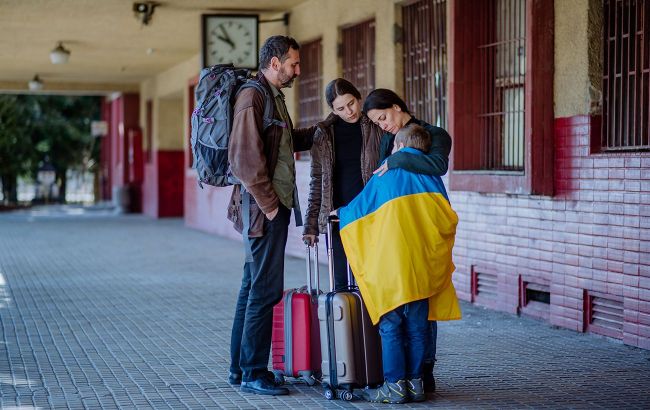 Illustrative photo: What Europe is preparing for Ukrainian refugees (Getty Images)
The status of many Ukrainian refugees in the European Union is once again in question. Many countries would prefer to implement changes that would allow some of them to return home.
Read the RBC-Ukraine article to find out exactly what changes are planned and what the consequences will be for Ukrainians in Europe.
Key points:
- Status change: The European Commission is preparing proposals regarding the residency status of Ukrainians in the EU after March 2027. This involves a selective approach to granting temporary protection.
- Focus on specific categories: European governments, particularly Germany, are insisting on excluding men of draft age from the protection program. This is explained both by Ukraine’s defense interests and by domestic political demands within EU countries.
- Kyiv's position: Ukraine officially advocates for maintaining protection for law-abiding citizens, but at the same time is interested in the voluntary return of refugees.
- Legal mechanism: A final decision on the exclusion of certain categories of refugees is expected in the coming weeks. The EU sets the framework, but implementation and details are up to each member state.
Discussions regarding changes to the status of Ukrainian refugees in the European Union have been ongoing for several months, but recently this issue has gained new momentum. The first major changes could take effect as early as next March.
Currently, the legal basis for Ukrainians in the EU remains the Temporary Protection Directive, which guarantees the right to residence, social assistance, and benefits. And although there are official plans to extend it, one thing is clear: not everyone will be able to retain their refugee status.
Grassroots initiative
Since the start of Russia’s aggressive war against Ukraine, over 4.8 million displaced individuals from Ukraine have found protection, shelter, and new opportunities in EU countries. Of these, 4.37 million have refugee status, European Commission spokesperson Elettra Di Massa tells RBC-Ukraine.
For European countries, the issue of refugees from Ukraine is quite problematic. Although many states have reaped economic benefits from them, this issue has long been the subject of political speculation.
Against the backdrop of the rise of populist forces, many European governments prefer to at least partially shift this burden off their shoulders. Some countries are attempting to influence the situation of refugees through national legislation.
For example, Czechia is proposing to require that people seeking protection have a valid work permit and be economically active.
Similar changes are taking place in Poland. As of March of this year, social assistance for refugees is no longer unconditional. Under the new rules, priority is now given to those who integrate into the local labor market and the social security system.
Meanwhile, the German government has implemented a reform under which refugees who arrived after April of last year receive a lower level of social support.
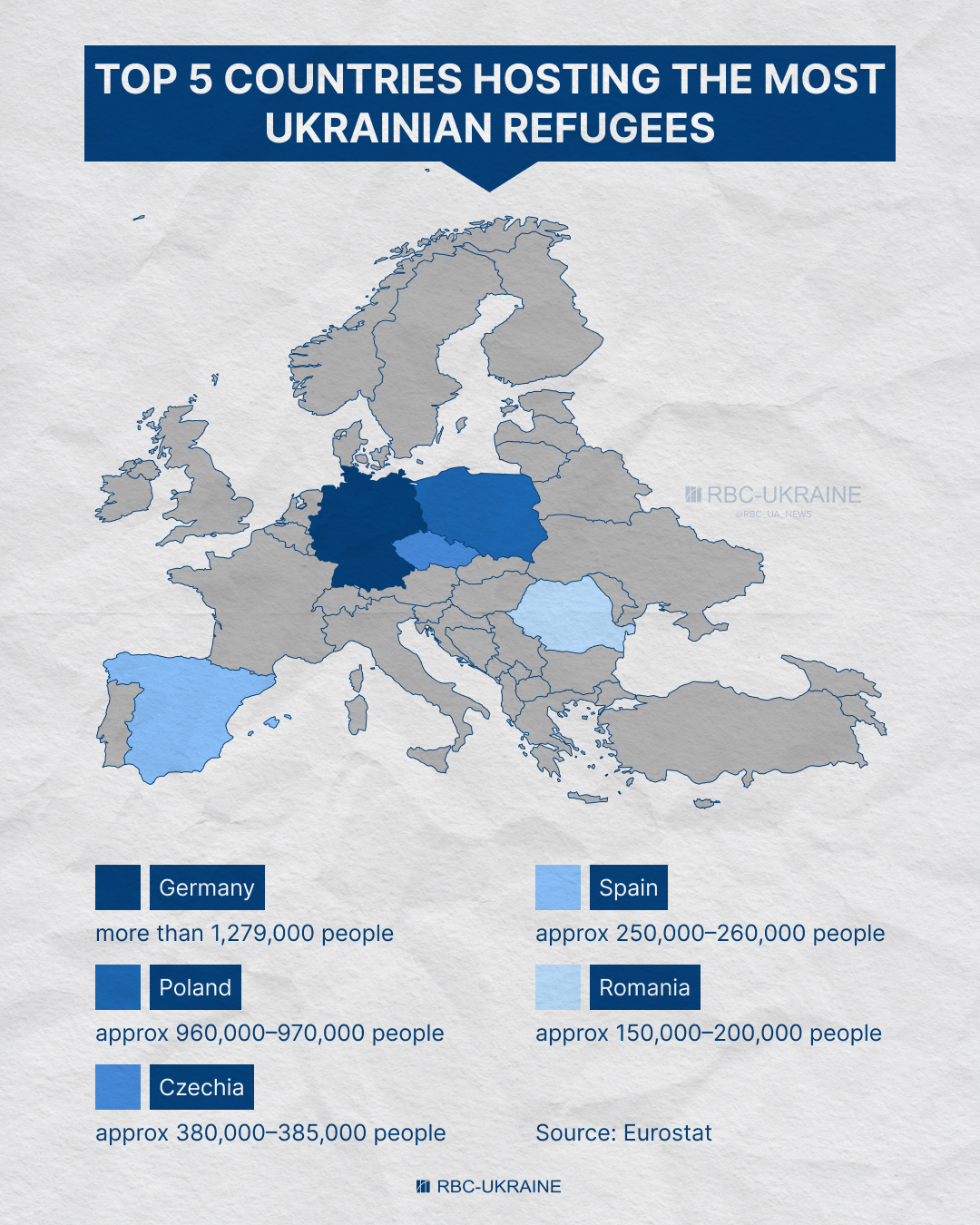 Photo: Top 5 countries with the largest number of Ukrainian refugees (infographic by RBC-Ukraine)
Norway and Switzerland, which are not EU members, introduced a ranking system in 2025. They no longer provide automatic protection for new arrivals from the regions of Ukraine that are not directly adjacent to the front lines.
Domestic political debates play a significant role in these processes. For example, in Germany, a review of refugee policy was on the agenda even before last year’s elections.
"Current Chancellor Friedrich Merz came to power, among other things, with a promise to modernize Germany’s social security and benefits system. And his party has consistently criticized what it considers to be excessively high benefits for, among others, refugees from Ukraine," says Viktor Savinok, an assistant at the Institute of International Relations at Maria Curie-Skłodowska University in Lublin, in a comment to RBC-Ukraine.
However, discussions about revising the status of Ukrainian refugees are taking place at the EU level as a whole, not just in individual member states.
Moreover, as early as last September, the Council of the EU approved recommendations to member states regarding the removal of Ukrainians from temporary protection status. And this is not an isolated initiative.
EU level changes
In early March 2022, the EU activated the temporary protection directive to support Ukrainians. Initially, it was supposed to remain in effect for only one year, but the term was subsequently extended, most recently until March 2027.
Changes are planned once this period ends. According to Politico, this issue was discussed at a recent meeting of EU Interior Ministers in Luxembourg.
"The Commission will now prepare a proposal regarding the protection of refugees from Ukraine starting in March 2027 (when the current regime expires). The EU Council will then make a decision based on this proposal," Elettra Di Massa confirms in response to a request from RBC-Ukraine.
As emphasized by the European Commission, support for Ukraine remains unwavering, and any new proposal will be in support of Ukraine and Ukrainians.
At the same time, Ministers from member states are determined to develop a solution that would remove protection for those barred from entry, that is, men aged 23 to 60.
On the sidelines of the meeting in Luxembourg, Swedish Migration Minister Johan Forssell stated that his colleagues from other countries were more or less unanimous in their support for extending temporary protection for Ukrainians.
But when asked about men of draft age, whether he expected the European Commission to include this idea in its upcoming proposal, Johan Forssell replied, "definitely."
For his part, European Commissioner for Migration Magnus Brunner, responding to the initiative, stated that the EU’s position on this issue aligns with the request from the Ukrainian government. According to him, a final proposal will be presented in the coming weeks.
The issue of changes regarding men remains the most pressing in several EU countries.
For example, German Chancellor Friedrich Merz emphasizes that this group of refugees is the most controversial and, if necessary, will be the first to be excluded from the protection program. Their share of the total number of refugees has now reached 30%.
"We also support Ukraine’s efforts to restrict the departure of men of draft age to the EU. This is necessary so that Ukraine can defend itself, so that Ukrainian society remains united, and so that Ukraine can truly be rebuilt," the Chancellor stated during a meeting with the President of Ukraine in April.
At least some countries are already openly endorsing restrictions on men.
Finnish Interior Minister Mari Rantanen said on June 4 that Finland was ready to consider such a restriction regarding the granting of temporary protection, for example, on men of draft age.
Spanish Interior Minister Fernando Grande-Marlaska Gómez believes that the EU needs to find a different common position on the protection of Ukrainian refugees. He argues that temporary protection cannot be a medium- or long-term measure.
At the same time, there are other views.
Estonian Interior Minister Igor Taro noted that they believed the most sensible step was to extend the amendment to the temporary protection directive in its current form.
However, unlike many other decisions in the EU, amending the directive does not require unanimity and can be adopted by a qualified majority (55% of countries representing 65% of the population).
Ukraine's position
"We understand that at the EU level, the initiative to review refugee status is coming from certain European countries. We understand that in many cases this is part of domestic policy," says an RBC-Ukraine source in diplomatic circles.
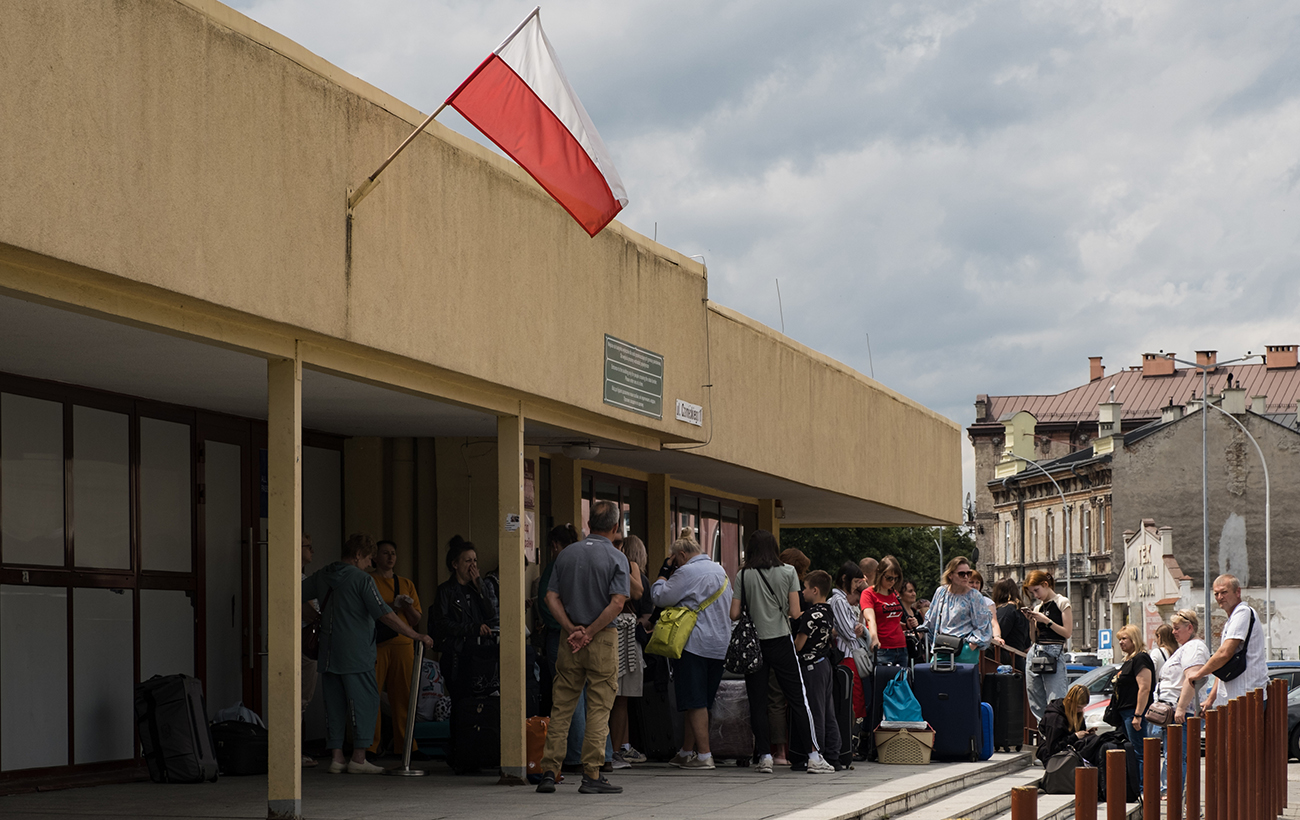 Photo: Ukrainians waiting in line near the train station in Przemyśl, Poland (Getty Images)
Meanwhile, within Ukraine itself, views on this issue are mixed. Kyiv has been talking for several years now about the need to bring its citizens home. This need is entirely objective: the Ukrainian army needs soldiers, and the economy needs workers.
"Your homeland needs you—this isn’t rhetoric, it’s a fact. Today we’re discussing how to bring Ukrainians back… Of course, we’re an open country and are happy to welcome anyone here, from any nation, but we’re still raising the issue of bringing Ukrainians back, millions of them, our own people, our kin, home," Volodymyr Zelenskyy said on May 26.
However, the Ukrainian government's options in this matter are limited. Furthermore, the government is clearly hoping to avoid unpopular decisions.
If some refugees are stripped of legal protection in the EU, it will clearly not be met with enthusiasm. This is especially true for those who left Ukraine illegally to evade mobilization.
Ukrainian Foreign Ministry spokesperson Heorhii Tykhyi, responding to a question from RBC-Ukraine, states that Ukraine is interested in the voluntary return of its citizens.
According to him, negotiations on encouraging voluntary return have been underway since the fall of 2022. However, Tykhyi notes that in many cases, this comes down to Ukraine creating the necessary conditions, primarily security-related ones.
"As for those people who are there (in the EU—ed.) legally, Ukraine advocates for their protection to be maintained," the Foreign Ministry spokesperson adds.
His emphasis on legal status may hint at certain decisions awaiting illegal refugees. The agency European Pravda, citing sources in EU diplomatic circles, notes that most European governments are ready to support such a move.
"If we propose something, you can be sure it will have a solid legal basis," the agency's source says.
Exactly how long it will take to develop this legal framework is currently unknown.
Practical nuances
The EU’s jurisdiction over refugees is not comprehensive. The Union sets a certain framework and creates legal mechanisms, but the actual work with refugees falls under the responsibility of each country.
"This primarily concerns the right to continued residence, prospects for obtaining citizenship, integration into social processes, and so on. There can be very significant practical differences here (between countries—ed.)," Borys Babin, Doctor of Law and an expert with the Association of Reintegration of Crimea, told RBC-Ukraine.
In fact, some governments are already resorting to complicating procedures and restricting assistance in an attempt to encourage the outflow of refugees. It can be assumed that if a decision is made by the EU, these governments will resort to expelling certain categories of refugees even more actively.
Hypothetically, the opposite situation is also possible, in which individual countries might formally comply with the EU directive but simultaneously offer Ukrainian men other means of legalization, for example, a simplified process for obtaining work visas instead of refugee status.
"If the EU directive includes certain exceptions for specific categories of Ukrainian citizens, this will be implemented at the national level," says Borys Babin.
The expert is convinced that all governments will comply with the EU's decision.
This confidence logically follows from the information currently available, at a meeting in Luxembourg, where ministers expressed unanimous support for both the extension of the Directive and the creation of an exemption mechanism.
However, it is currently unclear how long it will take to work out the details and whether this initiative will ultimately be buried due to minor disagreements among the participants in the process.
Both Ukraine and the EU clearly share a desire to encourage at least some Ukrainian citizens to return home, particularly those who left Ukraine illegally. However, in previous years, both sides have tried to avoid serious and unpopular decisions.
Today, European governments seem to have finally matured enough to make a concrete decision. However, every decision has one Achilles’ heel: the implementation phase. How quickly the legal framework will be developed and whether it will work in practice are the questions that will truly determine the success of this initiative.
Quick Q&A
— Does temporary protection for Ukrainians in Europe end in 2027?
— Officially, the directive expires in March 2027. It will likely be extended, but the conditions for receiving protection will become stricter, especially for certain categories of citizens.
— Who is most likely to lose their right to protection?
— The most controversial group consists of men of conscription age (23–60 years old). Some EU member states are prepared to develop a mechanism to revoke their right to temporary protection.
— How does Ukraine view these changes?
— Kyiv supports maintaining protection for individuals residing in the EU legally, but acknowledges the need for citizens to return. The issue of undocumented migrants remains sensitive and requires careful legal solutions.
— Can EU countries act independently?
— Yes. Many countries (Czechia, Germany, and Poland) are already implementing their own restrictions, such as reducing social benefits or prioritizing refugees based on security criteria in the regions from which they came.