Crimea is turning into an island. Will Russia feel the impact on the battlefield?


 How attacks on logistics are complicating the situation on the front lines for Russia (Infographic by RBC-Ukraine)
Gas stations are out of gasoline, Ukrainian drones can be heard in the air almost every night, and the Black Sea Fleet command is already packing its bags. These are the consequences of the Ukrainian Defense Forces' attacks on Russian logistics over the past weeks in the south and on the approaches to Crimea.
How these strikes are already affecting the front lines and what the goal of these attacks is, read in this RBC-Ukraine report.
Key points:
Strikes on logistics: The Ukrainian Defense Forces have been preparing for a long time for an operation to cut off Russian logistics in the south and in Crimea, taking out the eyes of Russian air defense. As of today, key roads and bridges are under fire.
Impact on the front line: The disruption of logistics is already yielding results—due to an acute fuel shortage and difficulties in supplying reserves, the intensity of Russian assaults in the south has decreased by approximately 15%.
Russian adaptation: Russia is forced to take more circuitous routes; fuel tankers are disguised as civilian vehicles, and cargo is transported via secondary roads or barges.
Overall objective: The Ukrainian Armed Forces' campaign aims to thwart Russia’s summer offensive and strengthen Ukraine’s position in future negotiations.
Commander of the Unmanned Systems Forces of the Armed Forces of Ukraine, Robert Brovdi, call sign Magyar, recently promised in an interview with Reuters to block and isolate occupied Crimea completely. According to OSINT estimates, over the past week, the Ukrainian Defense Forces have already carried out at least 10 attacks on seven bridges in the north of the peninsula.
The first bridge to be hit was in Chonhar, followed by a bridge south of Henichesk. After that, Ukrainian units attacked several more bridges across the North Crimean Canal near Armiansk.
In an attempt to maintain some connection with the peninsula, the Russian army has now begun using one of the bridges across the canal near the village of Myrne.
To restore traffic where bridges were damaged, Russia has begun setting up pontoon crossings. One of these has already been hit as well.
Additionally, the capacity of such crossings is relatively low, causing traffic jams and lines of Russian military trucks to form nearby. And they, too, can become targets of Ukrainian strikes.
Strikes are targeting Russian military logistics not only on the approaches to the peninsula but also within Crimea itself and throughout the occupied southern regions.
Ukrainian Defense Forces regularly attack the so-called land corridor to occupied Crimea—the so-called Novorossiya R-280 highway. For a long time, this was the main supply route for Russian troops on the peninsula after the Kerch Bridge was damaged.
According to Magyar, the Ukrainian strike campaign has reduced traffic on the R-280 highway by more than two-thirds over the past month.
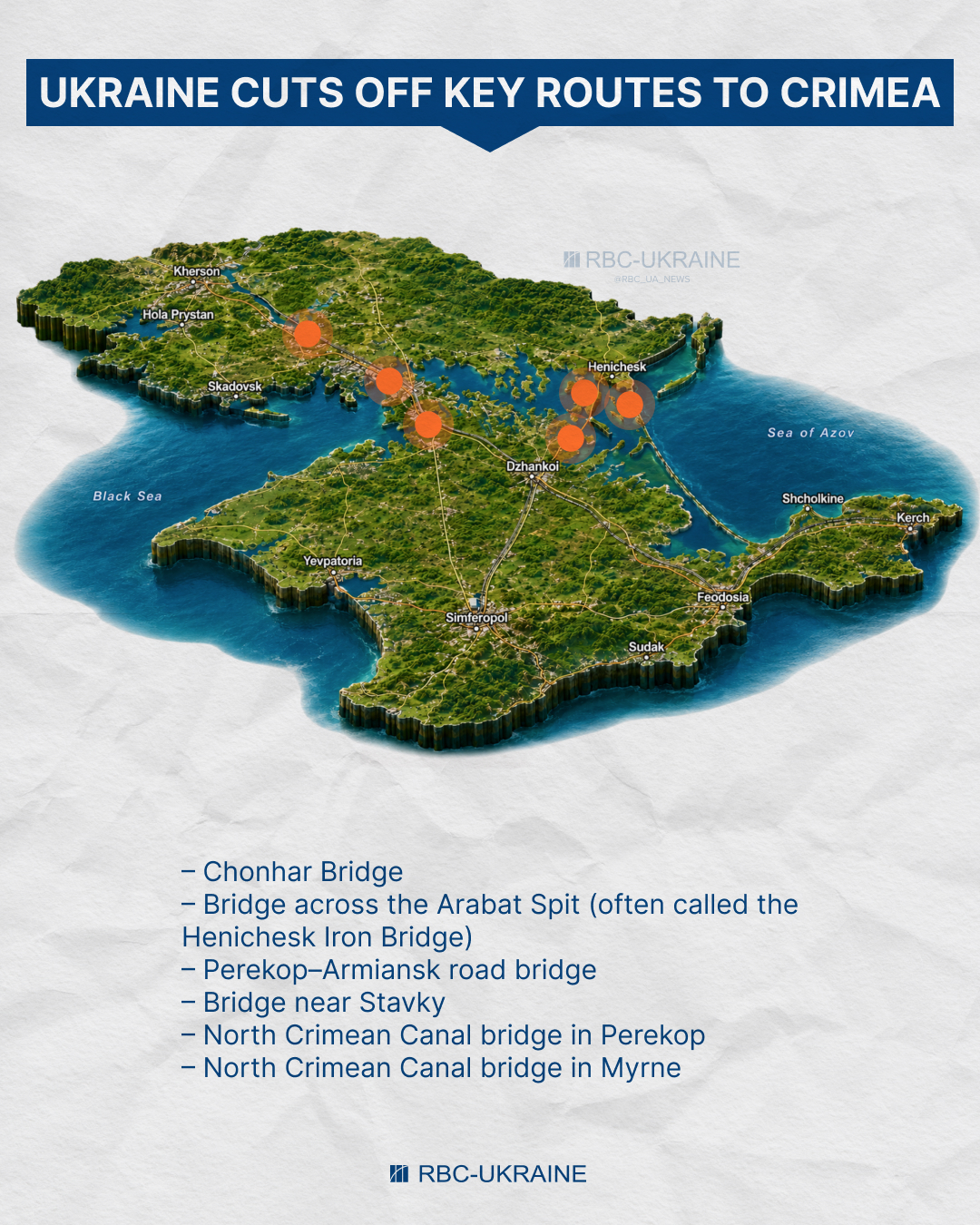 Photo: Ukrainian Defense Forces attacked key routes to Crimea (Infographic by RBC-Ukraine)
Crimea becoming useless burden for Russian troops
After seizing Crimea in 2014, Russia actively militarized the peninsula, turning it into a military base to support Russian forces in the south. Now, however, the peninsula is the most vulnerable location it has been since Russian troops entered the region.
The operation to cut off Crimea from the mainland was planned systematically, according to Vladyslav Seleznov, a former spokesperson for the General Staff of the Armed Forces of Ukraine and a military analyst. He says this is evident from the order and priority of the targets struck by the Ukrainian Defense Forces.
First came strikes on radar systems, which effectively blinded Russian air defense on the peninsula. This, in turn, created a window of opportunity that the Ukrainian army is now exploiting.
In addition to highways and bridges, the Crimean railway and ferry services are also under attack. The peninsula is being gradually cut off, leaving only the so-called Kerch Bridge as a supply route.
Perhaps this is precisely the Ukrainian Defense Forces’ plan—to force the Russian troops to concentrate all their logistics through a single artery. As a result, supplying Crimea will become even more precarious if this facility is attacked as well.
"A couple of weeks ago, monitoring sources reported that we had targeted the Kerch Bridge with Neptune missiles, but Russian air defense systems intercepted them at the time. Meanwhile, just a few days ago, we managed to strike an oil refinery in Moscow. Even the most powerful air defense network failed to deliver the result Russia had hoped for. I think the same will happen with the Kerch Bridge. Of course, one or two missiles or a few drones won’t destroy this structure. Still, even a suspension of traffic due to an air raid alert creates additional problems," Seleznov suggests in a conversation with RBC-Ukraine.
Moreover, new serious damage to the bridge in the event of repeated attacks, on top of the previous damage, will significantly complicate the already limited logistics across the Kerch Strait.
As Vladyslav Voloshyn, a spokesperson for the Southern Defense Forces of the Armed Forces of Ukraine, explains, the Russians face restrictions on transporting fuel and lubricants across the Crimean Bridge, and they try to avoid transporting explosives and ammunition across it. Therefore, traffic across this bridge is also quite limited.
Many OSINT sources suggest that the Russians may have resumed using the Kerch Bridge in recent days to transport fuel and military supplies, given that fuel has appeared at some gas stations on the peninsula. Of course, there is still not enough of it—occupied Crimea continues to face severe restrictions and a gasoline shortage.
 Photo: The Ukrainian Defense Forces are methodically striking at Russian logistics in Crimea (Russian media)
The ATESH movement claims that due to the Ukrainian strikes, the command of the Russian Black Sea Fleet is already developing a plan to relocate its command headquarters from Sevastopol to Novorossiysk.
According to Magyar, the Ukrainian Armed Forces plan to create conditions under which it will be difficult for Russian military personnel or defense industry enterprises to remain on the peninsula, in the temporarily occupied territories, or to use access routes to those areas.
"Every time I look at the results of the Defense Forces’ strikes on Russian military targets in Crimea and Sevastopol, I catch myself thinking that this is an attempt to prove to the Russians that Crimea has become for them a sort of suitcase without a handle, hard to carry, but a pity to throw away," notes Seleznov, former spokesperson for the General Staff of the Armed Forces of Ukraine.
How strikes on Russian logistics already affecting front lines
The Ukrainian strike campaign is also having a direct impact on the situation at the front.
The number of Russian assaults in the south over the past 4–5 days has decreased by approximately 15% as a result of Ukrainian strikes on logistics, says Voloshyn. Whereas previously there were 50 combat engagements recorded in the south, the number is now 35–37.
"The intensity isn’t as high as Russia had anticipated, since it had concentrated a certain number of forces and resources here to step up its activities in the south. With our middle strikes against Russian logistics, we prevented it from launching its offensive during this period," Voloshyn tells RBC-Ukraine.
In addition, it has become difficult in occupied Crimea to stockpile fuel reserves to support the Russian army’s offensive operations in the south, particularly in the Zaporizhzhia region.
"Ukrainian Defense Forces are preventing Russian troops from amassing forces and resources to intensify offensive operations in the Zaporizhzhia direction. We are thwarting Russia's offensive efforts," explains Oleksandr Musiienko, an expert and Ukrainian Armed Forces servicemember, in an interview with the agency.
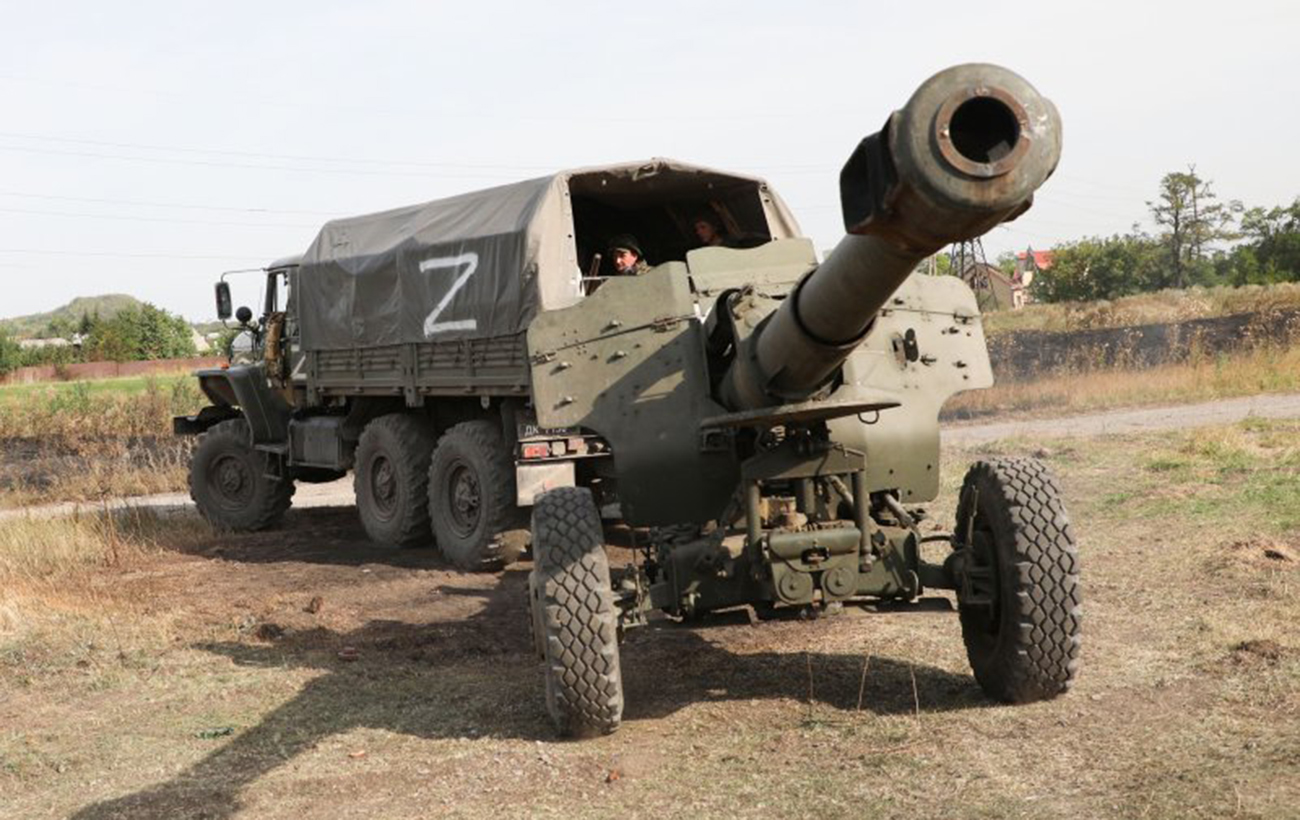 Photo: Russia is already feeling the effects of strikes on its logistics at the front (Russian media)
Against the backdrop of Ukraine’s campaign of strikes and attempts to isolate Crimea, experts have begun discussing a scenario in which the Russians would be forced to retreat from the peninsula or other occupied territories due to their inability to maintain logistics. This is analogous to what happened in the fall of 2022 in the Kherson region.
Recently, the ATESH partisans also reported an alleged Russian retreat from the Kinburn Spit, a part of the Mykolaiv region that borders the left bank of the Kherson region. Subsequently, the Southern Defense Forces of the Armed Forces of Ukraine denied this.
And although the Russian forces there are experiencing supply problems, their withdrawal from this territory, as well as from other occupied territories in the south, has not yet been observed, says Voloshyn.
According to him, Russian units on the spit carried out a rotation and withdrew 100–150 meters from their northern part to more fortified positions.
Another informed source in the Ukrainian Defense Forces explains that the key objective of the current middle-strike campaign is to improve Ukraine's situation on the front lines, and that this campaign involves not only strikes on bridges leading to Crimea but also on Russia’s entire logistics infrastructure in the south.
Earlier, several sources told the agency that this year Moscow wanted to intensify offensive operations in the Zaporizhzhia region, toward Zaporizhzhia, as well as in the Kherson region, with a possible crossing of the Dnipro River.
In addition, they continue to apply pressure in the Huliaipole area. The goal of the current campaign is to halt Russia’s advance in the south, reduce its reserves and maneuverability, and force it to abandon its plans, says one of the sources.
In addition to slowing the Russians’ advance on the front lines, Ukrainian attacks on Russian logistics could have another effect: improving Ukraine’s negotiating position, experts believe.
"Of course, Russia won’t face complete stagnation or an inability to carry out its missions tomorrow, because it has certain reserves and the ability to maneuver its forces and resources, shifting its focus to other sections of the front. But I think there’s a reason we’re hearing that in November we might achieve tangible results on the negotiation track with Russia," Seleznov suggests.
How long will window of opportunity last?
Over four years of war, one thing has become clear: both sides are constantly learning and adapting quickly. When Russian Molniya drones launched mass attacks on Ukraine's rear, Ukraine responded with defensive nets along the roads and new interceptor drones.
Now the situation has reversed, and Russia is forced to find solutions to the problems Ukraine's military is creating for them.
Due to the constant threat of strikes, the Russian army is forced to drastically complicate its logistics in the south, says Voloshyn. The Russian troops are abandoning traditional convoys of covered trucks in favor of passenger cars, and to protect supply routes from drones, the command has to pull soldiers directly from the front lines; they escort the logistics convoys as part of mobile fire support groups.
"To support the logistics of their troops in the southern sector, they have begun using secondary roads and other modes of transport. During the day, military vehicle traffic is generally prohibited within an 80-kilometer frontline zone," Voloshyn says.
The problem of supplying fuel to the troops has become particularly acute. According to Voloshyn, the Russians are disguising military fuel tankers as civilian trucks on a massive scale and are trying to transport fuel in smaller batches, even using 20-liter canisters.
To deliver fuel and lubricants to Skadovsk, Henichesk, or Berdiansk, Russia intends to use barges and small tankers, which significantly extend delivery times.
"Ukrainian strikes have had a significant impact on Russia. But they are trying to adapt to these conditions. Therefore, to say that logistics have been completely cut off is not entirely accurate," notes a spokesperson for the Southern Defense Forces.
Former Ukraine General Staff spokesperson Seleznov notes that the situation on the battlefield depends on many factors: constant technological advancements, the unpredictable behavior of Vladimir Putin, the pace of the Russian economy’s stagnation, China’s stance, support from North Korea, and so on.
"Under these conditions, it is still too early to draw definitive conclusions, whether it will take a month, a month and a half, or perhaps a longer period of time before the Russians can find a solution to counter Ukraine's strikes. The only thing that is clear to me right now is that the plan for the spring-summer phase of the Russian offensive campaign has been derailed," he notes.
Countering Ukrainian mid-range strikes will evidently become a key task for the Russian command. So far, Moscow has not managed to find an effective solution, given that the Ukrainian strike campaign has already been underway for several months and is only gaining momentum.
Moreover, as the agency’s sources note, disrupting Russia’s military logistics will be among the Ukrainian Defense Forces’ top priorities, at least for the summer campaign. And so far, Ukraine is in the lead in this race.