Nightmares, blindness, and healing with dogs: How Ukrainian defenders restore their lives after war trauma


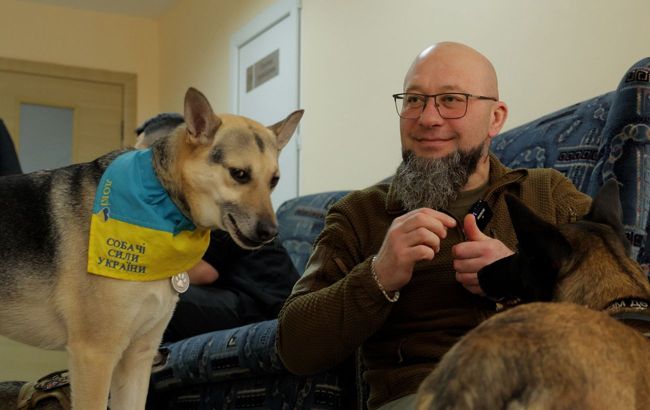 Serviceman during session with emotional support dogs (photo: RBC-Ukraine)
When a soldier cannot sleep at night because of post-traumatic stress disorder, has lost sight, or, after injury, can no longer do what was once possible, medical protocols are sometimes not enough. That is when emotional recovery becomes essential, and soldiers undergo it at the Ministry of Internal Affairs of Ukraine rehabilitation center in Pushcha Vodytsia, Kyiv.
How Ukrainian soldiers learn to live again, what pushed serviceman Serhii to finally seek treatment, how a psychologist with visual impairment helps patients through a peer-to-peer approach, and why sometimes dogs that people can play with work better than medicine — in a report by RBC-Ukraine.
Main points:
- Creativity as medicine: music and singing help fighters cope with stress, and for some, the guitar becomes a way to find inner peace.
- Peer-to-peer principle: a blind psychologist works with soldiers who have lost sight. This removes barriers and gives hope that a full life is possible.
- Four-legged therapists: interaction with dogs reduces the level of stress hormone. Animals help veterans come out of self-isolation.
- Family adaptation: rehabilitation often takes place together with families. Children learn to understand the condition of their parents through special games, which strengthen the connection in the family.
- Importance of learning: soldiers with loss of sight are taught everyday skills, from orientation in space to making a bed.
'Stars aligned': Music therapy and return to life after war, the story of Serhii Krasovskyi
Serhii Krasovskyi went to the frontline on the very first day of the full-scale invasion. He did not hesitate at all. He knew he had to protect his child and family. Before the big war, Serhii worked in a mine, which was used for heavy physical labor, but in 2022, he says, it changed everything. During the counteroffensive in the Kherson region, he received injuries of medium severity. His arm and abdomen were affected.
"Before the war, I was an extremely optimistic person. War changed my mood because of post-traumatic stress disorder. Constant problems with health, sleep, and mental state began. At first, I did not know anything about it at all, and when the condition worsened, I turned to doctors," Serhii tells RBC-Ukraine.
He did not decide to seek help immediately. Serhii has been with his wife for fifteen years, and she became one who witnessed how war was catching up with him in his sleep and started to pay attention to it. She insisted that he turn to specialists.
"She knows me very well. She saw how I was waking up… I do not want to talk about all the details. There was a simple moment when I understood that I could do something irreversible. That is why I decided to turn to specialists. Now I work with doctors and psychologists," he shares.
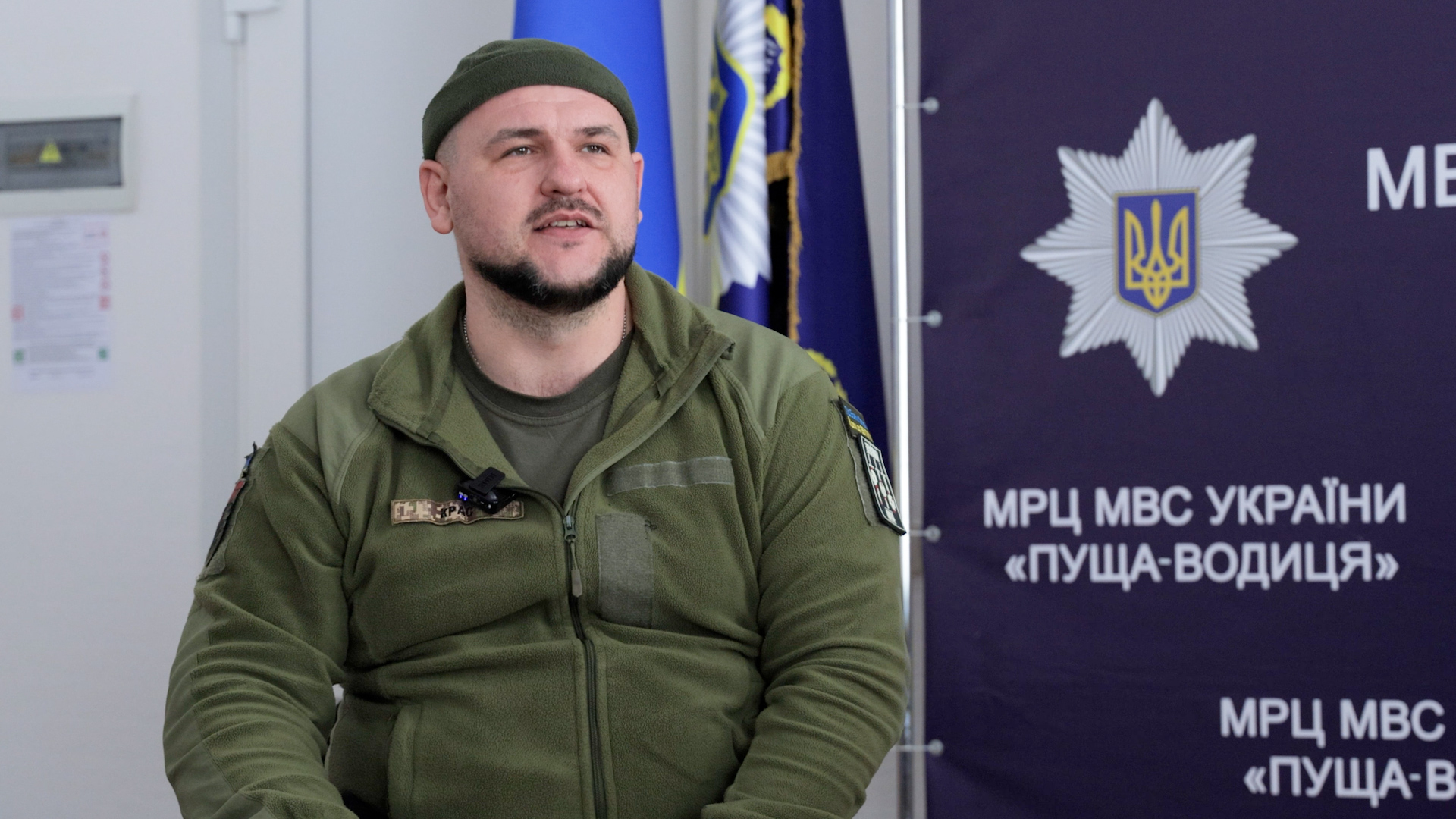 Serhii Krasovskyi hesitated for a long time over whether to seek help, his wife insisted (photo: RBC-Ukraine)
In addition to emotional wounds, physical ones also remind about themselves: his arm goes numb under strain, his back hurts, his past as a miner makes itself felt. However, in the rehabilitation center, Serhii found unexpected medicine, music. He always loved to sing, but during the war desire to sing almost disappeared.
In the rehabilitation center where he was sent, there are classes in music and singing, professional guitar teacher comes there specifically.
"At first, there was no such desire. But when I was sent here for rehabilitation, I had just arrived, and I was standing at reception. A woman runs out and says, 'We have an event here, there will be music, you will be able to sing.' Well, I went out and sang. Now I like that there is music therapy here, it really helps treatment," Serhii says.
He sings not for performances, but for himself, although sometimes friends of other patients come to listen. Process looks like a creative tandem: Serhii suggests a song, and an experienced musician picks it up instantly. However, for a song to work, a special state is needed.
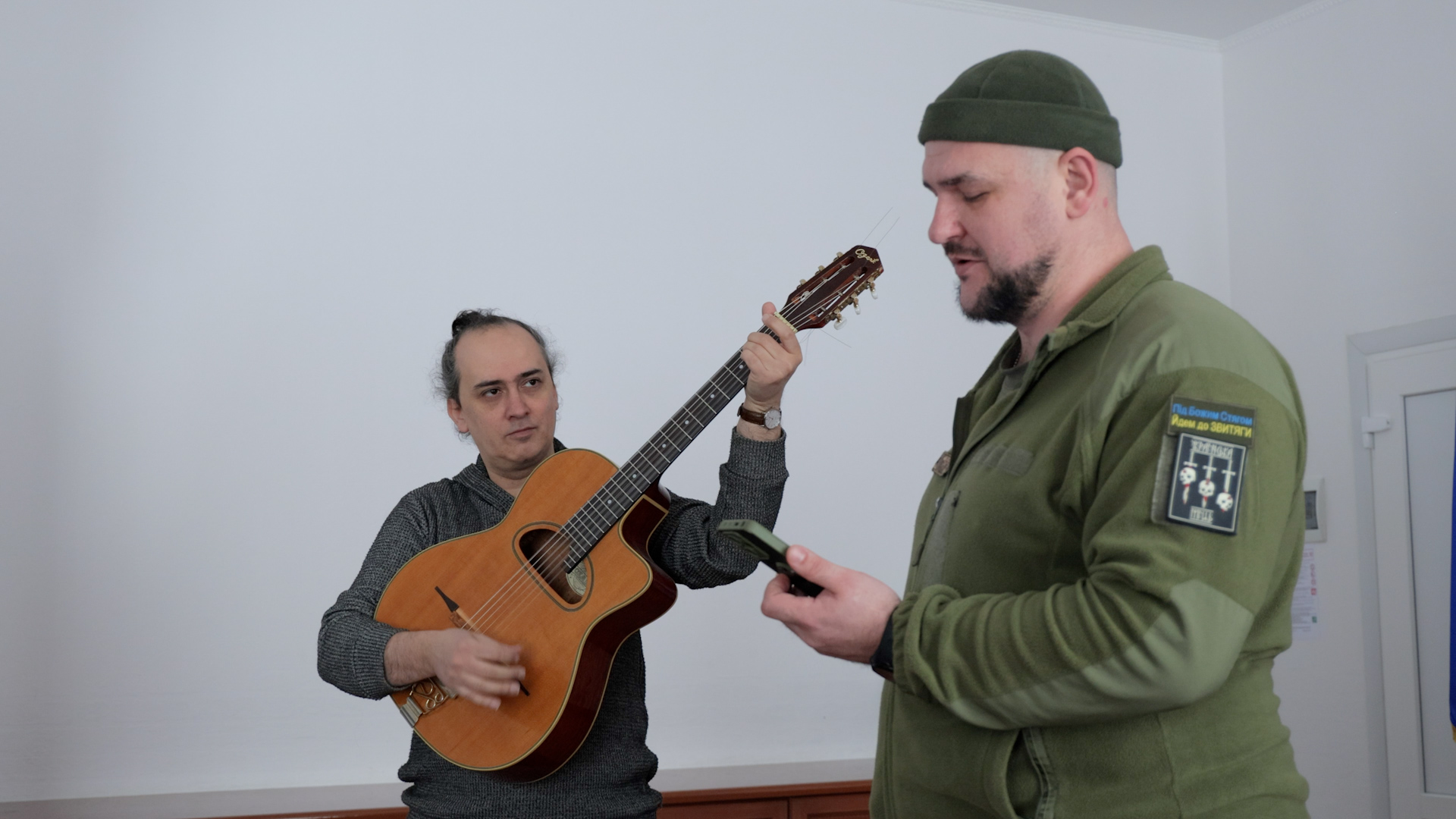 Serviceman says that singing and music give him inspiration and help in rehabilitation (photo: RBC-Ukraine)
"I did not come here to sing. There are procedures here. I sing when there is an opportunity. It is not always something I want, even for myself. Sometimes it depends on mood or health. When there are strong headaches or anxiety appears, I cannot sing. But here stars aligned," the defender explains.
Serhii's music distracts him, but he misses home very much. His family remained in Kryvyi Rih, and because of service and treatment, they have not seen each other for more than three months. Now his main task is to restore calmness and return to his family as the same optimist he was before the war.
Creativity as medicine. Who and how is helped in the rehabilitation center
The Medical rehabilitation center of the Ministry of Internal Affairs of Ukraine, Pushcha Vodytsia, has been operating after large-scale reconstruction for about three years.
Main focus is physical and psychological recovery of defenders, as well as a still rare direction for Ukraine, adaptation of people who have partially or completely lost sight. Such soldiers are helped to learn orientation in space again and to be as independent as possible.
"Our directions are physical and medical rehabilitation, the help of a physical therapist, psychologist, and many other specialists. We work with mine and blast injuries, treat people with lost limbs, and treat people with loss of sight. Patients also go through an important stage after prosthetic preparation," says head of rehabilitation center Yuliia Shvedenko to RBC-Ukraine.
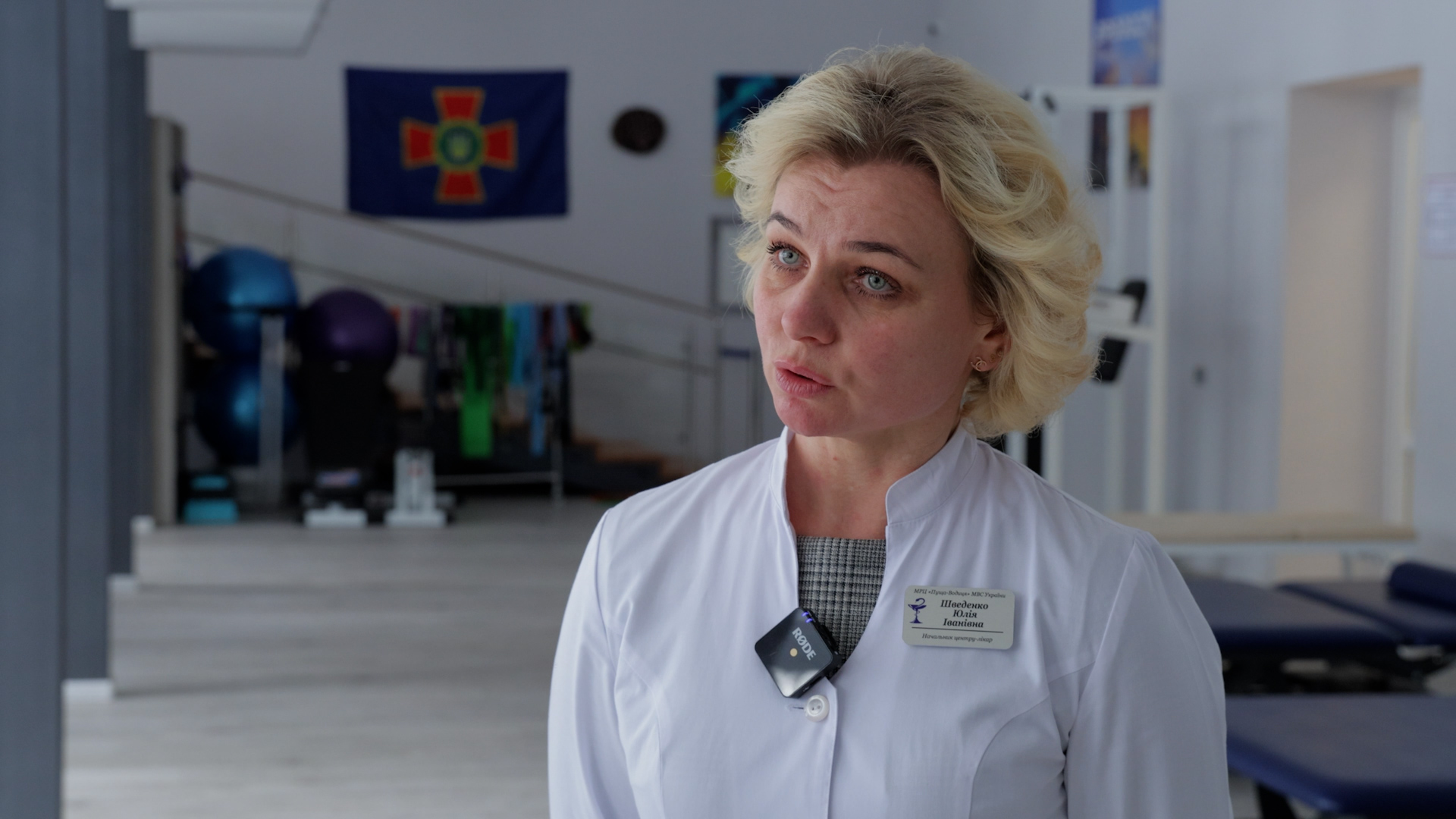 Head of rehabilitation center Yuliia Shvedenko (photo: RBC-Ukraine)
In addition to the main approaches, various additional methods are also used here for rehabilitation, as many as possible that can help soldiers improve their condition. Here, they can sing and walk around the territory with the dogs. Blind patients even planted trees. Later, they came back after some time, returned to their trees, and checked how they had grown.
There is a gym in the center where classes are held with professional rehabilitation specialists. Soon, a new hall for concerts and creativity will be opened. They want defenders to have the opportunity to play not only guitar but also other musical instruments. The chief doctor admits that soldiers in rehabilitation really dream about a swimming pool. She hopes that, over time, this idea will also be implemented.
"We add creative and social methods. But most important is that we adapt the whole family. We have the opportunity to stay together with relatives. We even put blindfolds on children, they play like this and begin to understand in what condition their father or mother is," she says.
A multidisciplinary team is constantly present in the facility, doctors of different specializations, and they decide step by step how to act and whose help will be needed for each soldier.
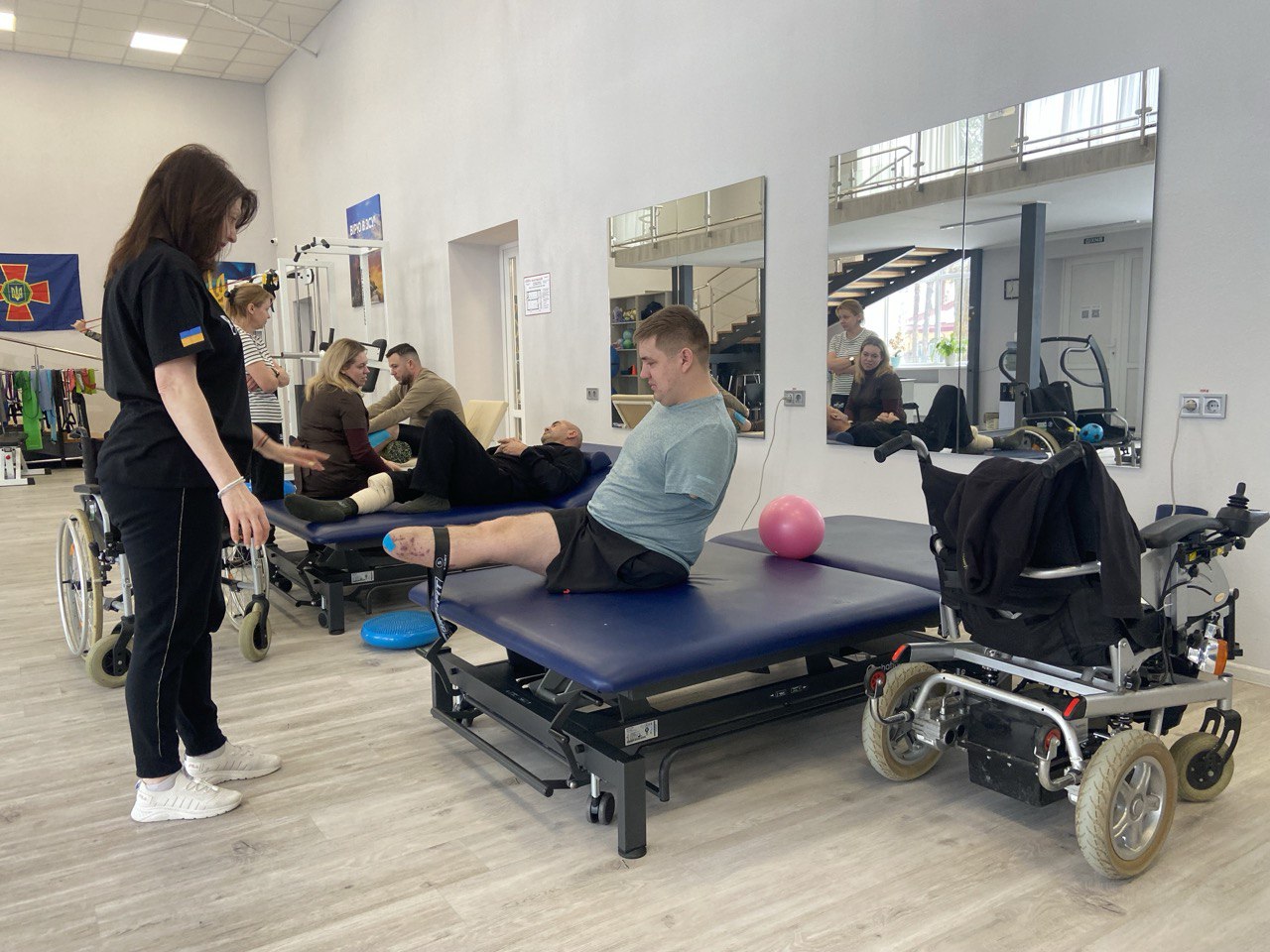 Professional rehabilitation specialists conduct sessions for servicemen (photo: RBC-Ukraine / Kateryna Honcharova)
Results of such work often look like small victories. Yuliia recalls patient Mykhailo from the State Emergency Service, who came to the center already for the third time together with his wife. Despite severe speech impairments, he is now beginning to speak.
"I see results of our patients, I am proud of this work and of the staff. Despite emotional exhaustion, burnout, and personal problems during these difficult periods, people stay patient. For us, this is a great responsibility," Yuliia Shvedenko concludes.
'There is hope until the last moment that some super technologies will restore sight'
A large part of the work consists of complex cases. Among them, there are many defenders who have lost sight completely or partially. A blind psychologist works in a rehabilitation center. This is how the peer-to-peer principle is implemented here, when a specialist who provides consultations is in the same situation as soldiers.
Such an approach helps to establish contact faster, speak more openly about difficult experiences, and creates a feeling that recovery is possible and very real.
Into the room where soldiers undergo physical rehabilitation, psychologist Oleksii Didenko enters, accompanied by a colleague. He has been working here for more than one year. Not long ago, he completed a master's degree and studied to become a psychologist. He himself was surprised that he managed to find a job quite quickly, in just a couple of weeks.
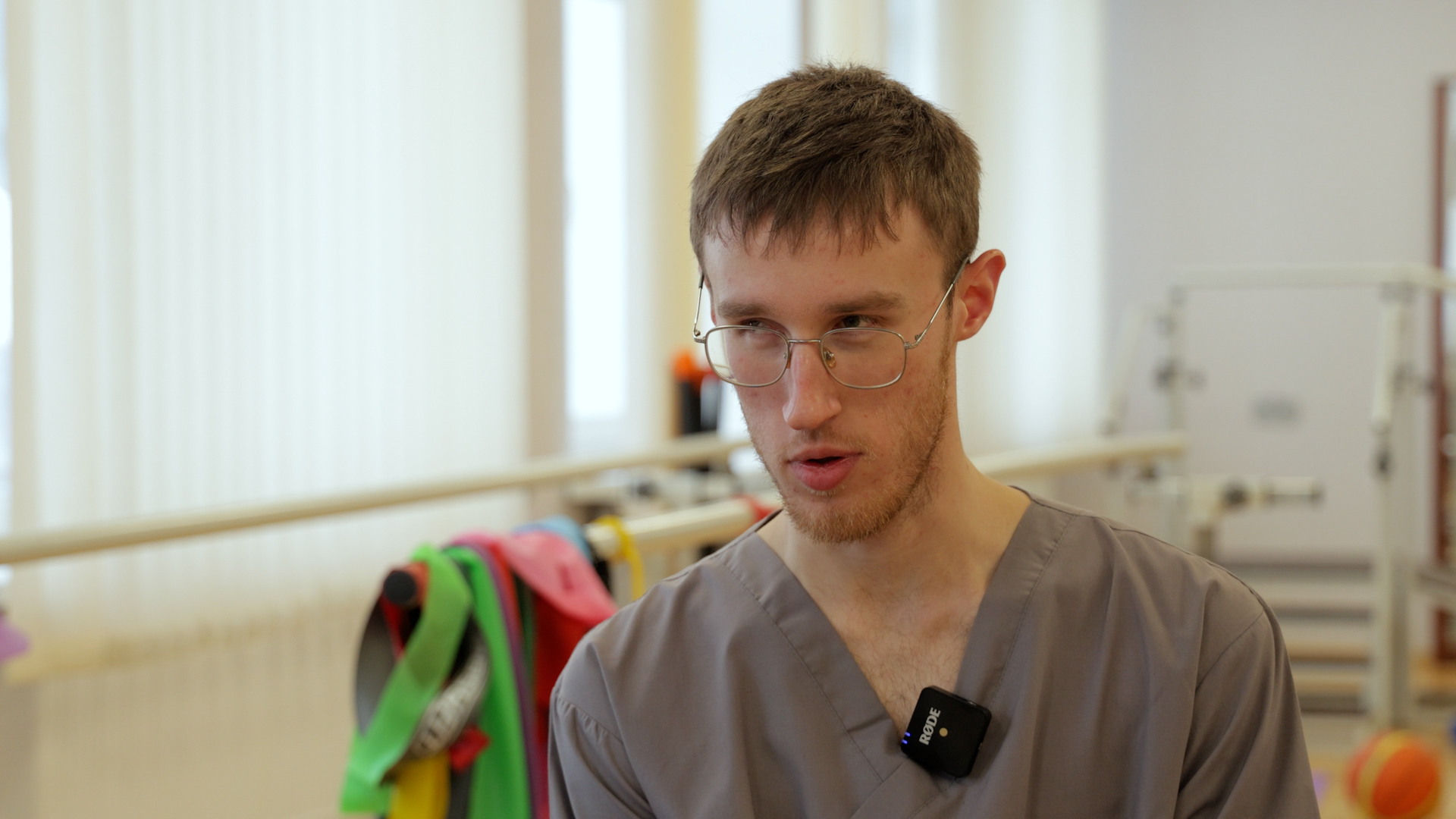 Psychologist Serhii Didenko can barely see and works with blind soldiers (photo: RBC-Ukraine)
"Sometimes I think that I would like to have more time for rest. But I am glad that I can help soldiers now. That is why I became a psychologist, to help people who are going through emotional suffering, and at the same time to inspire people, to give hope that it is possible to live further," the specialist says.
Oleksii's sight began to worsen when he was still a child. But at that time, he could still read a lot and loved studying. With his left eye, he saw quite well and did everything like a sighted person.
It became worse as he grew older. When he was a teenager, his vision dropped significantly. Oleksii could no longer read as before, but still walked without a cane. He transferred from one specialized school with minor vision problems to another where those who could not see at all studied. But even after that, he managed to receive higher education, first a bachelor's, then a master's.
Profession of psychologist, Oleksii says, is unlikely to ever be automated by artificial intelligence: "I cannot imagine a robot that could establish such contact that can be built between person and person."
Now soldiers come to him with many questions. Most often, these are problems with sleep, chronic stress, and general fatigue from service. When blind patients come, contact with a specialist can be closer than with a fully sighted specialist.
"As a rule, they have already lived through their loss. It is more about social and everyday adaptation. About overcoming fears connected with mastering what they need and in which they are limited, because of the absence of sight. But to say that they are depressed and broken, that is not the case," Oleksii notes.
According to psychologists, soldiers sometimes have a denial of their condition, hope until the last moment that some super technologies will restore sight.
"I say in such cases, it is possible, but it is important to rely on what we have now and do what we can today," he explains.
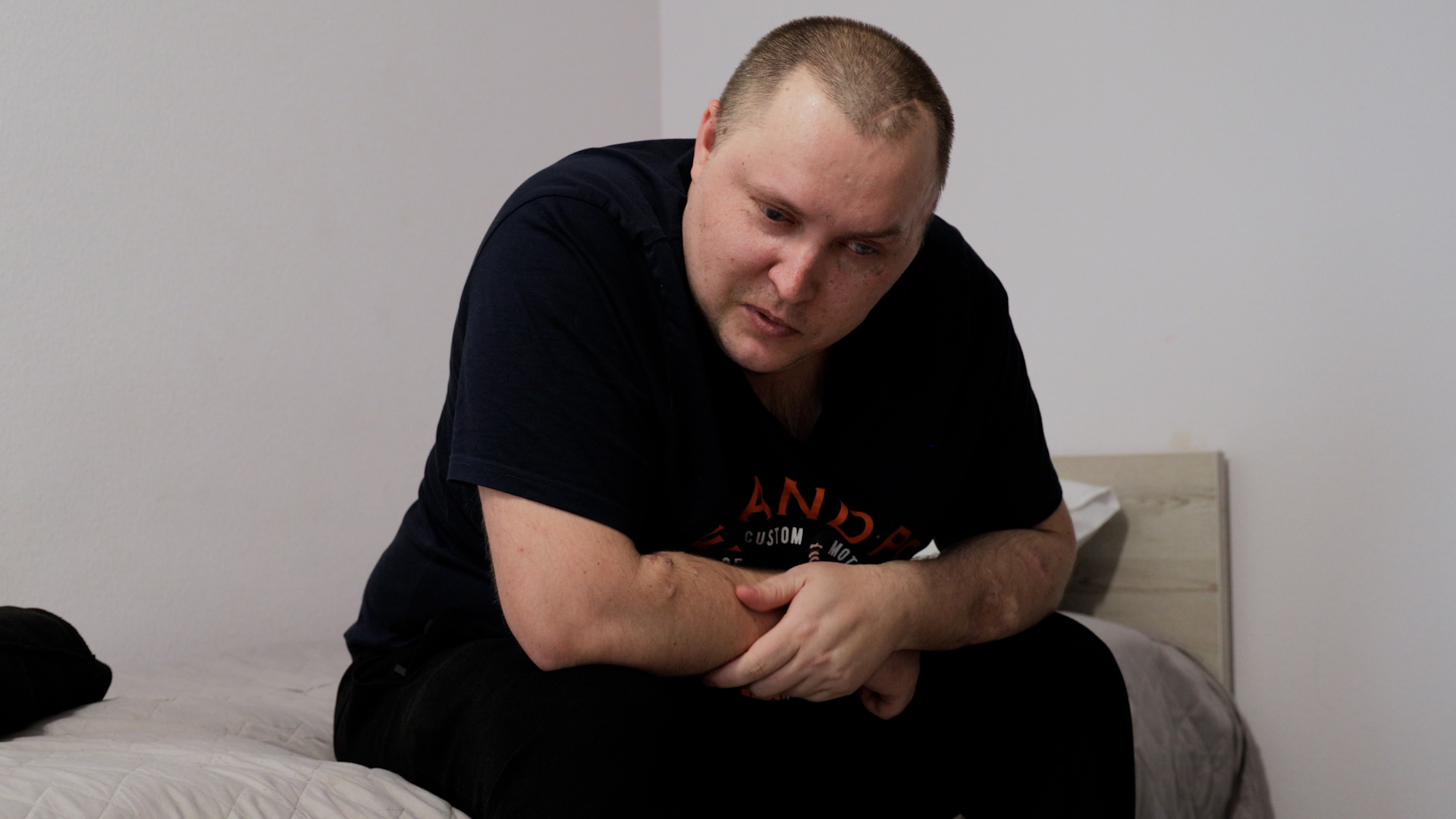 War veteran Serhii lost his sight during a combat mission near Urozhaine (photo: RBC-Ukraine)
'The saddest thing is that I do not see what I eat'
We enter one of the rooms for defenders. Serhii lives here during rehabilitation. Before coming to the center, he went through hell near Urozhaine in the Donetsk region: a drone hit group, his fellow soldier was killed, and Serhii survived but lost sight.
He wants to show what he has already learned to do when there is complete darkness in front of his eyes. To make the bed, he performs a set of actions: he opens the wardrobe, finds the needed shelf, and there is linen on it. He carefully takes it out and puts it on a chair nearby. First, he takes the sheet and begins to make the bed.
"You see how well you do everything," the occupational therapist praises him.
"It is just a room, there is not so much here, so why would I not be able to do it?" he replies.
He makes the bed carefully, millimeter by millimeter, feeling the edges of the sofa to calculate the distance. After the sheet comes the pillow and everything else. He arranges everything neatly, and it really does not look like the process is very difficult for him.
"The saddest thing is that I do not see what I eat. Whatever is served, that is what I eat until I try it. But now I have a lot of free time that I did not have before. So I decided to learn to play guitar," Serhii shares his plans for the future.
When wounds do not heal. About the hidden consequences of injuries
Doctor Yevhen Symonets came to rehabilitation after a big surgery. Behind him are years of experience in lung surgery and combined trauma. Today, he heads the department of recovery treatment, where patients with the most severe injuries are admitted.
Although the center works with recovery, surgical experience becomes decisive even at a stage that is considered "non-acute," he says to RBC-Ukraine.
"Most are those after mine and blast injuries, gunshot wounds. Many border guards, officers of the National Police and National Guard are now on the frontline, and they are often brought to us with limb amputations," the doctor says.
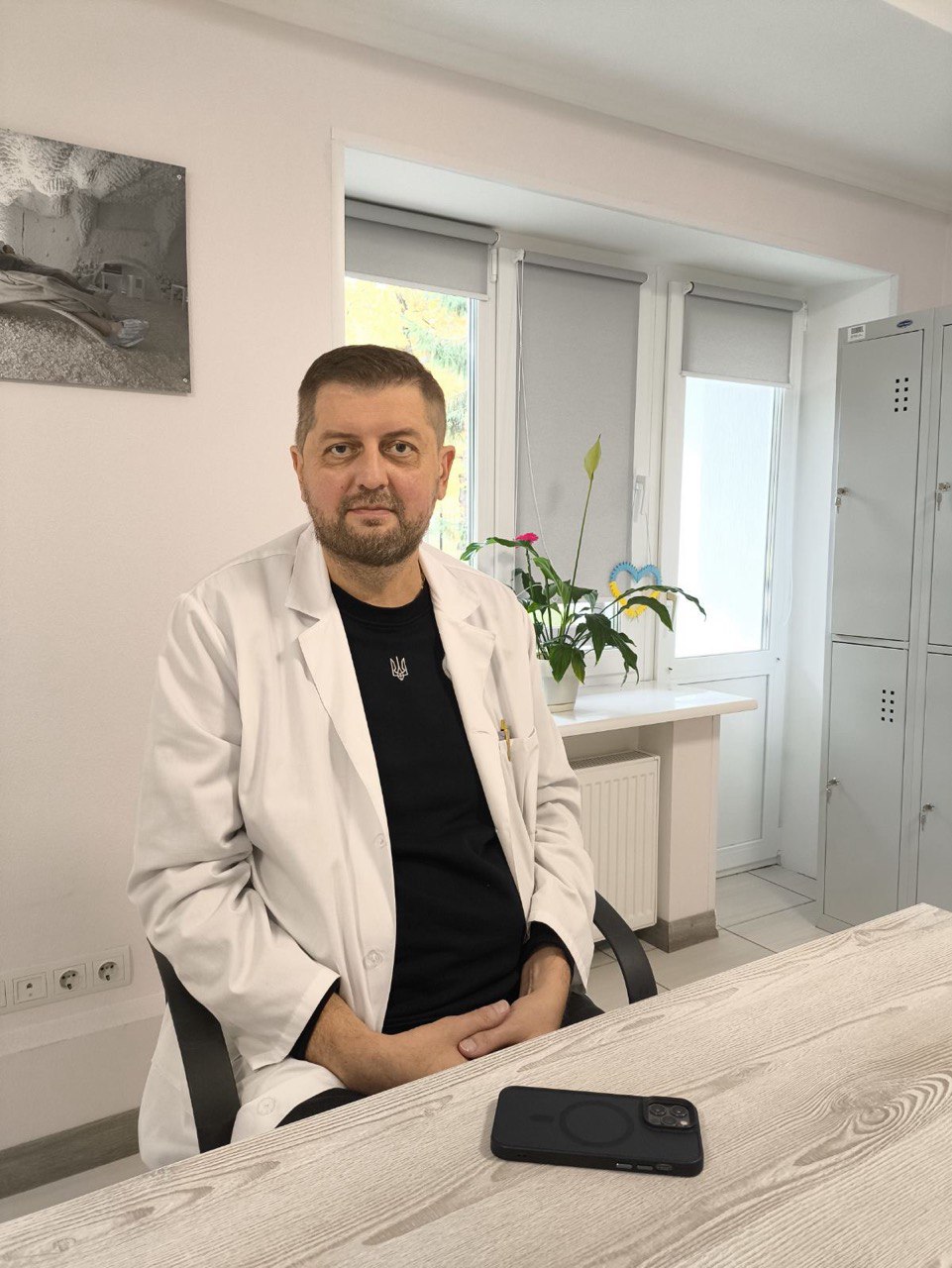 Yevhen Symonets has many years of experience in surgery (photo: provided by interviewee)
The best reward for him as a doctor is when the soldier begins to believe in recovery again.
"What always gives me the greatest joy in work is the smile of a soldier, gratitude in the eyes. There was a young man not long ago. He moves in a wheelchair, with a high amputation of one limb plus injury of another. And after mine and blast trauma, he also had an area that would not heal. He had already gone through several hospitals with this."
Yevhen Symonets developed a plan on how to treat this wound, and he was treated this way during the entire period while he was in the center.
"One day before discharge, he says: 'Yevhenii Mykolaiovych, I looked there with a small mirror, and there is nothing there anymore, how is that?' And I know why it is like that, and I just quietly smile," the doctor recalls.
"It is necessary to use different methods to try to help. And in the end, this will give more chances for a good result," Yevhenii Mykolaiovych explains.
More than friends. How dogs help veterans
Four-legged guests cause perhaps the most emotions in the corridors of the center.
"Whenever I come here, I think that I will stay here for a long time. With dogs, you want to stay longer and longer. I really wait for the handler to come again. It is a completely different atmosphere. A dog trusts a person without hesitation, and we must give the same in return. We must also be sincere," says one of the soldiers who came to spend time with the dogs.
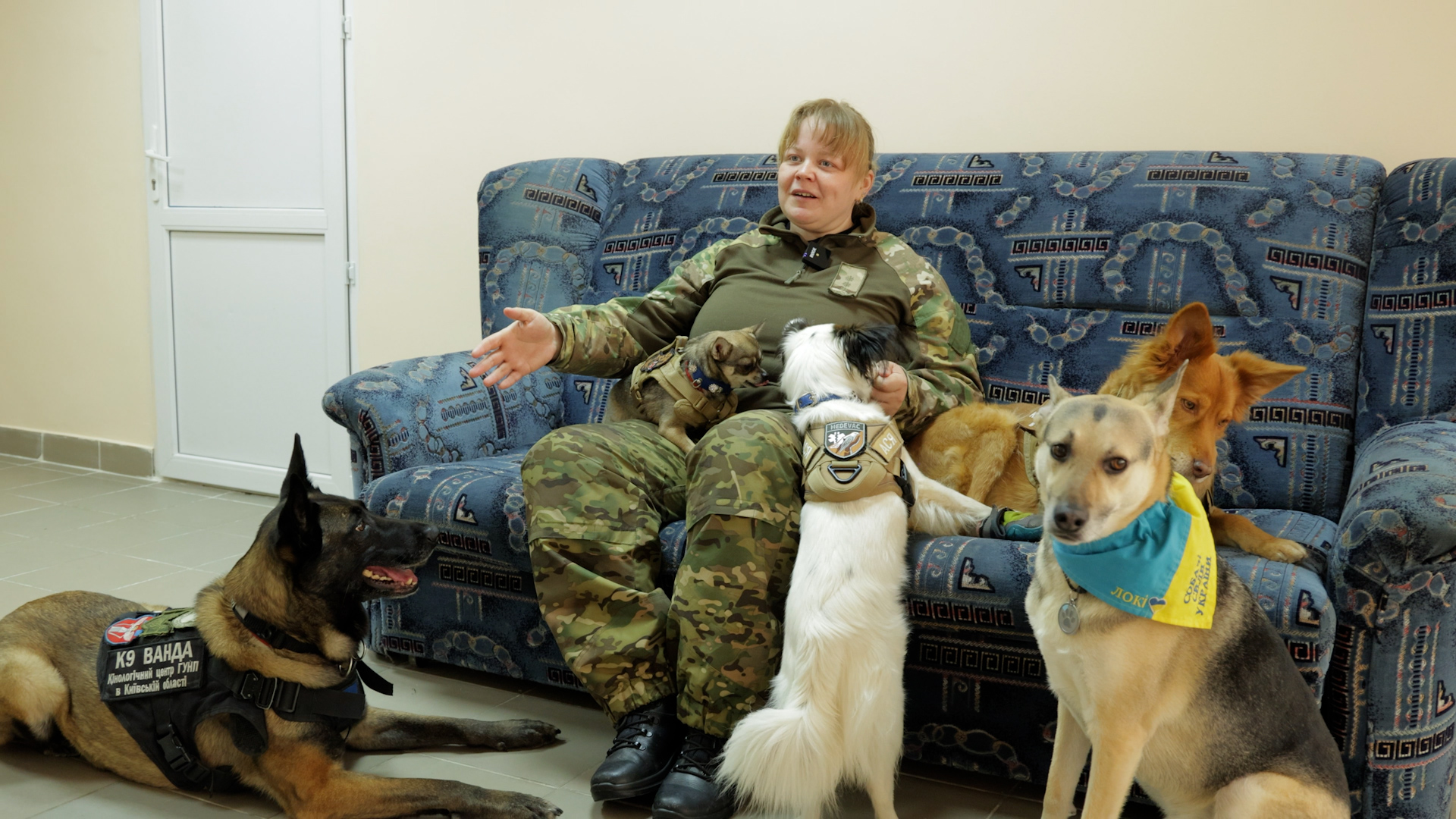 Dog handler Kateryna regularly comes to soldiers with dogs (photo: RBC-Ukraine)
These are not just dogs. This is emotional support. Service and search dogs Vanda, Knopa, Asya, Polia, and Loki help fighters perform exercises for coordination and attention, and teach them to hold objects in their hands. Most importantly, they give them sincere emotions.
One of the tasks in one of the exercises is to hold a ball, keep balance, and with the other hand feed the dog. In this way, they try to include human emotions in the rehabilitation process.
"When rehabilitation takes place, all spheres are involved, psychological, physical, mental," says dog handler Kateryna, who regularly comes to the rehabilitation center with dogs. "But the emotional sphere remains very unstable because of constant setbacks, inability to predict results, and long stay in a medical facility. A person begins to experience such emotional swings."
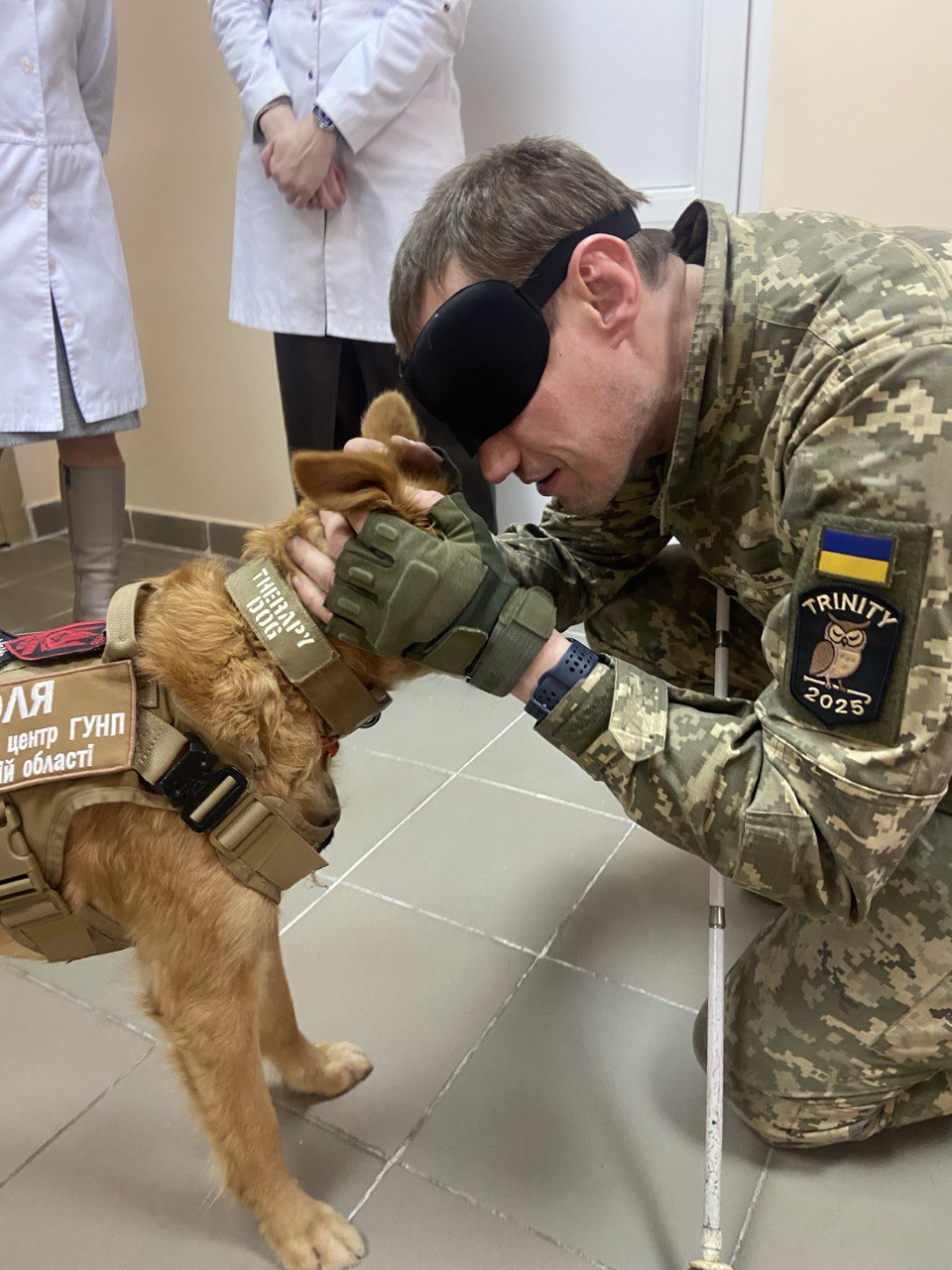 Blind soldier comes to meeting (photo: RBC-Ukraine)
A very important condition for such dogs is absolute tolerance toward a person. Because of injuries or vision impairments, the patient may accidentally step on a paw or drop crutches, and the dog must accept this without any aggression.
The special star here is dog Polia, the first police emotional support dog in Ukraine. She herself went through spinal injury and a nine-hour surgery, so more than anyone understands the will to live.
Soldier Oleksandr says that such meetings are a breath of fresh air: "At home, I have an English cocker spaniel. Dogs are my weakness. A dog will never betray, nothing… as practice shows lately."
Researchers around the world have been studying canine therapy for decades and confirm its effectiveness. When a veteran pets a dog or plays with it, the level of cortisol, a stress hormone, sharply decreases in the blood. In general, this helps fighters come out of a state of isolation and start communicating better with doctors.
Ukrainian doctors say that canine therapy accelerates the socialization of fighters with amputations. A dog does not judge appearance or anything else. It simply accepts people as they are, which helps veterans adapt to their new condition faster.
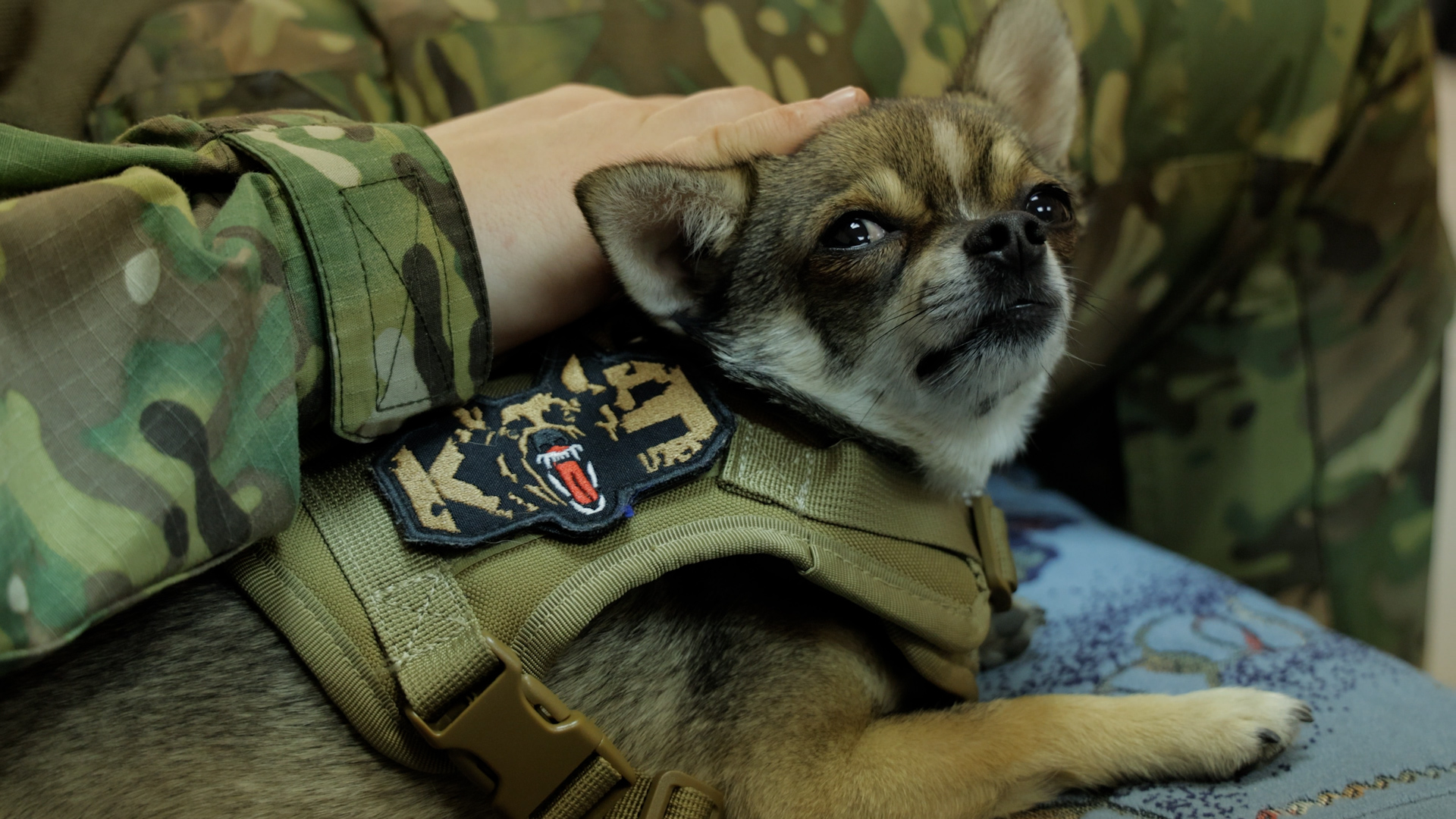 Stress level in soldiers decreases significantly after interaction with animals (photo: RBC-Ukraine)
***
Science has long proven that the emotional state of a patient directly affects how fast recovery happens. If a person is focused negatively and thinks that nothing will help anymore, the process becomes extremely difficult. It works oppositely as well, focusing on positive and desire not to give up speeds up the process many times.
For some, a big victory is when they make bed on their own, another overcomes stress when hugging a dog. Most important is to keep trying to fight and believe that recovery, even after very severe injuries, is completely real and achievable.