Letter on three fronts: Why Zelenskyy addressed Putin and how Russia and the West may respond


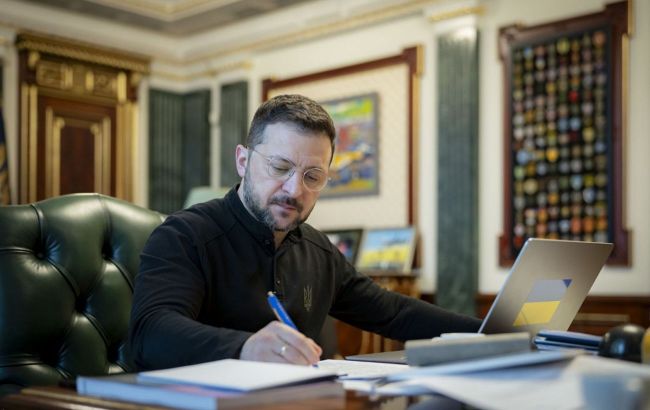 Photo: President of Ukraine Volodymyr Zelenskyy (president.gov.ua)
Yesterday’s letter from Zelenskyy to Putin is the most high-profile public move from the Presidential Office in recent weeks. And the story keeps developing.
Read below who Zelenskyy was actually addressing, and whether the letter creates any chance for real peace talks.
Key points
- Zelenskyy addressed Putin in an open letter, stating the inevitability of internal changes in Russia and touching on Putin's main pain points, including his physical condition and fear of losing power.
- The letter is also directed at Russian elites, aiming to trigger pragmatic reflection about continued support for Putin amid the loss of assets and worsening conditions inside Russia.
- The message is a clear signal to the West, especially European leaders, demonstrating Ukraine’s readiness to take concrete steps toward ending the war, thereby strengthening the position of Europe’s “forces of common sense.”
- The document provides rhetorical arguments for the more reasonable part of the American political establishment in internal US debates about ending the war, although Donald Trump traditionally calls on both sides to make compromises.
"But you, too, will have to fight much harder for your own existence — not Russia’s, but your own. And this is not a threat from me or from Ukraine. It is a fact of Russian history that you know well: when Russia grows tired, change comes," Zelenskyy wrote in the open letter to Putin.
One can see this letter as a continuation of Ukraine’s attempts to destabilize Russia. The first step was Zelenskyy’s decree “allowing” a parade on Red Square on May 9. To a large extent, it was a jibe that partially achieved its aim.
After Ukrainian drones later reached Moscow, ultra-patriotic and other circles in Russia began rhetorically asking what was happening and whether Ukraine was now capable of remotely regulating mass events in the Russian capital.
This time, however, the objective is much broader. Clearly, the nominal addressee of the letter — Vladimir Putin — is far from the only one.
A letter to Russia, but not only to Putin
While formally addressing the Kremlin leader, Zelenskyy targeted several of Putin’s vulnerabilities, including his perceived weak physical condition — even Russian ultra-patriots reportedly note that Russia is no longer led by a strong “alpha,” but by a stooped, stammering old man.
Also emphasized is Putin’s fear of losing power through a coup or elite rebellion, referencing Yevgeny Prigozhin’s 2023 mutiny — one of the most dangerous moments of his 25-year rule — along with broader anxieties about personal security.
With such a tone — not equal dialogue, but one from a position of strength — there is essentially no chance Putin will agree to a meeting or peace on Ukraine’s terms. And everyone understands that.
Yet, he also can't fully ignore the letter — its resonance is too large. Even Putin’s spokesperson Dmitry Peskov, who usually claims he is “not yet informed,” responded within an hour.
He later said Zelenskyy’s letter would “in one way or another” be discussed at the St. Petersburg economic forum panel with Putin’s participation.
Based on typical Russian rhetoric and Putin’s recent statements, the likely response is predictable: claims that the “Ukrainian regime is prolonging its agony,” that Russia supports diplomacy, but that high-level meetings must be properly prepared, and the usual invitation for Zelenskyy to come to Moscow.
At most, the constructive outcome would be the creation of yet another — the 145th — “working group to discuss current issues.”
According to an RBC-Ukraine source close to Zelenskyy, Putin was not the only real target inside Russia. The message was not aimed at the general population, which mostly reacts passively to new restrictions, fuel shortages, and Ukrainian drones overhead.
The real audience was Russian elites and influential groups. Some of them have been dissatisfied with the full-scale invasion due to lost assets in the West and the collapse of their previous lifestyle, but have largely remained silent.
Recently, however, more Russian business figures and officials have begun cautiously admitting that things are going poorly and heading in the wrong direction — without, however, facing immediate consequences for such remarks.
Asked whether there is hope of shaking up Russia’s elite circles, a Ukrainian government source said: “Either Putin will make their lives harder, or they will make his. Either way, the pressure will be on them.”
The assumption is that the letter may trigger pragmatic reflection among some elites about whether it is worth sinking with Putin over control of Mala Tokmachka. One should not overstate this factor, however.
Western audiences
The rest of the letter’s audience is in the West. According to sources, it was released partly ahead of planned meetings between Zelenskyy and European leaders.
There is a clear trend in Europe toward finding ways to move toward ending the war (not necessarily on the aggressor’s terms), especially in major countries like Germany.
Yes, Ukraine is defending Western democracy. Yes, Russia threatens all of Europe and may eventually act on those threats.
Yes, an unjust peace could lay the groundwork for future wars. And yes, support for Ukraine must continue. But there is also concern that future political shifts — such as the possible rise of the Alternative for Germany party — could reshape coalitions in the Bundestag. And there are real preconditions for that.
A clear message — that Ukraine is ready to end the war and proposes concrete steps such as a ceasefire and prisoner exchanges — strengthens moderate political forces in Europe. At least, because they can read and quote long passages.
The same applies, in a different way, to the United States. No one expects Donald Trump to read a 1,800-word document in detail, but people around him can.
The problem is that those people already understand the situation — for example, Secretary of State Marco Rubio, who recently said the US is not a neutral mediator but has chosen a side (Ukraine’s).
The problem with Trump is that his statements and actions are not driven by cause-and-effect relationships with objective reality. Ukraine has had many opportunities to see this over the past year.
Concessions, signals, evidence of Moscow’s intentions, open flattery for the world's leading peacemaker, endless thanks — all for Trump to say that ungrateful Zelenskyy extracted US money and weapons and refuses to end the war.
Just an hour or two after the letter appeared, Trump commented in his usual style, calling Putin a “good guy” (fortunately, Zelenskyy as well this time), while insisting both sides must make compromises.
In practice, this suggests continued pressure on Ukraine to give up parts of Donbas — the kind of compromise seen in Washington.
As RBC-Ukraine reported, they genuinely believe that this is merely a “small piece of land” that can easily be sacrificed for the sake of grand postwar prospects. And they are completely unwilling to see the bigger picture, in which Putin’s plans are by no means limited to the capture of Sloviansk and Kramatorsk.
Yet, the letter can serve as a useful rhetorical tool for parts of the US political establishment in internal debates about how to end the war, especially given the Republican Party’s weak position ahead of midterm elections.
***
“Will this letter bring the end of the war closer?” This question has been one of the most actively discussed in Ukraine since last night.
On one hand, it is clear that no letter from Kyiv, regardless of its content, can directly influence the Kremlin leadership. Only Ukrainian long-range drones, along with sanctions and economic pressure, can do that.
Thanks to successful operations on and behind the front line, the initiative is increasingly shifting toward Ukraine for the first time in a long period, raising cautious hopes that the Kremlin may not escalate the war into 2027 (although Zelenskyy publicly announces such plans in that same letter).
On the other hand, in the phrase “diplomatic front,” the word “front” is used deliberately. Unlike the real black-and-white battlefield, diplomacy involves many actors and shades of influence.
Zelenskyy’s letter is aimed at precisely those groups that can shape the situation beyond the battlefield. In that sense, it does serve a purpose.
Especially if this move turns out not to be the last in a broader strategy being played by the Presidential Office. And there are hints that it might not be.