US unleashes advanced bunker-buster bombs against Iran

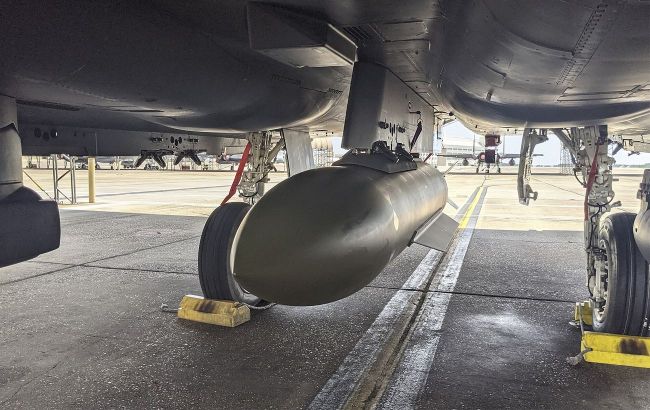 Photo: GBU-72/B Advanced 5K Penetrator bunker-busting bomb (wikipedia.org)
The US has deployed the latest GBU-72/B Advanced 5K Penetrator bunker-busting munitions against Iran. They were used to strike underground missile facilities along the coast of the Strait of Hormuz, according to Defence Express.
US Central Command officially confirmed the use of bombs weighing over 2.2 tons. They were used to strike positions housing anti-ship missiles that threatened shipping in the region.
Iran has several types of such missiles in its arsenal, including the subsonic Nasir and Ghadir with ranges of up to 90 and 300 kilometers, respectively. In addition, Tehran possesses the Khalij Fars, Hormuz-1, and Hormuz-2 ballistic missile systems, capable of striking targets at a distance of up to 300 kilometers.
Iran traditionally deploys such systems and munitions in underground shelters, which require specialized bunker-busting munitions to destroy. These include the GBU-72/B—the latest munition manufactured by Boeing, which has been in service since 2021.
GBU-72/B bunker-busting bomb
The latest GBU-72/B bomb is considered a standard solution for striking well-protected targets. It is not as powerful as super-heavy munitions such as the 12-ton GBU-57A/B, but it has a wider range of applications.
The GBU-72/B replaces the outdated GBU-28, which was developed on an accelerated schedule during Operation Desert Storm in 1991.
The exact specifications of the new bomb are unknown, but according to expert estimates, it surpasses the capabilities of its predecessor, which could penetrate dozens of meters of soil or several meters of reinforced concrete.
Dozens of bombs were dropped on Iran
Analysts estimate that up to several dozen GBU-72/B bombs may have been used during the strike on Iranian targets. Currently, these bombs are deployed on F-15E fighter jets and B-1B strategic bombers, though it is unknown which specific aircraft were used.
It is believed that B-1Bs based at the British airbase in Fairford were involved in the operation. The aircraft had to travel more than 8,500 kilometers one way, bypassing Europe via Gibraltar and the Mediterranean Sea.
The choice of the B-1B is explained by its payload capacity: each is capable of carrying up to 12 GBU-72/B bombs, whereas the F-15E can carry only one.
In total, the US could have dropped up to 48 GBU-72 bunker-busting bombs on Iranian bases housing anti-ship systems.
Strait of Hormuz
After the start of the US and Israeli operation against Iran, Tehran effectively closed the Strait of Hormuz in response. About 20% of the world’s oil passes through it, which caused a spike in its price.
For this reason, US President Donald Trump called on the EU and other countries to help unblock the strait, but was refused.
In response, Trump called the refusal by NATO allies a "very foolish mistake". He claimed he was not considering retaliation for this, but publicly stated that the US needs to reconsider its membership in the alliance.