Ukrainian Air Force colonel comments on complexity of downing Russian ballistic missiles


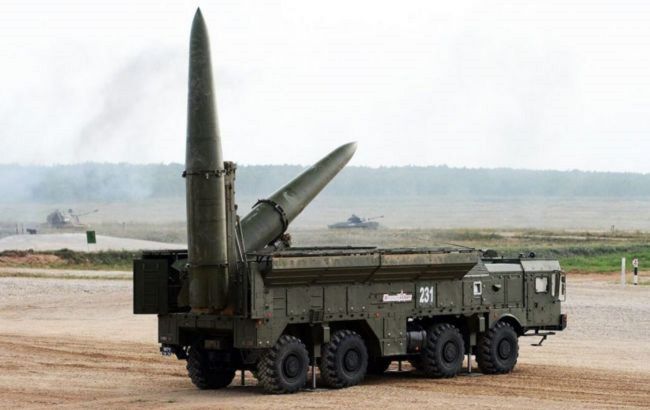 Photo: Ihnat explained the complexity of shooting down Russian ballistic missiles (Getty Images)
Russian massive attacks on Ukraine often combine several types of air threats at once—ballistic and cruise missiles, as well as strike drones. Under such conditions, even modern air defense systems are working at the limit of their capabilities, according to Colonel Yurii Ihnat, Head of the Communications Department of the Ukrainian Air Force Command.
Patriot forced to select targets
According to Ihnat, during Russian attacks on large cities, particularly Kyiv, Russia simultaneously uses various means of destruction.
Taking the Patriot system as an example — the only system capable of intercepting ballistic missiles — its radar during an attack looks in one direction. Patriot must intercept those ballistic missiles, which can number ten or more.
"At the same time, from another direction, cruise missiles and Shaheds are flying toward it 'down the collar.' That’s why protecting large cities requires more than one system, and the Patriot itself also needs protection," he explains.
Interaction between air defense and aviation
Ihnat emphasizes that coordination between all military command bodies and units plays a key role.
When ground-based air defense systems are actively operating, Ukrainian aviation—airplanes and helicopters—cannot operate in the same airspace to avoid friendly fire.
"They can intercept enemy missiles or UAVs farther away, in other regions, or on the approaches, to avoid friendly fire," he says.
Missile shortage and reloading problems
The shortage of anti-aircraft missiles remains a separate problem. During powerful attacks, NASAMS or IRIS-T complexes sometimes simply do not have time to reload.
"Although our personnel work quickly and have learned to master these systems rapidly, the issue is different — having something to reload with," Ihnat emphasizes.
He acknowledges that there have been situations where some systems have effectively been left without ammunition.
"I won’t reveal a secret: for example, a NASAMS system may be deployed with only two missiles in the launcher instead of six. That’s because missiles had to be distributed as widely as possible among other launchers to cover a larger area," explains the Ukrainian Air Force representative.
Why it is difficult to shoot down Iskander-M
According to Ihnat, Iskander-M ballistic missiles descend on their target almost vertically and at extremely high speed, while performing maneuvers.
Patriot is capable of intercepting ballistics within a radius of up to 25 kilometers. During this short time, the system must detect the target and accurately calculate the point of encounter between the anti-aircraft missile and the Russian.
"But when the Iskander-M performs so-called oscillations and maneuvers, it becomes difficult for the system to determine that intercept point. This creates certain challenges," he says.
According to Ihnat, this problem was raised with partners over a year ago, as Russia is constantly improving its tactics.
Is it possible to shoot down ballistic missiles?
Despite the difficulties, Ukrainian air defense is showing results. Ukraine continues to shoot down Iskander-Ms as well as S-300 and S-400 missiles.
He adds that Russia sometimes uses S-300 and S-400 anti-aircraft missiles as strike missiles to save on the more expensive Iskanders, as Russia still has many of these missiles.
China helps Russia with ballistics
According to the CSIS analytical center, Russia has tripled its production of 9M723 ballistic missiles for the Iskander-M OTRK thanks to exports from China.
In 2024, trade between China and Russia amounted to almost $250 billion, compared to $190 billion in 2022.
The Telegraph also wrote that China supplies Russia with specialized machine tools, instruments, and high-tech equipment used to create, in particular, Oreshnik medium-range ballistic missiles, as well as Shahed missiles.