This unusual asteroid baffled scientists for 170 years: Telescopes reveal what was hiding

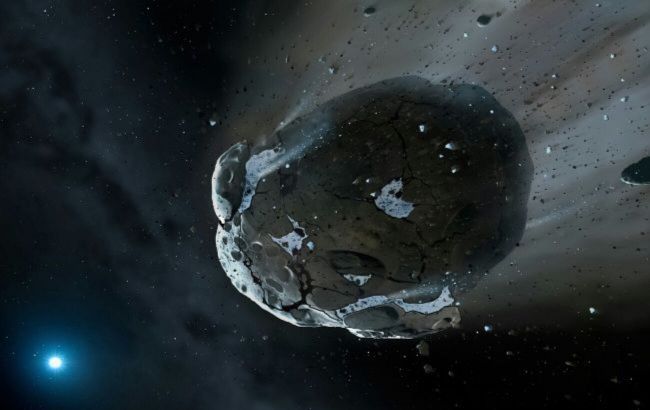 Astronomers discover an asteroid with a remarkably complex shape (photo: NASA Hubble Space Telescope)
An international team of astronomers has discovered a uniquely shaped asteroid in the Solar System for the first time. The object 44 Nysa consists of three interconnected lobes and has a small satellite of its own, according to a NASA study published on the arXiv preprint server.
The object 44 Nysa was discovered back in the 19th century and was long considered an ordinary point of light.
Using powerful telescopes equipped with adaptive optics, scientists examined its structure in detail.
It turned out that the asteroid has three interconnected lobes, making it the first known contact triple body of its kind.
Asteroid 44 Nysa is located in the Asteroid Belt between Mars and Jupiter and belongs to the rare E-type class.
Previous observations with the Hubble Space Telescope had only suggested that it was elongated or binary.
.png)
Orbital simulation showing the asteroid's position relative to Earth (photo: NASA)
New observations findings
The new high-resolution images were obtained using the SPHERE instrument on the Very Large Telescope (VLT) of the European Southern Observatory in Chile and SHARK-VIS on the Large Binocular Telescope (LBT) in Arizona.
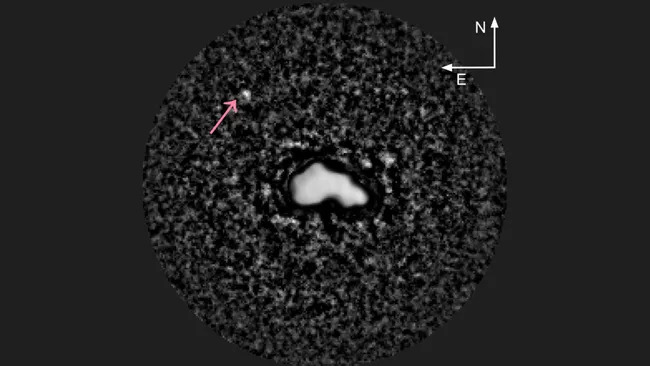
Asteroid 44 Nysa and its moon (photo: SPHERE)
Key characteristics of the discovery:
Size and shape: The asteroid is about 75.6 kilometers in diameter. The images clearly show three distinct lobes connected by narrow necks.
Its own satellite: Near 44 Nysa, astronomers discovered a previously unknown small satellite about 1 kilometer in diameter, orbiting at a distance of at least 170 kilometers from the main body.
Scientists' assessment: Lead researcher Kate Minker of Lowell Observatory said the most likely explanation is a contact triple configuration or an extremely irregular monolithic body.
Hypotheses about origin
Scientists have proposed several scenarios for how such a unique structure could have formed.
The leading hypothesis suggests that several celestial bodies collided at a relatively low speed in the distant past. Instead of being completely destroyed, the fragments slowly merged into a single object.
Another theory attributes the complex shape to a glancing impact by a larger asteroid, which partially deformed and altered the mantle of 44 Nysa.
To determine the full evolutionary history of this space object, astronomers plan to conduct additional observations and modeling.