Massive asteroid is set to pass Earth in rare event visible to billions

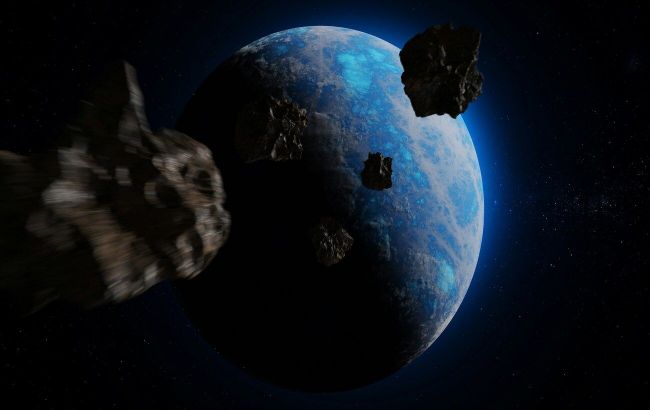 A skyscraper-sized asteroid will fly past Earth in 2029 (Photo: Unsplash)
Asteroid Apophis will make an extremely close pass by Earth in 2029. Scientists predict that up to 90% of the world's population will be able to witness the rare celestial event with the naked eye, according to Live Science.
Asteroid's size and flyby trajectory
The asteroid Apophis is named after the ancient Egyptian god of darkness and chaos. The peanut-shaped space rock measures about 450 meters (1,476 feet) across at its widest point.
Originally from the main asteroid belt between Mars and Jupiter, Apophis now follows an orbit between Venus and Earth, completing one trip around the Sun every 10.5 months.
According to The Planetary Society, the asteroid will pass as close as 30,600 kilometers (19,000 miles) from Earth. While this is much farther than the International Space Station, it is actually closer than the altitude of geostationary satellites.
Scientists emphasize that the probability of Apophis colliding with Earth during this flyby—or at any point over the next 100 years—is zero.
However, Earth's gravity could alter the asteroid's orbit or even reshape parts of its surface, prompting the international scientific community to closely monitor the encounter.
NASA's OSIRIS-APEX spacecraft is scheduled to rendezvous with Apophis to study its structure in detail.
The United Nations General Assembly has declared 2029 the International Year of Asteroid Awareness and Planetary Defense.
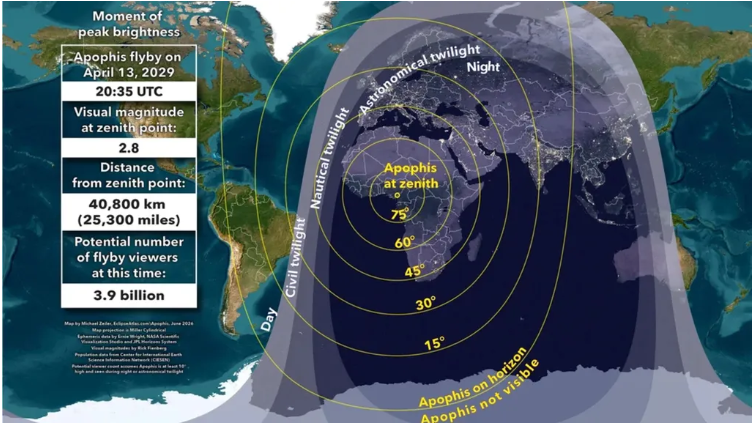
Scientists have released new maps showing how many people will be within the asteroid's visibility zone at every moment during its seven-hour flyby of Earth (Image: Eclipse Atlas)
Visibility zones and viewing conditions
The flyby will last for approximately seven hours. During that time, Apophis will appear as a moderately bright point of light slowly moving across the constellations, at a speed comparable to that of an artificial satellite.
.png)
Apophis' flight path (Image: Eclipse Atlas)
Whether you'll be able to see the asteroid will depend on your geographic location and the time of day:
- At the beginning of the flyby, up to 4.5 billion people across Australia and most of Asia will be able to observe it.
- The peak viewing window will occur midway through the flyby, when nearly 5.7 billion people in East Africa, Southern Europe, Asia, Australia, and the Middle East will have a chance to see Apophis.
- During the closest approach, around 1.9 billion people in eastern South America, North Africa, and parts of Europe will be able to watch the asteroid.
North America will be the only continent where Apophis will not be visible in the night sky.
For the best viewing experience elsewhere, observers should look for clear skies and a location with minimal light pollution