Spanish prime minister Sánchez opens door to troop deployment in Ukraine

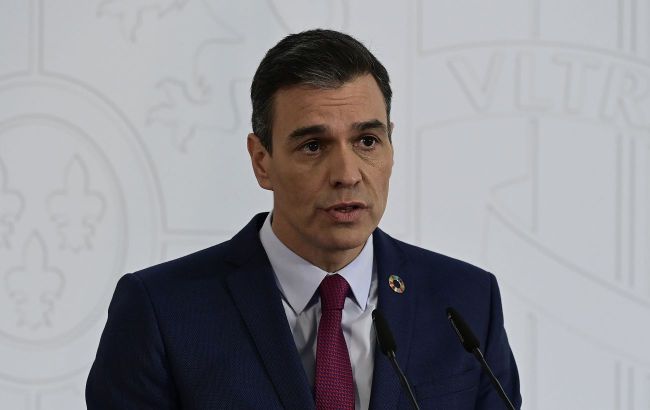 Spanish Prime Minister Pedro Sánchez (photo: Getty Images)
Spanish Prime Minister Pedro Sánchez has, for the first time, allowed for the participation of Spanish troops in a peacekeeping mission in Ukraine following a ceasefire as part of a potential peace agreement, EFE reports.
Sánchez said after the Coalition of the Willing meeting in Paris that starting next Monday, he will begin a series of meetings with representatives of most parliamentary groups to discuss Spain's potential contribution to the peace process in Ukraine.
According to him, Spain, "as a major European country," will participate in decision-making regarding a ceasefire and the opportunity to establish lasting peace in Ukraine.
The Spanish prime minister noted that this contribution should include both reconstruction efforts and "military capabilities."
Answering a question about whether he envisions Spanish service members participating in a potential international peacekeeping mission, Sánchez recalled that Spain has already taken similar steps "in other parts of the world."
"If we have done this in other parts of the world, why shouldn't we do it in Europe?" the Spanish prime minister said.
Sánchez had previously stated that it was still premature to talk about the presence of Spanish troops in Ukraine. At the same time, such a decision would require the support of the Congress of Deputies.
Talks in Paris
Yesterday, January 6, talks began in Paris involving Ukraine, the United States, and countries of the Coalition of the Willing on security guarantees for Ukraine as part of a peace agreement. The talks are continuing today.
Ukraine's allies plan to take on real binding commitments that would come into force in the event of renewed Russian aggression. These provisions are set out in the draft Paris agreement on security guarantees for Ukraine.
At a later stage, leaders plan to finalize the security documents, with a focus on security guarantees and Ukraine's recovery, after which consultations are planned in the United States with a broader group of countries.
Representatives of Ukraine and the United States, within the framework of the Coalition of the Willing, have also agreed on specific steps to implement and monitor a ceasefire regime. Still, the final progress of these agreements depends on Russia's position, which has so far not confirmed its readiness to comply.
It is known that France and Germany are ready to send their troops to Ukraine after a ceasefire.
Meanwhile, Germany has expressed its readiness to join efforts to secure a possible ceasefire in Ukraine, but has not committed to deploying troops.
Belgium, for its part, is ready to provide aviation and naval forces to ensure Ukraine's security after the war ends.