Russia сhanges strike tactics in Ukraine, ISW issues warning

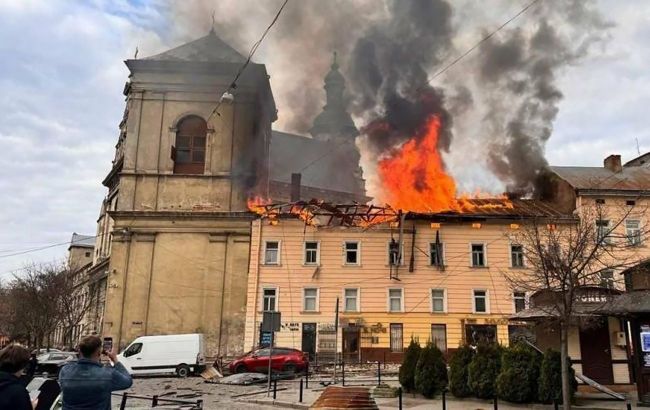 Photo: Downtown Lviv came under drone attack on March 24 (Getty Images)
The Russian massive attack on Ukraine on March 23–24 marks a significant and dangerous shift in Russian strike tactics. This new strategy allows Russia to maintain pressure for longer and target a greater number of regions, according to the Institute for the Study of War (ISW).
As analysts emphasize, this is not just about scale, but about a systematic approach: strikes are spread out over time, combining drones and missiles, with the main goal being to overwhelm and expose vulnerabilities in Ukraine’s air defense.
Serhii Beskrestnov, an advisor to the Ukrainian Ministry of Defense, states that the change in the duration of the strikes is likely aimed at identifying vulnerabilities in Ukraine’s air defense and overcoming them.
Andrii Kovalenko, head of the Center for Countering Disinformation, notes that Russian forces have been accumulating resources for a long time to carry out more intense and prolonged strikes targeting civilian facilities throughout Ukraine.
The ISW notes that Russia is employing a build-up and strike tactic: a limited number of missiles are launched over several days, followed by massive attacks involving the simultaneous use of missiles and large numbers of drones.
This approach allows for overloading Ukraine’s air defense and amplifying the destructive effect.
According to experts, Russia is already approaching the capability to launch over 1,000 strike drones in a single series of attacks. The events of March 23–24 were the closest example to date of such a scenario.
Political pressure and new risks
Separately, the ISW highlights the political factor. Such strikes often coincide with important diplomatic events.
In particular, the latest Russian attack occurred immediately after US-Ukraine talks in Florida, which may indicate an attempt to pressure Kyiv and its allies.
Experts also warn that Moscow may exploit the shortage of air defense systems, particularly Patriots, as well as the diversion of international attention to the Middle East, to intensify its air campaign against Ukraine.
Russia’s attack on Ukraine on March 24
On the night of March 24, Russia launched a large-scale air attack on Ukraine with several hundred drones, as well as ballistic and cruise missiles, in various regions.
Kyiv, Poltava, Zaporizhzhia, and other regions came under Russian attack. Devastating consequences were reported in 11 regions: four people were killed, dozens were wounded, and children were among the casualties.
Russian attacks continued throughout the day. By the evening of March 24, nearly all of Ukraine’s western regions were under drone attack.
In Lviv, strikes hit residential buildings on Soborna Square and on Brativ Rohatyntsiv Street and Chervonoyi Kalyny Avenue.
Russian attack resulted in casualties and damage to sites listed as UNESCO World Heritage Sites. Explosions were also heard in Ternopil, Ivano-Frankivsk, and Vinnytsia.
For more details on the consequences of the strikes in the west of Ukraine, read the RBC-Ukraine report.