Russia's Kalibr missiles got secret upgrade, experts say

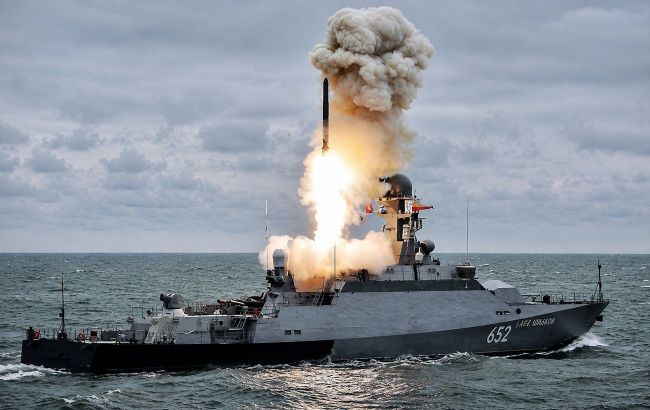 Photo: Russia fires Kalibr missiles at Ukraine (Russian media)
Ukrainian experts have dismantled Russia's new Kalibr missile down to the last screw and identified two significant changes, according to the Ukrainian Ministry of Defense.
Military engineers and scientists conducted a detailed analysis of several 3M14 Kalibr missiles that were shot down by Ukrainian air defenses.
For the study, the missiles were completely disassembled, all components and electronic parts were inspected, and a comprehensive diagram of their operation was created.
Read also: Russia used Kalibr missiles with cluster munitions against Ukraine: Expert explains their danger
Experts identify two major changes
According to the Ministry of Defense of Ukraine, during the full-scale war, the missiles underwent two significant changes:
- They were equipped with a cluster warhead
- They began using imported electronics again.
Experts note that previously, the Russian defense industry had attempted to switch to its own electronic components, but missiles manufactured in 2025 were again found to contain a significant number of foreign-made parts.
The Ministry of Defense speculates that Russian equivalents may have been inferior in quality and accuracy.
Why warhead changed
In the spring of 2026, a cluster warhead was detected for the first time in downed Kalibrs.
Previously, the missiles were equipped with high-explosive fragmentation warheads. Inside such warheads are about 3,600 metal fragments that scatter over a large area upon detonation.
The new cluster design allows for striking a larger area. According to experts, Russian designers may have adapted the missile for attacks on airfields, open positions, and other dispersed targets.
Research into the new warhead is ongoing.
Kalibr consists of:
- Booster engine
- Main engine
- Instrument compartment
- Warhead
- Fuel tanks
- Guidance system.
Depending on the variant, the missile is between 6 and 8 meters long, and the warhead weighs up to 450 kilograms.
Production of the Kalibr began in the early 2000s, but Ukrainian experts found markings on certain components indicating they were developed as far back as the 1980s.
How missile finds its target
The Kalibr uses several guidance systems simultaneously:
- Satellite navigation
- Inertial navigation system
- Radio altimeter
- Radar homing head.
The flight path is programmed in advance and takes terrain features into account.
Experts paid particular attention to the SN-99 navigation system. According to the Ministry of Defense of Ukraine, it was developed in the Ukrainian city of Smila back in the 2000s. Production was subsequently established in Russia.
Missiles contain foreign components
Analysis showed that more than 80–90% of the homing head’s electronics consist of foreign-made components.
The Ministry of Defense reported that all such parts were successfully identified by their markings.
The manufacturers of the electronics, as well as the designers and managers involved in the creation of the Kalibrs, have also been identified. This data will be used for further sanctions work.
.jpeg) Photo: The Kalibr missile has 3,600 warheads (mod.gov.ua)
Photo: The Kalibr missile has 3,600 warheads (mod.gov.ua)
Why Kalibrs can be shot down
The Kalibr is a subsonic cruise missile. This is considered one of its main vulnerabilities.
During flight, the missile attempts to fly as low as possible:
- Over water—up to 20 meters
- Over land—about 150 meters.
Despite this, their subsonic speed allows Ukrainian air defense forces to successfully intercept such targets.
Earlier, an expert explained to RBC-Ukraine why Kalibr missiles are dangerous.
Additionally, Vladyslav Vlasiuk, the President’s Representative on Sanctions Policy, displayed components of the missiles and drones used by Russian forces to attack Ukraine on May 24.
Furthermore, experts previously examined Russian Kh-101 missiles and discussed their modernization.