Europe's risk zone: Which countries are prepared to deter Russian aggression


 NATO on guard (collage by RBC-Ukraine)
European countries are preparing at different speeds to repel potential Russian aggression.
Who is doing best, where the weakest points lie, and how Ukraine could strengthen their defenses—read in the report by RBC-Ukraine.
Key points:
- Baltics in the danger zone: Lithuania, Latvia, and Estonia face the highest risk of a Russian strike and are stepping up their defenses the most.
- Lack of unity in Poland: Defense policy is partly shaped by political rivalry between President Nawrocki and Prime Minister Tusk.
- Total defense: Among the Nordic countries, Finland has the most combat-ready armed forces, while Sweden can back them up with its defense industry.
- Ukraine as a security provider: Kyiv is offering Europe an "anti-drone shield" to protect against Russia.
Estonia. May 2025. A British mechanized brigade and an Estonian division under NATO command were preparing for an offensive operation. Thousands of troops, columns of armored vehicles—all massed in tight battle formations, ready to surge forward.
Commanders were holding final briefings. It seemed the Alliance's powerful strike force was about to break through enemy defenses. But as soon as the columns began to move and deploy, they were already detected.
Within minutes, a small group of UAV operators got to work. They had a real-time view of the entire battlefield. Artificial intelligence instantly analyzed the data, assigned targets, and drones struck.
Within hours, seventeen armored vehicles were destroyed, the rest damaged or immobilized. Two NATO battalions completely lost combat capability.
Fortunately for the Alliance, the defeat was only simulated during the Hedgehog 2025 exercise. Instead of Russian forces, NATO troops faced fighters from Ukraine's 412th Separate Brigade of Unmanned Systems Nemesis, operating alongside Estonian counterparts.
The story recently spread across global media, sparking a strong reaction and pride in Ukrainian troops.
Some details of the exercise, however, remained behind the scenes.
"Command deliberately chose the worst-case scenario, without using air power, which is considered NATO's trump card. This was done to identify real weaknesses and fix them," a source within the Alliance told RBC-Ukraine.
Still, the takeaway is stark. "Countries of NATO are not prepared for this war. Because they all four years denied that drones are a game-changer in this new war," says Arūnas Kumpis, a Lithuanian volunteer who joined Ukraine’s Defense Forces after the full-scale invasion. After returning to Lithuania, he remains a leading UAV expert.
Despite the challenges, Europe is actively preparing for a possible war with Russia. As RBC-Ukraine has previously reported in detail, in most countries, this is primarily reflected in increased defense spending.
At the same time, countries bordering Russia are doing more than that. Training their armed forces and their societies is just as crucial. And here, everything is directly proportional to the distance from Russia's border.
Threats to the Baltics
The Baltic states—Lithuania, Latvia, and Estonia—are in the highest-risk zone. Their most vulnerable point is the Suwałki Corridor. This is a narrow strip of land between Poland and Lithuania, through which the Baltic could be logistically cut off from the rest of Europe.
However, each of the Baltic countries also has its own weak points that Russia could exploit for hybrid operations. Although each case has its specifics, all of these are economically depressed regions with a high share of Russian-speaking populations.
The most notable examples are Narva in Estonia, Daugavpils in Latvia, and Ignalina in Lithuania.
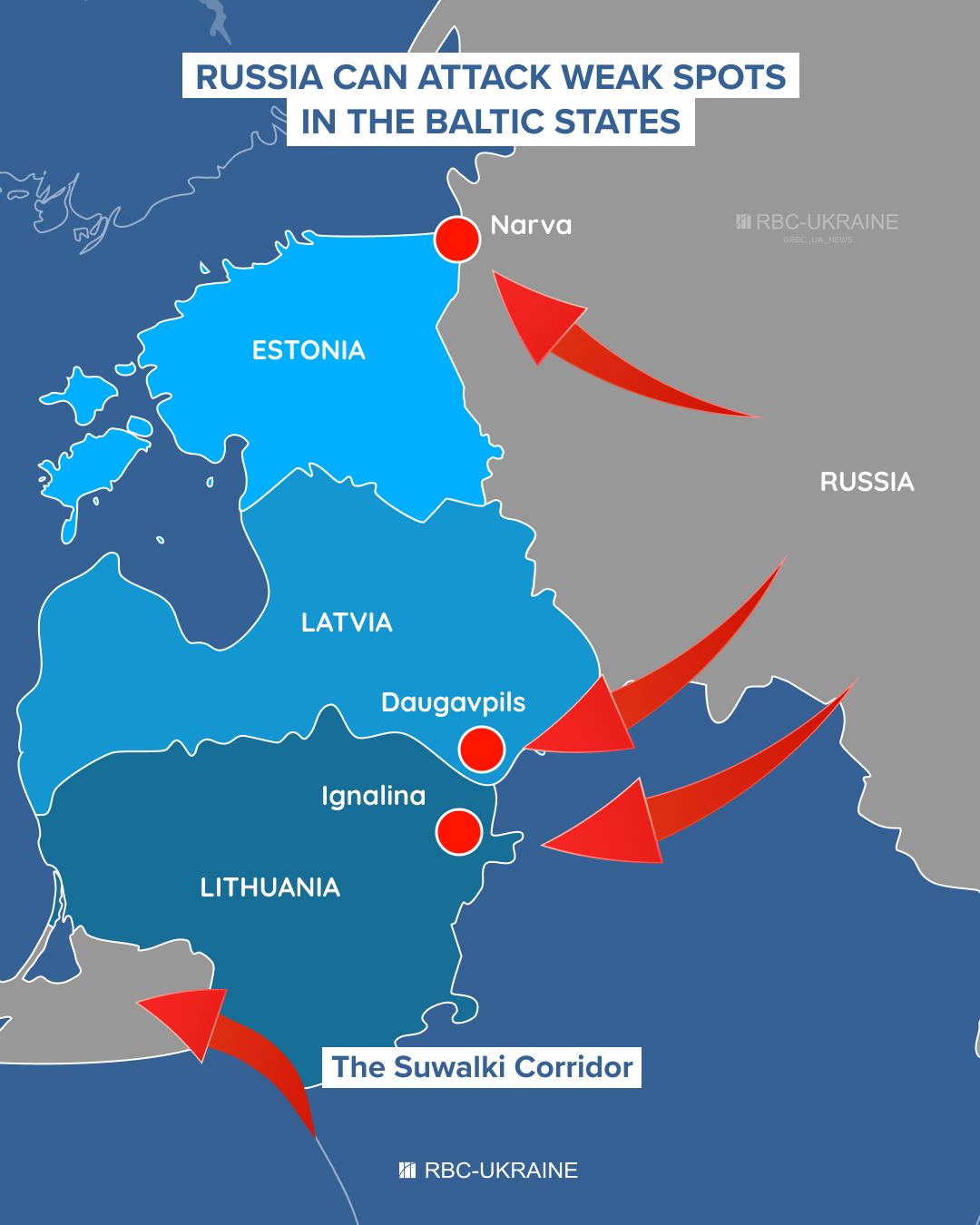 Possible directions of a Russian attack (infographic: RBC-Ukraine)
At present, Russia is using only hybrid methods there, but it is also potentially preparing for the direct use of force. On April 14, the Russian parliament passed in the first reading a bill that would allow Putin to legally send troops to other countries under the pretext of protecting the rights of Russian citizens.
At the beginning of March, the Kremlin stepped up promotion on social media and Telegram of the idea of proclaiming a Narva People's Republic. According to Bild, Estonian intelligence services view this campaign as possible narrative preparation for an invasion of the country.
Estonia's Ministry of Defense calls the amplification around Narva deliberate Russian provocations. According to the ministry’s response to a request from RBC-Ukraine, this is a simple and cheap tactic aimed at provoking outrage and societal division.
"It's important to bear in mind that it's targeting a topic with no relevance among Estonian people, including in Narva. Engaging with or amplifying such actions risks playing into their purpose and may even carry legal consequences," said Liisa Tagel, media adviser at Estonia's Ministry of Defense Strategic Communications Department.
In this story, the Russian-speaking population of Estonia is merely a pretext for possible Russian interference.
"The reason we are talking about the Russian military threat in the Baltic states is not because of the Russian minority. It is because of Russia’s overall strategy. That is to fundamentally weaken NATO and to weaken Europe," Tagel emphasized.
Russia is also using incidents involving Ukrainian drones attacking Russian facilities in the Baltic Sea region as a source of provocation.
"We have intelligence indicating that Russians are deliberately redirecting drones toward the Baltic states to use these incidents for information warfare and propaganda purposes," Ukrainian Foreign Minister Andrii Sybiha said on March 31.
Estonia's Ministry of Defense neither confirmed nor denied this information.
In addition, the Kremlin has recently begun accusing the Baltic states of allowing their airspace to be used for Ukrainian drones attacking Russia.
"These countries (Lithuania, Latvia, and Estonia – ed.) have received a relevant warning. If these regimes, these countries, have enough sense, they will listen. If not, they will face consequences," Russian Foreign Ministry spokesperson Maria Zakharova said on April 6.
Therefore, according to Liisa Tagel, what is needed now is a credible deterrence that clearly signals to Russia that it has no chance of achieving its goals by military means.
"That is also why there is a strong consensus in Estonia that defense spending at five percent of GDP is necessary," she explained.
NATO members agreed at the Hague summit to increase defense spending to at least 5% of GDP by 2035, and Estonia has already met this target.
"In terms of collective defense, the main focus is on rehearsing defense plans with allied units," Tagel noted.
When it comes to mass resistance, the Baltic states are also actively developing decentralized components—following the example of Ukraine's territorial defense. This model is most strongly developed in Estonia, according to Arūnas Kumpis, though Latvia and Lithuania are also working in this direction.
Political complexities
Despite awareness of the Russian threat, the Baltic states have their own nuances and challenges. "In Lithuania, up to a third of active voters are some variation of 'vatnik' (pro-Russian - ed.) sentiment. I mean people who don't just write or say things and hold an opinion, but actually go to elections and vote for parties and politicians,” Lithuanian political analyst Vytautas Bruveris told RBC-Ukraine.
In 2022, this part of society became somewhat quieter, but now it is becoming active again. Moreover, the Dawn of Nemunas Party, which represents their interests, has entered Lithuania's ruling coalition.
"This is an unprecedented situation in Lithuanian history. Openly pro-Russian, anti-Western, anti-Ukrainian narratives have been legitimized. And most importantly, they are now intensifying their offensive against Lithuania's traditional security and foreign policy," Bruveris said.
For example, in Lithuania, there has been a heated debate for over a year about building a new large military training ground near the town of Kapčiamiestis, in the Suwałki Corridor area.
At the same time, Dawn of Nemunas Party actively opposes the project. They argue that the construction of the training ground would lead to mass expropriation of farmland and forests from local residents and worsen the environmental situation.
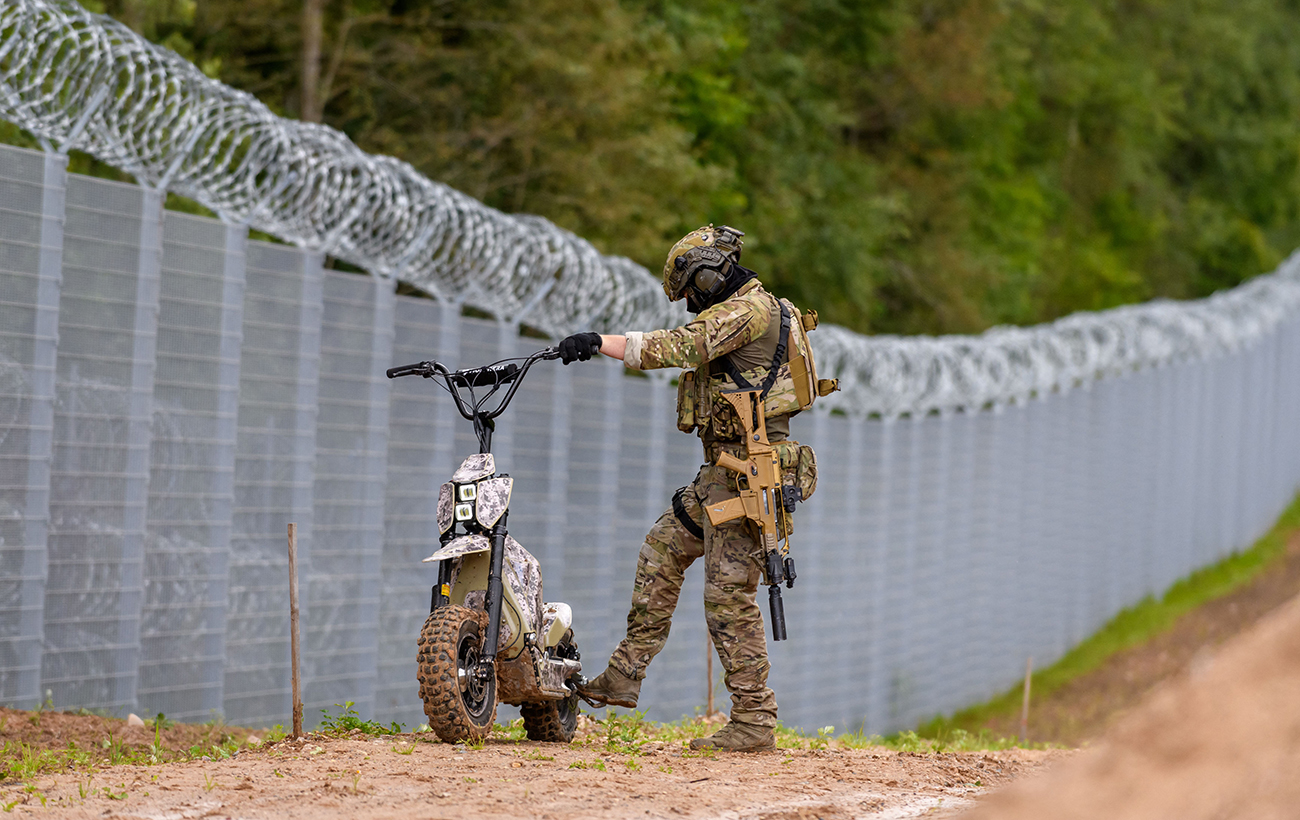
Patrols near fortifications on the Latvia–Russia border (photo: Getty Images)
According to Bruveris, Latvia is the most vulnerable to Russian attacks. Unlike Lithuania, which is actively expanding its military presence and infrastructure near the Suwałki Corridor, Latvia has significantly more limited resources and a less cohesive political stance on defense.
In Latvia, similarly to Lithuania, pro-Russian and anti-Western sentiments have not fully disappeared: despite an overall strengthening of defense after 2022, part of society—especially in the Latgale region in the east of the country—continues to show scepticism toward NATO spending and retains sympathy for Moscow's narratives.
Poland is not lagging behind
Poland directly borders Lithuania in the area of the Suwałki Corridor, as well as Russia's Kaliningrad region. In the event of a war, Warsaw would therefore be on the frontline.
At the government level, except for radical and pro-Russian right-wing forces, there is a broad understanding of the need to modernize the armed forces, increase their size, and prepare both the state and society, Dariusz Materniak, a security expert, analyst, and journalist at the Polish Press Agency (PAP), told RBC-Ukraine.
"Leading parties generally support these measures. However, the methods often become the subject of sharp disputes between the government and the opposition. Among the public, most people are aware of the Russian threat, but perceptions differ. For example, a recently distributed civil defense handbook delivered to every household was received quite positively, although some recipients considered it completely unnecessary," Materniak noted.
According to polling data, about half of Poles are genuinely afraid of a war with Russia. This figure increased slightly after the incident involving Russian drones last September, when around twenty UAVs entered Polish airspace.
"However, in reality, almost no one feels an immediate threat, which is also the correct perception. While such a threat exists in the medium term, there is no reason for panic, and none is occurring," Materniak stressed.
Poland is actively incorporating Ukraine’s experience of modern warfare. The armed forces have significantly expanded training in drone operations.
At the end of January, a contract was signed to build the SAN comprehensive counter-drone system. It will include artillery, missile systems, interceptor drones, and electronic warfare capabilities.
At the same time, Warsaw is not abandoning traditional doctrines. Mechanized units continue to prepare for combat operations involving tanks. However, the emphasis is increasingly placed on drone-related projects. For example, Poland is purchasing counter-drone systems for armored vehicles.
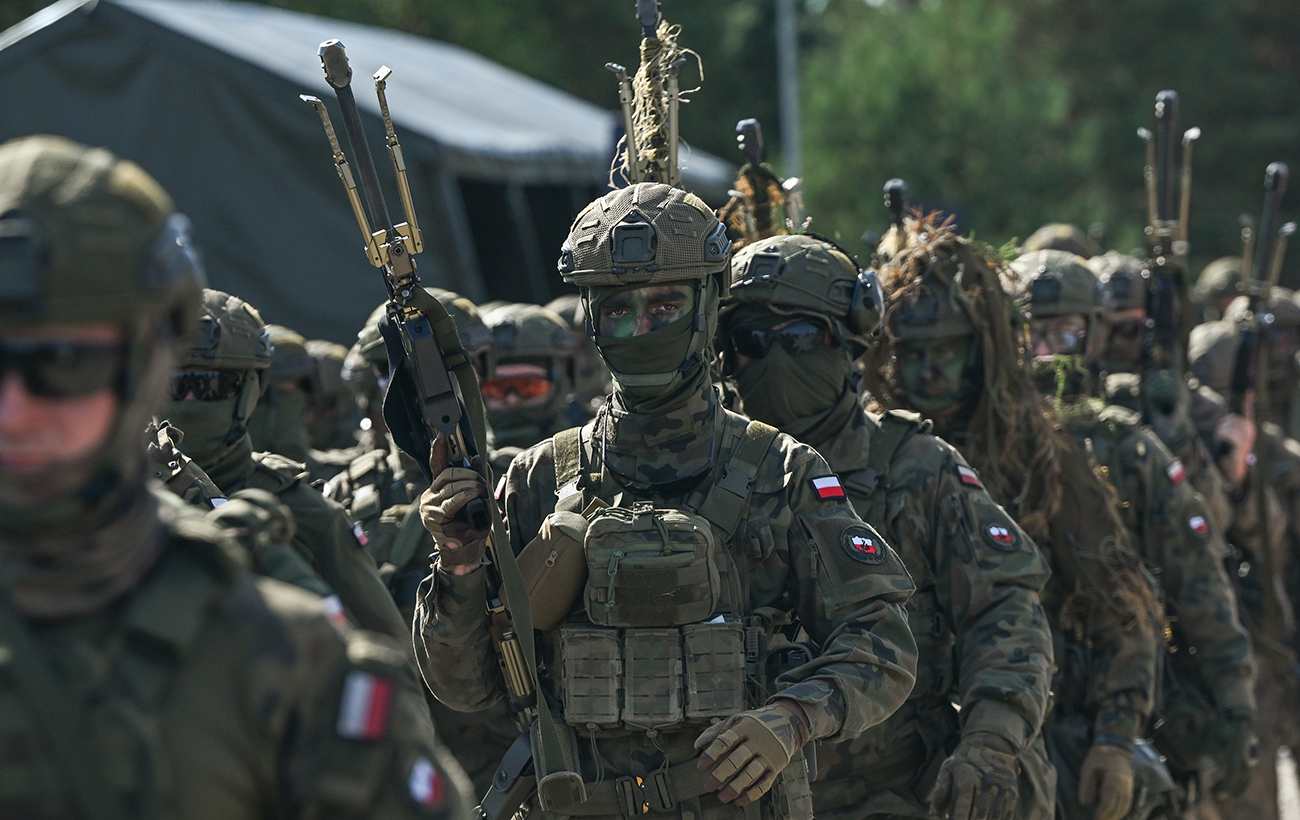 Polish soldiers during exercises (photo: Getty Images)
"Although Russia is conducting drone-based operations in Ukraine, it is still rebuilding its armored forces. This indicates that Moscow has not abandoned traditional armored-mechanized warfare methods, and readiness for that is necessary," the expert emphasized.
The main scenarios considered by Poland include a potential Russian attack on the Suwałki Corridor to cut off the Baltic states from the rest of NATO, as well as hybrid operations involving drones and infrastructure sabotage.
To prepare for these threats, the country regularly conducts military exercises—not only military ones.
In April, Poland will hold the strategic exercise Kraj-2026, designed to test the readiness of the entire national defense system for a potential armed conflict. It will involve the prime minister, ministers, speakers of the Sejm and Senate, as well as heads of central institutions, intelligence services, and armed forces commanders.
However, Poland's defense preparations are to some extent affected by political tensions between President Karol Nawrocki and Prime Minister Donald Tusk.
A striking example is the debate over the EU’s SAFE program—a mechanism providing up to €150 billion in low-interest loans to member states for joint arms procurement and strengthening the European defense industry.
"If such conflicts continue, they may ultimately negatively affect Poland's defense policy and, in the end, the army’s readiness for defensive operations," Materniak concluded.
Northern direction
Another possible direction of Russian aggression is Northern Europe. Russia has long-standing grievances with the Scandinavian countries and is currently continuing to target them using hybrid methods. On several occasions, telecommunications cables between Finland and Estonia have already been damaged.
In late March, three drones were found in different locations in southeastern Finland. They were identified as Ukrainian UAVs that had strayed from a swarm intended to strike Russian territory. Similar drones continued to be discovered in April as well.
Across the region — Finland, Sweden, Norway, and Denmark — there has long been a consensus on preparing for defense. In Finland, for example, this approach is rooted in historical experience. During the entire Cold War, the country served as a semi-independent buffer between the USSR and NATO.
"After the end of the Cold War, the rest of Europe started disarming; Finland actually started arming. So, we developed our defenses in the 1990s, procured an F-18 Hornet from the United States, and bought hundreds and hundreds of tanks from the old East Germany," Finnish political expert and former member of the Finnish parliament Risto Penttilä told RBC-Ukraine.
Differences among the countries lie mainly in how they should prepare for war. "Left-leaning parties tend to emphasize a whole-of-society approach and resilience, while center-right parties may place more focus on the defense industry and combat readiness," Penttilä explained using Sweden as an example.
Norway, which is not an EU member but maintains very close ties with the bloc, is directly responsible for the Arctic and is currently strengthening its presence there. The year 2026 has been officially declared the Year of Total Defense in the country. Similar discussions are also taking place in Denmark, where the focus is on rapidly increasing the size of the armed forces.
Immediately after Russia’s full-scale invasion of Ukraine, Finland and Sweden decided to join NATO. As both countries had long met the Alliance's standards, accession proceeded quickly.
Following Russia's annexation of Crimea, in 2015–2016, scenarios were developed in Northern Europe in which Russia would attempt to seize Sweden's Gotland, Norway's Svalbard, and Finland's Åland Islands.
However, after Finland and Sweden joined NATO, these scenarios have changed somewhat, Penttilä noted.
"Scenarios that military planners and the media discuss are still sort of the Narva option, or the Suvalki between Lithuania and Poland. And then, thirdly, Spitsbergen up in the Arctic, the islands where the Russians and Norwegians both have industrial mining," Penttilä explained.
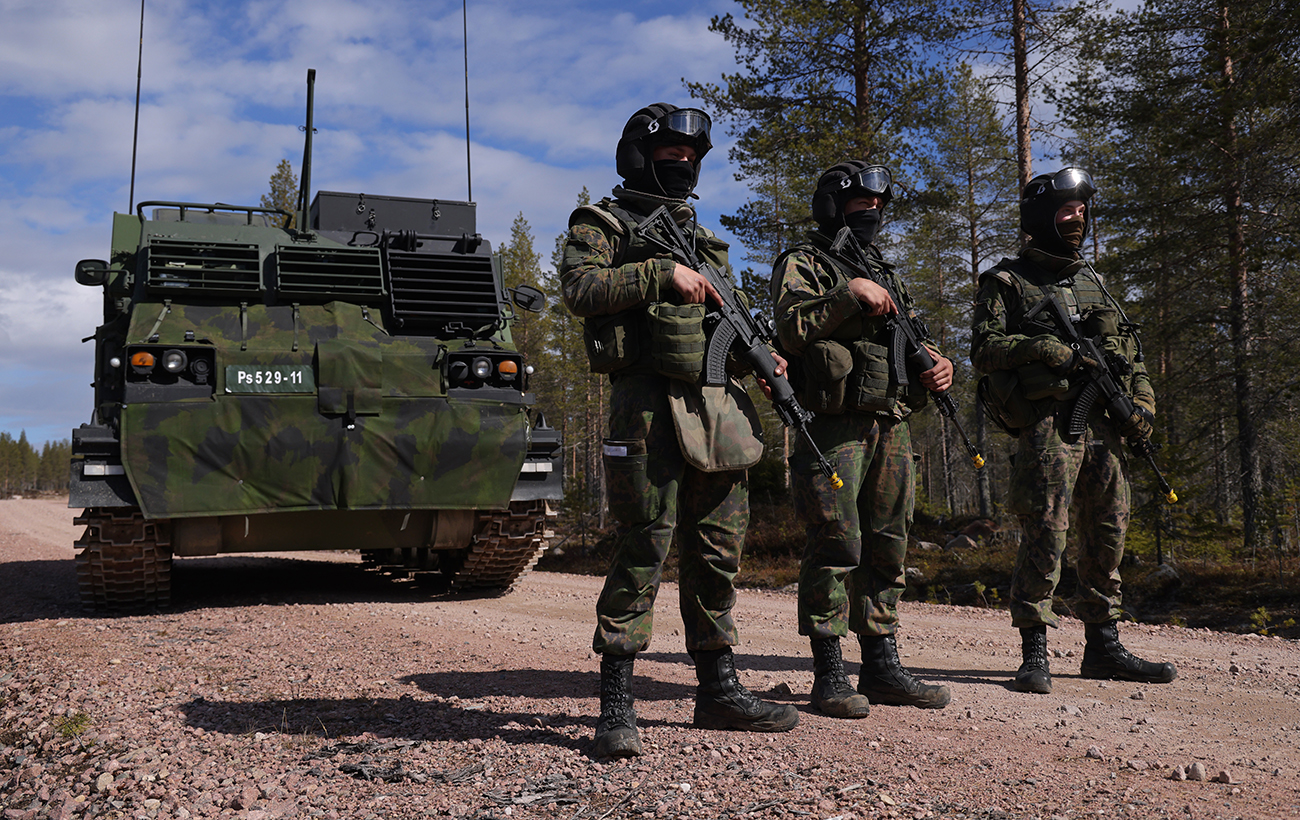 Border patrol in Finland (photo: Getty Images)
Sweden is currently rebuilding its total defense system. In 2017, it reintroduced partial conscription. The plan is to train up to 10,000 conscripts annually by 2030 and 12,000 in 2032–2035. However, according to Penttilä, its effectiveness remains limited.
Norway has taken a similar total defense approach and, in 2026, is conducting its largest civil-military exercises since the Cold War. These involve businesses, municipalities, and civilians.
"In terms of whole society preparedness, I think Finland is better off in terms of having a very large reserve, about 800,000 trained people. And Sweden doesn't have that, but Sweden has a very strong defense industry," the expert noted.
Between 2025 and 2030, Stockholm will allocate over €15.7 billion to the military component of its total defense programs and more than €3.5 billion to civil defense.
With these funds, Sweden plans to acquire the latest Gripen E fighter jets, submarines, and air defense systems, as well as develop protected infrastructure. In addition, it will build reserves of food and fuel to ensure full national self-sufficiency.
Denmark has taken a different approach: it has nearly tripled the length of compulsory service from 4 to 11 months. Starting in 2025, it will also begin conscripting women for the first time to strengthen its armed forces.
At the same time, Northern European countries, like the Baltic states, rely on support from other NATO members.
Alliance's uncertainty
On the territory of the Baltics and Northern Europe, troops from other NATO countries are stationed. But whether they are ready to "die for allies" remains a key question. This especially concerns the United States. The backbone of deterrence forces consists of multinational units that in recent years have expanded from battalions to brigades.
In Lithuania, the German 45th Armored Brigade is being deployed. In Latvia, a Canadian multinational brigade. In Estonia, a British battalion group, as well as units from Denmark, Belgium, France, and other countries. In Poland, American troops.
In theory, countries that do not share a border with Russia should thus contribute to the defense of NATO's Eastern Flank. They also declare preparation for war.
Germany is actively transforming the Bundeswehr into the strongest conventional army in Europe and plans to increase its numbers to 255,000–270,000 personnel by 2035. France is launching a voluntary military training program for 50,000 people and is modernizing its nuclear arsenal. However, everything comes down to their political and moral willingness to fight.
"Personally, I can understand when you are ready to die for your country or at least for a neighboring country, when you understand that your front line is in the neighboring country, like Lithuanians. But for me, it's difficult to understand that Americans will fight for Lithuania, or Spain will fight for Lithuania, or Italians," reflects Arūnas Kumpis.
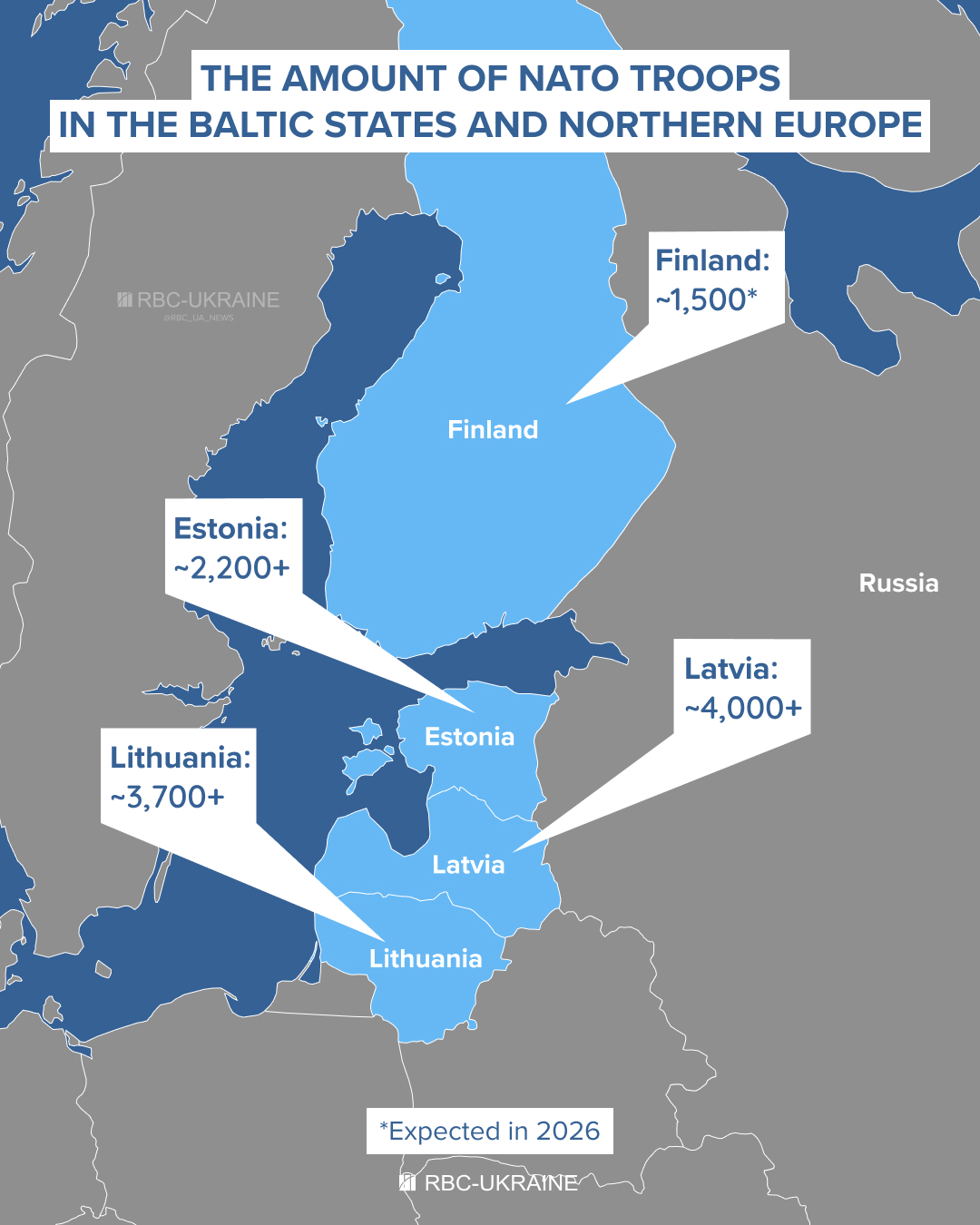 The Alliance has stationed its contingents near Russia (infographic: RBC-Ukraine)
Another challenge is the extent to which the United States—the most powerful NATO member—would be willing to engage in a possible war, even without deploying ground troops. Donald Trump has a highly specific attitude toward the Alliance. He alternates between criticizing it and being more conciliatory.
Recently, Trump promised to review US participation in NATO after European members refused to support him in the war with Iran.
"I don't think that the US is going to leave NATO, but we still need a plan B. And plan B is to, number one, keep up a very strong national defense. Number two, build closer military relations with our neighbors, the Nordic countries, and also third - strengthen bilateral military relations with the US," emphasized Risto Penttilä.
Under these conditions, opportunities are opening for Ukraine. As in the Middle East, Kyiv can provide its own anti-drone "umbrella" and share its experience with the Baltic and Northern European countries. And last year's exercises in Estonia are far from the only case in this regard.
Recently, President Zelenskyy stated that Kyiv is preparing talks with European partners on creating a joint air defense system. The main thing is not to delay. If the Arab monarchies of the Persian Gulf were caught off guard by Iranian drones, Europe still has time.
Quick Q&A:
Which regions of Europe are at the highest risk of a Russian attack?
The Baltic states – Lithuania, Latvia, and Estonia – are considered the most vulnerable. A key risk point is the Suwałki Corridor, the capture of which could cut the Baltic countries off from NATO allies in Europe.
What hybrid scenarios does Russia use to destabilize the Baltics and Poland?
The Kremlin uses provocations in border towns (Narva, Daugavpils), spreads fake claims about the creation of "people’s republics," and accuses these countries of providing airspace for Ukrainian drones. There have also been documented cases of deliberate diversion of Russian drones toward NATO territory to test air defense responses.
How does political confrontation in Poland affect its defense capabilities?
The conflict between President Karol Nawrocki and Prime Minister Donald Tusk is slowing access to the EU SAFE program, which allocates €150 billion for armaments. Disputes over procurement control could delay army modernization and the development of the SAN anti-drone defense system.
What is the difference between Finland's and Sweden's defense strategies?
Finland has the largest trained reserve in Europe (around 800,000 people) and relies on mass civilian readiness. Sweden, on the other hand, focuses on a strong defense industry, the production of Gripen fighter jets, and the development of autonomous civilian infrastructure in case of isolation.
What assistance can Ukraine provide to Europe for protection against Russian drones?
Kyiv proposes creating a joint anti-drone shield based on its unique experience in repelling large-scale attacks. This includes transferring electronic warfare (EW) technologies, AI-based target analysis algorithms, and tactics for countering drone swarms.