'Narva Republic' in NATO? Could Russia use Donbas playbook in Estonia


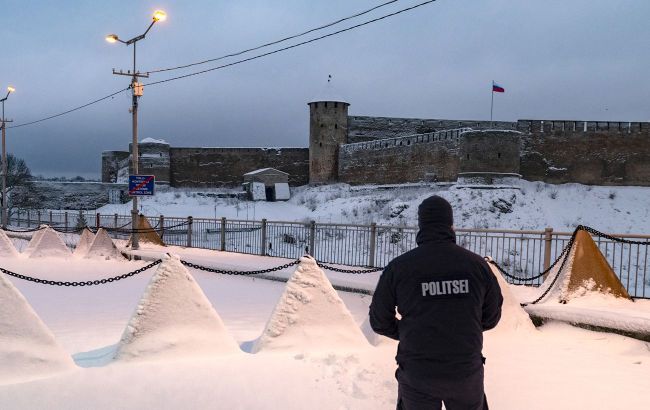 Estonian police officer in Narva (Photo: Getty Images)
Russia is laying the groundwork for hybrid aggression against Estonia through the so-called Narva People’s Republic.
RBC-Ukraine explains why the city of Narva has become a target and whether Estonia and NATO are prepared for Russian aggression.
Key points:
-
Annexation threat: Russia is promoting the idea of establishing the Narva People’s Republic, replicating the scenario of the 2014 takeover of the Donbas.
-
"Russian-speaking" leverage: In the border city of Narva, 95% of the population is ethnic Russians, making the city vulnerable to Russian propaganda.
-
Hybrid pressure: The Kremlin has intensified its campaign amid the war in Iran, attempting to demonstrate NATO’s inability to respond quickly to provocations.
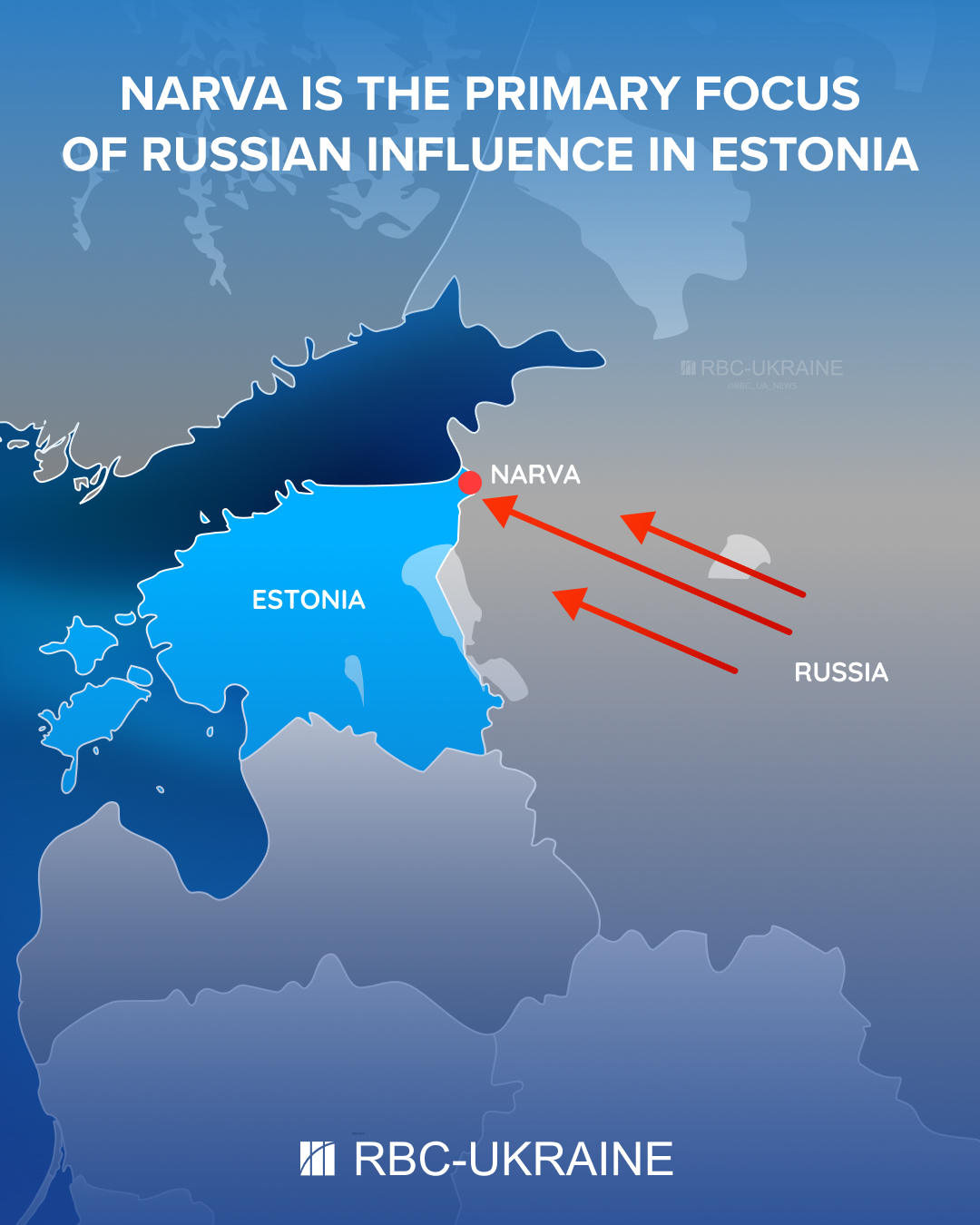 Russia has once again brought up the "Russian-speaking population" in Estonia (infographic: RBC-Ukraine)
While the US is bogged down in a war against Iran, and China, together with North Korea, is escalating tensions around Taiwan, another dangerous hotspot could emerge on the world map. This time, it concerns potential Russian aggression against Estonia and, by extension, NATO.
Although Russia’s main forces are tied up by the Ukrainian Armed Forces, since early March, the Kremlin has intensified the idea of proclaiming a Narva People’s Republic on social media and Telegram. According to Bild, Estonian intelligence considers this campaign a potential narrative preparation for an invasion of the country. The model is the same as in 2014, when Moscow claimed to protect the Russian-speaking population in the so-called LPR and DPR (Luhansk and Donetsk People's Republics).
Why Narva
Russia’s choice of Narva as the center of its influence is no coincidence. Currently, this border city sits opposite Russia’s Ivangorod and is home to a compact Russian-speaking community — about 95% of Narva’s population. In the wider Ida-Viru County, where Narva is located, ethnic Russians and Russian-speaking residents make up around 70% of the population.
This demographic makeup is a result of Soviet policies. During the occupation of Estonia from 1940 to 1991, Narva was turned into a hub for the shale oil industry.
As in Donbas, thousands of workers were brought from other Soviet territories to work in local enterprises. Ethnic Estonians were displaced, and Soviet migrants and their descendants formed a closed community nostalgic for the USSR.
After Estonia regained independence in 1991, local leaders organized a referendum on autonomy in Narva, where 97% voted "yes," but turnout was low at 55%, and the Estonian authorities declared the vote unconstitutional.
In the following decades, Narva gradually declined. High unemployment and challenges in integrating the Russian-speaking population further worsened living conditions for the city’s residents.
Constant threat
The Kremlin has been "stirring up" the situation around Narva for a long time and in a methodical way. In 2007, after the relocation of the Bronze Soldier monument in Tallinn, the city became a stage for protests by the Russian-speaking population. Estonian intelligence at the time already recorded how Russian media were pushing narratives about the "oppression of Russians" in the country.
After the annexation of Crimea and the invasion of Donbas, Russia began promoting the idea of creating a Narva People’s Republic in Estonia as well.
For a variety of reasons, this scenario has never materialized, but tensions in Narva flare up from time to time. For example, in 2022, the dismantling of the Soviet T-34 tank monument sparked local protests.
This state of affairs continues. A source from Estonian intelligence told Bild that the Russian campaign is deliberately starting now, "while the world’s attention is focused on Iran," but it is still unclear what the ultimate goal of the Russian narrative is.
At present, the focus is more on demonstrating Russia’s capabilities, says Yevhen Magda, director of the Institute of World Politics.
"Of course, the Russians are trying to show that, unlike the United States, they can play on multiple chessboards at the same time. The question is how effectively they can do it. But showing that such potential exists is politically important," Magda told RBC-Ukraine.
Under the current circumstances, a clear and decisive response to Russia’s actions regarding Narva is necessary.
"I don’t think this should be exaggerated. However, turning a blind eye is also unwise, because this threat is real. For today’s Russia, a small, successful hybrid war in the European theater is very significant," Magda emphasized.
According to him, Russia cannot fail to understand that Estonian intelligence has long been preparing countermeasures. Therefore, the Kremlin is unlikely to have illusions about its own success.
The Estonian authorities have already increased border monitoring and are preparing countermeasures against Russian influence agents. In addition, for a long time, the government has focused on the rapid integration of the Russian-speaking population and strengthening defensive lines along the border with Ivangorod.
However, this does not rule out other objectives that Russia may be pursuing.
Pressure on NATO
Politically, this is about undermining NATO’s collective security system. Russia has been systematically pursuing this since its full-scale invasion of Ukraine. Moscow has been particularly active since last autumn, when two dozen Russian drones entered Polish airspace.
"This is more an element of Russia’s systemic pressure on NATO countries, which is partly due to NATO not being in its best military-political shape right now. We see statements from the US and everything else," Magda noted.
This is especially dangerous against the backdrop of the US president’s actions, who, on one hand, pushes European NATO members to spend more on defense, while on the other hand, threatens them. The situation with Greenland, which occasionally resurfaces on the agenda, is just one — but far from the only — example of this approach.
As recent months have shown, the Alliance should not be expected to take rapid or decisive action. The reasons are not only Brussels bureaucracy but also the vastly different interests of member states.
"Whether we like it or not, the main country in NATO is the US. So I don’t think NATO will quickly change its modus operandi and start, you know, flexing its muscles on Russia’s border," Magda concluded.
At the same time, in the event of escalation by Russia, Estonia can certainly count on support from those who understand the real threat from Russia — other Baltic countries, Northern Europe, and also Ukraine.
Quick Q&A:
– Why did Russia choose the city of Narva for a hybrid attack on Estonia?
– Narva is the most vulnerable point due to its geography and demographics: the city is located on the border with Russia, and 95% of its residents are Russian-speaking. The Kremlin exploits the region’s social isolation and nostalgia for the USSR to spread separatist sentiments.
– What is the Narva People’s Republic, and does it exist now?
– It is a Kremlin propaganda project aimed at creating a self-proclaimed quasi-state modeled after the LPR/DPR (Luhansk and Donetsk People's Republics). Currently, it exists only as an information campaign, which Russia intensified in March 2026 to exert political pressure on Tallinn and NATO.
– Would NATO protect Estonia if an attempt to proclaim the Narva People’s Republic occurred?
– According to Article 5 of the NATO Charter, an attack on Estonia is considered an attack on the entire Alliance. However, the hybrid nature of the threat (protests, disinformation, "little green men") could slow the political decision-making process for a military response.
– Are the events around Estonia connected to the US war against Iran?
– Yes, Russia is using the US focus on the Middle East as a window of opportunity. The Kremlin seeks to demonstrate that the West cannot manage security simultaneously in multiple strategic hotspots worldwide.