'Russia would be eager to regain what it had before the crash of the USSR.' Interview with NATO admiral Dragone


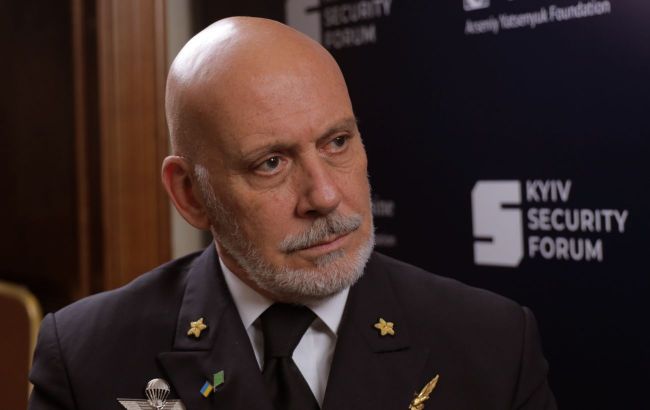 Admiral Giuseppe Cavo Dragone, Chair of the NATO Military Committee (Photo: Vlad Nesterov / RBC-Ukraine)
The war in Iran has led to yet another conflict between the US and its NATO allies.
Read the interview with Admiral Giuseppe Cavo Dragone, a senior military official of the Alliance, to learn about the risk of a reduction in American participation in the Alliance, the restoration of trust among allies, the Russian threat, and NATO’s use of Ukrainian military experience.
Read also: NATO addresses Trump's threat to expel Spain
Key takeaways:
- Russia’s imperial ambitions: Russia has been officially designated as NATO’s top threat. The Alliance expects the Kremlin to attempt to regain control over territories it held before the collapse of the Soviet Union, targeting not only the Baltic states.
- Exhaustion as a strategy: The key to defeating Russia lies in economic and military exhaustion. Russia is already losing about 35,000 soldiers per month—more than the Soviet Union’s total losses during 10 years of war in Afghanistan.
- Ukraine as a security provider: Ukraine has transitioned from being a security consumer to a security provider. The Ukrainian Armed Forces are serving as instructors for NATO forces, sharing their unique experience in countering drones.
- Lessons from the Iran war: The conflict in Iran has confirmed the critical importance of complete air superiority and the search for cost-effective ways to counter mass drone attacks. This experience will be integrated into the Alliance’s long-term strategy.
With Donald Trump’s return, relations between the US and its allies across the Atlantic have seriously deteriorated. The new US President has largely accused Europeans of not wanting to spend on their own defense, relying entirely on America’s protective umbrella.
Ultimately, under pressure from Trump at the NATO summit in The Hague, Alliance countries committed to increasing future spending on defense capabilities (in the broadest sense of the term) to 5% of GDP.
But the operation against Iran has given the US President a new reason for discontent—this time because, in Trump’s view, the Europeans have failed to provide the US with the necessary support in the war. Washington is already drawing up plans to punish its so-called bad allies, and the future of NATO itself has once again become a topic of debate.
However, Italian Admiral Giuseppe Cavo Dragone, who chairs the NATO Military Committee, assured RBC-Ukraine that, although a certain reduction in US participation in the Alliance is possible, he sees no preparations for a large-scale redeployment of American forces. In a conversation recorded on the sidelines of the Kyiv Security Forum, we also touched on other topics, including the experience of the war in Iran and the situation with the Russian-Ukrainian war.
— In your opinion, Admiral, how viable is a European-led NATO in the event of a significant United States strategic pivot? And what are the most urgent military requirements for Europe to maintain a credible deterrent on its own?
— First of all, I don't think there will be a huge disengagement from NATO by the United States.
But I just consider that Europe needs to stand up, and we are starting to do that with the great investment commitment in the Hague last year. We will see the first result at the next summit in Ankara.
What does the European side of NATO need to do? Of course, things that are in our capability targets, something that we are planning to buy, depending on financing and also procurement: our air defenses, our ISR, improve electronic warfare, go on with the new stuff, like AI integration, and drones. And there will be a need for mass soldier training that the nations will be providing to NATO.
— The US divides its allies into 'good' ones, who spend a lot on defense and assist the US in its operations, and 'bad' ones, who do not; what practical measures could follow from the US, such as moving American contingents in Europe to the 'good' countries?
— That's something that has been said recently, of course, but we need to see what the real facts on the field are. I try to be practical.
Big movement – no, nothing at all. I think there could be some disengagement, but I still have to see what this really means. But again, there will be some redirection from one ally who needs to go somewhere else just to prevent something, let's say, in Indo-Pacific.
But if we really are a strong and mature alliance, the other allies will be able to reshuffle, to fill gaps, and be able to take care of the traditional area of responsibility of NATO, while another ally is going somewhere else to intercept a crisis farther away from us, which is good.
— Is the 5% target sufficient to deter the evolving Russian threat to Europe? Which specific capabilities will the increased defense spending prioritize first?
— We need, of course, this kind of amount of money, also because we have been spending at a very, very low level, right after the Cold War. But again, the game will be to be able to balance and compensate for what is the conventional inventory that needs to be modernized, needs to be updated, and it is needed because we see a conventional war in Europe right now. And also innovation, because we have a big technical edge compared to Russia.
We are looking for quality and quantity; they are just stuck with quantity. And we need to maintain this kind of gap because it's fundamental for us.
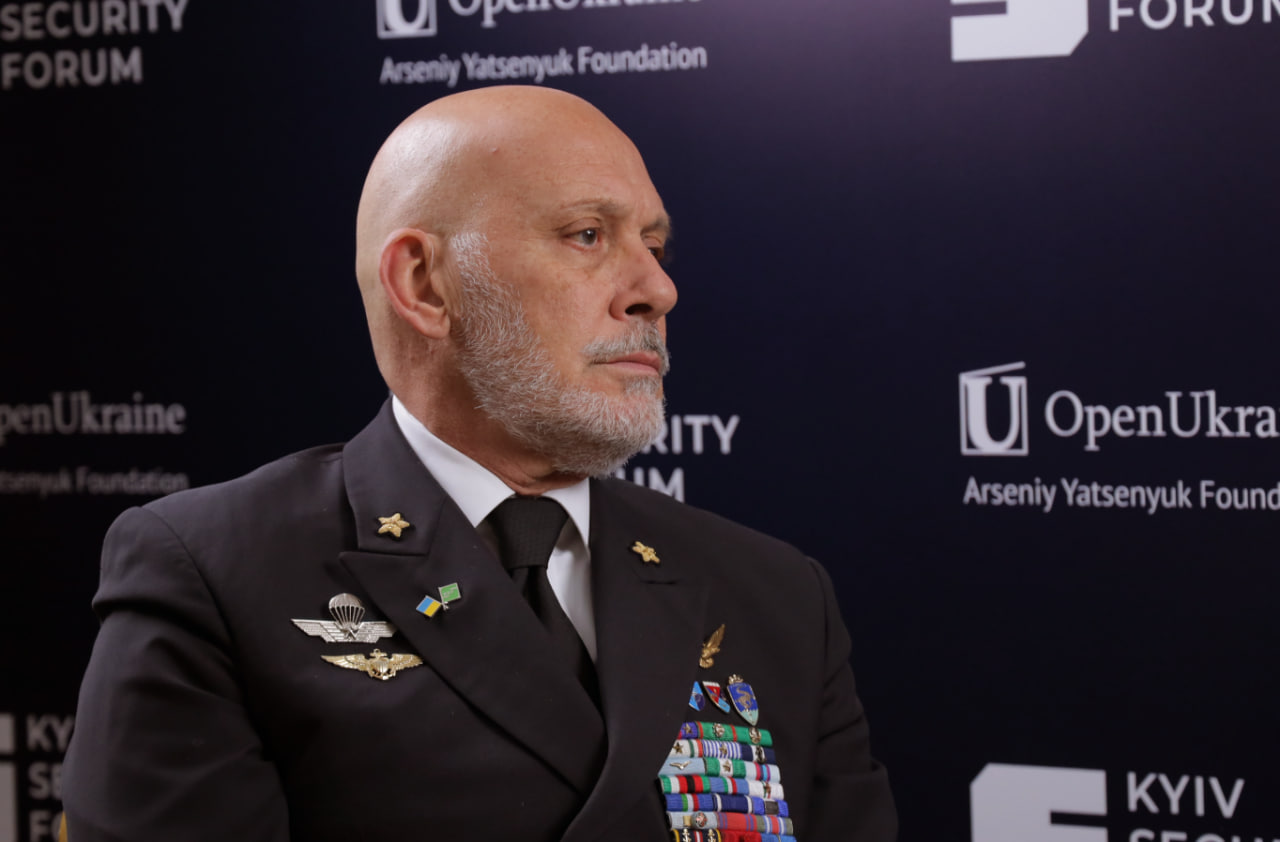 Admiral Giuseppe Cavo Dragone (Photo: Vlad Nesterov / RBC-Ukraine)
— Do you believe that all the allies have this gap that you mentioned? Maybe some of them, like the US, obviously have this gap, but not all the non-US allies have this superiority against Russia these days.
— Yeah, but I think that this commitment to 5%, this more money on the table, will drive us to do more of a multinational joint venture. And this automatically will balance any kind of differences that we could have right now. This roadmap in front of us will balance these kinds of gaps.
— How does the current Russian posture, their military build-ups, or whatever you know about their strategic or tactical plans, how does it all influence NATO's long-term strategy or long-term deployment strategy, for example, in Europe?
— We need to be aware of what the future holds for us. I mean, we foresee a build-up, an increase in the build-up of the Russian war machine. We will cope with that, with our capability target, I mean, whatever we are planning to buy and to acquire in the near and far future.
And this is triggered by what our threat is. The threat to NATO is, of course, Russia and the terrorist groups. So, we are working on these two lines to be ahead.
— Is Russia the number one threat?
— Russia is number one, of course. Of course, they just confirmed that recently, I think. There is no doubt about that.
Also, on the unconventional side, the terrorist groups are still around, still sleeping, and there could be a rise.
— Do you mean some Islamist ones? Or radical left and right?
— Whatever. Whatever is unhappy with their status.
— As of now, as of April 2026, do you see any short-term, maybe middle-term, immediate threats from Russia against some European countries? A straightforward invasion like the one we had in 2022 here, or some hybrid stuff that we've experienced here in 2014?
— Well, hybrid and unconventional threats, they are going on, and there will be these threats. We could expect that Russia would be eager to regain what it had before.
— What do you mean by 'before'?
— Before, I mean, the crash of the USSR. So, I left it to you to understand, to see who could be the target.
— Obviously, Baltic states, you don't have to be a big strategist to understand this.
— You know, it's not just them. But we are oriented to defend ourselves, to deterrence and defense on 360 degrees. We are in the Arctic, we are in the East, and we are taking a good glance at the South.
— Recently, a lot of Baltic states' officials, in all three countries, have said that they don't see any sort of immediate threat here and now. Do you agree with such an assessment?
— I think they are the right ones to have the feeling of this. So I trust them. And these are the ones who are just checking how the situation is evolving.
They are right on the front line. So, nobody better than them can give us advice and information.
— After everything we've heard from the other side of the Atlantic, regarding NATO, its capabilities, individual allies, how to fully restore the European allies' trust in NATO?
— If we just take into consideration not words or declarations, but the facts, this is already enough to say that the alliance is strong.
We just need to confirm trust in fulfilling our commitment. European allies are stepping up. We are really pushing hard on our defence industrial base, doing joint ventures. So, I think these are all concrete, real messages that everybody can trust everybody with no differences.
— So, is there some difference between what is said on the press conferences or written in Truth Social, and what is going on on the ground?
— Yeah, just look at Ukraine. NATO, all the alliance, I mean, all the 32 allies are backing up Ukraine, are sustaining and supporting Ukraine as we did before. Even more if we can, but all of us, all the alliance. So, no one is out of this game.
— There is another elephant in the room. This is Iran, obviously. So, what are the primary military lessons that NATO as an alliance has learned from the recent war in Iran? Or the ongoing one, I don't know.
— One thing, for example, that was not present the way it is at the present time in the war between Ukraine and Russia is air power. We don't have air power except for drones and missiles in the Ukraine-Russia war. But we have a strong air power in the Iran conflict right now.
So, this means how important air power is, how important it is to have total ownership of the airspace. But besides this – drones.
You have to find a way to counteract them in the cheapest way, which is one of the other challenges that we need to face. And Ukraine did a lot to help the Gulf states in facing this kind of threat.
— Many countries used to build something very big, for example, a gigantic battleship worth I don't know how many billions of dollars, very sophisticated. As we've seen, it may be easily destroyed by something 1,000 times cheaper. So does one have to change the philosophy of military production?
— No, I wouldn't say no, because we also need capital ships. The difference is the way you use them, how far you use them from the danger area, and how you protect them.
Because if you have an aircraft carrier with 92 jets on board and you protect it, it's going to be a huge, huge war machine. If you leave her alone, I mean, it can be sunk. So, that's how wise you use what you have available. But I think the big stuff is still usable.
— Who has eventually won the war in Iran, which side, in your opinion, as a professional?
— Well, it's difficult to say right now. I mean, there has been a huge, huge, massive attack, destroying on the ground. There is also a kind of new resilience from the other side.
That's two big things. I would wait a little bit more time to decide who's winning, who's losing, because it's still something that is going on. I think that negotiation will prevail.
— Let's get back to Ukraine. In what ways does NATO integrate Ukrainian combat experience in your formal doctrine? And there is multiple evidence that in different joint military exercises, Ukrainian troops often have the role, not of the students, but often of the tutors of the NATO forces. To what extent is this true?
— To a big extent. It's very, very common. I mean, they play as a 'red team' sometimes for counter-drone exercises. And I can tell you that we had good surprises because they have been very, very good like 'enemies'. And keeping on doing this will improve NATO's capability to defend, for example, from drone attacks a lot.
— How do you assess Ukraine's overall transition from the security consumer to security contributor?
— It is a huge contributor. Even if Ukraine is extra busy on the frontline, I mean, it is giving us a lot of lessons learned through the JATEC, Joint Analysis Training and Education Center.
We are getting and absorbing lessons learned from you. You see what they did in the Gulf, helping the Gulf countries from the Iranian air attacks. So, I mean, they are a security provider now.
— What is your general assessment of the current situation on the frontline? Is it fair to say that now we've reached a point of an effective stalemate where no major breakthroughs are expected?
— I agree. I agree that there is a stalemate, but there is also a huge loss of lives from the Russian side. I mean, they're losing 35,000 per month, something like that.
And they lost 20,000 in the whole Russia-Afghan war, which lasted for 10 years. So, this is amazing.
There is a stalemate, but they are having a lot of losses every single day. And that's unbelievable.
— The way to defeat Russia is to exhaust Russia and the Russian economy to the point that they will not be able to keep waging the war. Is this a good strategy?
— Yes. And if the fight in the Strait of Hormuz comes to an end, we will need to rewind and go back to sanctions and on. And that's my hope.
Quick Q&A
— Is Europe ready to defend itself without active US involvement?
— The admiral does not believe the US will withdraw from NATO on a large scale, but he emphasizes that Europe has already begun to stand on its own two feet. Thanks to investments and purchases of air defense systems, electronic warfare capabilities, and AI, European allies will be able to fill emerging gaps and rotate forces.
— How critical are the Russian army’s losses?
— The situation on the front lines is assessed as hopeless, yet the cost to Moscow is enormous: Russia is losing about 35,000 personnel per month. For comparison: this is more than the total losses of the Soviet Union over the entire 10 years of the war in Afghanistan.
— What is the main military difference between the wars in Ukraine and Iran?
— The key difference lies in the use of aviation: while air forces are barely involved in the Ukraine-Russia war (except for missiles and drones), aviation plays a decisive role in the Iranian conflict. This has underscored the importance of complete air superiority and control of airspace.
— What is NATO learning from Ukraine?
— Ukraine has become a provider of security. The Ukrainian Armed Forces serve as instructors for Alliance forces, and Ukraine’s experience in countering drones and integrating new technologies is being directly incorporated into NATO doctrine through joint training centers.