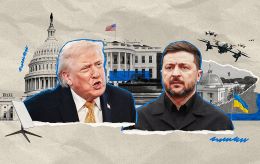
'Europeans and Americans behave as sleepwalkers, walking through abyss.' Interview with Bernard-Henri Lévy


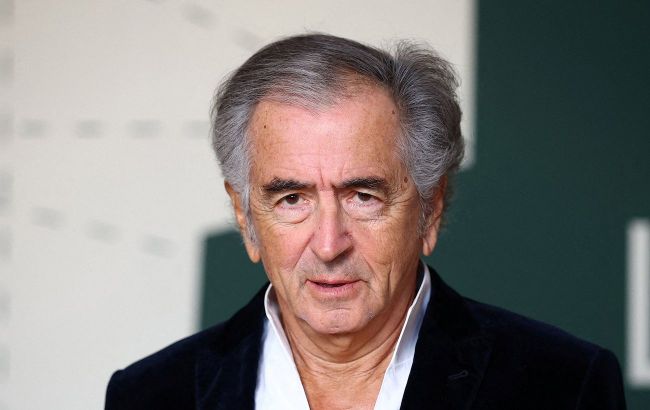 French philosopher, writer, and filmmaker Bernard-Henri Lévy (photo: Getty Images)
"For me, Putin has already lost," leading Western philosopher Bernard-Henri Lévy tells RBC-Ukraine.
Why he has reached that conclusion, as well as his thoughts on democracy fatigue in the West, the rise of antisemitism, and why he feels safer in Sumy than at home in France, Lévy discussed in a conversation with RBC-Ukraine.
Read also: TikTok revolution: Why youth in Europe and US turning to radical politics
Key points:
- Putin’s strategic defeat: The leader lost on the very first day, having failed to achieve any of his military objectives, but he refuses to admit defeat out of fear.
- West's moral weakness: Europeans and Americans behave like “sleepwalkers, walking through the abyss," as people grow "fed up with democracy" and seek false salvation from radicals.
- "Empty" dictatorships: Regimes in Russia, Iran, and Türkiye rely on "dead" culture and nostalgia; they have no future and cannot be attractive to the world.
- Ukraine as a source of meaning: The struggle of Ukrainians on the front lines breathes life into old democratic values that, for the West, had already become "dead flowers."
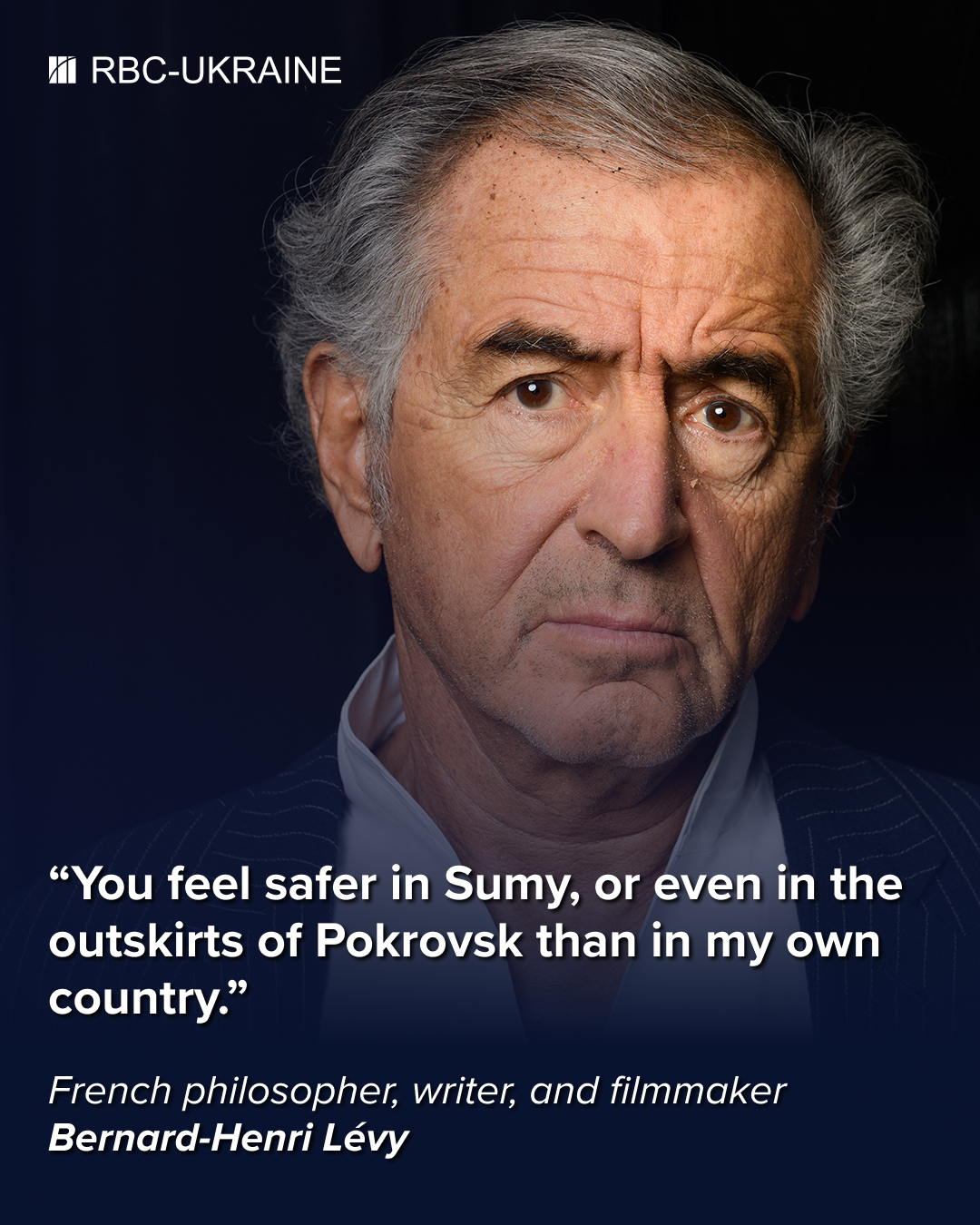 Bernard-Henri Lévy on the rise of antisemitism in the West (source: RBC-Ukraine infographic)
Philosopher, journalist, writer, and filmmaker — Frenchman Bernard-Henri Lévy is one of Europe's most prominent public intellectuals. He moves in the highest cultural, business, and political circles of the West and maintains close ties, for example, with French President Emmanuel Macron.
Lévy has taken a keen interest in Ukraine for many years. He spoke from the stage of Euromaidan, repeatedly visited the front line both after the first wave of Russian aggression in 2014 and following the full-scale invasion in 2022, and made several documentary films about those events.
RBC-Ukraine spoke with Lévy during his latest visit to Kyiv, marking the fourth anniversary of the start of the full-scale war.
We began our conversation with the philosopher by addressing the most pressing issue — the current peace negotiations — but went on to cover a much broader range of topics, from the rise of radical sentiments in the West to antisemitism.
"I think that pessimism and optimism are symmetrical mistakes. Stupid are those who say: I'm sure the good will prevail. Stupid are the ones who say: I'm sure the evil will prevail. History is never written. It is a struggle," Lévy says. "And what we do on our own, we shape the future. And I saw so many examples of that in this country."
War and Putin's defeat
— Now that you're visiting Ukraine, almost no one is talking about the victory of Ukraine in this war anymore. It's all about compromises, it's all about concessions from both sides, so Ukrainians have to do this, Russians have to do that, to find some sort of a peaceful settlement for the war. Why has it happened?
— As for myself, I'm still talking about that. In France or in America, in every single intervention of mine, I mention that, and I believe it. I never stopped believing in the victory of Ukraine. And for me, Putin has already lost.
— Why do you think so?
— He lost from the very day. All his war targets failed. Everything. He wanted to capture Kyiv, but he did not. He wanted to weaken NATO; instead, he strengthened NATO. He wanted to weaken Europe. He did not. He wanted to topple Zelenskyy, but he reinforced him. He wanted to gain territory. He did not.
— Well, he managed to occupy some parts of Ukraine.
— Come on! Such a force. So much machinery. So many human losses to win so small. The biggest part of the occupied territory was occupied before, as you know. So, he lost.
The only reason why he does not admit that he lost is that he is afraid of the domestic consequences of the recognition that he lost. And if we, the West, provided a little more help, a little more support, if we had a little more determination, Ukraine would win in a decisive way. I'm convinced of that.
I said that in the beginning. I made four films, saying that I believe in the recovery. Of course, it takes time, the price is very high, the losses on our side are insufferable in terms of numbers, in terms of mental health, in terms of society, in terms of children.
Of course, it's insufferable, but I don't see any outcome except the victory of Ukraine. It's still today. I would like it to come quickly.
— If the ongoing peace negotiations end up in some form of ceasefire or peace deal, it will mean that Russia is not defeated, unlike Nazi Germany in 1945. What will be the consequences for the world if the aggressor is not fully punished for such a massive invasion?
— It will be a strategic defeat for the West. Ukrainians have to decide. If Ukrainians decide to make a compromise, by principle, they are right. Whatever they decide.
The people of Ukraine are on the front line. They pay the price. They shed the blood. So, who are we to give them any lesson?
But Europe has to know that in this case, there will be a strategic disaster for the West and for Europe. Because it will be Putin who will be politically reinforced, who will have time to regroup, to rearm.
So, any responsible European person should wish with all of their heart the defeat of Russia, and to help Ukraine defeat Russia. Any other outcome will be very bad for Europe.
— You communicate with European elites a lot. Among the politicians and the business leaders, how strong is their desire to get back to business as usual with the Russians, as it used to be before February 24, 2022?
— A lot of them, of course, would like it to happen. Europeans and Americans are behaving as sleepwalkers, walking through the abyss without realizing it. It's difficult to understand what is at stake. Like in 1913, like in 1938-39.
Rise of radicalism in the West
— Do you agree that now there is a huge leadership crisis in Europe? Because many people say that all those leaders, especially of big European nations, do not fit the times they are in. They could be very OK at their positions, say, 30 years ago. But not in 2026. I mean the leaders of France, Germany, the UK, etc.
— No, France and the UK, Macron and Starmer, they are fit for that. And they understand the stakes.
The problem is that they are both domestically desperately weak. Macron understands. Macron knows what is at stake, what would happen if Ukraine were compelled to compromise.
Macron sincerely wishes, from the bottom of his heart, the victory of Ukraine. Macron said two years ago: Ukraine cannot and will not lose. Ukraine can and will win. Macron said that. And Starmer thinks the same. And also Merz.
The problem is that they are democratically elected. And they have strong domestic opposition. And the problem is that they have an ally, a big ally, a big brother, who is apparently no longer a strong ally. If ever he is still an ally. That is really new data.
— As we see now, President Macron more or less manages to hold the situation in balance between the ultra-left and ultra-right. But next year there will be elections. Can something be done with the desire of people to support the radical guys from both sides of the aisle, who usually suggest very simple answers to all the challenges?
— These are democracies. But now we see what we see. Because we are morally weak.
And when you are morally weak, you choose simplistic solutions. When you have a real identity crisis, as we have in Europe, you select simple, moronic, stupid solutions to give you the impression that you are yourself again. But it is the worst part of yourself. I mean Marine Le Pen or Jean-Luc Mélenchon. But it gives people the impression they have found a way.
It worked like that in the 1930s in France, with all that fascism and communism, people were fed up with democracy.
And you are battling for democracy. Thank God, you are here, since the Maidan. Because we are tired of democracy. I said that on the Maidan in February 2014: thank you, you are giving again a meaning, a new breathing, a new spirit to the old words of democracy in which we don't believe any longer.
You are refreshing, I told Maidan. I told thousands of people who were there, thank you for refreshing, for rebranding, re-filling with sense, with meaning, words which are like dead flowers for us.
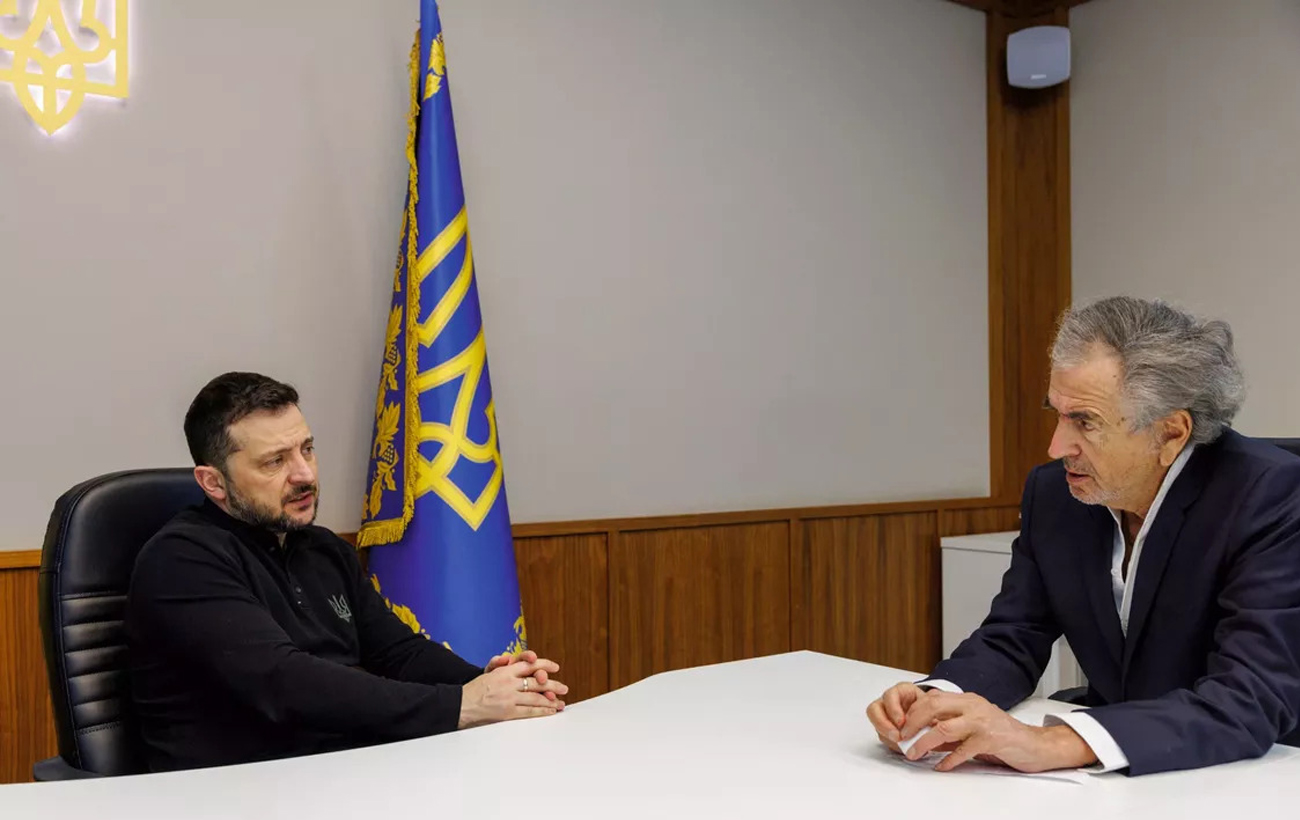
Bernard-Henri Lévy with President of Ukraine Volodymyr Zelenskyy (photo: x.com/BHL)
— Why do people in the wealthy, well-established democracies like France or Germany get tired of the democracy that has given them it all, their rights, their prosperity, their well-being? Why do they get tired and look for "charismatic authoritarian leaders"?
— This is the third time it appears in Europe. Before 1914, in the 1890s, you had that. People were sick of democracy. In France, it was clear. It happened again in the 1930s.
Read also: 'Whether you like it or not': Trump downplays Europe's role in defeating Hitler
Why? Because there are two things that people desire. Of course, freedom. People sincerely wish for freedom, sincerely wish for democracy, etc. But you also have a sincere desire in humanity for nihilism. This is also a desire, a human passion. Fascism has sometimes been imposed on society. But often not imposed. It's natural. It does not need to be imposed. People were happy to have such a leader.
— Last time it all ended up extremely terribly for Europe. It was a nightmare. This time, are we going to have the same?
— It's never the same. And thank God, Russia is weak. Russia is not Germany of the 1930s. Germany was strong.
And Putin is really out of breath. He is short of ammunition, short of missiles, short of men, compelled to bring some mercenaries, short of money, etc.
Our chance is that he is weak. He is deeply weak. Even inside Russia.
I will never forget, as I was in the Zaporizhzhia area the day when Prigozhin tried his coup.
— Yeah, he advanced into Russia almost without any opposition.
— People were offering him coffee on his way. Applauding. And it was the proof that the regime is really weak.
— So, all in all, in your opinion, as of now, do democracies really lose their fight to authoritarian powers all around the world?
— The game is not over. Look at America. Counterpowers start to wake up. Trump has backed down on tariffs. He was compelled to step away from Minneapolis. In Los Angeles, he was shunned by the governor. Again, he took the National Guard out.
Read also: US Supreme Court strikes down Trump's tariffs
Trump is the same. He is not so strong.
— But still, Trump's rise to power is not a coincidence, is it?
— It's a moment. There is a wish for that at this moment in the world.
But all these authoritarian regimes are weak in another sense. They are morally weak. They don't have deep beliefs.
They don't rely on a real, old, and well-built culture. Look at Putin. He always lectures everyone. His culture, even in Russian history, is stiff, frozen. It is not a living, vivid, vibrant culture. It is an old memory. An old culture.
Erdogan in Türkiye is the same.
— He talks about the Ottoman Empire and its glory.
— But an Ottoman culture is also looking like a fossil.
Iranians, their memory is also dead, frozen, automatic. The Chinese have no memory. And therefore, when your own culture is dead, you cannot impose it on the rest of the world. Who wants to be Chinese today? Who wants to be Russian? No one.
I remember in 2019, I made a report in the Luhansk and Donetsk areas, on the Ukrainian side. There was still one checkpoint open, and every day I saw people coming to Ukraine to take some cash from the ATM, to take their pensions, to buy some medicines at the drugstore, and so on. They were living there, on occupied territory, and nobody liked it. Nobody said: I'm happy to be under Russian authority. They were starving to come back to Ukraine. They did not have the means, but nobody was happy.
— You mentioned the moral weakness of authoritarian regimes and fringe politicians. But maybe those people who vote for Rassemblement National (far-right party of Marine Le Pen and Jordan Bardella - ed.) in France don't want to gain any moral superiority. They just want simple solutions, and they're okay with that. Don't you think so?
— I am one of the few French who really believe that Rassemblement National will not win the presidency.
— Why?
— Because they are unfit, because the campaign will reveal that they are just zeros, because they are traitors, friends with the enemies of France.
— But their rhetoric about the Russian invasion has changed, hasn't it?
— They don't say that they support the Russian invasion, but they say that it's time to stop, that the mistakes are equal, the responsibilities are put equally on the two sides, and they buy all the Russian narratives. And they voted recently against the European package of aid to Ukraine.
Even if it does not cost one cent, one euro, to the European citizens, because it's based on frozen assets. But in principle, they disagree with such a process.
— How great a catastrophe would it be for the whole continent if they manage to win the election?
— It will be an economical catastrophe, moral catastrophe, and geostrategic catastrophe. The victory of Putin and an unprecedented economic crisis in the markets.
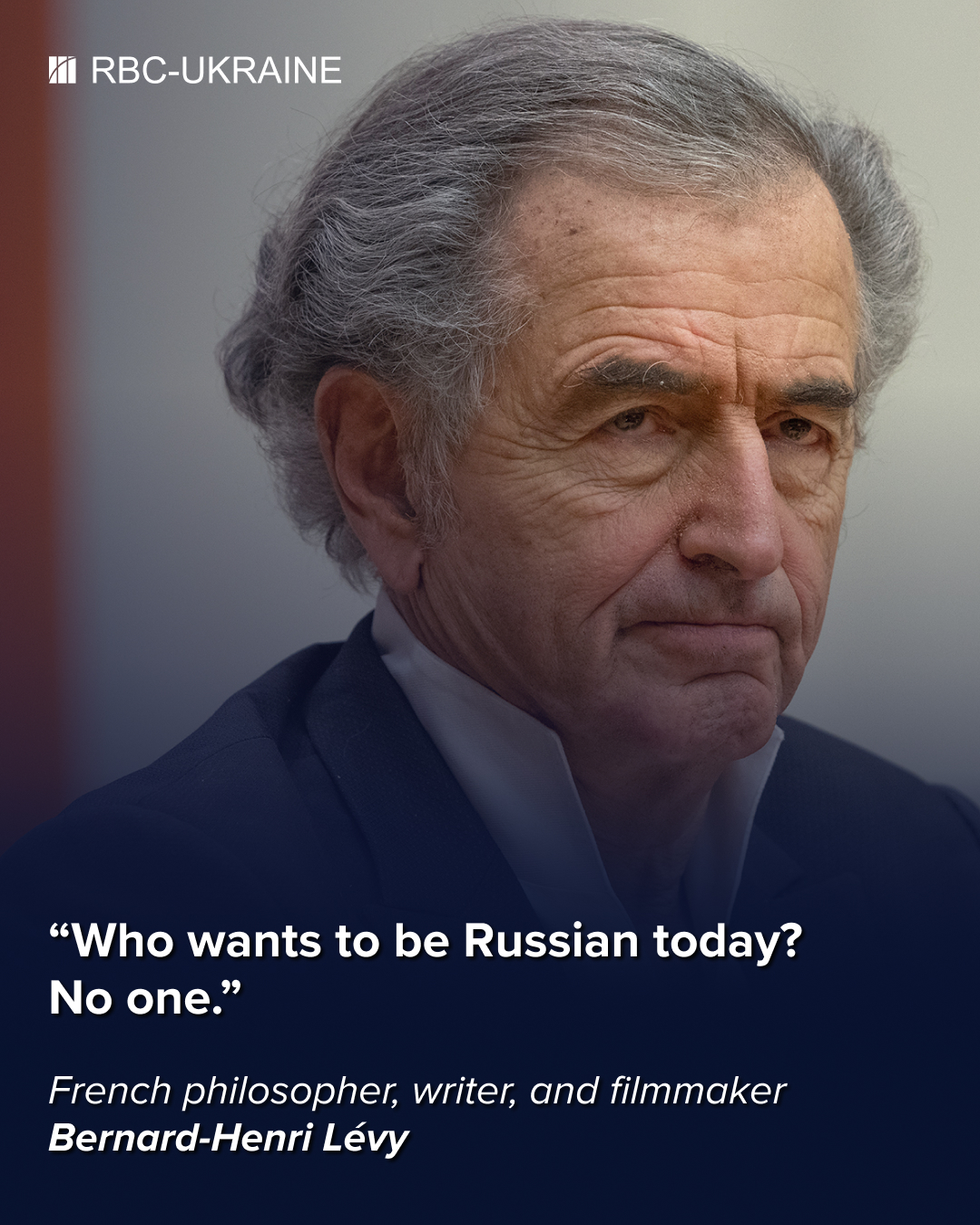
Bernard-Henri Lévy on the weakness of today's Russia (source: RBC‑Ukraine infographic)
The left and antisemitism
— How did it happen that leftists worldwide are massively siding against Israel, supporting its elimination, and effectively standing with terrorists like Hamas, who, by definition, reject the very rights and freedoms the left has historically fought for?
— In the tradition of the left in Europe, in the definition of the left, you have two traditions that mingle. There is the anti-colonial tradition and the anti-totalitarian tradition. A true leftist has to be really at the point of junction of anti-colonial and anti-totalitarian.
If you give the privilege to one of them, if you don't keep the balance equal between the two, a catastrophe starts. The people you are talking about forget completely about anti-totalitarianism, and they give preference and focus only on anti-colonialism.
Read also: Greta Thunberg released after arrest at pro-Palestinian London protest
So, when you say that the only thing that counts is being against empires, to be pro-nation, whatever happens inside, to be pro-any sovereignty, whatever the way they treat their people, exactly what you said happens. But anti-colonialism has to match with anti-totalitarian values also, to be a true left. Which means equality, gender equality, human rights. Then it sounds correct. So this side of the equation is completely disappearing.
Number two, this is not new. Look at what happened with the left in the 1930s or 1950s.
— A lot of them admired the USSR and Stalin, for example.
— A lot of them.
— Jean-Paul Sartre.
— He was schizophrenic about it. Sometimes he was pro-Soviet. Sometimes he behaved like a real free man. But Louis Aragon, one of the best French writers...
On the other side, you had true heroes of thought, who were anti-Hitler, anti-Stalin. They were few, the minority, but they finally prevailed, thirty years later.
— How far may all those anti-Semitic go? I've read some reports, in French media, that some local Jews even think about or have already moved to Israel. Because they feel uncomfortable being in France and prefer to move to a place where no one will bully them just because they are Jews.
— Sometimes I feel it myself. It happened to me. You feel safer in Sumy, or even in the outskirts of Pokrovsk, than in my own country.
— Just for the reason that you are a Jew?
— Yes, I am. I live under 24h protection in France. Not here.
— Because of the threats from some Islamists?
— Not only Islamists. Antisemitism.
— To sum it all up, you are still an optimist, aren't you? About the future of civilization, Western civilization?
— I think that pessimism and optimism are symmetrical mistakes.
Again, nothing is written. Stupid are those who say: I'm sure the good will prevail. Stupid are the ones who say: I'm sure the evil will prevail.
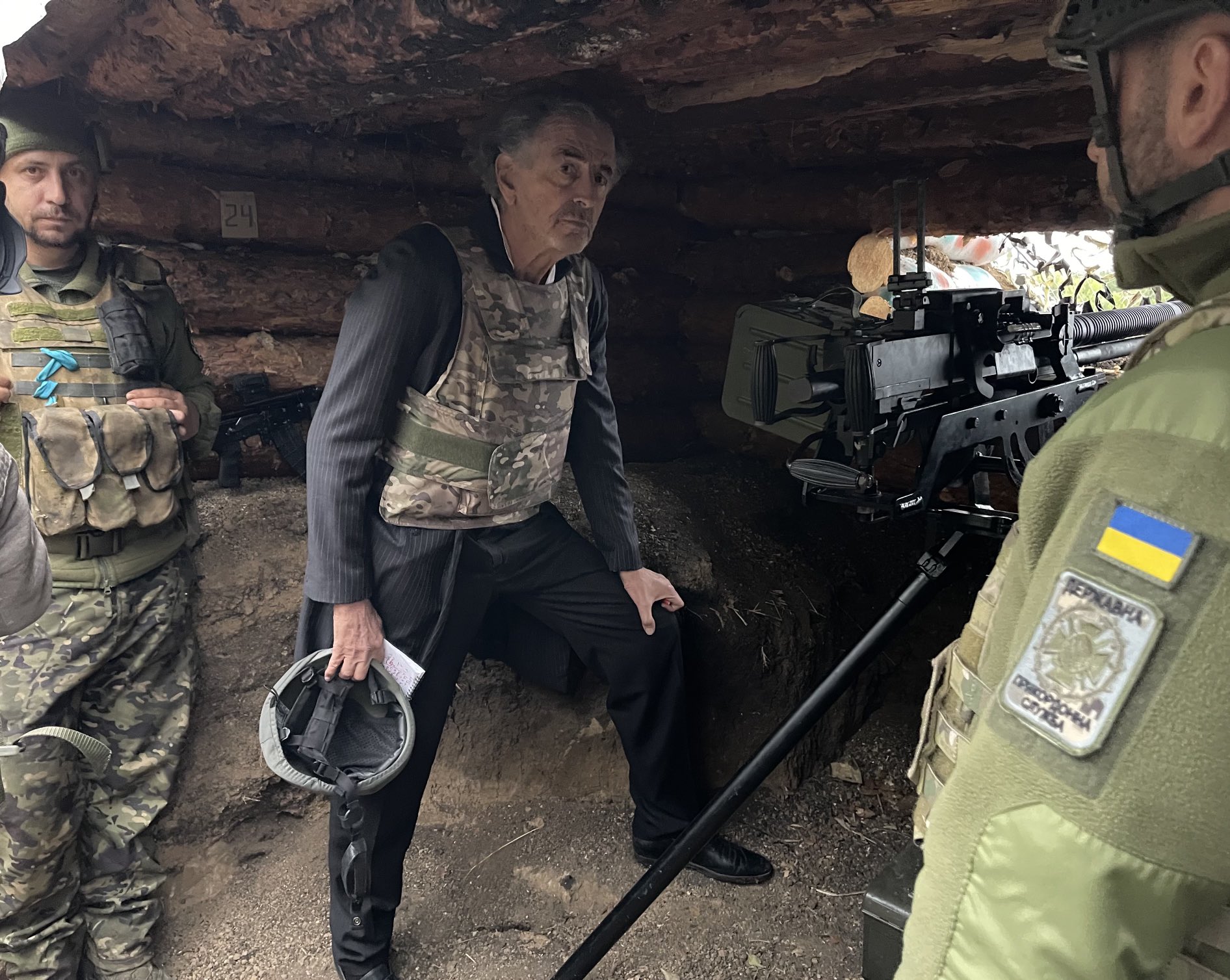
Bernard-Henri Lévy on the front lines in Ukraine (photo: x.com/BHL)
History is never written. It is a struggle. It's a battle. It depends on so many things. Including the will of man. Including the apparition of a single individuality sometimes.
Including accidents of history. Including black swans. And what we do on our own, we shape the future. Each of us.
And I saw so many examples of that in this country. I saw so many men on the front lines. I spent a reasonable time on the front line since 2022. And these Ukrainian men, they have this creed that they have a role to play in the general plot. Each of them. They are not just a pawn. They are not just a piece. They are real actors. Each of them.
I saw this feeling each time I traveled, from Huliaipole in 2022 to Pokrovsk in 2025.
Quick Q&A:
— Why has Putin already lost the war?
— He has achieved none of his military objectives: he didn't take Kyiv, didn't overthrow the Ukrainian government, and only strengthened NATO. Today, he survives solely through fear of a domestic explosion if he admits defeat.
— What does the comparison of Europeans to "sleepwalkers over an abyss" mean?
—It reflects the elites' unwillingness to recognize the real threat. Instead of decisive action, we see a desire to return to business as usual with Russia.
—Why are radicals gaining popularity in today's Europe?
—Because of many Europeans' democracy fatigue and their pull toward nihilism. Europe has gone through this before both world wars.
— What significance does Ukraine's struggle hold for the Western world?
— Ukraine restores meaning to democratic values that have become "dead flowers" in the West. Ukrainians, especially the soldiers on the front lines, are shaping the future with their own hands right now.