Zelenskyy, Rubio and Ukraine's new role: What to know about Munich Security Conference 2026


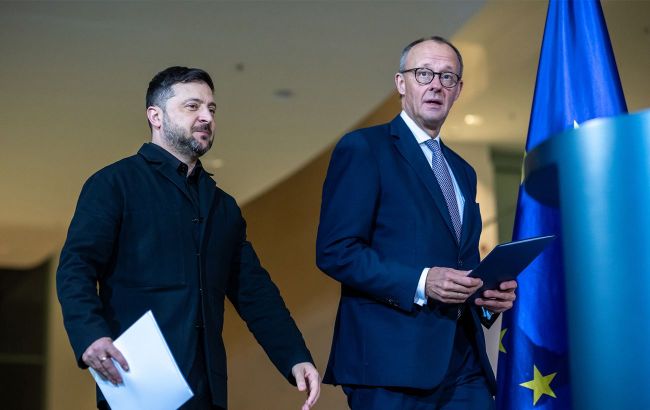 Illustrative photo: German Chancellor Friedrich Merz plans to meet with President Volodymyr Zelenskyy at Munich Security Conference 2026 (Getty Images)
The Munich Security Conference will take place on February 13–15, where participants will discuss European security, America’s role, and Russia’s war against Ukraine. Ukrainian President Volodymyr Zelenskyy and US Secretary of State Marco Rubio are expected to attend.
Key details about the Munich Security Conference 2026 are in the report below.
Read also: Trump and Russia’s new war: Munich Security Conference releases explosive report
Key points:
- The Munich Security Conference (MSC) will be held on February 13–15 and will mark its 62nd edition.
- Nearly 50 heads of state and government have confirmed their participation. Secretary of State Marco Rubio will represent the United States.
- Main topics include European security, transatlantic relations, multilateral cooperation, regional conflicts, and technology.
- President Volodymyr Zelenskyy and the Ukrainian delegation, including Foreign Minister Andrii Sybiha, have been invited to attend.
- For the first time, a Ukrainian House will open at the conference as a sign of solidarity with the country.
The 62nd Munich Security Conference (MSC) will be held at the Bayerischer Hof and Rosewood Munich hotels.
One of the world’s leading security forums traditionally brings together political leaders, government officials, and experts to discuss key challenges in international politics and defense.
Who will attend
According to the organizers, nearly 50 heads of state and government have already confirmed their participation, including leaders of most European countries.
A large number of German officials, led by Chancellor Friedrich Merz, are expected to attend.
Under the leadership of MSC Chairman Wolfgang Ischinger, hundreds of politicians, representatives of international organizations, businesses, and think tanks will discuss the main threats to global security.
Secretary of State Marco Rubio will head the US delegation.
According to Merz’s office, he plans to hold meetings with Rubio and President Zelenskyy during the conference.
Key themes
Organizers stress that this year’s conference is taking place amid significant geopolitical shifts — against the backdrop of doubts about traditional alliances, the weakening of the international order, growing instability, and escalating conflicts across various regions of the world.
Among the key items on the agenda:
- European security and defense;
- The future of transatlantic relations;
- Restoring multilateral cooperation;
- Competition between different models of world order;
- Regional conflicts;
- The impact of emerging technologies on security.
The Munich Security Report 2026 also highlights the growing influence of political forces that count on radical change and the dismantling of existing institutions over reform.
Alarming MSC report on the Russia threat and new security risks
A significant portion of the MSC report focuses on the growing threat from Russia. Analysts say the period when Europe could rely on American security guarantees for a long time has effectively come to an end.
The second administration of President Donald Trump is signaling a shift in approach: the main burden of supporting Ukraine, both militarily and financially, has now largely fallen on European countries.
The report also notes that since early 2025, US military aid has substantially declined, and the security issues are increasingly linked to economic demands on the EU.
At the same time, experts assess that Russia has placed its economy on a war footing, allocating roughly 40% of its federal budget to defense spending. The report stresses that the Kremlin has not abandoned its objectives in Ukraine and may be preparing for new conflicts.
Among the potential scenarios outlined:
- A regional conflict in the Baltic region within two years after a possible ceasefire in Ukraine;
- A localized war against one of Russia’s neighbors in the short term.
The report also documents an escalation of Russia’s hybrid activities across Europe, including sabotage targeting energy infrastructure and repeated violations of the airspace of certain countries.
Ukraine at the conference
President Volodymyr Zelenskyy and a Ukrainian delegation that includes Foreign Minister Andrii Sybiha have been invited to this year’s Munich Security Conference.
According to Foreign Ministry spokesperson Heorhii Tykhyi, special attention will be given to Ukraine in different formats. The delegation’s key priorities will be:
- A peaceful settlement of the war;
- Strengthening defense capabilities, particularly air defense;
- Boosting energy resilience;
- Increasing pressure on Russia through sanctions, political and diplomatic measures, and further isolation.
Tykhyi emphasized that these messages will be highlighted at the conference.
At the same time, the Presidential Office has not yet commented on the format of Zelenskyy’s participation at the MSC.
In addition, the Ukrainian House will open for the first time at the Munich conference — a symbol of support and Ukraine’s evolving role in global security.
Last year, the US delegation was led by Vice President JD Vance. His speech became one of the forum’s most talked-about moments.
In his address, he sharply criticized European countries, particularly over the restrictions affecting democracy and freedom of speech. This was an unusually blunt signal and demonstrated the tension in transatlantic relations.
Zelenskyy also said, summing up the 2025 conference, that he would be ready for talks with Russian President Vladimir Putin only if there is a coordinated plan agreed upon with the United States and European partners.