Why Zelenskyy put spy chief Budanov in charge of President's Office and ousting SBU head


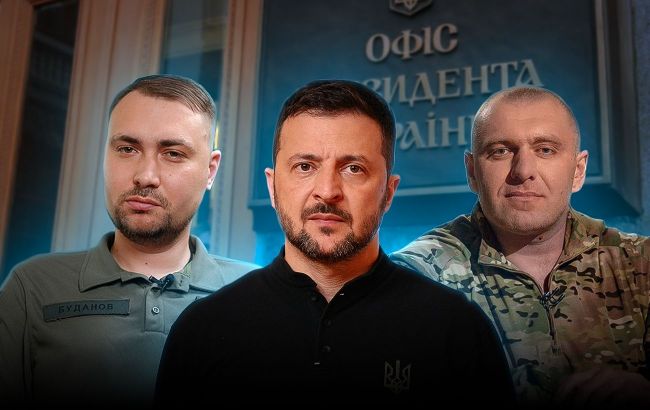 Kyrylo Budanov and Volodymyr Zelenskyy (photo: Office of the President of Ukraine)
Why Volodymyr Zelenskyy initiated large-scale personnel changes in the government, will Kyrylo Budanov become his possible successor as president, what is the point of replacing Denys Shmyhal with Mykhailo Fedorov in the Ministry of Defense, and what complaints have been raised against the head of the Security Service of Ukraine, Vasyl Malyuk, read in RBC-Ukraine's article.
Key questions:
- Why did Zelenskyy choose Budanov from among all the candidates for the position of head of the President's Office?
- Is Zelenskyy removing a competitor in the elections or preparing a successor by appointing Budanov?
- How did they manage to persuade Shmyhal to head the Ministry of Energy of Ukraine?
- How did Mindichgate affect Vasyl Malyuk's position?
"It will be a confederation. It's not like a young, semi-independent duke went to serve an old king," one of the prominent Servants of the People representative commented to RBC-Ukraine on the main domestic political news: the appointment of Kyrylo Budanov, head of the Defense Intelligence of Ukraine (HUR), as head of the Office of the President of Ukraine.
Although Budanov was on the shortlist of candidates from the second day after Andriy Yermak vacated the position of head of the Presidential Office, he initially did not seem the most likely successor to the post. This was precisely because of his independence and the clear formation of his own political image. But after several weeks of deliberation, Volodymyr Zelenskyy ultimately chose him.
At the same time, the President made a series of high-profile personnel changes that caused some surprise among the public. However, most questions concern the changes that have not yet occurred. Although they may happen soon.
New head of President's Office
The pause in appointing a new head of the Presidential Office has certainly dragged on. However, as RBC-Ukraine has already noted, this has had no visible impact on the work of the head of state: visits, meetings, negotiations, and other processes have continued as usual.
"The President was choosing the best course of action. He had been thinking about making changes in the State Bureau of Investigation for a long time, then decided that there were still some positions that needed to be changed, and thought: by the end of the year or the beginning of next year. He chose this timing – between negotiations with the Americans," a source at the President's Office tells RBC-Ukraine.
Throughout December, First Deputy Prime Minister of Ukraine Mykhailo Fedorov had the best chance of getting the job. "Yesterday, everyone thought it would be Fedorov 99% of the time," another source in the President's Office told RBC-Ukraine a few weeks ago. But the Minister of Digital Transformation scared Zelenskyy with an overly radical program of reform for the Office, which the President considered excessive.
The choice was ultimately made just before New Year's Eve, but was kept strictly secret for a couple of days. Informed sources told RBC-Ukraine that Budanov agreed to join the Office of the President without consulting anyone in his circle.
"He just said he couldn't refuse, without explaining why. Now Kyrylo Oleksiiovych will be going to wear a suit," says one of the agency's sources. Perhaps he will, but on his first full working day, Saturday, January 3, Budanov appeared at the Office in his old HUR uniform.
"Of course, there will now be more military spirit in the Office of the President," says an RBC-Ukraine source in the Servant of the People party.
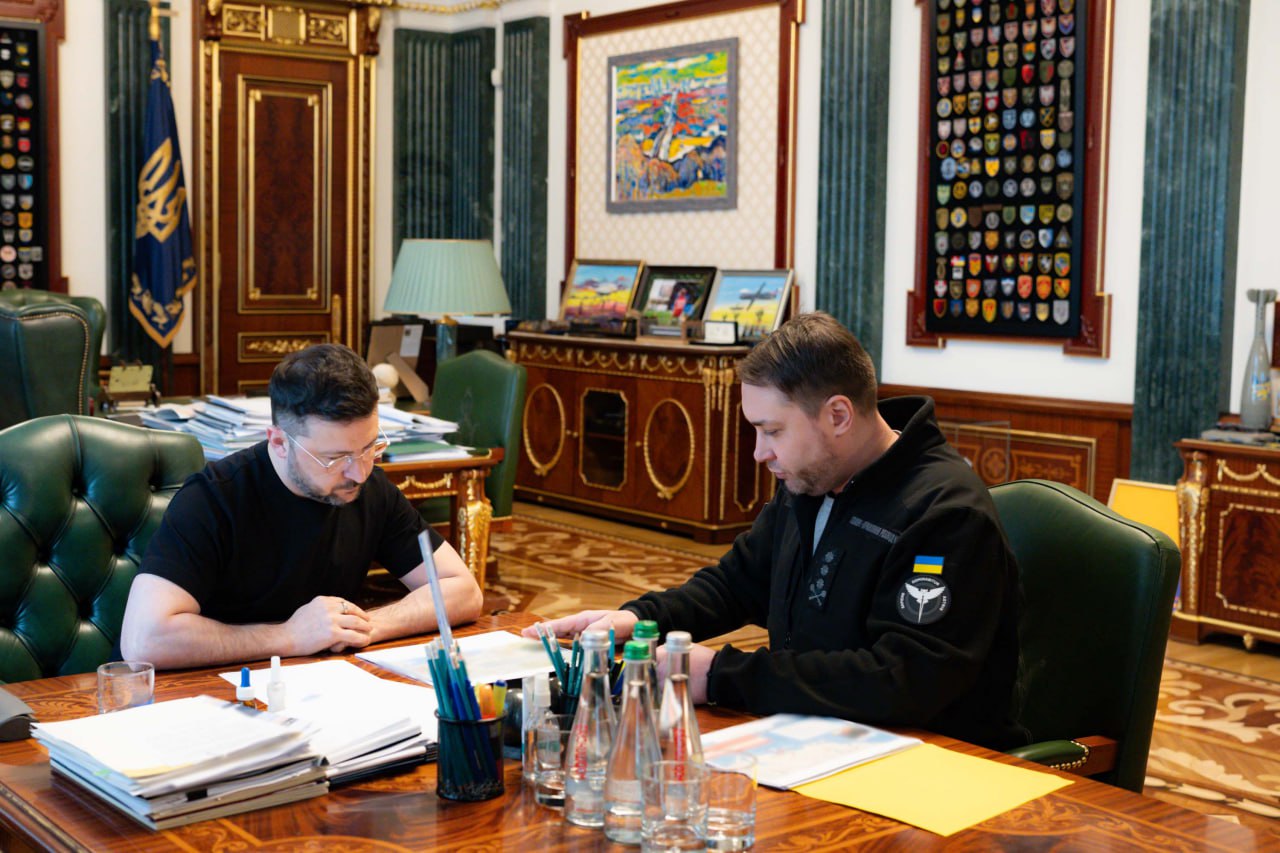 Zelenskyy and Budanov on the day of the appointment of the new head of the Office of the President (photo: Office of the President of Ukraine)
Why did Zelenskyy ultimately choose Budanov? Various sources of RBC-Ukraine offer several versions that complement each other.
The most obvious factor, although essentially secondary, is to finally eradicate the spirit of his predecessor from the Office of the President and put an end to talk that Yermak is still in charge, only now from behind the scenes.
Budanov had a difficult relationship with the previous head of the Office. From around the summer of 2024 to the fall of 2025, there was talk in political and military circles that Yermak wanted to force the head of the HUR to resign.
For a long time, they did not even communicate normally with each other, except at official events. And during the climax of Mindichgate, on the eve of Yermak's resignation, Budanov leaned more toward the camp of so-called revolutionaries who sought the dismissal of the head of the President's Office.
"There was no single factor in Budanov's appointment, but rather a combination of factors and the weight of the figure himself. Kyrylo is a strong figure, very experienced, and he is a good choice when it comes to negotiations and security issues," explains a source in Bankova.
Indeed, Budanov has good relations with the current US administration and has experience in negotiations, including the most difficult and unpleasant ones – with the Russians. At least on the subject of prisoner exchanges and the return of civilians to Ukraine.
Several members of parliament told RBC-Ukraine of another argument in favor of appointing Budanov. If Ukraine ultimately has to agree to a controversial peace deal, with those same painful compromises, it would be better if this issue were communicated by Budanov, a man with an impeccable military background, rather than someone from the civilian sector. Then the level of disappointment in society, especially in light of a possible referendum on that very agreement, may be kept under control. The same goes for a number of radical forces, particularly in the military, who may strongly disagree with this agreement.
All these considerations are quite logical. But the political aspect of Budanov's arrival in the Office of the President is of much greater interest. What is Zelenskyy trying to achieve: is he preparing a successor or, on the contrary, removing a potential competitor in the elections?
Why President chooses Budanov?
Among RBC-Ukraine's interlocutors in political circles, there are plenty of supporters of both versions.
The scenario with Budanov as Zelenskyy's successor will come to pass if Zelenskyy himself decides not to run in the next election due to various circumstances. For example, if he has to sign a peace agreement that the majority of the population considers bad and unfair.
The keyword here is consider. It is not so important how beneficial (or not) the peace agreement will actually be for Ukraine, but if the majority of the electorate decides that Ukraine has lost the war, then all responsibility for this will automatically fall on Zelenskyy and no one else.
In addition, the agreed transfer of power will be accompanied by certain non-public guarantees of personal immunity, not so much for Zelenskyy himself as for those around him. In fact, this is the main point of having a so-called successor.
Budanov's starting position is already quite good. According to opinion polls, he is already among the leaders in the upcoming presidential race. "Zaluzhnyi, Zelenskyy, and Budanov. These are the three names that enjoy the greatest trust among Ukrainians," says Oleksii Antypovich, head of the Rating Sociological Group, in a recent interview with RBC-Ukraine.
According to RBC-Ukraine, Budanov currently ranks third in this trio, far behind Zaluzhnyi and Zelenskyy. But his new position gives him plenty of resources for growth.
"So far, Budanov has been seen politically by those interested in the war. Now other groups of the population will begin to see him too," one of the experienced Servants of the People representatives explains to RBC-Ukraine.
There is a certain part of the electorate, and a significant one at that, up to 10%, which is oriented towards the flag, that is, supports the current government simply because it is the government, and in wartime, there will be no other government in Ukraine. Some of these voters may eventually shift their support to Budanov, especially if there are more active insider reports that Zelenskyy will not run for a second term, whether in The Wall Street Journal or on anonymous Telegram channels.
In addition, Budanov will take the electorate of Zelenskyy's main competitor, Valerii Zaluzhnyi. And if the London Ambassador does decide to run in the election, he will have to respond more actively to events in Ukraine and around the world. And where there is activity, there is always the risk of making a mistake.
It is noteworthy that, according to an RBC-Ukraine source in Servant of the People, Budanov is already attracting part of Zelenskyy's 2019 electorate – young people and residents of the center, south, and east of Ukraine.
Of the canonical worldview triad of Army-Language-Faith, Budanov is active only in the first component. During his tenure as head of the HUR, he did not particularly emphasize the topics of language and faith, which could attract part of the electorate. At the same time, Budanov cannot be labeled pro-Russian simply by definition.
Despite the fact that the position offered to Budanov can be considered a promotion, since, according to the established political hierarchy, the head of the President's Office is almost a vice president, a number of interlocutors interviewed by RBC-Ukraine view Budanov's new appointment with caution. The new position could be either a springboard for his political career or an attempt to stifle it.
"And although many are now talking about the successor scenario, I don't really believe in it. So far, it doesn't look like Zelenskyy has decided not to run in the next election. So why is he appointing his closest rival in the polls as his right-hand man, essentially?" wonders one of RBC-Ukraine's interlocutors.
According to Ukrainian political tradition, the head of the President's Office often becomes a sponge that absorbs all the negativity directed at the government, whether deserved or not. Budanov's predecessor in the position could tell a lot about this.
Budanov had a well-established system, team, and infrastructure at the HUR. He was known as an excellent military man and architect of daring operations against the enemy.
"But while his personal rating as head of the HUR remained consistently high and largely unaffected by political turbulence, his new position may make him more vulnerable to public sentiment. And this is even before the election process begins. Perhaps this was the calculation?" notes one of the agency's sources.
In support of this version, the agency's interlocutors draw attention to another point. The new head of the HUR is not a member of Budanov's team or close circle. Oleh Ivashchenko headed the Foreign Intelligence Service of Ukraine, where he came in 2024 from the position of first deputy head of the HUR.
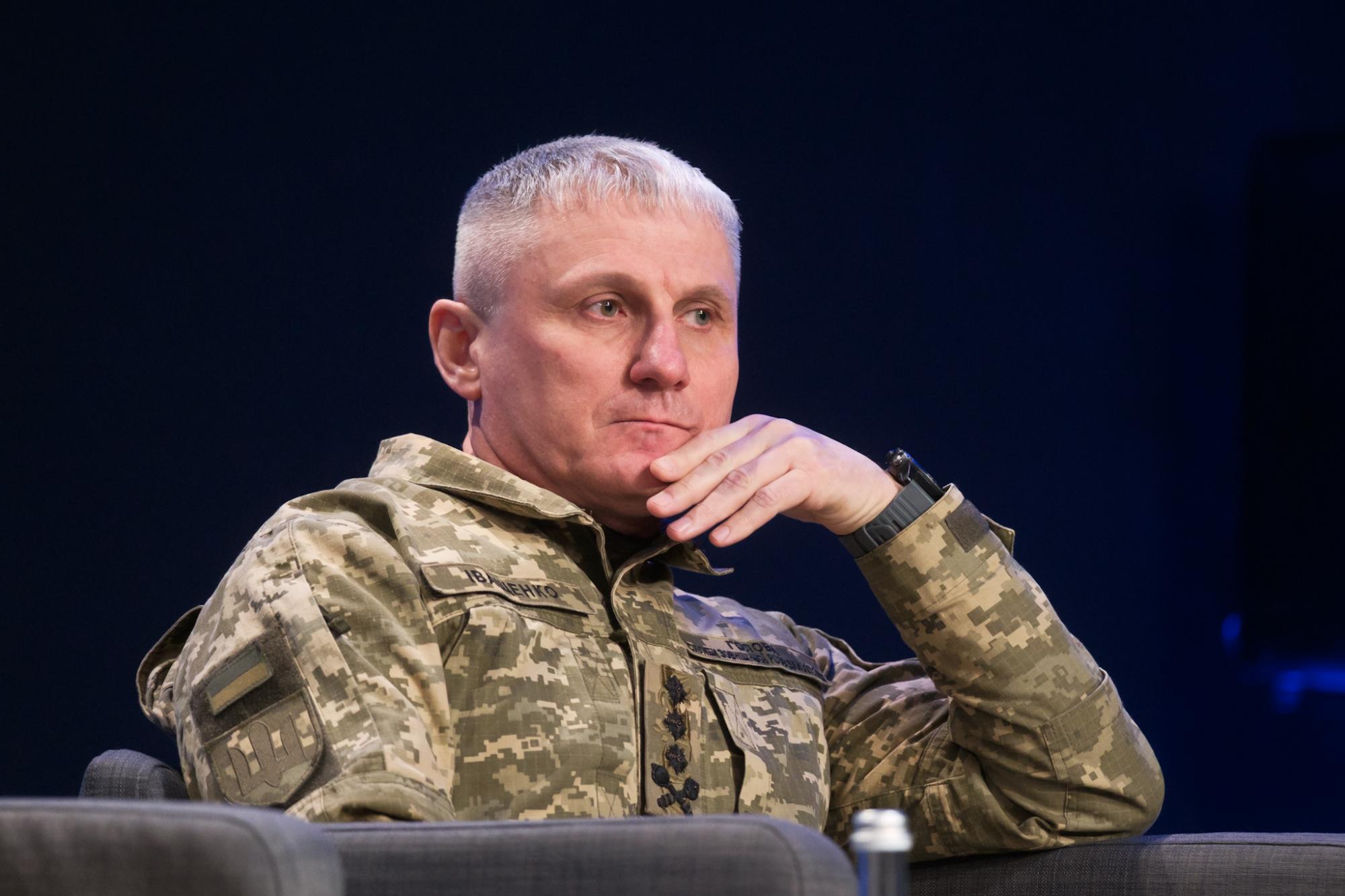 Oleh Ivashchenko (photo: Vitalii Nosach / RBC-Ukraine)
"Ivashchenko can be described as a military technocrat. Most likely, his approaches will lead to changes in the HUR. And what can be said with a high degree of certainty is that the Defense Intelligence of Ukraine will now become a more closed structure," one of the agency's sources notes.
Some of RBC-Ukraine's interlocutors call Ivashchenko a person who, as before, is loyal to Yermak, although most still characterize him as an independent figure. According to the agency, the candidate for the new head of the HUR was chosen by the President, but not on Budanov's recommendation.
"If Budanov's transfer to the Office turns out to be a ploy to neutralize him, that's not a verdict. It all depends on how Budanov himself starts playing this game," says another RBC-Ukraine source.
New positions for Shmyhal and Fedorov
Budanov's appointment was not the only personnel change. Mykhailo Fedorov did get a new position – not as head of the President's Office, but as Minister of Defense of Ukraine. This rotation should not come as a surprise: in his current position as head of digitalization, Fedorov has long been involved in military-tech issues and wanted to head the Ministry of Defense himself.
"As we say, Fedorov is the only person who has a war plan, so such a person should head the Ministry of Defense: deal with the old ineffective general's guard, work according to clear key performance indicators, put things in order with the territorial center for recruitment and social support, etc. Radical reforms are needed here," says an RBC-Ukraine source in the government.
But with Fedorov's transfer to the Ministry of Defense, the question arose of what to do with the current minister, Denys Shmyhal. Zelenskyy immediately had an answer ready: to put Shmyhal in charge of the vacant, problematic, and scandal-ridden Ministry of Energy.
But RBC-Ukraine's sources claim that Shmyhal delicately rejected the first proposal to move from the Ministry of Defense to the Ministry of Energy.
"First, this new position hit him like a bolt from the blue. After all, he had only just begun to delve into the work of his ministry and make some changes. And now, after a few months, he is being thrown into a new Augean stable. Secondly, he obviously does not like the fact that after being prime minister, he is being made into a person who is used to plugging holes," says one of the interlocutors.
Indeed, despite the absence of scandals and, in general, any complaints about his work in the government, Shmyhal's career somehow began to develop in the opposite direction. First, he was demoted from the post of head of the Cabinet of Ministers to minister, albeit of a key ministry in a country at war. The Ministry of Energy is clearly lower in the informal hierarchy.
As a result of the second day of negotiations, Shmyhal was offered, in addition to the Ministry of Energy, the position of first deputy prime minister, which will become vacant after Fedorov's transfer to the Ministry of Defense. Shmyhal has already agreed to this, formally becoming the second person in the government.
At the same time, Fedorov's transfer to the Ministry of Defense may exacerbate another conflict. Several sources from various military and political circles note that he does not have the best relationship with the commander-in-chief of the Armed Forces of Ukraine, Oleksandr Syrskyi.
In essence, the Commander-in-Chief commands the army, while the Defense Minister manages the system in which the army exists. And according to procedure, it is the Defense Minister who submits the Commander-in-Chief's resignation to the President, who has the right to either accept or reject it. How constructively they will be able to work together is a big question, given the obvious difference in generations and worldviews.
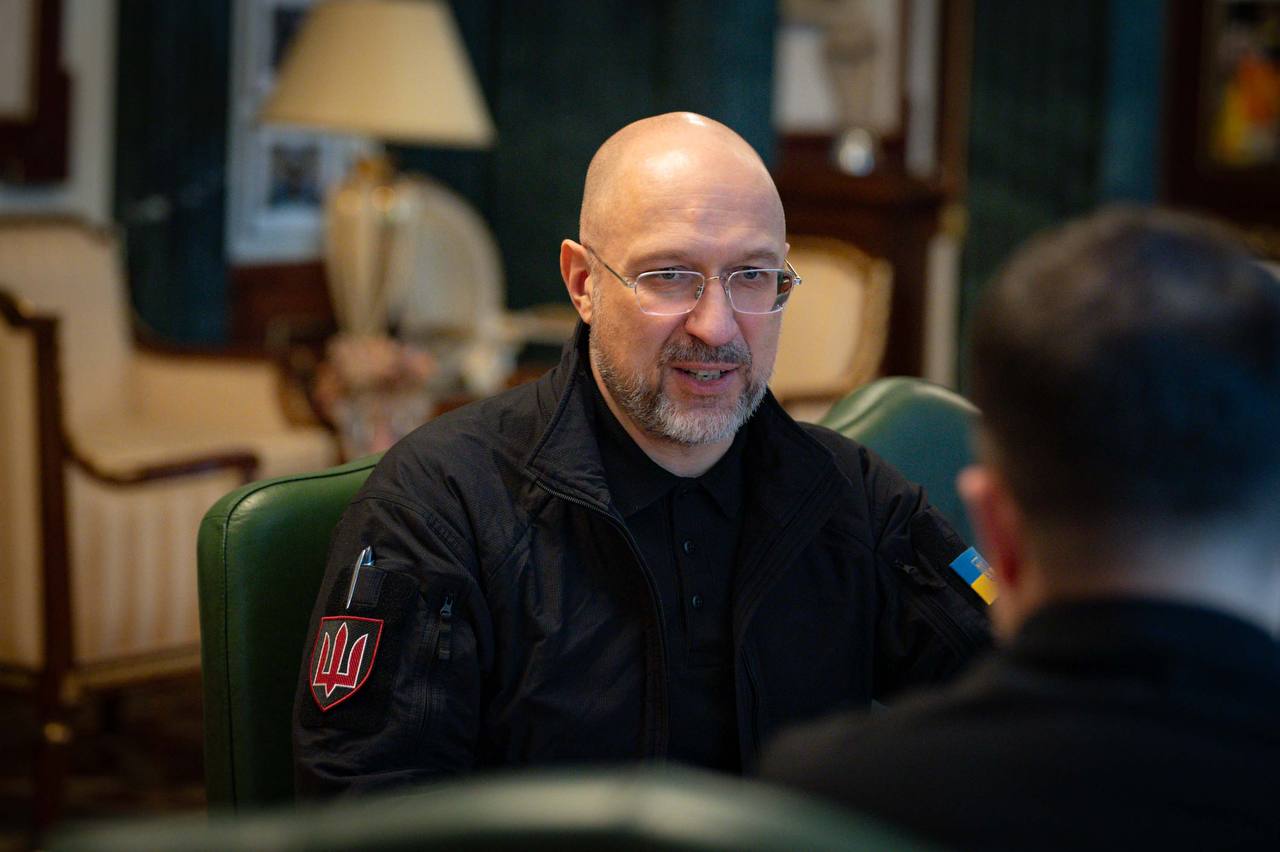 Denys Shmyhal at a meeting with Zelenskyy (photo: Office of the President of Ukraine)
After Zelenskyy himself announced a major reset on Saturday, including in the Armed Forces, journalists asked him directly about replacing Syrskyi. The President replied that he had no plans to replace him for the time being.
"If we continue to fight, then most likely Syrskyi will not be dismissed. But if there is some kind of truce, then there is a risk that this will happen, and Fedorov will propose an alternative candidate, probably Drapatyi (commander of the Joint Forces, ed.)," says one of RBC-Ukraine's interlocutors in Ukraine's General Staff.
What will happen to Malyuk?
The most problematic personnel issue of the entire reset is the one that has not been officially announced. For no apparent reason, the chair of the Security Service of Ukraine (SBU), Vasyl Malyuk, has been shaken, as confirmed by sources at RBC-Ukraine and a number of other media outlets.
According to the agency, last Friday, on the first day of the large-scale reshuffle, Zelenskyy offered Malyuk another position – either to head the Foreign Intelligence Service instead of Ivashchenko, or to become secretary of the National Security and Defense Council instead of Rustem Umerov. According to RBC-Ukraine, the head of the SBU refused.
Interlocutors in political circles interviewed by the agency see only one explanation for why the President is considering replacing Malyuk: a loss of trust.
"When Operation Midas began, and the National Anti-Corruption Bureau of Ukraine (NABU) came to Yermak, Malyuk was not on his side. He brought the leadership of NABU and the Specialized Anti-Corruption Prosecutor's Office (SAPO) to negotiations with the President. It seems that Zelenskyy believes that Malyuk did not side with him," one of the interlocutors says.
However, even before Mindichgate, during the summer scandal surrounding the powers of NABU and SAPO, Malyuk publicly supported the government's line, drawing criticism from anti-corruption activists and the public who supported them. And at the height of Mindichgate, he took a neutral position, not wanting to be used in anyone's interests. Probably, this neutrality seemed too little to someone.
At the same time, another source of the agency notes that Ivashchenko was appointed to the HUR primarily in order to free up a position in the Foreign Intelligence Service of Ukraine for Malyuk. And for the position of head of the SBU, according to the interlocutor, one of the deputies, Oleksandr Poklad, was considered, and he was also considered for the position of head of the HUR instead of Budanov.
There is another nuance with the replacement of the SBU head that will be difficult to get around. His resignation (as well as the appointment of a new SBU head) will still have to be voted on by the Verkhovna Rada.
There should be no particular problems with other reshuffles concerning Fedorov and Shmyhal. However, there are still voices of indignation in the Rada: they say that after Yermak's resignation, deputies were promised that ministers would no longer be appointed from above but would be agreed upon with deputies, primarily with the relevant committee.
There was no response to the outrage, but it is not difficult to predict: the deputies had more than a month to decide on candidates for the head of the Ministry of Energy, but they failed in this mission. These issues will likely be discussed at a faction meeting when deputies return to plenary work next week.
The situation with Malyuk, however, looks more serious. Several representatives of Servant of the People interviewed by RBC-Ukraine say they do not understand the need to remove an effective head of the special service from office. Therefore, most of the interlocutors believe that there are not yet enough votes in the chamber for Malyuk.
 Vasyl Malyuk (photo: facebook.com/SecurSerUkraine)
Amid rumors of Malyuk's resignation, a number of prominent military figures have begun to speak out publicly in his defense. When asked by journalists about plans to replace Malyuk after these appeals, the President replied: "I respect everyone. I will make the rotations that I have decided to make." Practice shows that in such cases, Zelenskyy usually sees his plans through to the end.
***
"This is only the first move so far. If we see that Kyrylo's rating is growing and that he will beat Valeryi in the second round, then we can play the successor game. If not, well, we'll think about what to do next," says a source in the President's circle.
However, all these scenarios only make sense if the matter ever reaches the elections themselves. So far, there are no signs of the war ending. And Budanov's appointment, according to the authorities, sends a message to society: despite all efforts in the peace talks, we still have to continue fighting. At the same time, diplomacy is being stepped up—Budanov's first deputy is Sergiy Kyslytsya, an active participant in the peace talks and former deputy foreign minister.
But the reshuffle launched by Zelenskyy is obviously only the first series of the major reboot he promised a few days ago. According to the President, the rotations will affect almost all sectors. So, throughout January, there will most likely be a lot of different news, but hardly any new faces. After all, even all the high-profile appointments that have taken place are essentially just reshuffles of existing figures.