Oil for loan: How Orbán is pressuring Ukraine and blackmailing EU


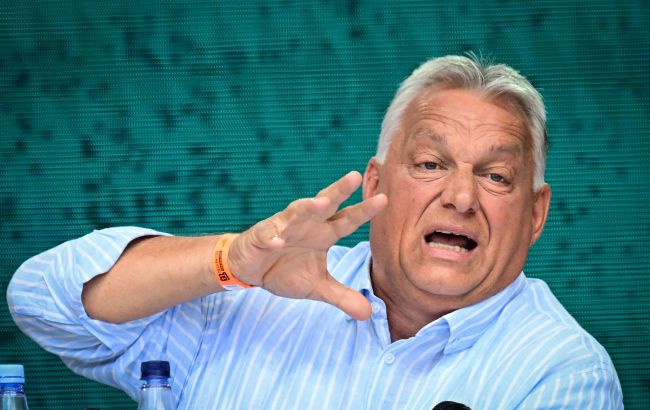 Hungarian Prime Minister Viktor Orbán (Photo: GettyImages)
Budapest demands the resumption of Russian oil transit through the Druzhba pipeline. Viktor Orbán is trying to save his election ratings by threatening Kyiv with blocking the EU’s €90 billion loan and halting transit to Ukraine.
What really happened with the Druzhba pipeline, why Budapest is putting pressure on Ukraine and the EU, and how the scandal might be resolved – read in the RBC-Ukraine report.
Key points
- Why did oil transit stop? Damaged equipment could be repaired in a month to a month and a half.
- Is inspection of the facility impossible? Ukraine does not plan to allow Hungarian experts on the Druzhba pipeline
- Is conflict over Druzhba reaching its limit? Ukraine and Hungary escalate rhetoric
As Hungary’s elections, scheduled for April 12, approach, relations between Kyiv and Budapest have grown increasingly tense.
Prime Minister Viktor Orbán, facing the real prospect of losing power, has made confronting Ukraine a central theme of his campaign. This is reflected in his rhetoric through constant accusations against Zelenskyy.
Orbán and his allies tell voters that the Ukrainian leadership conspired with Brussels to bring Hungary to its knees, take money from Hungarians and give it to Ukrainians, or even drag Hungary and its army into a war with Russia.
Hungary and its EU partner Slovakia have been demanding the restoration of Russian oil transit via the Druzhba pipeline, damaged on Ukrainian territory due to Russian attacks, for about a month.
By early March, the situation had escalated almost to the maximum. The rhetoric on both sides became aggressive, involving ultimatums and blackmail.
Hungarian Foreign Minister Péter Szijjártó said the halt in oil supplies is an attack on Hungary by Ukraine. From the Ukrainian side, harsh statements were also made in response to Hungary’s stance not only on oil transit but also on its behavior in the EU.
Even Orbán’s main rival, Péter Madyar, reacted sharply to recent statements by the Ukrainian President:
"No foreign head of state can threaten anyone, any Hungarian," Magyar commented regarding Zelenskyy’s hint that he could give Orbán’s address to Ukrainian forces "to speak with him in their own language."
Overall, Budapest is deliberately obstructing EU support for Kyiv, seeking to maintain financially and politically advantageous relations with Russia.
Hungary demands an inspection of Druzhba
On March 5, Hungarian Energy Ministry State Secretary Gábor Czepek sent a letter to Ukraine’s Deputy Prime Minister Denys Shmyhal, asking Kyiv to allow Hungarian experts to inspect the damaged section of the Druzhba oil pipeline to verify Ukraine’s claims that restoring transit is currently impossible.
"We ask you to facilitate and grant permission to organize the trip and visit the site, as well as inform the relevant professional bodies and experts about the need to cooperate with members of this mission," the letter says.
Czepek said a five-member delegation has already been appointed to assess the technical condition of Druzhba. Alongside him, it includes two representatives from MOL, Hungary’s largest company that receives Russian oil, and two government officials. The Hungarian delegation hopes to visit the damaged facility within three working days, by March 10.
If oil supplies are not restored in the coming days, Prime Minister Viktor Orbán says he is ready to push the issue by force.
"There will be no agreements, no compromises. We will forcibly break Ukraine’s oil blockade. Hungary’s oil will soon flow through the Druzhba pipeline again," he said.
Hungary has also threatened to suspend the transit of goods that are vital for Ukraine.
What exactly Hungary plans to restrict remains unclear. Earlier, Orbán and his political ally, Slovak Prime Minister Robert Fico, had already threatened to halt supplies of electricity, gas, and motor fuel.
Gasoline and diesel deliveries from Hungary to Ukraine have already nearly stopped. Suspending gas and electricity supplies appears unlikely and would be ineffective after the end of winter.
At the same time, Ukraine has made it clear it will not agree to any inspections of the pipeline. Recently, Volodymyr Zelenskyy said he is confident that EU representatives trust Ukraine’s information about the impossibility of resuming oil transit and that no additional verification is needed.
He also expressed his personal view that the pipeline should not be repaired at all.
"Frankly speaking, I wouldn’t restore it. That’s my position. I’ve told EU leaders and those who have contacted me on this matter," Zelenskyy said.
Why Ukraine halted oil transit
Oil transit through the Druzhba pipeline was halted on January 27 after a Russian drone damaged a facility. As a result, most of the internal equipment was damaged due to oil combustion.
The drone struck one of the largest storage tanks, which at the time contained 25,000 cubic meters of oil. The oil effectively began to boil, raising the risk of a major environmental disaster.
To prevent combustion and an environmental disaster, the oil was pumped out of the tank through the pipeline system. According to Naftogaz CEO Sergii Koretskyi, serious damage was caused to equipment that does not directly pump oil but is involved in the process. This includes pump units, compressors, cable racks, electronics, control panels, and switchboards.
For now, Ukraine intends to carry out comprehensive restoration work at the facility rather than simply patching up the damage before the next potential strike, the likelihood of which remains high under current conditions.
"We are not talking about temporary fixes, but about a full, high-quality technological process that will ensure uninterrupted and safe operation," Koretskyi said.
At least up to a month and a half will be needed to complete the work. In the longer term, there are plans to build underground casemate-type oil storage tanks that meet NATO standards.
Volodymyr Zelenskyy said that the European Commission, which had requested information about the situation with the pipeline, has been informed about the process and the possible timeline for the facility’s relaunch.
The roots of the dispute with Hungary and Slovakia
Hungary and Slovakia, which for many years have effectively been both economic and political partners of Russia, are using every possible means to slow Ukraine’s rapprochement with the European Union and, in the long term, its accession.
Almost every EU decision concerning Ukraine that requires unanimity faces opposition and sometimes a veto from Viktor Orbán.
Since 2017, Hungary has systematically blocked meetings of the Ukraine–NATO Commission, demanding changes to Ukrainian legislation regarding the rights of the Hungarian national minority.
After Russia launched its full-scale invasion, Hungary slowed EU decisions on Ukraine’s integration, as well as military and financial assistance. Budapest is now blocking the allocation of a critically needed 90-billion-euro loan for Ukraine.
The European Union has promised to find a solution to the loan issue and still approve the necessary changes to the EU budget by bypassing Hungary. A final decision on the loan is expected to be made at the European Council on March 19, 2026. However, this is not guaranteed yet due to Hungary’s blockade. It is also unclear whether Viktor Orbán would lift the veto if Ukraine resumes oil transit.
"We ask the Europeans: can you guarantee that Orbán will unblock the 90 billion then? They give some vague answer. We ask again: so what exactly is the problem? They say: you have to unblock the Druzhba pipeline… But Orbán was blocking the 90 billion even before that," a government source told the outlet.
If a positive decision on the loan is eventually made, Ukraine may be able to speed up the repair work. However, President Volodymyr Zelenskyy has already made it clear that there are no plans to restore oil transit before Hungary’s elections scheduled for April 12.
“They (Russia - ed.) are killing us, and yet we have to give oil to Orbán, because poor guy, without this oil, he can’t win the elections," the Ukrainian President said..
But Orbán is accusing the European Union itself of playing unfairly. He is trying to simultaneously pressure both Brussels and Kyiv. From the EU, he wants to secure a 16 billion euro military loan, but the EU does not want to give him such a gift before the elections. To obtain this loan, Orbán has blocked the release of 90 billion euros to Ukraine.
According to sources speaking to RBC-Ukraine, EU officials are now strongly urging Kyiv to restart the Druzhba pipeline as soon as possible, but they do not want to publicly link this to Ukraine receiving the 90 billion euros. Nor can they guarantee that Orbán will definitely lift the veto in such a case.
Meanwhile, a new escalation has emerged in bilateral relations. On March 5, Hungary detained seven Ukrainian cash couriers from Oschadbank without justification. They were transporting approximately 40 million dollars, 35 million euros, and 9 kilograms of gold. The Hungarian National Tax and Customs Administration (NAV) stated that a criminal investigation is being conducted on suspicion of money laundering.
The Ukrainian Ministry of Foreign Affairs is investigating the situation and has already summoned the acting chargé d’affaires of Hungary in Ukraine for explanations.
Quick Q&A
Why was the Druzhba oil pipeline transit stopped?
On January 27, 2026, a Russian drone damaged an oil storage tank. About 25,000 cubic meters of oil overheated, creating a risk of an environmental disaster.
What does Hungary want?
Hungary wants the pipeline to be restarted urgently and doubts that it cannot operate in the coming days. Budapest has already prepared a team of experts to inspect the facility.
Why is Ukraine against restarting the pipeline?
Ukraine insists on an overhaul of the Druzhba pipeline. Volodymyr Zelenskyy stated that the EU trusts Ukraine’s information about the impossibility of resuming oil transit, so no additional inspection is needed.
When could Druzhba be restarted?
Repairs to the pipeline could be completed in a month to a month and a half, just after Hungary’s elections, which will take place on April 12.