Relief for Ukraine: IMF and EU loans are near, but crunch talks expected by March


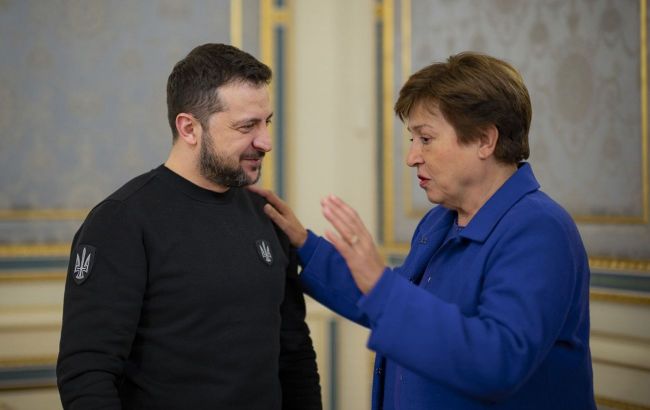 IMF decides to allocate new loan to Ukraine (photo: https://www.president.gov.ua/ )
Ukraine may soon gain access to loans from the IMF and the EU, but this will only provide temporary breathing space. By the end of March, Kyiv could face difficulties meeting IMF program requirements, meaning Ukraine will likely need to negotiate softer terms.
More about the prospects of lending to Ukraine and the challenges that could hinder the allocation of funds – in the report by RBC-Ukraine.
Key points
- EU loan blockage. Neither Ukraine nor the EU is overly concerned about Hungary’s blocking of the EU loan. Officials say a solution will be found.
- IMF concessions. The IMF made concessions out of concern that other partners’ financing for Ukraine could collapse.
- Chances of passing headline laws. Lawmakers are not ready to vote for the IMF program conditions.
- IMF program may need revision again. Ukraine will likely have to reopen negotiations as early as March.
- EU loan possible even without the IMF. If cooperation with the IMF pauses, EU lending may partially continue.
The IMF Executive Board could approve a new four-year Extended Fund Facility (EFF) program worth $8.1 billion for Ukraine as soon as today, February 26.
As recently as last week, RBC-Ukraine sources said there were no risks of delays. “Everything will be OK already in February,” said a source familiar with preparations in Washington.
The source also indicated that the IMF does not consider Hungary’s blocking of the €90 billion EU loan a real threat at this stage. That loan is a condition for the new IMF program.
Hungary unlikely to block EU loan for Ukraine
It recently became known that Hungary blocked the final decision needed to allocate EU funds by refusing to approve amendments to the EU budget. These changes are required for the EU to begin borrowing money under its budget guarantees for Ukraine following the political decision on the loan.
Ukrainian officials remained calm, confident the loan would go through. "The process is already irreversible," a government source said.
Ukraine’s Foreign Ministry called Hungary’s move another instance of blackmail, a tactic Budapest regularly uses to pursue its objectives. In this case, Hungary’s threats are linked to the suspension of oil transit due to Russian attacks.
"This is typical Hungarian blackmail. We should treat it as such. There’s no need to panic. This happens before every important decision regarding Ukraine. All technical possibilities exist for allocating the funds," Foreign Ministry spokesperson Heorhii Tykhyi said.
The specific mechanism the EU may use to bypass Hungary is unclear. However, Hungary, along with Czechia and Slovakia, did not participate in the decision to allocate the loan, as they refused to assume financial obligations.
French President Emmanuel Macron stated during a February 24 meeting of the Coalition of the Willing that the loan issue would definitely be resolved. "There is no other choice, as the relevant decisions have already been made," he said.
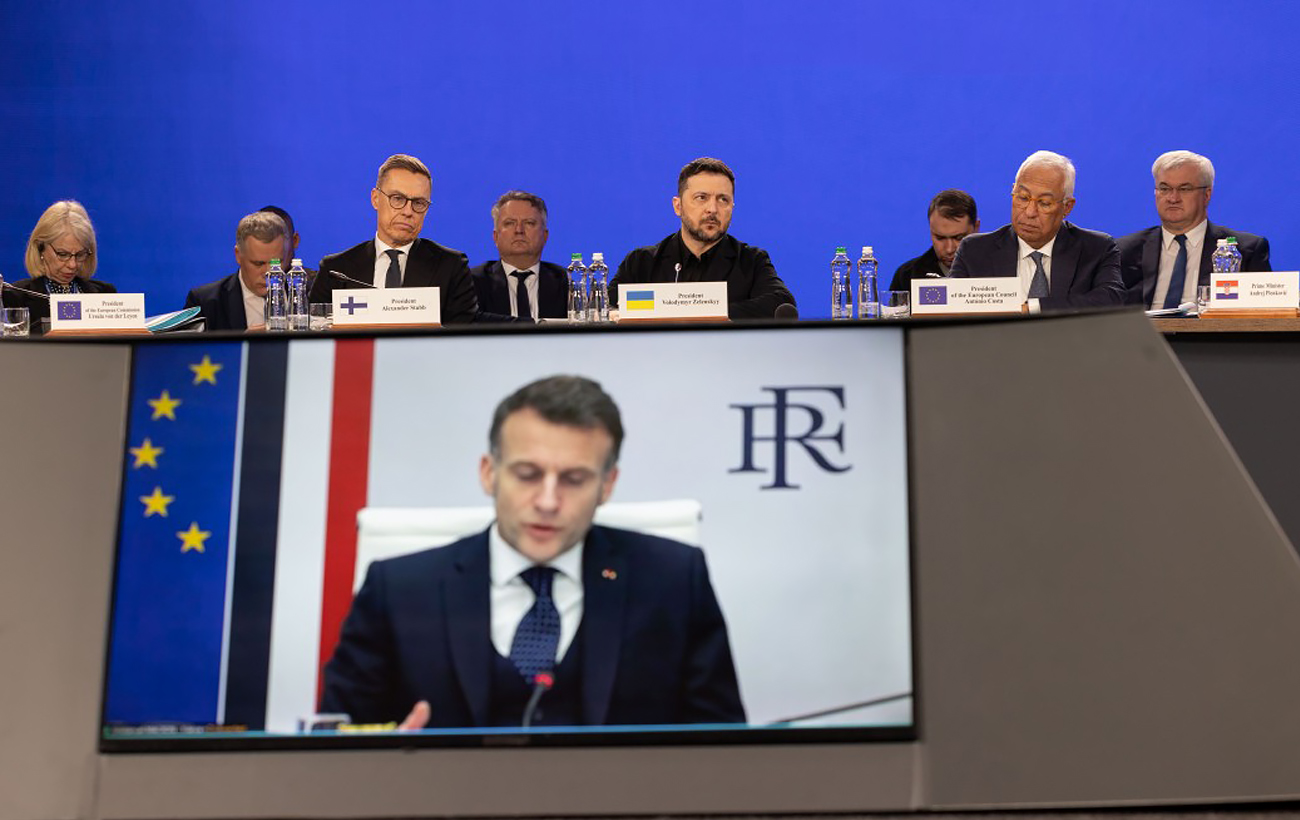
Emmanuel Macron speaking at a meeting of the Coalition of the Willing (photo: https://www.president.gov.ua/)
On February 24, the EU Council formally approved two key documents required for the loan. They will enter into force on February 27, with funds expected in the second half of March and potentially reaching Ukraine in early April.
However, IMF and EU loans will not eliminate Ukraine’s financing challenges — they will only postpone them briefly.
IMF concessions not driven by emotion alone
The IMF took an unprecedented step by canceling prior actions related to tax changes, clearing the way for a new program. This was unexpected, as these conditions had been agreed upon just in November.
Sources said the move followed IMF Managing Director Kristalina Georgieva’s visit to Kyiv, during which she reportedly witnessed firsthand the difficult conditions for businesses and concluded that increasing their tax burden would be inappropriate.
Still, IMF decisions are based on calculations, not emotions.
The EFF program is not merely a loan but a tool to address balance-of-payments issues through structural reforms. In recent years, IMF funds have served more as debt rollover mechanisms than direct budget support.
Most importantly, IMF backing signals to other creditors — including the EU, the UK, and Japan — that Ukraine’s financial situation is under control and risks are manageable.
Former presidential adviser Oleh Ustenko believes the IMF’s fear of leaving Ukraine without global financial support was the main reason for concessions. Ukraine’s budget requires $35 billion in external financing this year alone.
“The IMF dropped prior actions because it understood Ukraine might not receive needed financing at all, which would lead to budget collapse and then economic collapse,” he said.
A government source confirmed this reasoning: “The IMF simply did not want Ukraine to be left without funding because of them.”
Ukraine will have to negotiate with the IMF again
The tax conditions were not canceled but postponed to March and slightly modified. The VAT threshold for sole proprietors was raised to 4 million hryvnias, with implementation delayed until 2028 or after EU accession.
This means four conditions — VAT, customs duties on all parcels, a tax on internet platforms, and extending the military levy into the postwar period — must be adopted by the end of March. However, there are still not enough votes in parliament.
A government source said there is no clear path to passing these bills, even if combined into a single Beautiful Tax Bill. The proposed cancellation of lifetime politically exposed person (PEP) status has also failed to secure support.
Head of the parliamentary tax committee Danylo Hetmantsev sees little prospect of adoption. "As of today, I see no potential for passing the so-called Beautiful Tax Bill that would combine all postponed initiatives," he said.
Hetmantsev believes passage depends on:
-
The situation in the energy sector, whose critical condition adds pressure on the budget and businesses.
-
Progress in peace talks, which would influence expectations about the duration of active fighting and macroeconomic projections, including the budget deficit.
"We will continue consultations with the government, colleagues in parliament, and international partners to reach the best decision in Ukraine's interests," Hetmantsev said.
Consultations with partners, namely the IMF, could be key and decisive here. Ustenko believes that Ukraine will have to renegotiate the deadlines for the beacons to a later period.
If no agreement is reached, the program could be paused. A likely scenario would be postponing tax milestones to the third review, at the end of summer or early fall. Further delays would be unlikely.
"The program may be at risk, and this could happen in the second half of the year. But if the IMF stands firm on its position, it could happen earlier. I think that if it is not possible to fulfill the milestones, our negotiators will try to postpone them until the second half of the year," he said in a comment to the media outlet.
The IMF, Ustenko noted, is also "old hands" and understands this game. "Therefore, only a conscious turning of a blind eye to our game can make it possible to postpone the milestones to a later date," the expert is convinced.
EU lending could partially slow down
EU financing could theoretically slow if the IMF program is suspended — though not entirely, and only in the portion intended for budget revenues.
In 2026, out of the total €90 billion two-year EU loan package, Ukraine plans to receive €60 billion. Of that amount, €15 billion may go toward budget expenditures and €45 billion toward military needs.
However, part of the military budget could also be redirected to the state budget to cover payments to service members. The final breakdown of amounts and spending directions has not yet been fully agreed.
"Discussions on this issue are still ongoing. The financial strategy is being finalized," a government source told the outlet.
Ukraine is negotiating with the EU to allocate the military portion without any conditions. This was confirmed by Deputy Head of the Presidential Office Ihor Zhovkva in an interview.
"We want there to be no additional conditions for allocating funds for military assistance. And we want this to happen without excessive bureaucracy," he said.
Thus, military support should not be affected by a suspension of the IMF program.
The €15 billion budget portion, however, will depend on specific conditions. Their list is currently unknown. According to the latest information, part of the loan will be provided as macro-financial assistance, subject to separate conditions. Another part will come under the Ukraine Facility program.
This program has its own set of conditions, the fulfillment of which has been delayed since last year. The exact distribution ratio between these instruments has not yet been finalized.
Recently, Prime Minister Yuliia Svyrydenko stated that the Ukraine Facility would be reformed so that its implementation would no longer depend on parliamentary voting.
If EU financing is no longer tied to legislative approval and is instead linked to the Ukraine Facility, a pause in the IMF program may not impact EU funding.
If political agreements with parliament cannot be reached, the ideal scenario for the government would be full or partial cancellation of the established tax “milestones.” Theoretically, this is possible and may become a topic in negotiations with the IMF during the first program reviews, which are typically held quarterly.
If Ukraine proposes new mechanisms to balance the budget, the IMF may accept such proposals.
Quick Q&A
When will the new IMF loan be approved?
The IMF Executive Board is expected to make a final decision on an $8.1 billion loan to Ukraine on February 26. After approval, the first $1.5 billion tranche could be disbursed within days.
Can Ukraine count on the €90 billion EU loan?
EU officials say they will be able to approve the final decision despite Hungary’s blockage. Actual disbursement of funds is expected to start in April.
How will the EU loan funds be used?
The €90 billion EU loan covers 2026–2027. This year, €60 billion is expected to be allocated: €45 billion for military needs and €15 billion for budget support. Budget funds will be distributed between macro-financial assistance and the Ukraine Facility program. The proportions, conditions, and schedule have not yet been finalized.
Could IMF financing be suspended, and what would happen?
Ukraine will receive the first IMF tranche immediately after board approval. Future tranches depend on meeting program conditions. If Ukraine fails to fulfill structural tax milestones (VAT changes for sole proprietors, customs duties on parcels, taxes on internet platforms, and extension of the military levy), further disbursements could be paused.
Can the IMF tax milestones be canceled?
During program reviews, Ukraine can initiate discussions on the cancellation of tax-related structural benchmarks. If alternative budget-balancing tools are proposed, the IMF may agree to adjustments.