Graham's "hell sanctions": Will Trump turn up the pressure on Russian oil?


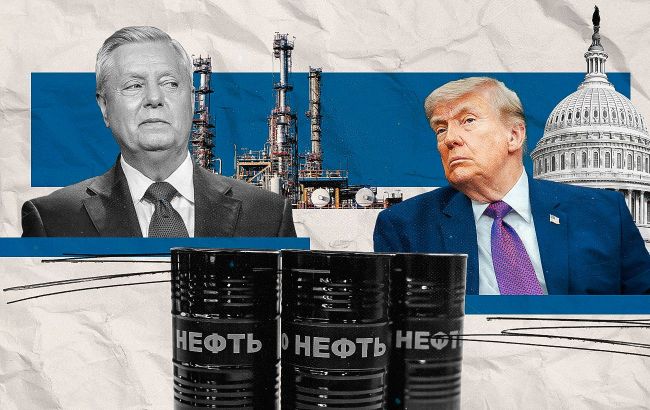 Photo: The implementation of Lindsey Graham's proposals for new pressure on Russia depends entirely on Donald Trump's decisions (RBC-Ukraine collage)
Last week, the US Senate backed a bill introduced by the late Senator Lindsey Graham that proposed such sweeping sanctions against Russia that they became known as "hell sanctions".
What happens next with the bill, what restrictions on Russian oil and gas it proposes, and whether Trump will actually move toward a tougher confrontation with Moscow — RBC-Ukraine explains in the report below.
Key points:
- Lindsey Graham's bill successfully passed its first Senate vote with bipartisan support;
- The legislation could be passed and signed by Trump before the midterm elections;
- The bill would allow secondary tariffs of between 0% and 100% to be imposed on buyers of Russian oil and gas;
- China, India and Türkiye remain the largest buyers of Russian oil, and the new initiative is designed to limit this trade;
- Russia would cut oil production and sell its oil at lower prices if the secondary tariffs take effect;
- Graham's initiative could become merely another tool in Trump's negotiations if the US president decides against adopting a tougher policy toward Russia.
First Senate vote
On July 28, Ukrainian President Volodymyr Zelenskyy visited Washington for a meeting with Donald Trump. The Ukrainian president also attended a US Senate session where lawmakers voted on the bill introducing “hell sanctions” against Russia.
The bill's main innovation is the so-called secondary tariffs. The legislation would allow the US president to impose additional tariffs on countries that purchase Russian oil and gas. This could primarily affect China, India and Türkiye. The maximum rate could reach 100%.
One of the bill's authors and its prominent advocate was the late Republican Senator Lindsey Graham. He was known for his tough stance toward Russia, China and Iran. It was no coincidence that Trump called him a “tough cookie” while speaking at the senator's funeral.
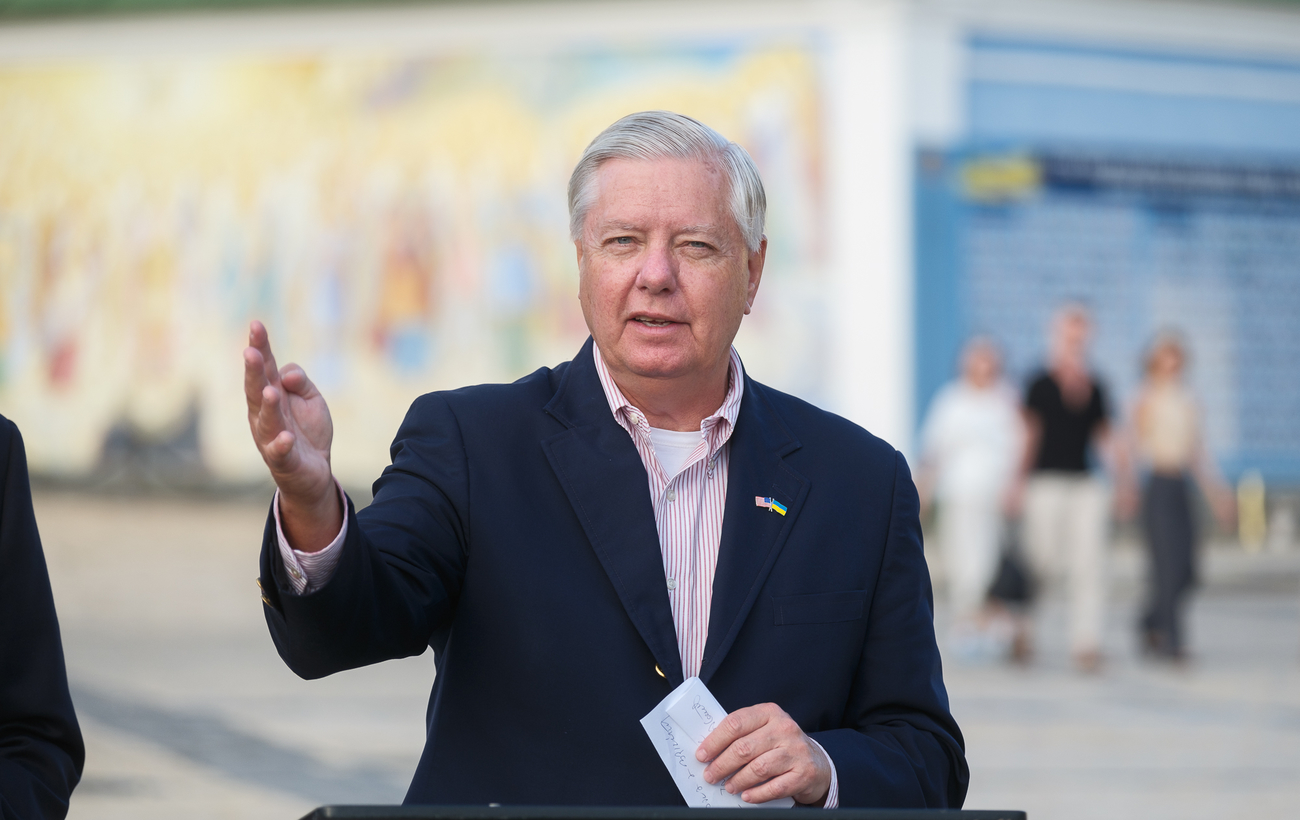
Photo: During his visit to Kyiv, Lindsey Graham spoke about the need to increase pressure on the aggressor (Vitalii Nosach, RBC-Ukraine)
Graham and Democratic Senator Richard Blumenthal began promoting the initiative in April 2025, but activity surrounding it resumed only recently. During his visit to Washington, Zelenskyy met with numerous senators and urged them to support the bill. On the night of July 29, the Senate held its first vote, with 86 of the 100 senators backing the Graham-Blumenthal bill.
This was a procedural vote. It is similar to the first reading of a bill in the Ukrainian parliament.
“Since April last year, there had been no movement, and now the process has started. That's already good — it's the first step,” political analyst Volodymyr Fesenko told RBC-Ukraine.
The next step will involve amendments and a vote incorporating them, similar to the second reading in Ukraine. After passing the Senate, the bill must be sent to the lower chamber of Congress, the House of Representatives. The House is currently on recess, so consideration there will most likely be postponed until September, the source told the publication.
Chances of the bill passing
For the bill to successfully pass through Congress, it will need Democratic support. Democrats previously objected to the legislation because it significantly expands the powers of the US president by giving him the ability to impose new tariffs, which could have negative consequences for the US economy.
There is also a group of Republicans from the conservative MAGA wing who do not want to enter into a confrontation with Russia. Despite this, the Graham-Blumenthal bill has a strong chance of passing, Fesenko says.
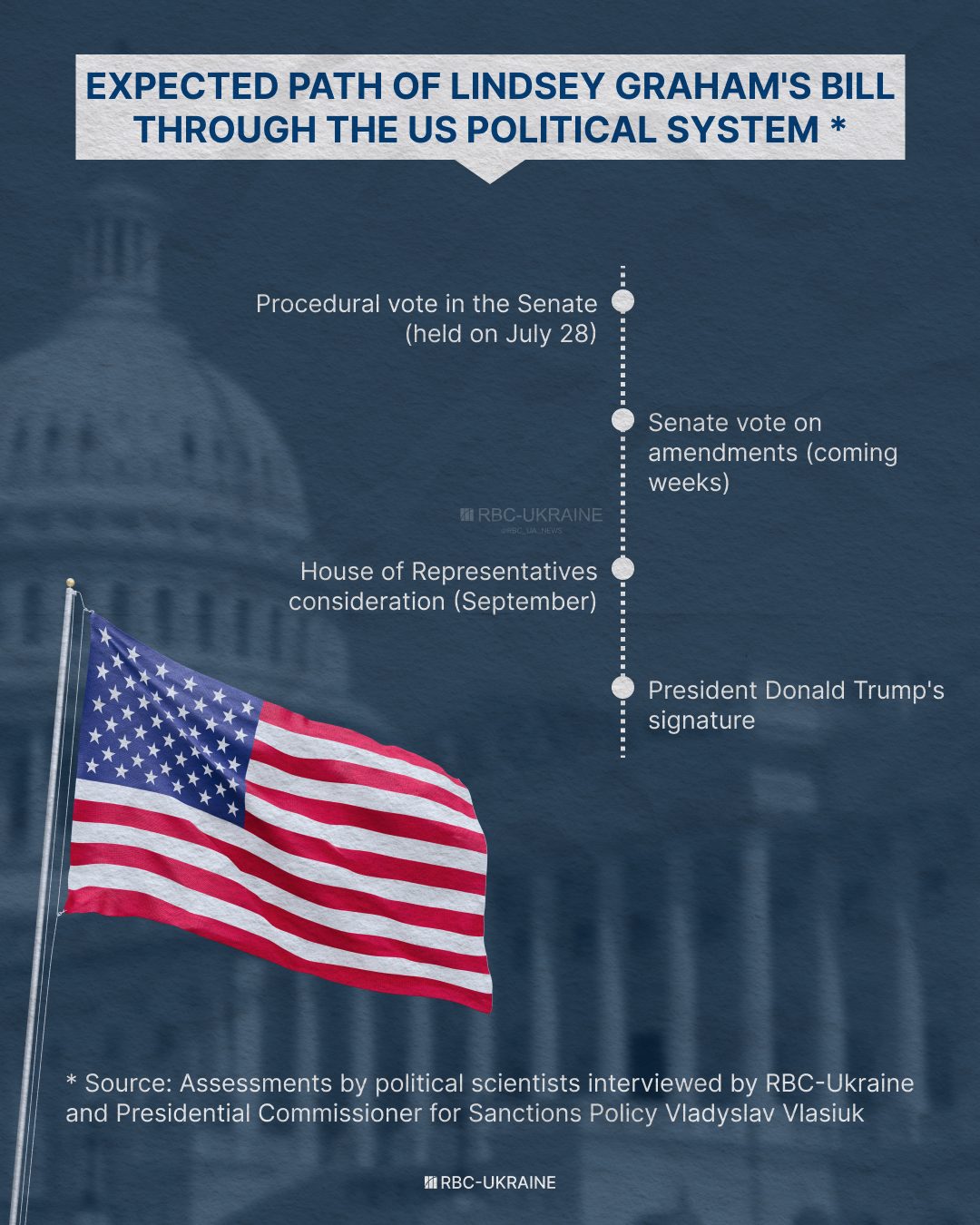
Photo: The Graham-Blumenthal bill has a strong chance of being passed before the congressional midterm elections (RBC-Ukraine infographic)
Trump has already declared his support for the bill. This guarantees that the House of Representatives will support it because Speaker Mike Johnson will do whatever the White House tells him to do, says Oleksandr Kraiev, an expert at the Ukrainian Prism think tank.
“Therefore, there is a strong chance that the bill will be passed,” the expert adds.
Ukrainian presidential sanctions policy envoy Vladyslav Vlasiuk offered a similar timeline. He believes the bill will reach the House of Representatives in September and then land on the desk of the president in the Oval Office. This means the bill could be passed and signed before the congressional midterm elections, which will take place in November this year.
A sanctions menu for Trump
The bill does not mandate the implementation of any specific measures against Russia. Instead, it offers a set of tools that the US president could use.
For example, the legislation provides for possible sanctions against suppliers to Russia's defense industry, restrictions on banks and insurance companies that support the activities of the shadow fleet and help sell sanctioned Russian hydrocarbons.
“The bill significantly increases the risks for banks, traders, insurance companies and oil refineries that work with Russian energy resources,” says Maksym Hardus, a communications specialist at the civil society organization Razom We Stand.
The bill also proposes a ban on investments in the aggressor country and sanctions against Russian state-owned companies.
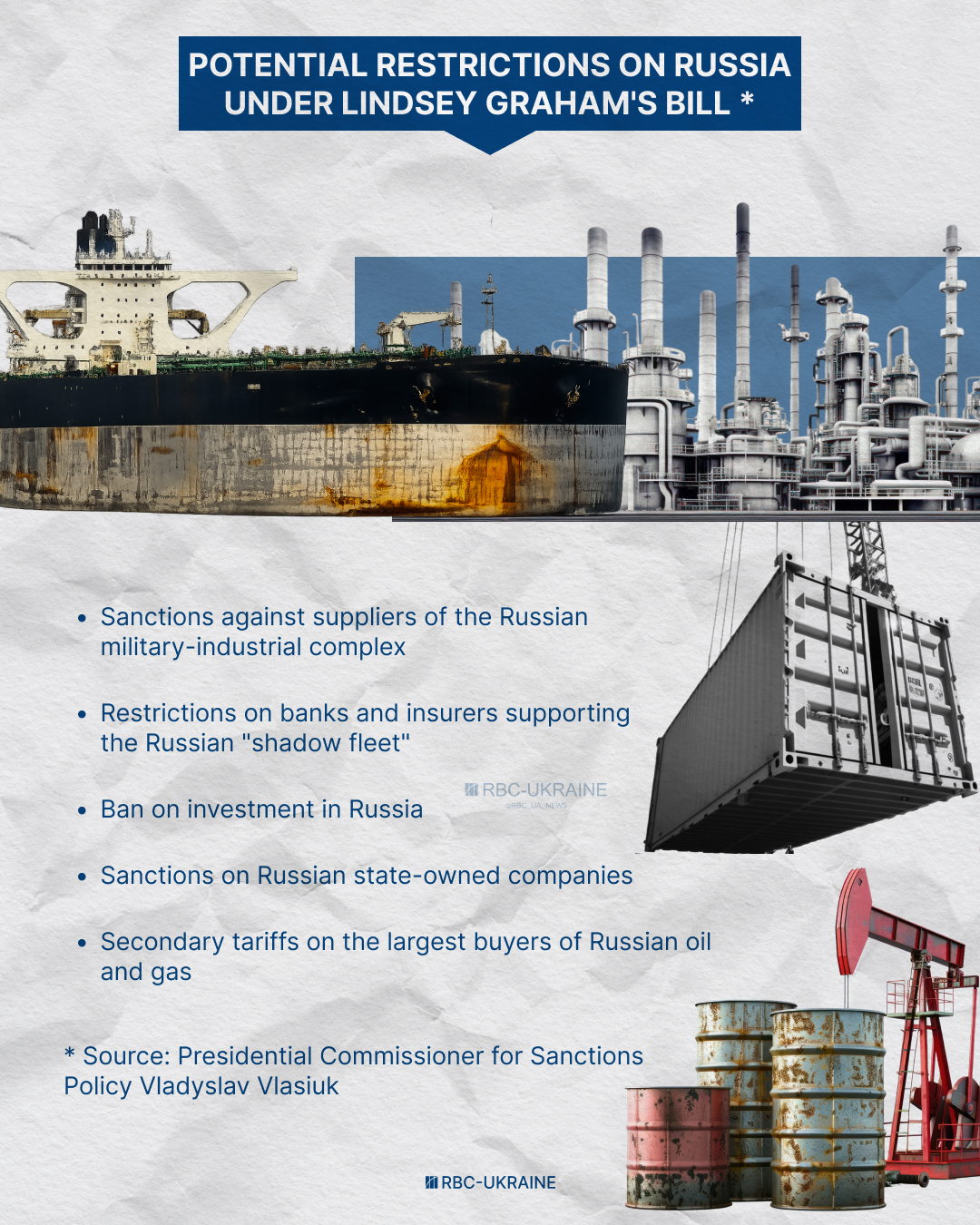
Photo: Secondary tariffs on buyers of Russian oil are just one of the tools proposed by the Graham-Blumenthal bill (RBC-Ukraine infographic)
The most painful and significant measure is secondary tariffs — tariffs that could be imposed on goods and services imported into the US from countries that purchase Russian oil and gas.
“There is a lot to choose from. The bill is comprehensive and offers a very wide range of different tools,” Vlasiuk said on a national telethon, comparing the legislation to a “sanctions menu.”
The Graham-Blumenthal initiative gives Trump the ability to raise tariffs on the largest buyers of Russian oil and gas by anywhere from 0% to 100%, although a range of 0% to 500% had previously been discussed. Since 2022, China, India and Türkiye have remained the largest buyers of Russian oil, according to data from the Kyiv School of Economics Institute, which specializes in sanctions policy.
Chinese companies are also the largest buyers of Russian pipeline gas. In 2025, China purchased nearly 40 billion cubic meters of gas from the aggressor country, says Mykhailo Svishcho, a gas market analyst at consulting company ExPro, in a comment to RBC-Ukraine. Türkiye, Belarus — although open data is likely unavailable — Hungary, Slovakia, Serbia and Greece follow.
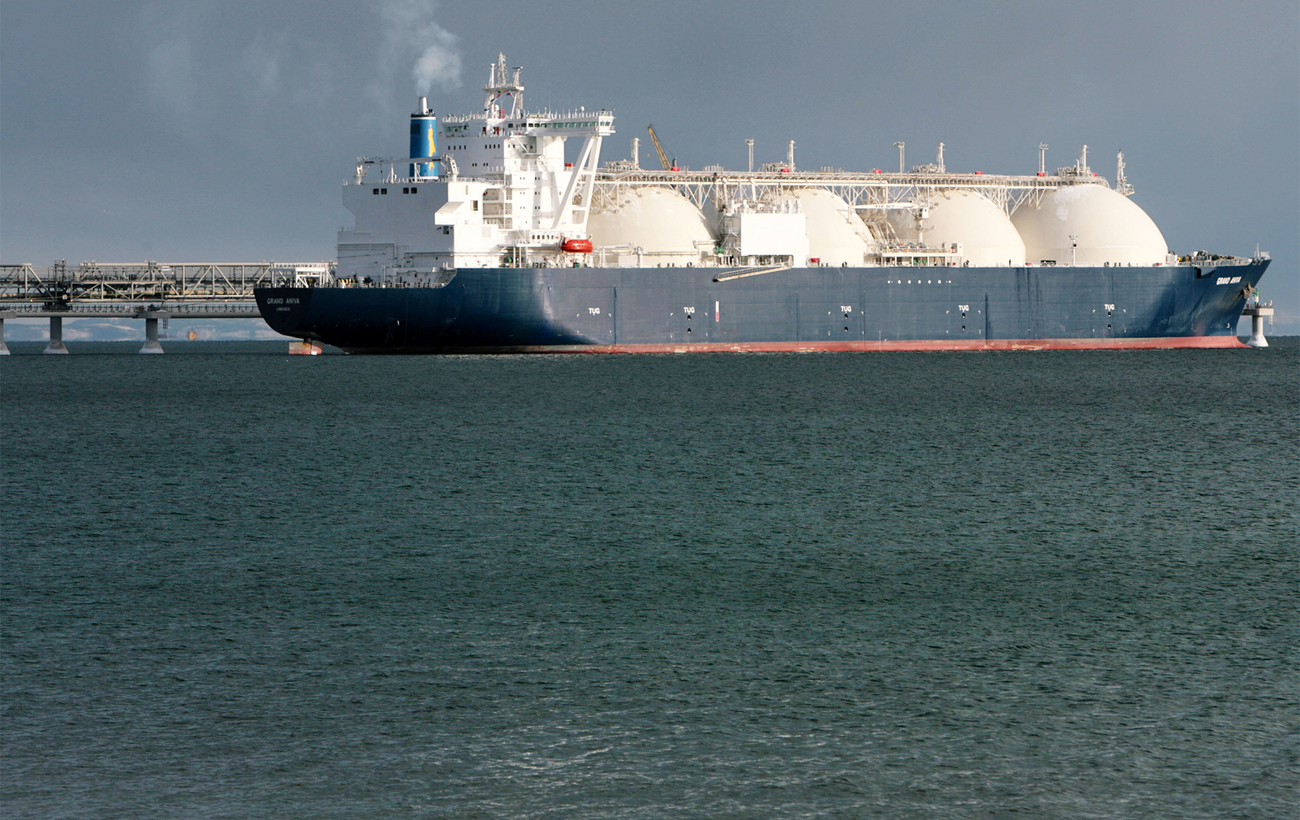
Photo: Russian liquefied natural gas continues to be supplied to the EU and Pacific countries (Getty Images)
China is once again the largest buyer of Russian liquefied natural gas (LNG). Last year, 7.5 billion cubic meters of Russian LNG arrived on tankers at Chinese ports, the analyst says.
Significant volumes of LNG enter the EU through France, Belgium and Spain. Due to a gas shortage in the Persian Gulf region, Japan and South Korea also import Russian LNG.
The question is whether Trump will want to deepen confrontation with countries such as China, India or Türkiye in order to punish Russia.
Prospects for imposing tariffs
A scenario in which the US raises existing tariffs on Chinese goods is unlikely, according to Fesenko. This is linked to Chinese President Xi Jinping's upcoming visit to Washington and Trump's policy of peaceful coexistence with Beijing. An exception could arise if China does something unfavorable to the US in support of Iran.
The situation is different with India. The US can afford to put pressure on New Delhi. India is more dependent on Washington and may be willing to make certain concessions, as it has done before. Therefore, new tariffs on Indian goods and services are a more realistic possibility, the political analyst believes.
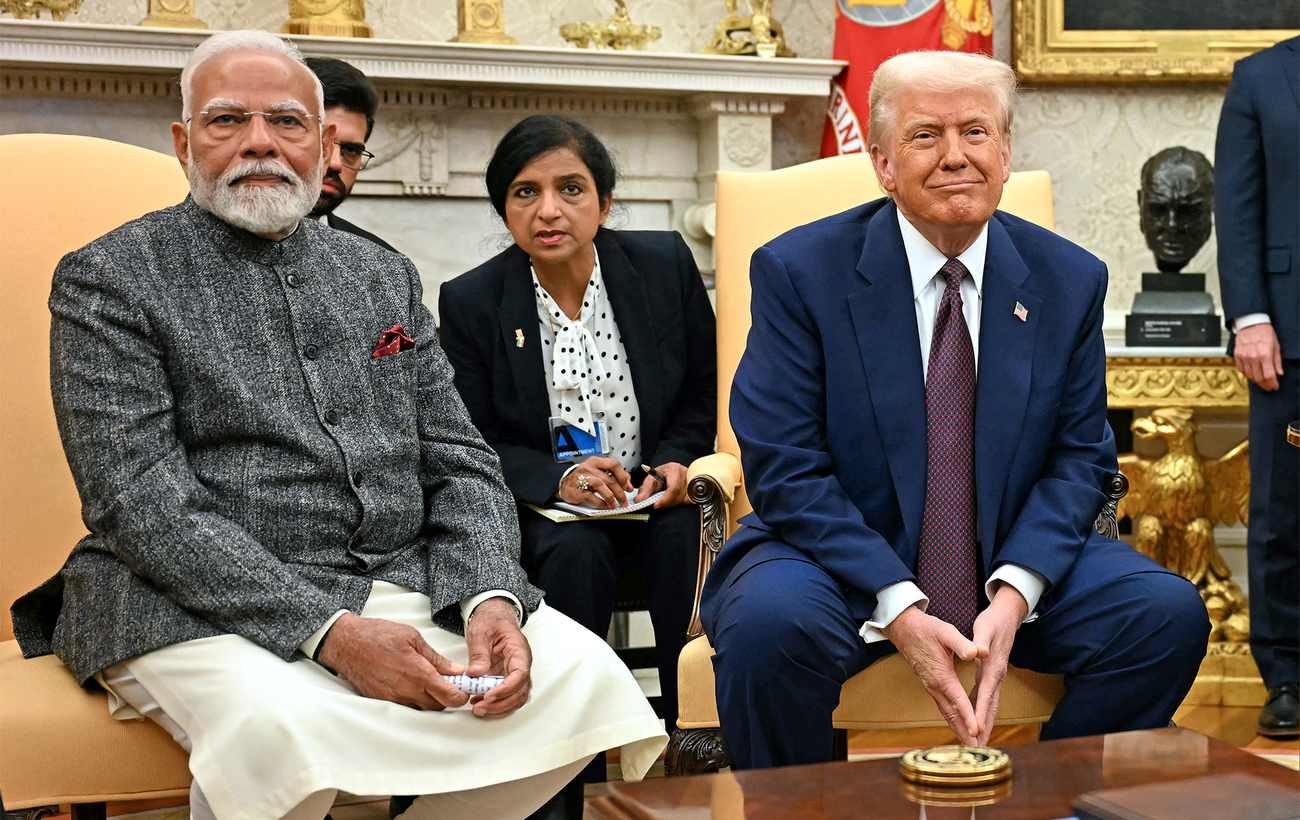
Photo: Donald Trump has the ability to pressure India into limiting its purchases of Russian oil (Getty Images)
When it comes to relations with Türkiye, the US will prioritize geopolitical cooperation in the Middle East over Ankara's trade with Russia. If Türkiye takes steps toward Washington, particularly regarding the continued presence of US military bases in the country and efforts to contain Iran, sanctions from Washington are unlikely, Fesenko says.
A tough scenario for Russia
At the same time, Trump is highly unpredictable and has repeatedly relied on tariffs as a policy tool. There is therefore reason to believe he could take similar steps again. Additional tariffs of 20% to 50% could inflict significant economic damage on China, India and other importers of Russian hydrocarbons. In that case, some companies in these countries would begin looking for new suppliers, says Maksym Hardus.
If that happens, the discount on Russian grades of oil, including Urals, would increase, while operations of the shadow fleet would become more difficult, adds the representative of Razom We Stand.
Reduced oil purchases would lead to a buildup of crude and lower production volumes. Russia would be forced to take these steps because it cannot increase refining capacity due to Ukraine's long-range strikes, says Oleksandr Sirenko, an analyst at the consulting company NaftoRynok, in a comment to RBC-Ukraine.
Read also: 'Russia's goal is our water supply': Ukraine's energy minister warns of new winter threat
He notes that Russia remains one of the world's largest oil producers. In 2025, it ranked second after the US, producing an average of 9.9 million barrels of crude per day, according to data from the US Energy Information Administration.
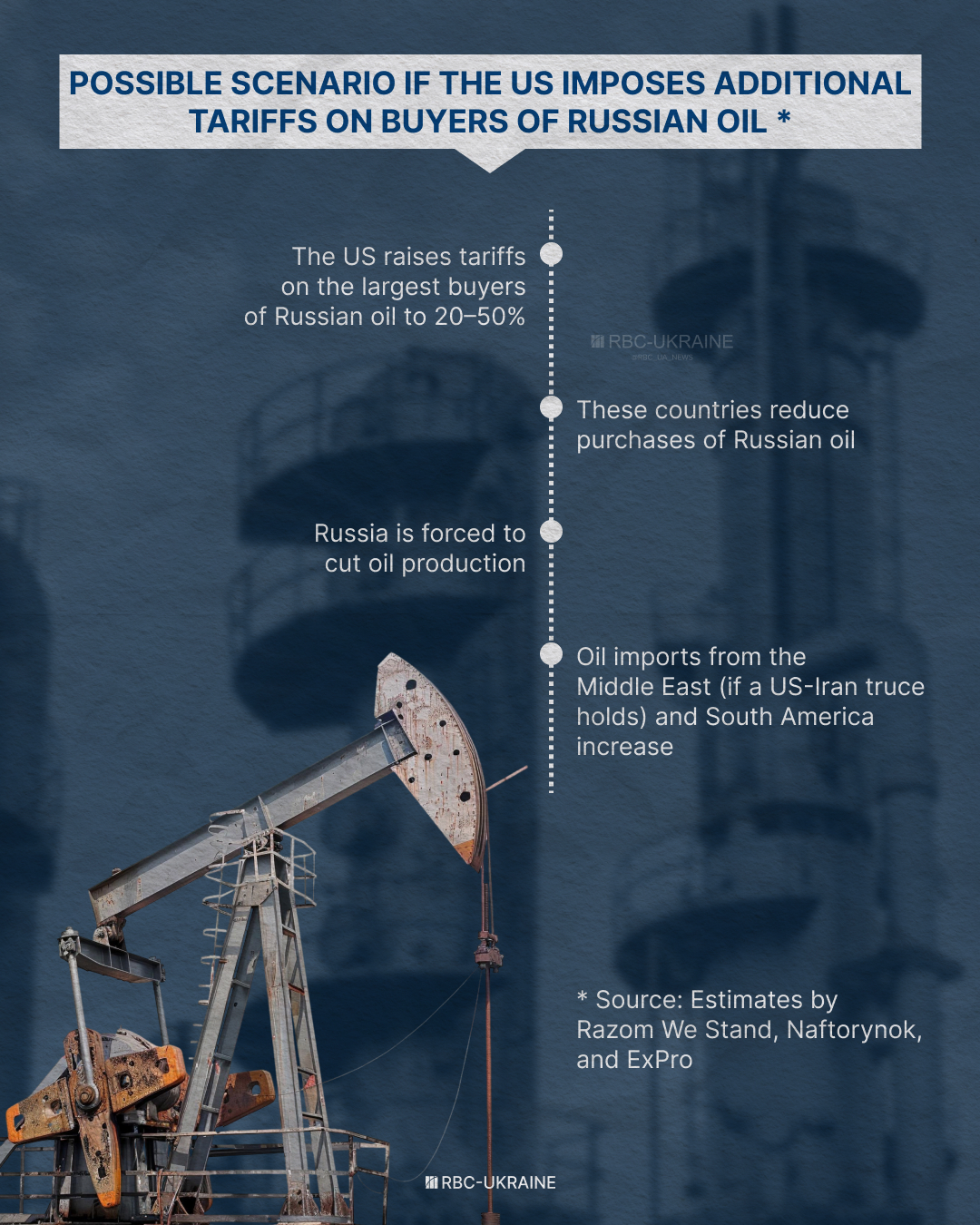
Photo: New US tariffs could force Russia to reduce oil production and prices (RBC-Ukraine infographic)
Countries would begin looking for alternatives to Russian oil. The Persian Gulf remains the largest potential source. Only countries in the region can compensate for the huge volumes of oil currently produced by Russia, says Gennadiy Kobal, director of the consulting company ExPro.
The main obstacle to establishing supplies from the Middle East remains the tense situation around the Strait of Hormuz.
“Without a ceasefire in the war between the US and Iran, this is impossible,” the expert told RBC-Ukraine.
The United States itself could increase oil purchases from South American countries, including Venezuela, where Washington has significant influence, as well as neighboring Guyana, which has significantly increased its oil production recently. Washington will take advantage of this opportunity, Kobal believes.
Expectations for the bill
The bill should show Vladimir Putin that he is on the losing side, said its co-author, Senator Richard Blumenthal, during its passage in the Senate.
The initiative is intended to show the Kremlin that it would be better to sit down at the negotiating table than to continue destroying its economy and sacrificing more lives. Blumenthal believes that China and India are fueling the aggressor's economy and that the new tariffs should therefore target them.
The senator's logic is understandable. At the same time, Trump already has all the tools he needs to raise tariffs and impose sanctions on countries buying Russian oil. A new bill is not required for that. From the outset, the legislation was designed as a means of pushing the US president toward imposing new sanctions on Russia, but his position has not changed.
“If he wanted to tighten sanctions or increase tariffs, he could do it without this bill, so the bill's role is being overstated,” a source familiar with the outcome of the Washington talks told RBC-Ukraine.
Trump could use the bill not to exert real pressure on Russia, but simply as a tool in trade negotiations.
“He is not a strong supporter of tougher sanctions against Russia. For Trump, this bill is an additional tool in negotiations with Russia and in putting pressure on individual countries,” Fesenko believes.
It remains to be hoped that the value of the secondary tariffs and sanctions developed by the late Lindsey Graham will not be lost during another round of international negotiations. The Trump administration could make much more effective use of the late senator's work both to protect US interests and to genuinely pressure the aggressor into pursuing peace.
Quick Q&A
– What does Lindsey Graham's bill provide for?
The bill gives the US president the ability to impose new sanctions directly on Russia and Russian companies, as well as impose secondary tariffs on countries that purchase Russian oil and gas.
– What stage is the bill at?
The bill has passed a procedural vote in the Senate. Another vote incorporating amendments will follow. The legislation must then be considered by the House of Representatives and sent to the US president for signature.
– Which countries could be affected by the new US secondary tariffs?
Primarily China, India and Türkiye, which are the largest buyers of Russian oil. Tariffs could also be imposed on major importers of Russian gas, including China and Türkiye, as well as EU countries such as Hungary, Slovakia and Serbia.
Russian liquefied natural gas is imported in significant volumes through France, Belgium and Spain, and is also purchased by Japan and South Korea.
– What could the tariff rate be? Who determines it?
The secondary tariffs could range from 0% to 100% of the value of goods imported into the United States. The rate would be determined by President Donald Trump.
– How likely is the US to impose new tariffs on China and India?
An increase in tensions between Washington and Beijing over trade is unlikely. At the same time, the US has opportunities to put pressure on India.
– What would happen to Russia if the US decided to impose tariffs under Graham's bill?
In that case, buyers of Russian hydrocarbons would likely begin limiting their purchases and looking for new sources of supply. Russia itself would be forced to offer larger discounts on its oil and reduce production.
– Would the “hell sanctions” work against Russia?
The bill gives the US president new tools to pressure the aggressor, but whether they are used and to what extent will ultimately be Donald Trump's decision. There is a possibility that the new tariffs and sanctions could become bargaining chips between the White House and other countries, including Russia.