Drone diplomacy in action: How Ukraine is building ties in Asia outside China's reach

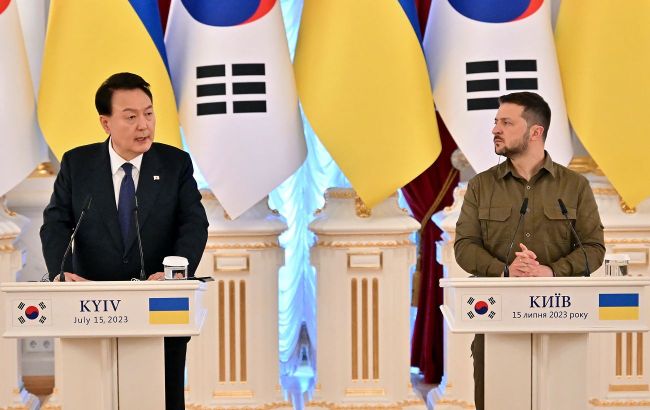 Photo: Volodymyr Zelenskyy and South Korean President Yoon Suk Yeol (2022–2025) (Getty Images)
Instead of appealing solely to democratic values, Ukraine offers countries of East Asia a hard, pragmatic exchange — technology and experience of large-scale war in return for investments and informal alliances.
Whether Japan, South Korea, and Taiwan are ready for this deal, and what they can offer Kyiv in return, read below.
Key points
- In search of friends. On June 29, Foreign Minister Andrii Sybiha begins a tour of East Asian countries. The goal is to transform Ukraine from a recipient of aid into a full-fledged partner.
- Export of experience. The experience of modern warfare (e.g, the use of UAVs) has become Kyiv’s main export product. Japan, Taiwan, and South Korea need this knowledge, considering threats from China and North Korea.
- Japanese bridge. Tokyo is becoming a key partner in non-lethal technologies and a potential mediator in informal cooperation with Taiwan.
- Korean dilemma. South Korea remains on the sidelines of military cooperation, but Sybiha will have something to discuss in Seoul. North Korean soldiers are still held in Ukrainian captivity.
Today, June 29, Ukraine’s Foreign Minister Andrii Sybiha is visiting East Asia, where he plans to discuss expanding political and economic cooperation with countries in the region.
The period of the full-scale war has become, among other things, a time of unprecedented diplomatic activity for Ukraine. Traditionally, most attention has been focused on the West - Europe and the United States. However, global dynamics require Ukraine to pursue a much broader, global diplomacy.
This spring, the world observed how Ukraine unexpectedly “entered” the Middle East. Kyiv demonstrated readiness to cooperate in new regions and sectors. This momentum mustn't be lost. East Asia appears to be a good place to seek new partners.
Ukraine and Asia
The history of Ukraine’s attempts to present itself in East Asia is quite long, although not very successful. For example, complex and tangled Ukraine–China relations have never developed into something truly significant.
Ukraine and China are not enemies, but they are not close to friendship or even to mutually beneficial cooperation.
In the context of an informal Russia–China alliance, questions arise about prospects with more pro-Western states in the region: Japan, South Korea, and Taiwan. Ukraine’s relations with these countries cannot be called very close, but some foundation has already been laid.
The most significant here is, of course, Japan’s position. Regarding the Russia–Ukraine war, the country has consistently, albeit with some self-limitations, stood on Ukraine’s side.
Since the beginning of the Russian invasion, Tokyo has supported pro-Ukrainian initiatives at the G7 level. Although Japan is legally unable to send weapons to countries at war, it has provided Ukraine’s army with protective equipment and machinery, and has joined international programs for Ukraine’s reconstruction.
After the change of government in fall 2025, the country’s position became even more proactive. In May 2026, Japan made its first contribution to the PURL program, with the note that the funds would be used for non-lethal military equipment. It also sent personnel to NATO command in Wiesbaden, Germany, which coordinates aid to Ukraine and the training of Ukrainian Armed Forces soldiers.
Japan’s Prime Minister Sanae Takaichi confirmed continued stable support for Ukraine at the latest G7 summit, which was also attended by Volodymyr Zelenskyy.
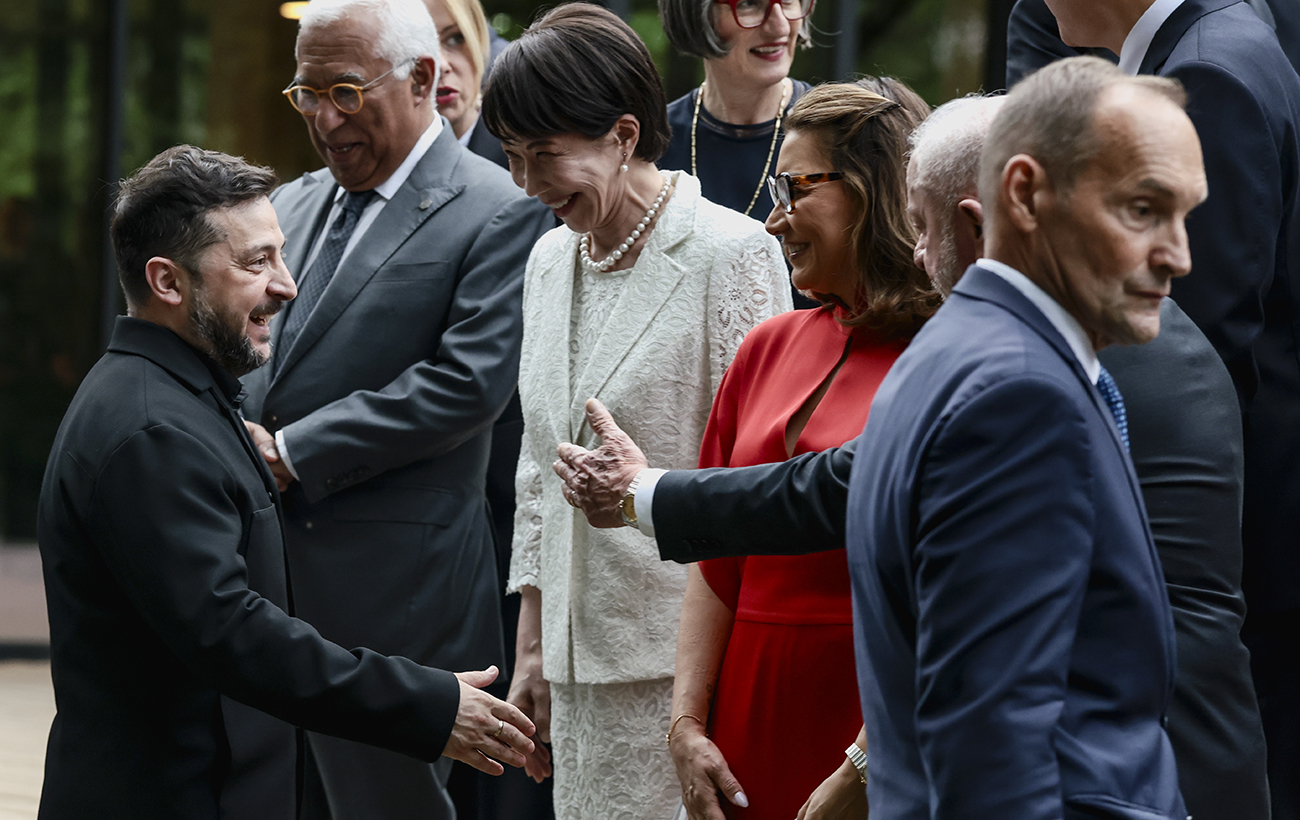 Photo: G7 summit. Japanese Prime Minister Sanae Takaichi (center) and Volodymyr Zelenskyy (Getty Images)
Relations with South Korea are much more complex. Although Seoul has also supported Ukraine diplomatically during the war and repeatedly provided humanitarian aid, the country’s position is far less clear-cut.
Old ties with Russia play a role — Russia was for a long time an economic partner of Seoul and was also seen as one of the mediators in relations with North Korea.
Former South Korean President Yoon Suk Yeol could not be called a big friend of Ukraine, but his foreign policy followed the US line, which in turn pushed Seoul toward more pro-Ukrainian positions. In summer 2023, the Korean leader even visited Kyiv.
However, in 2025, South Korea experienced a crisis involving the president's attempt to impose martial law. As a result, President Yoon resigned (and soon went to prison), and the new team of President Lee Jae Myung declared a “pragmatic” foreign policy.
In current realities, this pragmatic policy means hopes of resuming economic cooperation with Russia and almost complete disregard for Russia’s close military cooperation with North Korea in the war against Ukraine.
“If Japan sees itself as a global power participating in world politics, then Korea is more focused on its local problems. First of all, they are interested in peace on the Korean Peninsula, which they believe Russia can help ensure,” says Nataliya Butyrska, Asia Pacific expert at the New Europe Center, in an interview with RBC-Ukraine.
Relations with Taiwan also remain ambiguous. Officially, Kyiv and Taipei do not have diplomatic ties, and Ukraine recognizes the government of communist Beijing as legitimate. However, since Russia’s invasion, the fates of Ukraine and Taiwan have become closely connected.
Although the island has been de facto independent since 1949, it is officially considered part of a single China and once even competed with the PRC for legitimacy. In recent decades, mainland China has sought to “reverse historical injustices,” with the key element being restoring national territorial integrity.
Taipei has lived for many years in anticipation that Beijing will announce its “special operation” to reclaim “historical territories.” This fear intensified significantly after Russia invaded Ukraine.
In these conditions, an informal network of ties has developed between citizens, volunteer groups, and individual companies of the two countries. In 2025, a group of Ukrainian MPs visited Taipei for the first time in 20 years.
The Taiwanese government sponsors humanitarian projects, and several Taiwanese volunteer initiatives operate in Ukraine, including those related to assistance for the Armed Forces of Ukraine. Business ties also exist, but there are no official relations between the countries.
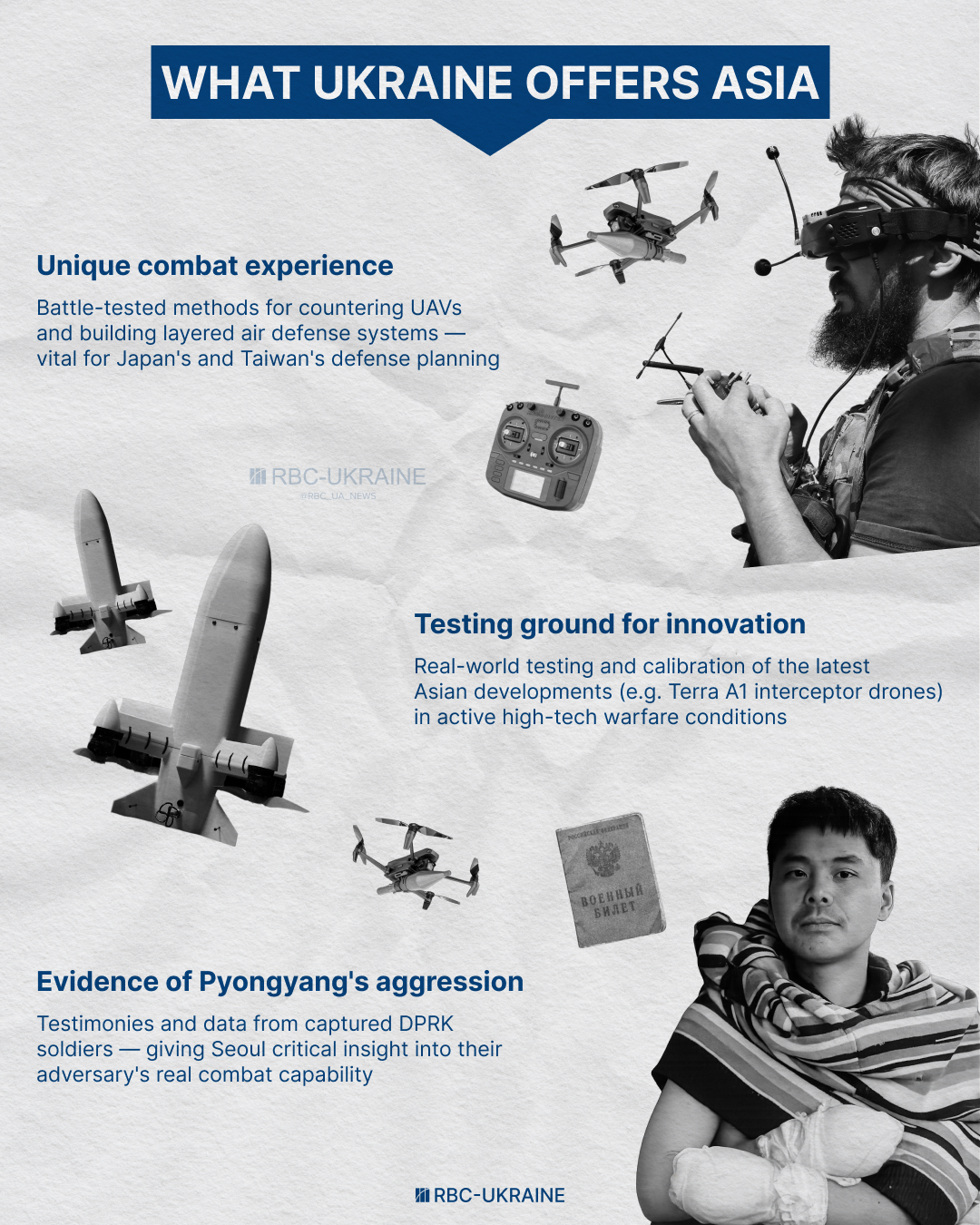 Photo: What Ukraine offers Asia (infographic by RBC-Ukraine)
What can Ukraine offer?
Until recently, Ukraine, to use Donald Trump’s terms, had no cards to play in its favor on the international stage. In the first years of the full-scale war, Kyiv constantly had to convince the international community of the need to continue and expand support. This required arguments.
With European countries and the US, it was possible to speak about shared regional interests. In other regions, however, Ukraine mostly had to appeal to values and international law. But 2026 changed this.
The conflict in the Persian Gulf demonstrated that Ukraine can now act not as a recipient, but as a partner — sharing its experience and technologies.
This cooperation is not just an opportunity; it is essentially a necessity, because today there are only two countries in the world with experience of modern large-scale war. Russia can pass (and will certainly pass) this experience to China and North Korea. In these conditions, Japan, Taiwan, and South Korea need Ukraine’s experience.
Currently, the most in-demand area is countering UAVs. In April, it became known that interceptor drones Terra A1, a joint development of Japan’s Terra Drone and Ukrainian startup Amazing Drones, had been supplied.
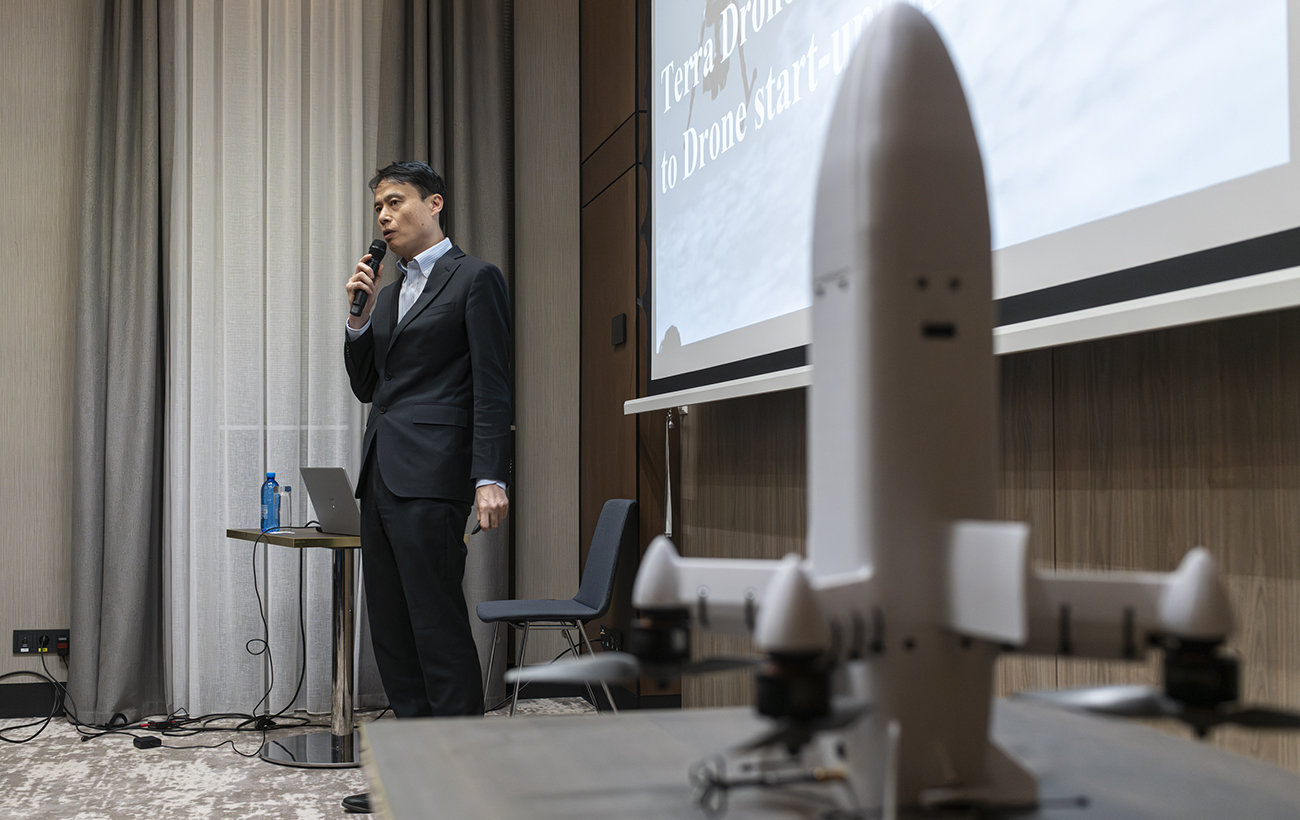 Photo: Japanese drone Terra A1 (Getty Images)
The drones were developed in Japan and transferred to Ukraine in April for testing in real combat conditions. This is happening amid legislative changes regarding arms and technology exports, which potentially open the way for expanded international cooperation in this field.
It is possible that such cooperation was discussed during the recent visit to Kyiv by Japanese deputy ministers Ayano Kunimitsu from the Foreign Ministry and Kenji Yamada from the Ministry of Industry.
In Ukraine, officials met with deputy prime minister Taras Kachka, foreign minister Andrii Sybiha, and economy minister Oleksii Sobolev. Following the meeting, the parties signed an action plan to promote private-sector cooperation, particularly industrial.
South Korea has so far shown limited interest in Ukrainian weapons, but there is a unique point of contact. Several North Korean soldiers remain in Ukrainian captivity, who, under the law, are citizens of South Korea.
According to The Korea Times, the fate of these prisoners is expected to be one of the topics during Sybiha’s visit to Seoul. The Ukrainian foreign minister is also expected to discuss the course of the war and bilateral relations between Ukraine and Korea with his counterpart.
In Taiwan, Ukraine is of interest not only to politicians but also to many citizens due to its geopolitical position. Kyiv’s experience in developing and using UAVs and air defense systems would be valuable to Taiwan in the event of a (not entirely implausible) need to defend its sovereignty.
Although there is no official interaction between the countries, private individuals and entrepreneurs have already established exchanges of experience and technology. Taiwanese defense companies have opened branches in Eastern Europe, from where they work with Ukrainian manufacturers.
For Ukrainian companies, this opens access to investment, markets, and technology. For Taiwanese actors, it is an opportunity to test their developments in real conditions.
Oleksandr Leonov, executive director of Penta Center for Applied Political Research, believes that cooperation can indeed be established if desired, even through unofficial channels.
“Japan has officially declared readiness to defend Taiwan. Within this policy, one could, for example, talk about cooperation with Taiwan through second hands,” the expert says, referring to a scheme in which Japan would act as a bridge for transferring experience and technology.
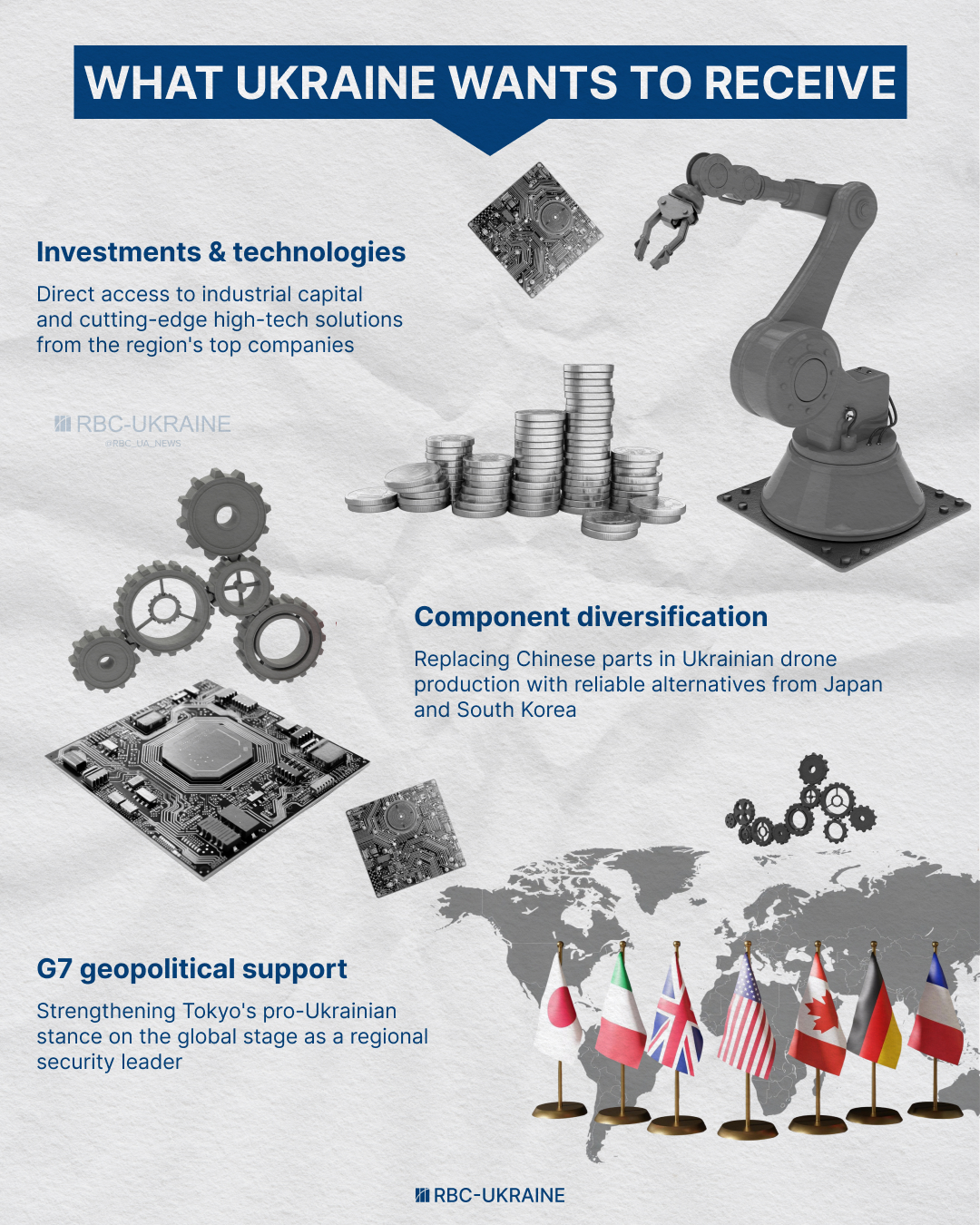 Photo: What Ukraine wants (infographic by RBC-Ukraine)
'Chinese wall' on Ukraine’s path
When discussing partnership prospects, it is important to consider factors that may stand in the way. One of them is unquestionably China.
East Asia is a zone of tension that could eventually escalate into a full-scale conflict. And China is unlikely to welcome Ukraine contributing to the rearmament of its potential adversaries.
Of course, Beijing does not control Ukraine’s foreign policy. But the Chinese position may become an influencing factor, as is already the case in Ukraine–Taiwan relations.
“China is a country that some in Ukraine still call a strategic partner,” notes Nataliya Butyrska.
The issue is not personal beliefs, but primarily economics. China is a major supplier of imported goods. Particularly important are Chinese components used by Ukraine in manufacturing, including military UAVs.
Although Ukraine and its partners are taking steps toward diversification, dependence on Chinese components remains significant. This somewhat limits Ukrainian diplomacy.
The war in Ukraine is not a local conflict; it is a strike on the global security architecture that existed for the past two decades. This understanding exists both in Ukraine and in Asian countries.
“When the war began, Japan’s Prime Minister Kishida said: ‘Today Ukraine — tomorrow East Asia.’ This was his view that Russia and China act in similar ways and create the same kind of problems,” recalls Nataliya Butyrska, explaining the connection between events in seemingly distant regions.
With this understanding, Ukraine’s policy in Asia goes beyond commerce and becomes a question of choosing a side in a looming confrontation.
“We need to ask ourselves what role we can play in the event of a conflict in the Indo-Pacific region. We need to start thinking about this now,” Butyrska states.
***
Ukraine’s entry into new diplomatic horizons is certainly cause for celebration. It will give the country greater visibility on the world stage and provide businesses with access to markets, technologies, and investments. Yet, high-level politics requires a readiness to face challenges.
Just like the Middle East, East Asia is a zone of potential conflict. Ukraine’s prolonged involvement in the largest war of recent decades makes its experience exceptionally valuable. Ukraine is ready to share it, and Asian countries are ready to learn from it. The remaining task is to figure out how to make this exchange truly productive.
Quick Q&A
– Why has East Asia become important now?
After its successful diplomatic entry into the Middle East, Ukraine is seeking new regions for cooperation. East Asian countries (Japan, South Korea, Taiwan) see Russia’s aggression against Ukraine as a precedent that threatens their own security.
– What can Ukraine realistically offer Asia?
Experience in countering massive drone attacks and using modern electronic warfare systems, maritime drones, and interceptor drones. Technological cooperation has already begun but still has more potential for expansion.
– Why are relations with South Korea so complicated?
Seoul continues to balance, hoping for Russia’s influence over North Korea. The pragmatic policy of the new Korean government ignores Russia–North Korea military cooperation, complicating expanded cooperation.
– What are Ukraine’s relations with Taiwan like?
There are no official diplomatic relations, but there is an active informal network of contacts through volunteers, businesses, and parliamentary groups. Japan could become a bridge for transferring Taiwanese investment and technology to Ukraine.