Back to Abu Dhabi: Why new Ukraine–US–Russia talks matter


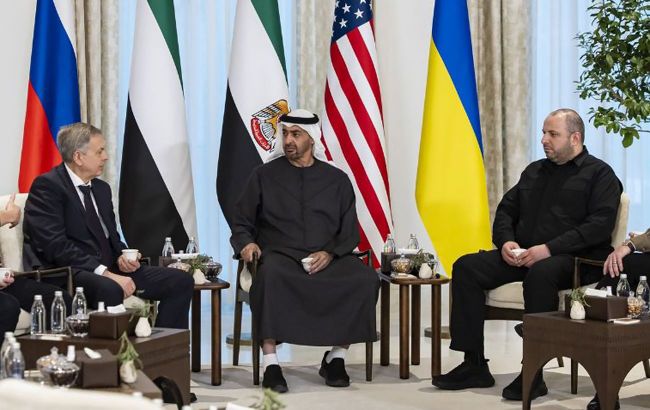 Secretary of the National Security and Defense Council of Ukraine Rustem Umerov, President of the UAE Sheikh Mohammed bin Zayed Al Nahyan, and Chief of the General Staff of the Armed Forces of Russia Igor Kostyukov (photo: Getty Images)
Today, a new meeting between delegations from Ukraine, the US, and Russia will take place in the United Arab Emirates.
RBC-Ukraine explains why this time they may achieve more results than before and how they can bring the war closer to an end.
Key points:
- Substantive talks: more constructive approach from Russia
- Territorial issues remain the most problematic
- Energy truce broken
- Talks focus on technical aspects, with little chance of a political breakthrough.
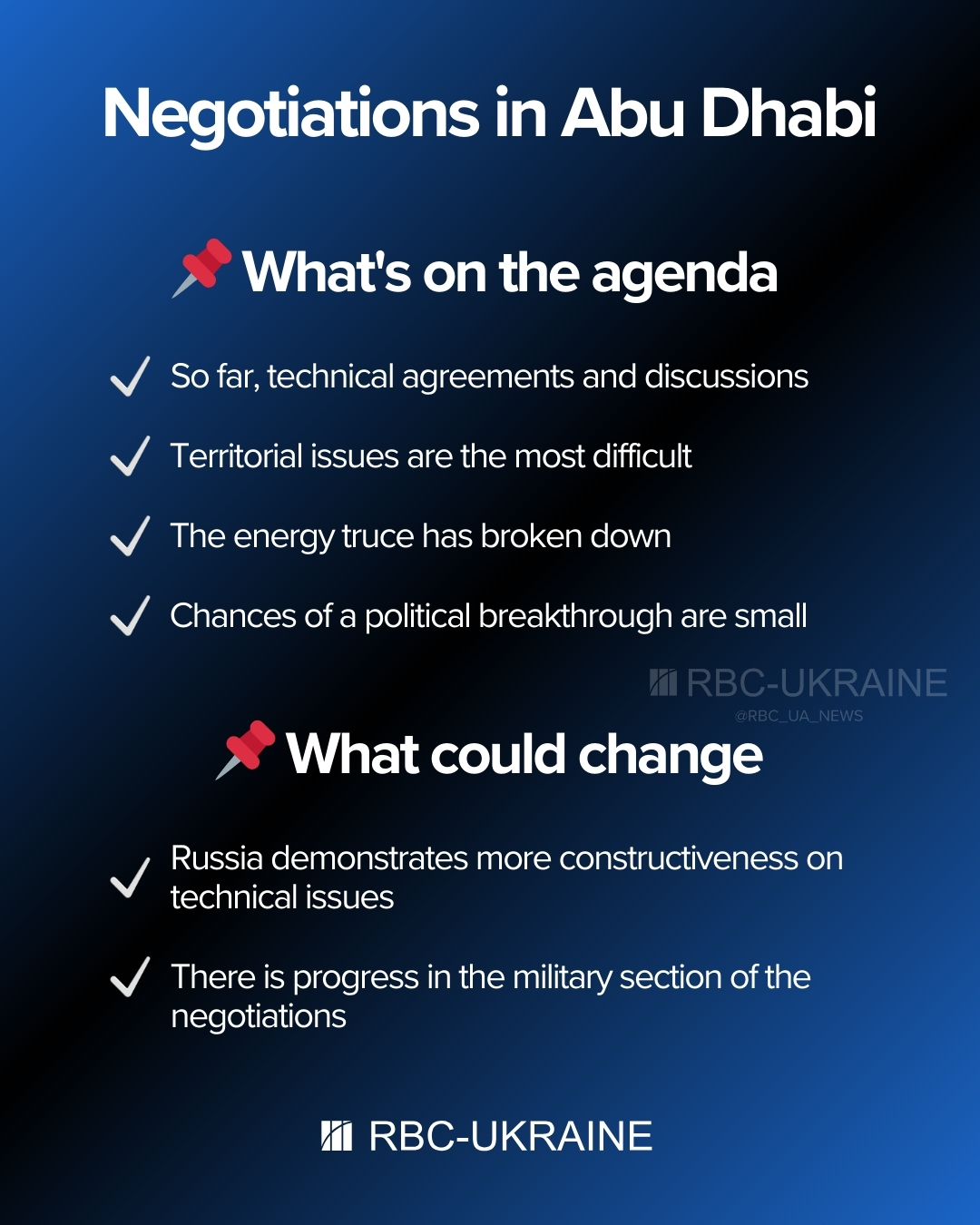 Agenda for negotiations (Infographic by RBC-Ukraine)
Read also Ukraine agrees with US and Europe on three-step response to Russia breaking ceasefire, media
Today's meeting in Abu Dhabi will be the second in the new format. It will be attended not so much by Russian propagandists as by military personnel. This means a greater inclination towards constructiveness, which was evident in the first round on January 23-24.
An informed source at RBC-Ukraine, familiar with the details of the negotiations, noted that the first round was introductory. After that, the delegations met again in an expanded format and decided to divide into two subgroups: political and military. These two sections held separate negotiations.
The military subgroup did make some progress.
"They discussed whether it was necessary to withdraw forces, how the cessation of hostilities and the ceasefire would be monitored, the creation of a center to control and coordinate ceasefire issues, and which countries could be represented there," says RBC-Ukraine's interlocutor.
However, no significant progress was made in the political section. In essence, there are not many differences here, but they remain fundamental.
Status of problematic issues
US Secretary of State Marco Rubio previously reported that the only unresolved issue in the negotiations remains territorial – under whose control Donbas will ultimately fall.
Russia continues to insist that Ukraine cede the entire territory of Donetsk Oblast to it. However, this is unacceptable to Ukraine.
"I know there is active work going to see if both sides' views on that can't be reconciled," Rubio said last week.
At the same time, there appears to be progress on the Zaporizhzhia Nuclear Power Plant. According to Politico, during the first round of negotiations in Abu Dhabi, Russia insisted that Ukraine and Russia share the plant's electricity.
AP clarified that the ZNPP's electricity would be distributed on a fair basis, but the issue of control over the plant remains unresolved.
At the end of December, Washington proposed that the Zaporizhzhia NPP be jointly managed by three countries: Ukraine, the US, and Russia. According to Zelenskyy, Russia believed that it would ultimately secure control over the plant's operation.
Ukraine's compromise position was to create a joint venture at the ZNPP. It would include the US and Ukraine with equal shares.
"50% of the electricity produced would go to Ukraine, and the US would independently determine the distribution of the other 50%," Zelenskyy clarified on December 24.
However, last week, the Ukrainian President announced that the future of the ZNPP would not be considered separately.
"The issue of the Zaporizhzhia Nuclear Power Plant is included in the list of territorial issues. Therefore, when we talk about the ZNPP and the east of our country, our other regions, from where there were signals that the Russians are ready to leave, etc., these are all territorial issues," Zelenskyy says.
Ukraine's position on this remains unchanged: territorial issues must be resolved by the leaders of the states during a personal meeting. But the chances of this happening are slim at the moment, even though Zelenskyy invited Putin to Kyiv and Putin invited Zelenskyy to Moscow.
In addition, Russia continues its attempts to cause a humanitarian catastrophe in Ukraine.
Energy truce
The story of the energy truce is indicative in this regard. Donald Trump unexpectedly announced it on Thursday, January 29, after a conversation with Putin.
"I personally asked President Putin not to fire on Kiyv and the cities and towns for a week during this. It's extraordinary. It's not just like cold. It's extraordinarily cold, record-setting cold," the US President said.
Putin's spokesperson Dmitry Peskov confirmed that Russia had agreed to refrain from striking Ukraine until February 1.
The truce was discussed at the first meeting in Abu Dhabi on January 27, Zelenskyy later noted. At the same time, according to the Ukrainian President, it began on the night of January 30.
"If Russia does not attack our energy sector, whether it be power generation or any other, we will not attack their energy sector. I think this is the answer that the mediator of the negotiations, the US, was counting on," Zelenskyy said at a meeting with journalists.
However, on January 30 and 31, Russia once again attacked Ukraine's energy sector, albeit with fewer drones than usual. And on the night of February 2-3, the Kremlin launched a new massive strike with a record number of ballistic missiles and drones.
Read also Trap for Trump? How Russia exploited energy truce during Abu Dhabi talks
After that, Zelenskyy directly accused Russia of violating the energy truce.
"In our opinion, the Russians have broken their promise. Either Russia now believes that a week is four days instead of seven, or they are really betting on war and simply waited for the coldest days of this winter, when temperatures across a significant part of Ukraine are below minus 20 degrees Celsius," he said.
According to Zelenskyy, the work of the Ukrainian negotiating team will be adjusted. However, as Trump said on the eve of the negotiations, "Putin kept his word" by not attacking Ukraine during the week.
Technical negotiations
Judging by Russia's actions, Putin still has no plans to make a political decision to end the war. Despite this, work on documents to regulate the peace process is progressing quite actively.
According to Zelenskyy, an agreement on security guarantees for Ukraine from the US and a plan for Ukraine's post-war reconstruction are already fully prepared.
Many other documents regulating the military aspects of the cessation of hostilities are still in progress. Similarly, the general framework agreement, in which the issue of territories will be key until the last moment, has not been fully agreed upon.
In such conditions, the task of the negotiating teams is to continue working on the technical aspects of the peace process so that they are ready when Putin finally agrees to end the war. According to RBC-Ukraine, the military subgroup is to prepare proposals from the parties on a further ceasefire.
Quick Q&A
– Who is participating in the negotiations in the UAE, and why is this composition considered more constructive?
Delegations from Ukraine, the US, and Russia are participating in the meetings. A distinctive feature of this format is the participation of military personnel rather than Russian propagandists. This has allowed for a shift to discussing specific technical aspects instead of political slogans.
– What issues is the military subgroup discussing, and is there any progress?
Yes, there has been some movement in the military section. The parties are discussing the withdrawal of forces, monitoring the ceasefire, and creating a special center to control and coordinate these processes.
– What is the main obstacle to a political breakthrough?
The most problematic issue remains the territorial question, in particular, the status of the Donetsk region. Russia demands that the entire territory of the region be transferred to its control, which is absolutely unacceptable for Ukraine.
Sources: Volodymyr Zelenskyy, Marco Rubio, and RBC-Ukraine sources related to the negotiations, Politico, AP, and Bloomberg.