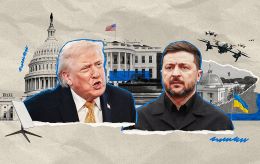
Zelenskyy ultimatum meets Kremlin threats: Will ceasefire follow?


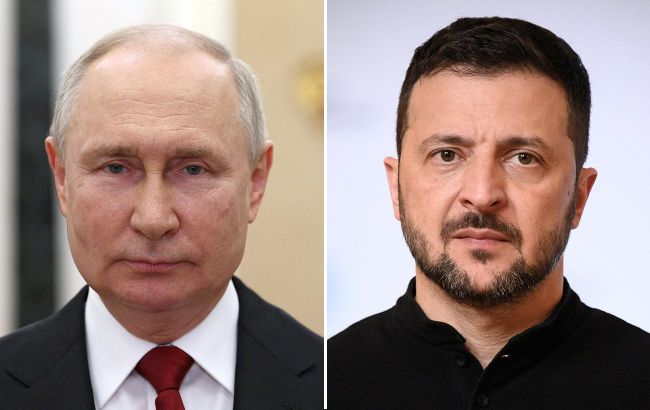 Photo: Vladimir Putin and Volodymyr Zelenskyy (RBC-Ukraine collage)
The idea of a ceasefire that Russia discussed with the United States has turned into threats of strikes on Kyiv. While the Kremlin is asking for two days of ceasefire to calmly hold a parade without equipment, Ukraine has announced its own counterproposal.
Key points
- Trump–Putin initiative. During a phone call, the United States and Russia discussed a ceasefire on May 9. Official Kyiv was not directly informed about these arrangements.
- Kremlin’s interest. Putin set May 8 and 9 as the dates of the ceasefire. Ukraine suspects Russia only seeks to guarantee the safety of the parade in Moscow, which this year will take place without heavy equipment.
- Zelenskyy’s counterproposal. The President of Ukraine proposed starting the ceasefire much earlier — from midnight on May 6 — to test Russia’s readiness for real steps, not just a PR pause.
- Threats to Kyiv. Russia’s defense ministry responded to Zelenskyy’s remarks about a possible flight of Ukrainian drones over Moscow with threats to strike central Kyiv and a call for diplomats to leave the city.
- Ukraine’s psychological victory. Russia’s statements about silence are already destroying the Kremlin’s main narrative, and expectations of an attack on Moscow could force the enemy to expose other sections of the front by pulling air defense systems to the capital.
Where the idea of a new ceasefire came from
Last week, during a call between US President Donald Trump and Russian president Vladimir Putin, the idea of a ceasefire on May 9 (Russia’s Victory Day) was voiced, the Kremlin said. Later, Trump confirmed it.
Ukraine was not officially informed about this ceasefire.
Ukrainian President Volodymyr Zelenskyy instructed his representatives to find out the details from the American side.
“We will clarify what exactly is meant: a few hours of safety for a parade in Moscow or something more,” Zelenskyy said.
Zelenskyy also emphasized that for the first time in many years, there will be no military equipment at the traditional parade in Moscow. According to the president, Moscow fears Ukrainian drones can fly over.
The ceasefire dates from Russia
Yesterday, Zelenskyy once again stressed that Russia has still not officially informed Ukraine about the ceasefire. He noted that Ukraine has no holidays, and after May 9, Russians will again be killing Ukrainians.
Closer to the evening, the Russians issued another statement on a ceasefire. Their defense ministry reported that Putin had set May 8 and 9 as the dates of the ceasefire. It did not come without threats toward Ukraine. Responding to Zelenskyy’s words about Ukrainian drones at the parade, the Russians threatened a massive missile strike on central Kyiv in response.
They advised Kyiv residents and employees of foreign diplomatic missions to “leave the city promptly.”
Ukraine’s response
After Russia’s statement, the President of Ukraine once again stressed that no one had officially approached Ukraine. Zelenskyy put forward a counterproposal.
“We are announcing a ceasefire regime starting from 00:00 on the night of May 5 to 6. It is time for the Russian leadership to take real steps to end their war, if the Russian Ministry of Defense already believes that it cannot hold a parade in Moscow without Ukraine's goodwill,” he stressed.
Commenting on the president’s words, Foreign Minister Andrii Sybiha called on all partners to support Ukraine’s call to stop hostilities.
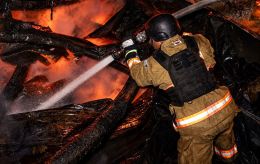
While the Kremlin publicly calls for a ceasefire, on the night of May 5, Russia carried out a missile and drone strike on Ukraine. Energy facilities, oil and gas infrastructure, railways, and residential buildings in the Dnipropetrovsk, Poltava, Kharkiv, and other regions came under fire. As a result of the attacks, 5 people were killed, and dozens were injured. The most difficult situation is in the Poltava region, where a repeated strike on a gas production facility killed two rescuers and injured more than 20 others.
Zelenskyy has already called such actions “absolute cynicism.” According to him, demanding “silence” for a propaganda parade while simultaneously striking civilians is proof that Russia’s proposals remain only empty statements, so Ukraine will act symmetrically.
What to expect?
As war experience shows, the enemy cannot be trusted, and it is uncertain whether there will actually be a ceasefire. But even if the proposed ceasefire does not take place, Ukraine has already achieved an important psychological and tactical victory in this situation, believes military expert and former SBU officer Ivan Stupak.
According to him, the May 9 military parade for modern Russia is an unshakable “spiritual event,” held in any weather and economic crises.
“And now Russia, which says that ‘Ukraine does not exist on the maps,’ is asking us through the Americans not to spoil their holiday. So, the ‘victorious nation’ is begging a country that supposedly ‘does not exist’ to leave their parade alone. We have already broken this narrative and called into question the security of an event that is critically important to them from a propaganda point of view,” the expert notes.
Stupak believes that creating tension around Moscow should primarily serve a military purpose, not symbolic strikes. The expectation of an attack forces Russian command to pull additional air defense systems (such as Pantsir and Buk) from Crimea, Rostov, or Taganrog to protect the Moscow region.
“Attacking Moscow itself, where a huge number of air defense systems are now concentrated, makes no military sense — it will not affect the situation near Kostiantynivka or Lyman. But taking advantage of the fact that the Russians have exposed other regions to protect the capital, and striking large defense enterprises or enemy deployment sites where protection has been left weakened — that would be a truly effective step for the front,” the expert concluded.